
 You are here
- Here we see how atoms of the same element join by forming covalent bonds .
- These bonds can be either single , double or triple .
How do we find how many electrons an atom will share?
- Step 1: Write the electronic configuration of the atom.
- Step 2: Count how many electrons it needs to get a full shell (8, or 2 for the K-shell).
- Step 3: The atom shares that many electrons.
| Atom | Atomic number | Electronic configuration | Electrons needed | Electrons shared by each atom | Type of bond |
|---|---|---|---|---|---|
| Hydrogen | 1 | 1 | 1 (to make 2) | 1 | Single bond |
| Chlorine | 17 | 2, 8, 7 | 1 (to make 8) | 1 | Single bond |
| Oxygen | 8 | 2, 6 | 2 (to make 8) | 2 | Double bond |
| Nitrogen | 7 | 2, 5 | 3 (to make 8) | 3 | Triple bond |
- An atom shares as many electrons as it needs . So the number of shared pairs, and the type of bond, changes.
What is a single covalent bond?
- In a single bond, each atom shares 1 electron , so there is 1 shared pair .
If two atoms are joined by sharing one electron each, they are said to be joined by a single bond.
Breaking it down:
| Part of the definition | Meaning |
|---|---|
| Two atoms are joined | The atoms are held together by a covalent bond |
| Sharing one electron each | Each atom gives 1 electron, so there is 1 shared pair (2 electrons) |
| Single bond | One shared pair = one bond, shown by one line ( ─ ) |
Example: Chlorine molecule (Cl₂)
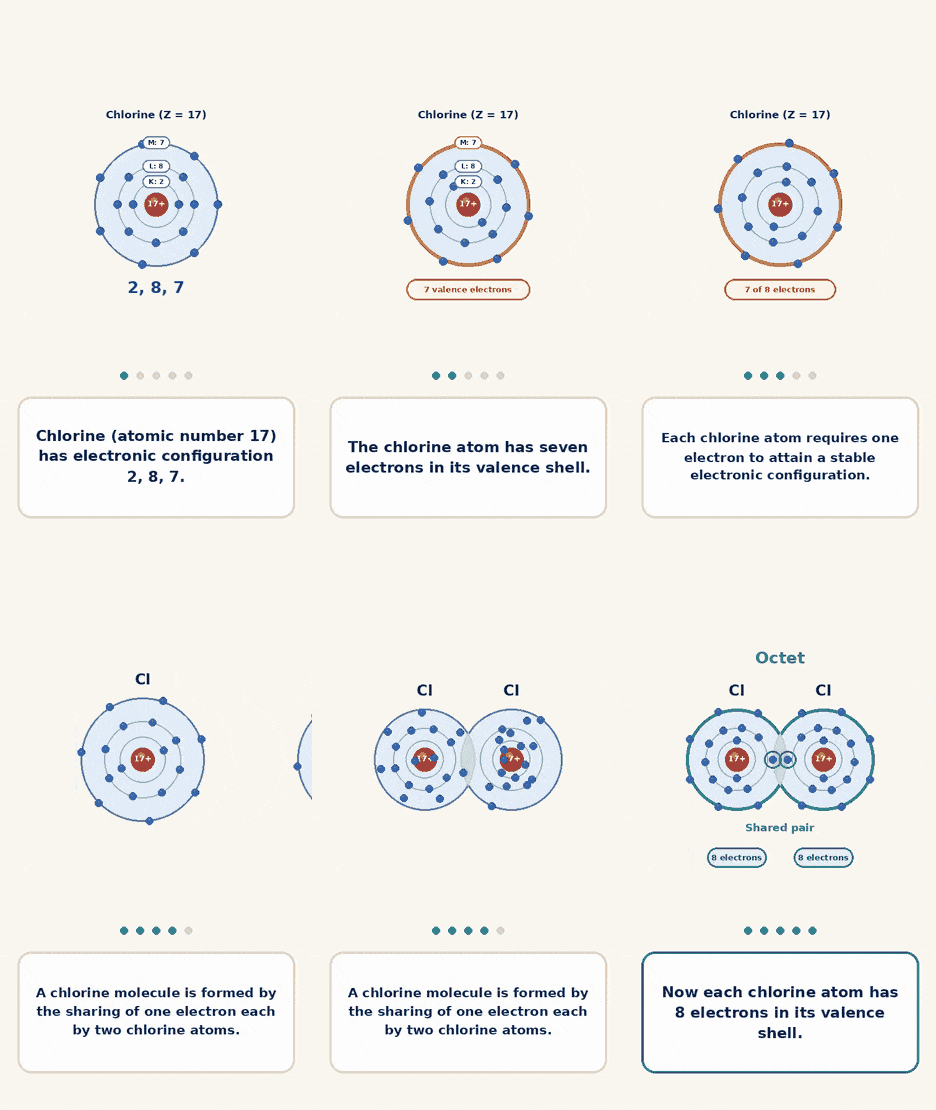
- Chlorine (atomic number 17) has electronic configuration 2, 8, 7 .
- The chlorine atom has seven electrons in its valence shell.
- Each chlorine atom requires one electron to attain a stable electronic configuration.
- A chlorine molecule is formed by the sharing of one electron each by two chlorine atoms.
- Now each chlorine atom has 8 electrons in its valence shell.
- Depiction: Cl─Cl
What is a double covalent bond?
- In a double bond, each atom shares 2 electrons , so there are 2 shared pairs .
The two atoms are joined by two pairs of shared electrons, and are held together by a double bond.
Breaking it down:
| Part of the definition | Meaning |
|---|---|
| Two pairs of shared electrons | Each atom gives 2 electrons, so there are 2 shared pairs (4 electrons) |
| Held together | Both pairs together keep the atoms joined |
| Double bond | Two shared pairs = two bonds, shown by two lines ( = ) |
Example: Oxygen molecule (O₂)
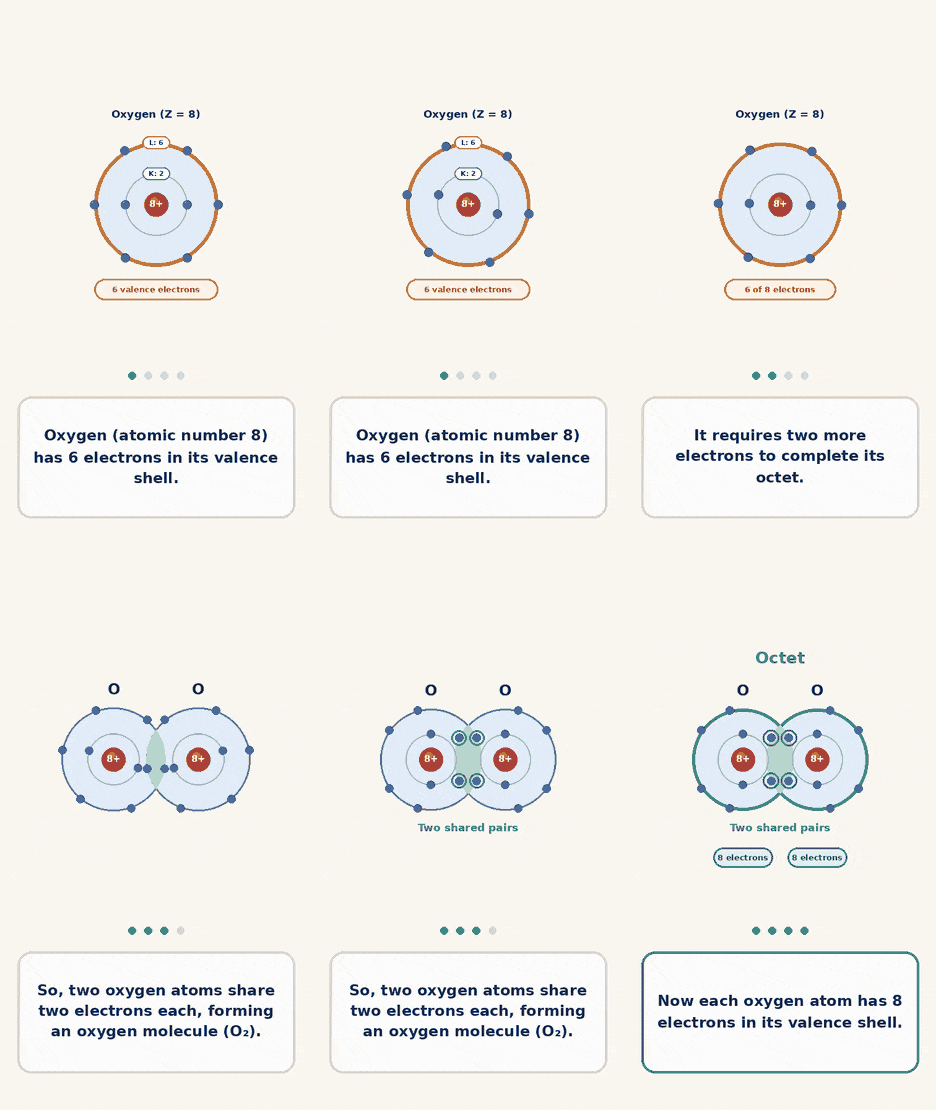
- Oxygen (atomic number 8) has 6 electrons in its valence shell.
- It requires two more electrons to complete its octet.
- So, two oxygen atoms share two electrons each, forming an oxygen molecule (O₂).
- Now each oxygen atom has 8 electrons in its valence shell.
- Depiction: O=O
What is a triple covalent bond?
- In a triple bond, each atom shares 3 electrons , so there are 3 shared pairs .
📖 Definition
when two atoms are joined by
sharing three electrons each
, that is,
three shared pairs
, they are held together by a
triple bond
.
Breaking it down:
| Part of the definition | Meaning |
|---|---|
| Sharing three electrons each | Each atom gives 3 electrons |
| Three shared pairs | 6 electrons shared in total |
| Triple bond | Three shared pairs = three bonds, shown by three lines ( ≡ ) |
Example: Nitrogen molecule (N₂)
GIF
Watch: nitrogen
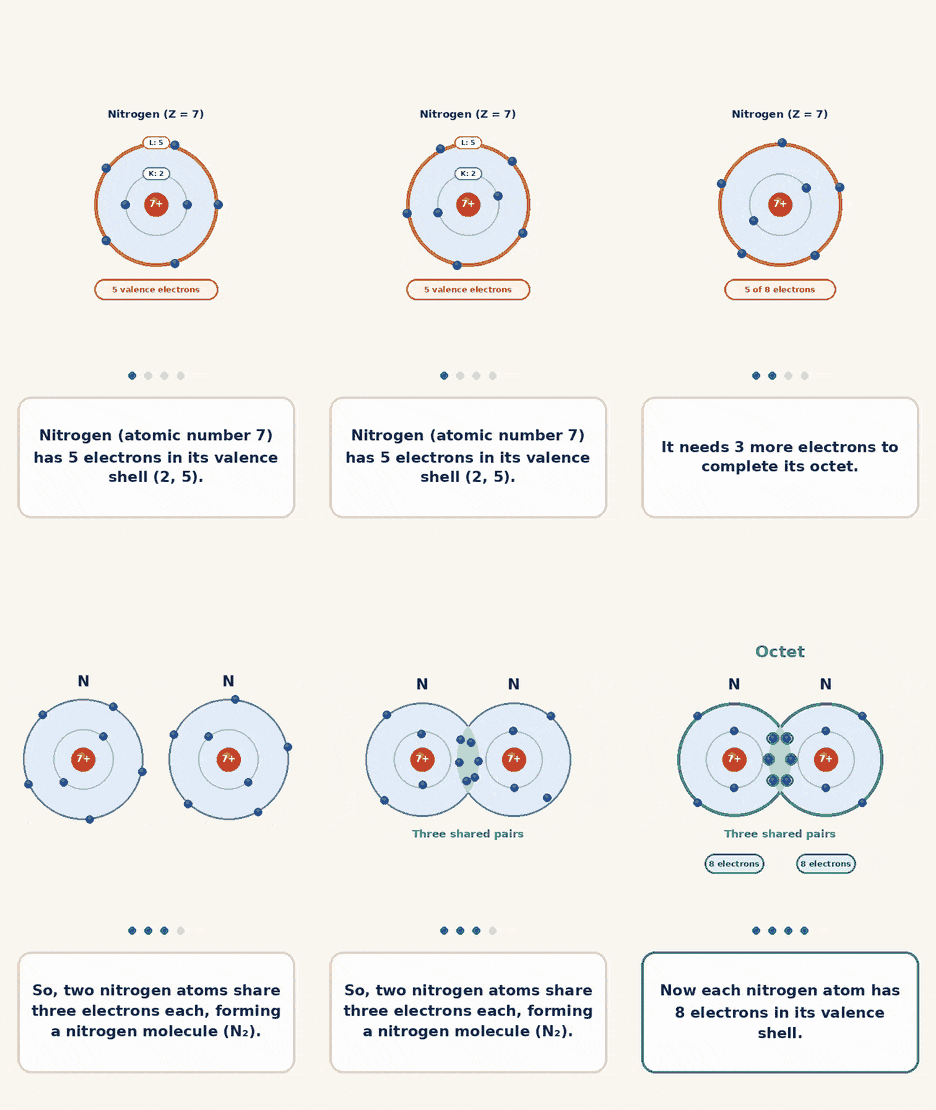
- Nitrogen (atomic number 7) has 5 electrons in its valence shell (2, 5).
- It needs 3 more electrons to complete its octet.
- So, two nitrogen atoms share three electrons each , forming a nitrogen molecule (N₂).
- Now each nitrogen atom has 8 electrons in its valence shell.
- Depiction: N≡N
How do single, double and triple bonds compare?
| Single bond | Double bond | Triple bond | |
|---|---|---|---|
| Electrons shared by each atom | 1 | 2 | 3 |
| Shared pairs | 1 | 2 | 3 |
| Total shared electrons | 2 | 4 | 6 |
| Lines in depiction | One | Two | Three |
| Examples | H─H , Cl─Cl | O=O | N≡N |
Together we are strong...
- Just as atoms share electrons to form covalent bonds, we too, can share and care to build strong relationships with people around us.
- This sharing brings unity and stability, laying the foundation for a stronger community, and ultimately, a strong nation.
Questions from the book for this section
-
🤔 Pause and Ponder 8
Nitrogen has five valence electrons. Draw the structure of the nitrogen molecule (N₂).View answer
Answer- Nitrogen has 5 valence electrons, so it needs 3 more to complete its octet.
- Two nitrogen atoms share three electrons each , forming three shared pairs .
- Each nitrogen atom now has 8 electrons in its valence shell.
- They are joined by a triple bond .
- Structure: N≡N
-
🤔 Pause and Ponder 9
The atomic number of fluorine is 9. Explain the formation of the fluorine molecule (F₂).View answer
Answer- Electronic configuration of fluorine (9) = 2, 7
- It has 7 valence electrons, so it needs 1 more to complete its octet.
- Two fluorine atoms share one electron each , forming one shared pair .
- Each fluorine atom now has 8 electrons in its valence shell.
- They are joined by a single covalent bond .
- Structure: F─F
