
 You are here
- We have already learnt about molecules of a single element , like H₂ .
- Now we will learn about molecules of compounds , like HCl .
- These also share electrons to make covalent bonds .
- So these are called covalent compounds .
What is a covalent compound?
Since the hydrogen and chlorine atoms in a hydrogen chloride (HCl) molecule bond by sharing electrons, it is a covalent compound.
Breaking it down:
| Part of the definition | Meaning |
|---|---|
| Hydrogen and chlorine atoms | Atoms of two different elements |
| Bond by sharing electrons | They are joined by a covalent bond |
| Covalent compound | A compound whose atoms are joined by sharing electrons |
- These bonds can also be either single , double or triple .
How do we find how many electrons each atom will share?
-
We use the
same 3 steps
from part A:
- Step 1: Write the electronic configuration of each atom.
- Step 2: Count how many electrons each atom needs to get a full shell (8, or 2 for the K-shell).
- Step 3: Each atom shares that many electrons.
- Rule: the number of bonds an atom forms = the number of electrons it needs.
| Compound | Atoms and their configuration | Electrons needed | Bonds formed | Type of bond |
|---|---|---|---|---|
| Hydrogen chloride (HCl) | H ( 1 ), Cl ( 2, 8, 7 ) | H: 1 , Cl: 1 | H shares 1 with Cl | Single bond |
| Water (H₂O) | H ( 1 ), O ( 2, 6 ) | H: 1 each, O: 2 | O shares 1 with each H | Two single bonds |
| Carbon dioxide (CO₂) | C ( 2, 4 ), O ( 2, 6 ) | C: 4 , O: 2 each | C shares 2 with each O | Two double bonds |
| Ethyne (C₂H₂) | C ( 2, 4 ), H ( 1 ) | C: 4 each, H: 1 each | Each C shares 1 with H and 3 with the other C | Single bonds + one triple bond |
Which compounds have single bonds?
- In a single bond , each atom shares 1 electron (1 shared pair), shown by one line ( ─ ).
Example 1: Hydrogen chloride (HCl)
-
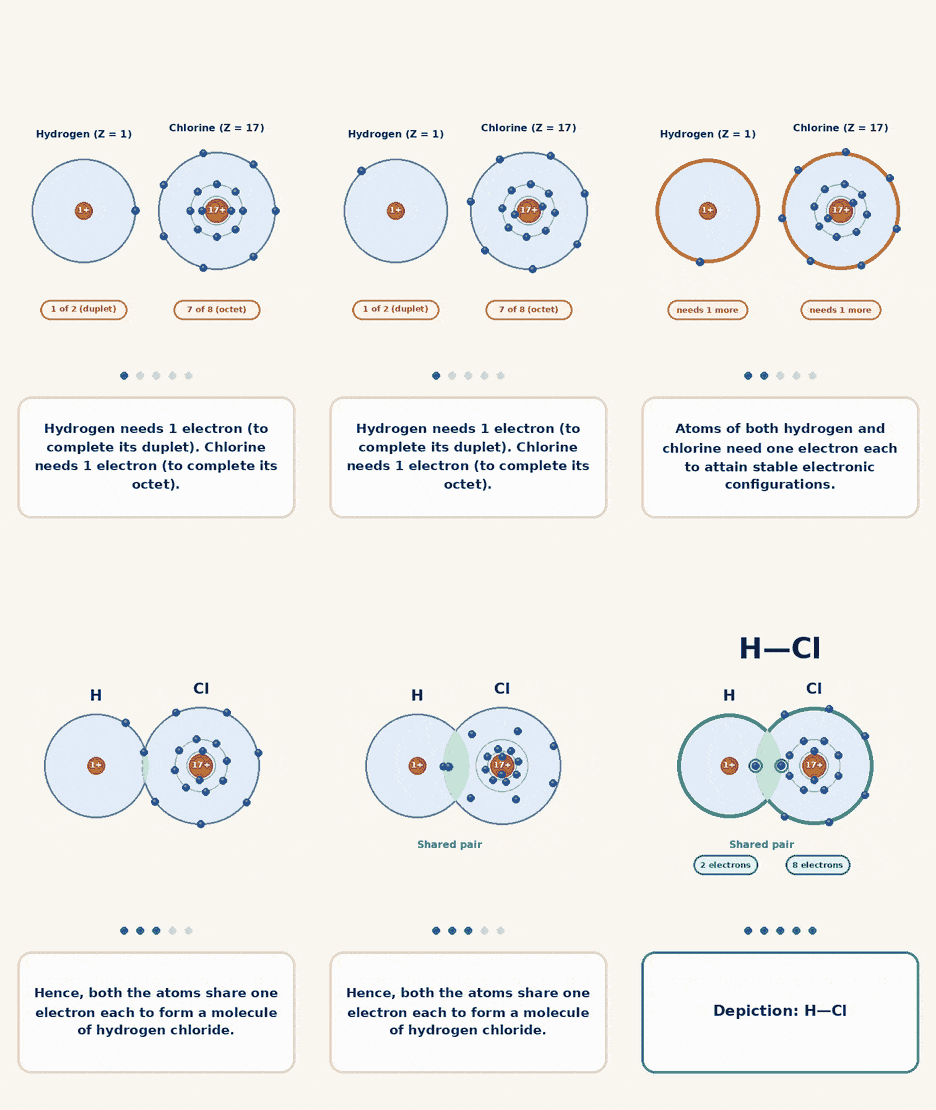
- Hydrogen needs 1 electron (to complete its duplet ). Chlorine needs 1 electron (to complete its octet ).
- Atoms of both hydrogen and chlorine need one electron each to attain stable electronic configurations.
- Hence, both the atoms share one electron each to form a molecule of hydrogen chloride.
- Since hydrogen and chlorine atoms share one pair of electrons, they are bonded by a single bond.
- Depiction: H─Cl
Example 2: Water (H₂O)
GIF
Watch: h2o
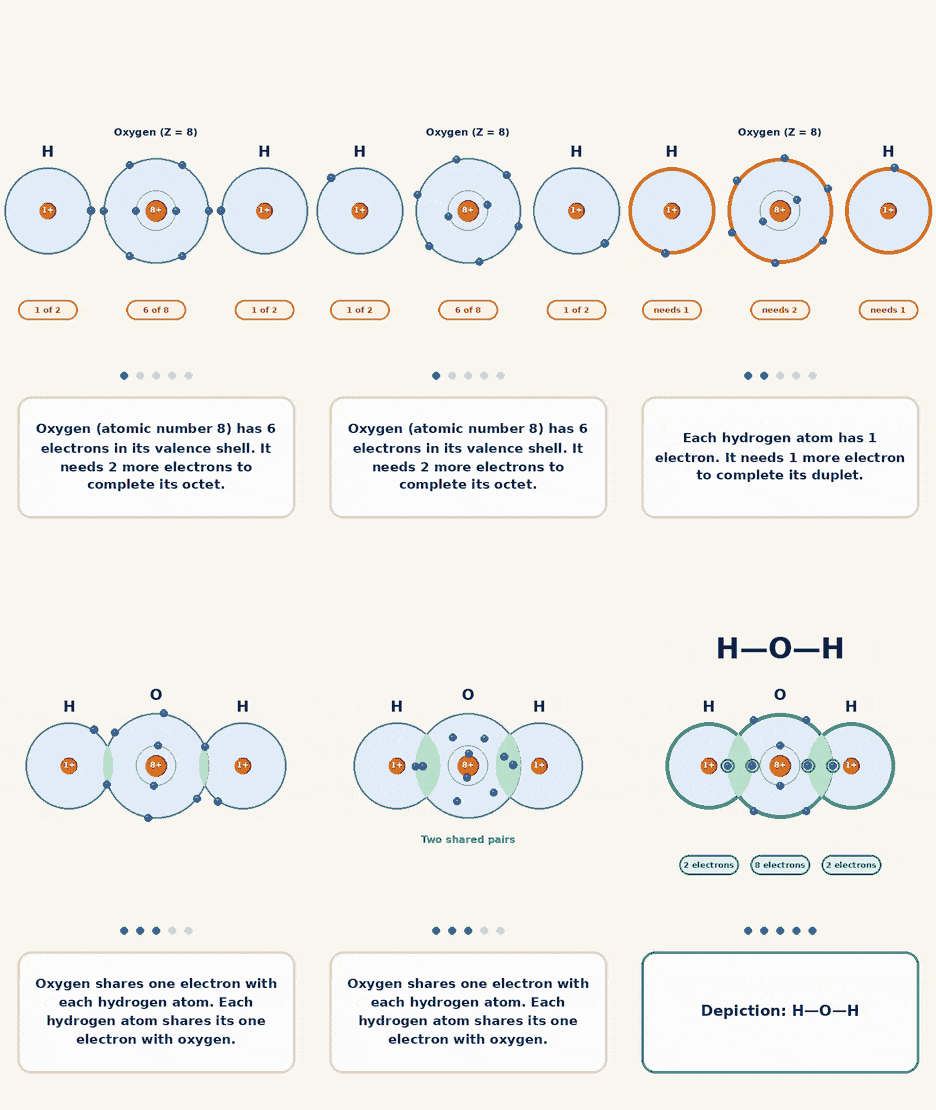
- Hydrogen needs only one electron, while oxygen needs two electrons to acquire stable electronic configurations.
- How can oxygen share its two electrons with another atom that requires only one electron?
- This is achieved by two hydrogen atoms sharing an electron each with an oxygen atom.
- So oxygen forms two single bonds , one with each hydrogen atom.
- The water molecule formed is represented as H₂O, which indicates the presence of two hydrogen atoms and one oxygen atom.
- Depiction: H─O─H
Key idea:
one atom can form
more than one bond
. Oxygen needs 2 electrons, so it makes
2 bonds
.
Which compounds have double bonds?
- In a double bond , each atom shares 2 electrons (2 shared pairs), shown by two lines ( = ). (See 9.4.1 A.)
Example: Carbon dioxide (CO₂)
GIF
Watch: co2
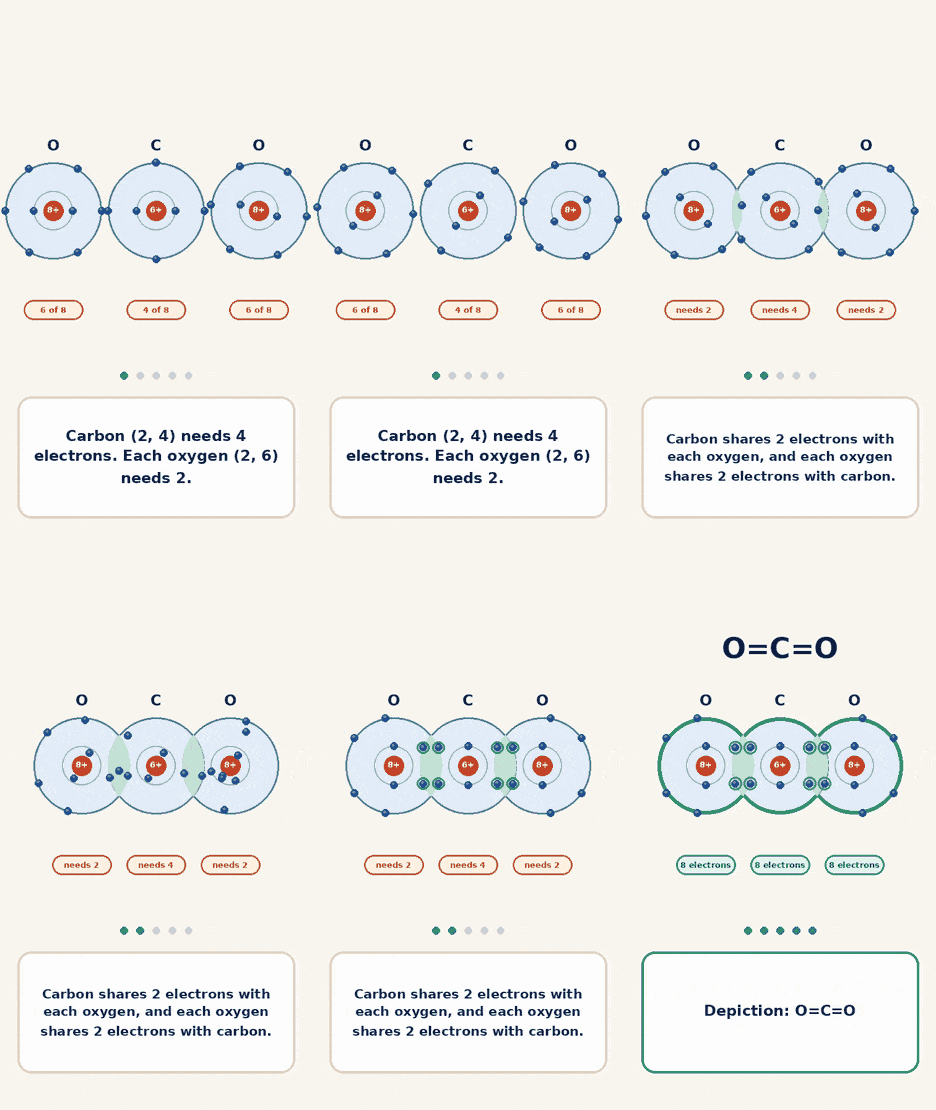
- Carbon ( 2, 4 ) needs 4 electrons. Each oxygen ( 2, 6 ) needs 2 .
- Carbon shares 2 electrons with each oxygen , and each oxygen shares 2 electrons with carbon.
- So carbon forms a double bond with each oxygen atom.
- Carbon now has 8 electrons, and each oxygen has 8 electrons.
- Depiction: O=C=O
Which compounds have triple bonds?
- In a triple bond , each atom shares 3 electrons (3 shared pairs), shown by three lines ( ≡ ). (See 9.4.1 A.)
Example: Ethyne (C₂H₂)
GIF
Watch: ethyne
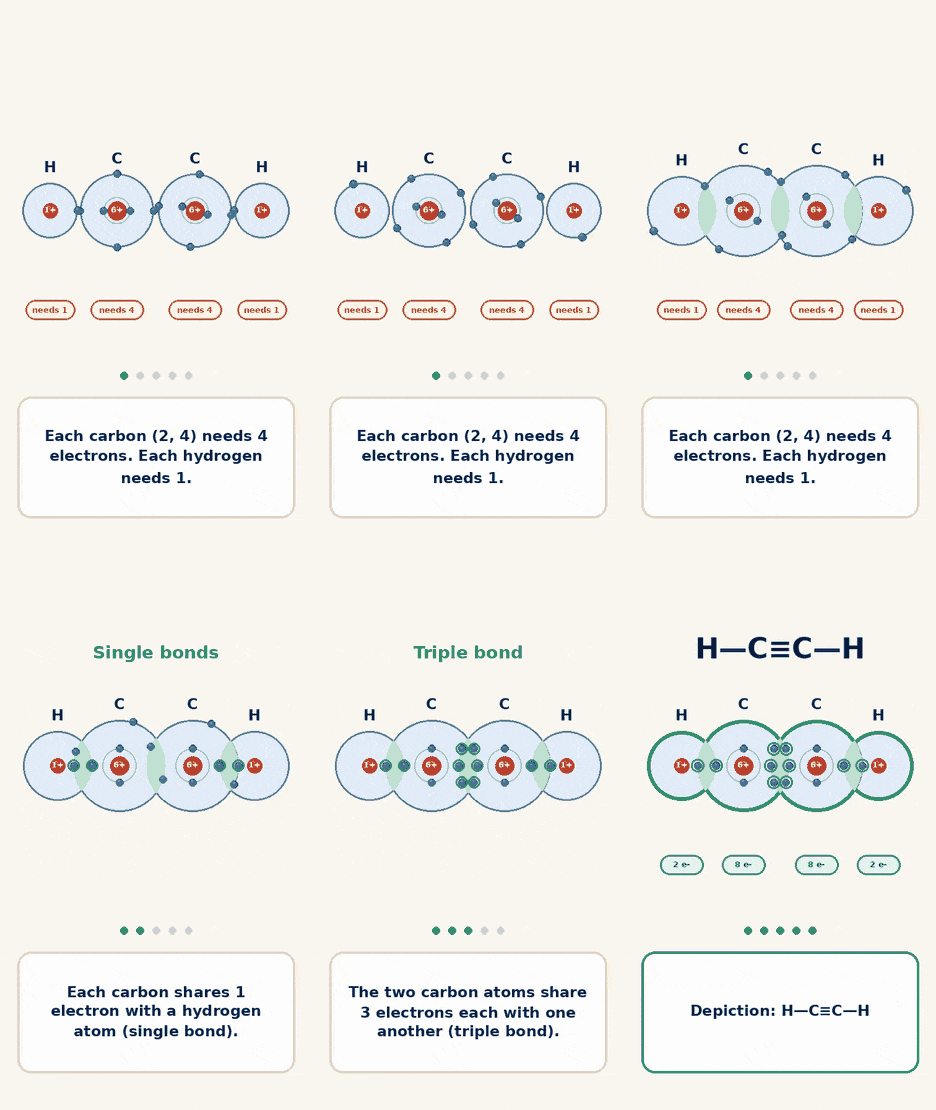
- Each carbon ( 2, 4 ) needs 4 electrons. Each hydrogen needs 1 .
- Each carbon shares 1 electron with a hydrogen atom ( single bond ).
- The two carbon atoms share 3 electrons each with one another ( triple bond ).
- So each carbon has 4 bonds in total: 1 + 3 = 4.
- Depiction: H─C≡C─H
How do these covalent compounds compare?
| Compound | Atoms in one molecule | Bonds present | Depiction |
|---|---|---|---|
| Hydrogen chloride (HCl) | 1 H, 1 Cl | 1 single bond | H─Cl |
| Water (H₂O) | 2 H, 1 O | 2 single bonds | H─O─H |
| Carbon dioxide (CO₂) | 1 C, 2 O | 2 double bonds | O=C=O |
| Ethyne (C₂H₂) | 2 C, 2 H | 2 single bonds + 1 triple bond | H─C≡C─H |
Bridging Science and Society: Nuclear energy
- Atoms can release enormous energy when their nuclei split or combine to form new elements. This is called atomic or nuclear energy .
- It is used to make electricity , and also in medicine , scientific research and space exploration .
- In nuclear power plants , heat from nuclear reactions makes steam , which turns turbines to generate electricity.
- It is a cleaner alternative to fossil fuels .
- Raja Ramanna , often called the Father of the Indian Nuclear Programme , helped develop India's nuclear energy programme and promoted its peaceful use for development.
Questions from the book for this section
-
🤔 Pause and Ponder 10
Show the formation of the following molecules:
(i) Carbon dioxide (CO₂)
(ii) Hydrogen sulfide (H₂S)
(iii) Ammonia (NH₃)View answer
Answer(i) Carbon dioxide (CO₂)- Carbon (2, 4) needs 4 electrons. Each oxygen (2, 6) needs 2 .
- Carbon shares 2 electrons with each oxygen atom, forming two double bonds .
- Structure: O=C=O
(ii) Hydrogen sulfide (H₂S)- Sulfur (atomic number 16) = 2, 8, 6 , so it needs 2 electrons.
- Each hydrogen needs 1 electron.
- Two hydrogen atoms share one electron each with sulfur, forming two single bonds .
- Structure: H─S─H
(iii) Ammonia (NH₃)- Nitrogen (atomic number 7) = 2, 5 , so it needs 3 electrons.
- Each hydrogen needs 1 electron.
- Three hydrogen atoms share one electron each with nitrogen, forming three single bonds .
- Structure:
H─N─H | H
-
🤔 Pause and Ponder 11
Neon (atomic number 10) neither transfers nor shares its valence electrons. Explain.View answer
Answer- Electronic configuration of neon (10) = 2, 8
- Its valence shell already has 8 electrons (a complete octet ).
- So neon is already stable .
- It does not need to gain, lose or share electrons.
- That is why neon neither transfers nor shares its valence electrons, and exists as single atoms .
