
 You are here
What is Dalton's Atomic Theory?
- As per the name, this was given by John Dalton .
- Atomic theory is a set of ideas that explains what matter is made of and how its tiny particles (atoms) behave .
- He proposed his atomic theory in terms of certain postulates.
What is a postulate?
- A postulate is a basic idea that we accept as true, and then build other ideas on it.
A postulate is a fundamental assumption accepted as truth without formal proof from which further ideas are formed or developed.
Breaking it down:
| Part of the definition | Meaning |
|---|---|
| Fundamental assumption | A basic idea |
| Accepted as truth without formal proof | We accept it as true without proving it |
| From which further ideas are formed | Other ideas are built on it |
Example:
- If we mark two points , a straight line can always be drawn joining them.
- We all accept this as true. There is nothing to prove in it.
- So, it is a postulate .
What are the postulates of Dalton's Atomic Theory?
John Dalton postulated that:
- All matter is made up of very tiny particles called atoms, which participate in chemical reactions.
- Atoms are indivisible particles, which cannot be created or destroyed in a chemical reaction.
- Atoms of a given element are identical in mass and chemical properties.
- Atoms of different elements have different masses and chemical properties.
- Atoms combine in the ratio of simple whole numbers to form compounds.
- The relative number and kinds of atoms are constant in a given compound.
How can we understand the postulates with the example of water (H₂O)?
| Postulate | Example of water (H₂O) |
|---|---|
| 1. All matter is made up of atoms | Water is made up of hydrogen atoms and oxygen atoms . |
| 2. Atoms cannot be created or destroyed in a chemical reaction | When hydrogen and oxygen form water, no atom is broken, made or lost . The same atoms are present before and after. |
| 3. Atoms of a given element are identical | All hydrogen atoms in water are alike. All oxygen atoms in water are alike. |
| 4. Atoms of different elements are different | A hydrogen atom and an oxygen atom have different masses and different properties . An oxygen atom is much heavier. |
| 5. Atoms combine in simple whole number ratios | Hydrogen and oxygen atoms combine in the ratio 2 : 1 . |
| 6. The relative number and kinds of atoms are constant in a compound | Every water molecule has only hydrogen and oxygen , always 2 hydrogen atoms and 1 oxygen atom . |
Is Dalton's theory fully correct today?
- Dalton's postulates provide the basis for the modern understanding of atoms and their behaviour .
- But in Chapter 8 , we learnt more about atoms. So two postulates have been updated.
| Dalton said | What we know now |
|---|---|
| Atoms are indivisible | Atoms are made of electrons, protons and neutrons . But in a chemical reaction , atoms are still not broken. They only rearrange . |
| Atoms of an element are identical in mass | Isotopes are atoms of the same element with different masses (different numbers of neutrons). Their chemical properties are the same. |
How does Dalton's theory explain the two laws?
- The two laws we have learned formed the basis of Dalton's Atomic Theory.
-
Dalton explained both laws with one idea:
- In a chemical reaction, atoms are not broken, made or lost. They only rearrange.
| Law | Explained by which postulate? | How? |
|---|---|---|
| Law of Conservation of Mass | Atoms cannot be created or destroyed in a chemical reaction | Same atoms before and after, so same mass |
| Law of Constant Proportions | Atoms combine in simple whole number ratios and the relative number and kinds of atoms are constant | Same number ratio of atoms every time, so same mass ratio every time |
Are atoms destroyed or changed when they combine?
- No. The atoms themselves are not destroyed or changed into something else. They only combine with other atoms.
Example: Magnesium and oxygen
- When magnesium burns in air, a white powder of magnesium oxide forms.
- This shows that the atoms of magnesium have combined with those of oxygen to form magnesium oxide.
- The magnesium atoms are still there . They are now joined with oxygen atoms.
Magnesium + Oxygen → Magnesium oxide
Meet a Scientist: John Dalton
-
GIF Watch: john dalton
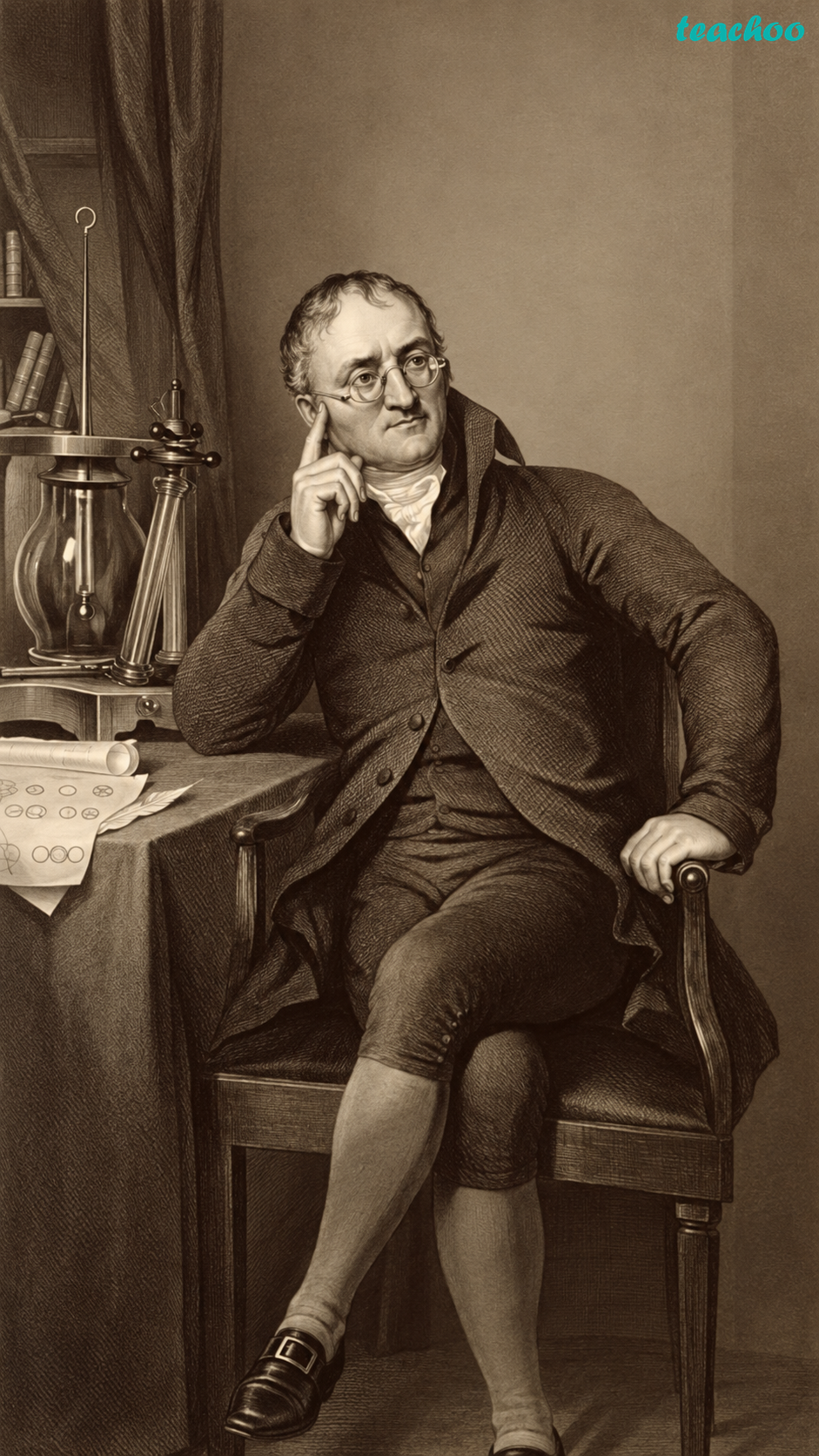
- John Dalton was born in England .
- In 1793 , he moved to Manchester to teach mathematics, physics and chemistry at a college.
- He spent most of his life teaching and researching there.
- In 1808 , he presented his atomic theory , which proved to be a turning point in the study of matter.
Questions from the book for this section
-
💭 What if...
What if atoms could combine in any ratio and not in a fixed ratio? How would this affect the substances around us?View answer
Answer- A compound would not have a fixed composition.
-
So the
same
compound could have
different properties
at different times.
- Water from two places could behave differently.
- Salt or a medicine made in one factory could be different from the same one made in another.
- We could not trust any substance to behave the same way every time.
- That is why fixed ratios are so important.
-
🤔 Pause and Ponder 7
Assertion (A): 2 g of hydrogen combines with 16 g of oxygen to form 18 g of water.
Reason (R): According to Dalton's Atomic Theory, atoms combine in a simple whole number ratio by mass to form compounds.
Choose the correct option:
(i) Both A and R are true, and R is the correct explanation of A.
(ii) Both A and R are true, but R is not the correct explanation of A.
(iii) A is true, but R is false.
(iv) A is false, but R is true.View answer
Answer-
Assertion is true.
- 2 g + 16 g = 18 g, so mass is conserved.
- 2 : 16 = 1 : 8 , which is the fixed mass ratio of hydrogen and oxygen in water.
-
Reason is false.
- Dalton said atoms combine in a simple whole number ratio of number of atoms , not by mass .
- Example: in water, the ratio of atoms is H : O = 2 : 1 , but the ratio by mass is 1 : 8 .
- Correct option: (iii) A is true, but R is false.
-
Assertion is true.
