 You are here

📌 Task from the book
Design and perform an experiment to show and compare that water always contains hydrogen and oxygen in the same ratio, regardless of its source.
What to do:
- Collect water from 3 sources , for example tap water, rainwater and river water.
- Purify each sample (filter it, then boil it and collect the steam as water).
-
Break down each sample using
electricity
:
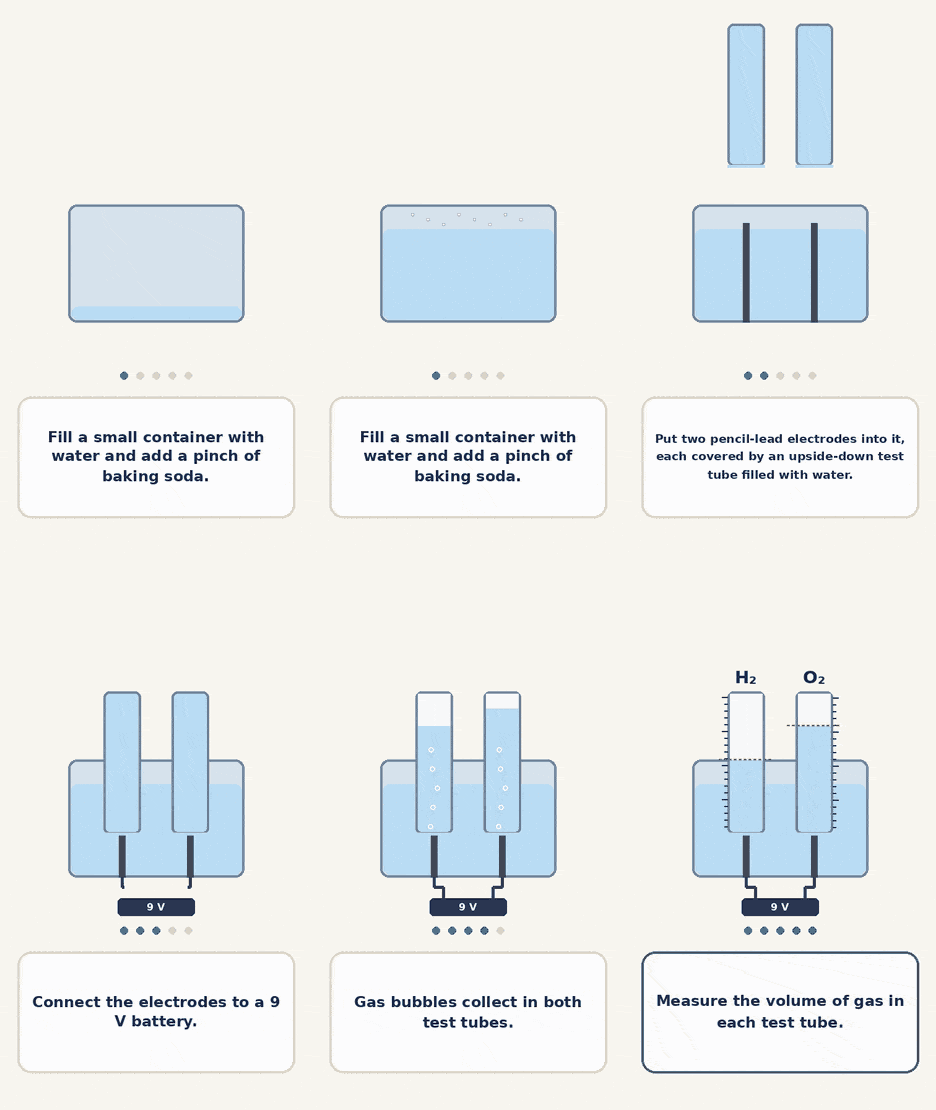
- Fill a small container with the water and add a pinch of baking soda (so the water conducts electricity).
- Put two pencil-lead electrodes into it, each covered by an upside-down test tube filled with the same water.
- Connect the electrodes to a 9 V battery .
- Gas bubbles collect in both test tubes.
- Measure the volume of gas in each test tube.
-
GIF Watch: 1
What will the student find?
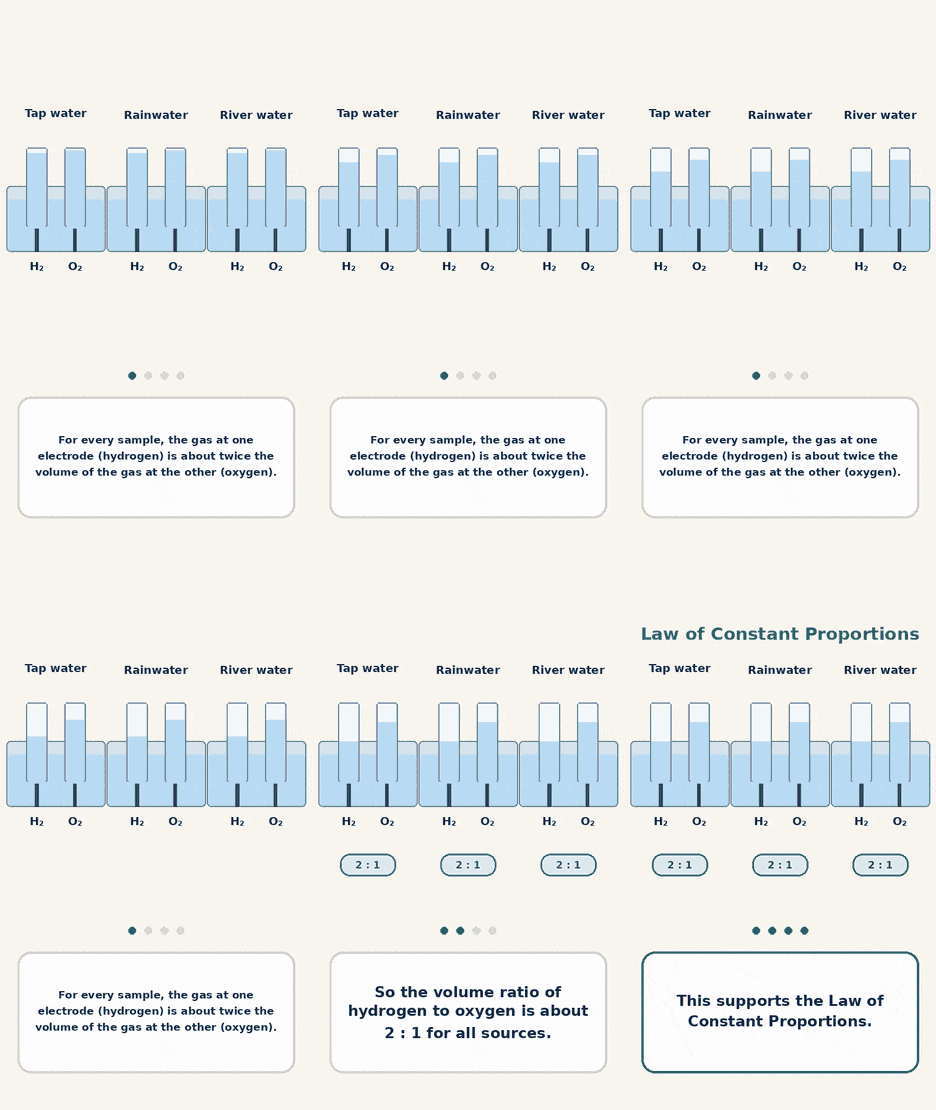
- For every sample, the gas at one electrode ( hydrogen ) is about twice the volume of the gas at the other ( oxygen ).
- So the volume ratio of hydrogen to oxygen is about 2 : 1 for all sources.
-
GIF Watch: 1
Conclusion:
- The ratio is the same for water from every source.
- The 2 : 1 here is a ratio by volume . Hydrogen is a very light gas, so by mass this is the same as the 1 : 8 given in the book.
- This supports the Law of Constant Proportions .
Recording table:
| Source of water | Volume of hydrogen (mL) | Volume of oxygen (mL) | Ratio (hydrogen : oxygen) |
|---|---|---|---|
| Tap water | 20 |
10
|
2 : 1 |
| Rainwater | 18 | 9 | 2 : 1 |
| River water | 22 | 11 | 2 : 1 |
