
 You are here
📌 Task from the book
Compare atoms and ions of any three elements. Show the number of electrons before and after ion formation using bar graphs.
What to do:
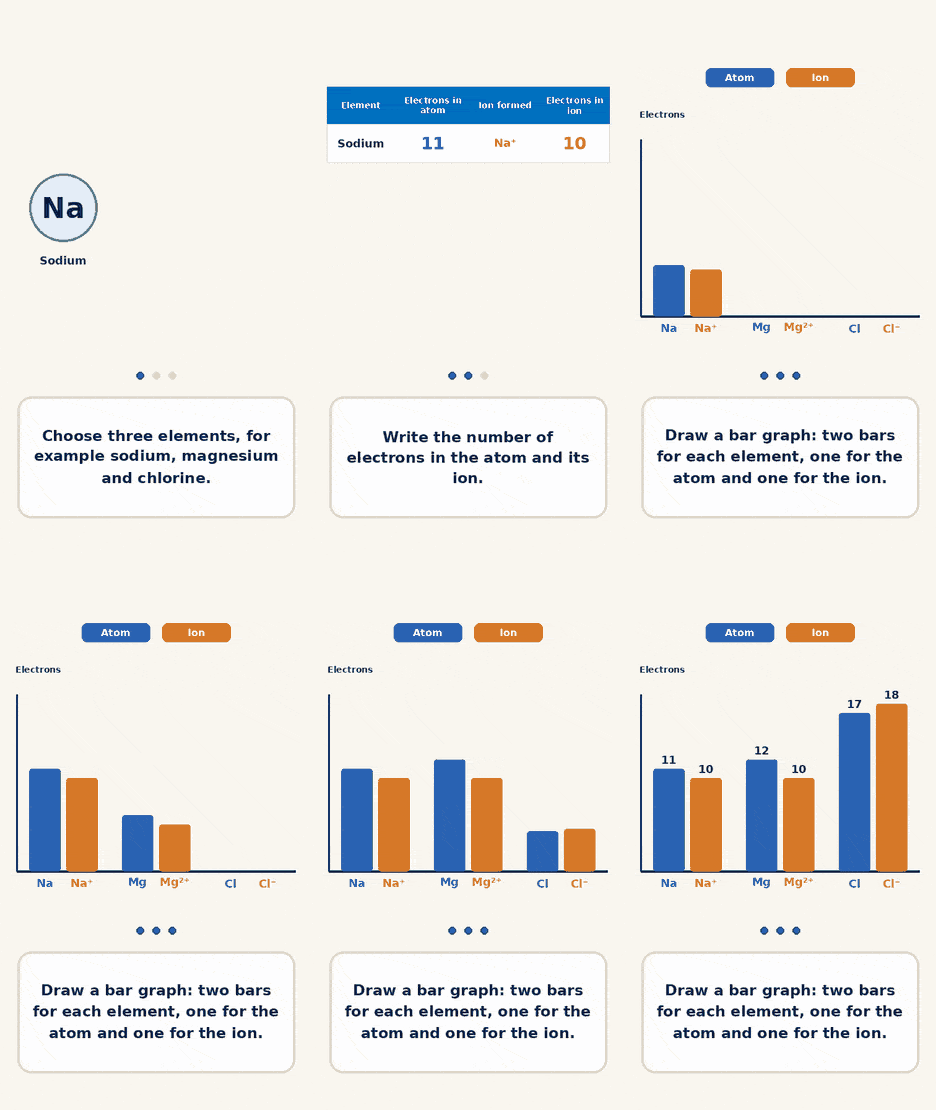
- Choose three elements, for example sodium, magnesium and chlorine .
- Write the number of electrons in the atom and in its ion .
- Draw a bar graph : two bars for each element, one for the atom and one for the ion.
-
GIF Watch: 2
| Element | Electrons in atom | Ion formed | Electrons in ion | Change |
|---|---|---|---|---|
| Sodium | 11 | Na⁺ | 10 | Loses 1 |
| Magnesium | 12 | Mg²⁺ | 10 | Loses 2 |
| Chlorine | 17 | Cl⁻ | 18 | Gains 1 |
What will the student find?
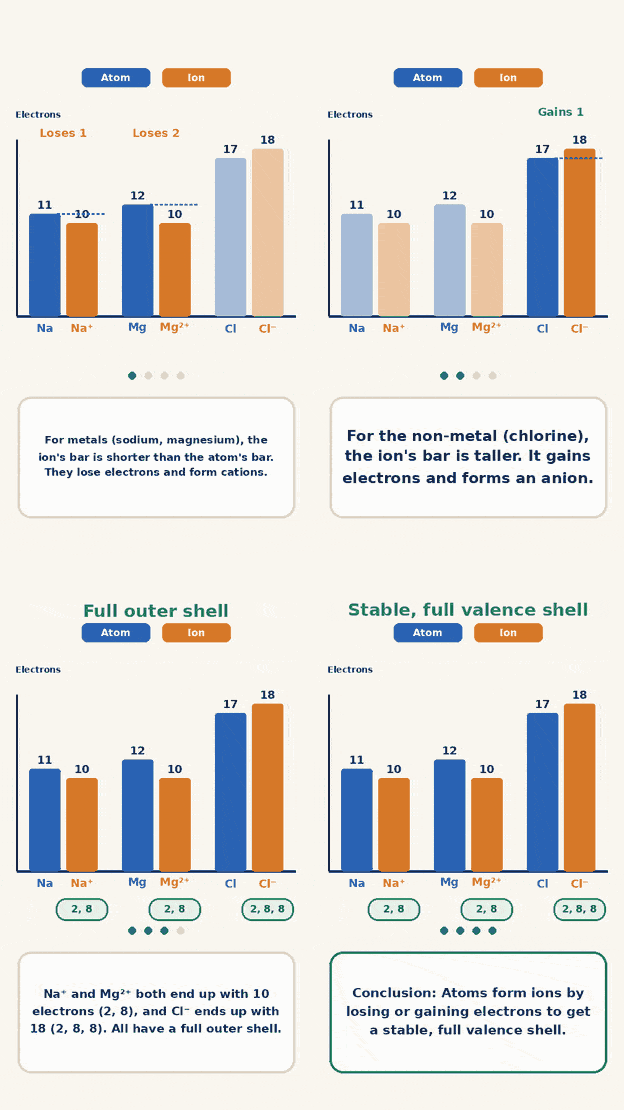
- For metals (sodium, magnesium), the ion's bar is shorter than the atom's bar. They lose electrons and form cations .
- For the non-metal (chlorine), the ion's bar is taller . It gains electrons and forms an anion .
- Na⁺ and Mg²⁺ both end up with 10 electrons (2, 8), and Cl⁻ ends up with 18 (2, 8, 8). All have a full outer shell .
GIF
Watch: 2
Conclusion:
- Atoms form ions by losing or gaining electrons to get a stable, full valence shell .
