 You are here

What did we learn in Chapter 8 that we need here?
- Atoms are made of electrons, protons and neutrons .
- The valence shell is the outermost shell of an atom.
- An atom with 8 electrons in its valence shell (an octet ) is stable.
- Atoms can lose, gain or share electrons to get an octet.
What are elements?
- An element is a pure substance made of only one kind of atom .
-
Examples:
- Hydrogen is made only of hydrogen atoms.
- Oxygen is made only of oxygen atoms.
What are compounds?
- A compound is a pure substance formed when two or more elements combine chemically .
- Example: water is a compound of hydrogen and oxygen .
What happens when elements make a compound?
- Hydrogen and oxygen combine to form water .
- Many properties of the elements are not retained when they form a compound.
- But the mass stays the same : the mass of the water formed equals the sum of the masses of the hydrogen and oxygen that combined to form it.
| Hydrogen | Oxygen | Water (compound) | |
|---|---|---|---|
| State at room temperature | Gas | Gas | Liquid |
| Burning | Combustible (it burns) | Supports combustion (helps things burn) | Neither burns nor helps burning |
| Effect on fire | Catches fire | Makes fire stronger | Extinguishes (puts out) fire |
| Mass | Together, they equal the mass of water | Same total mass |
So: properties change, but mass does not.
What are physical and chemical changes?
- A physical change is a change in form, size or state, where no new substance is made.
- A chemical change is a change in which new substances are formed.
| Physical change | Chemical change | |
|---|---|---|
| New substance formed? | No | Yes |
| What changes? | Only form, size or state | The substance itself |
| Examples | Tearing paper , dissolving salt in water, melting ice | Vinegar + baking soda , burning of paper, rusting of iron |
What happens to mass in a physical change?
-
Example:
weigh a piece of paper. Tear it into pieces and weigh all the pieces.
- The mass stays the same , because tearing is a physical change.
What do we need?
- A clean, dry 100 mL beaker
- A digital weighing balance
- About 50 mL of water
- A spatula full of common salt
What do we do?
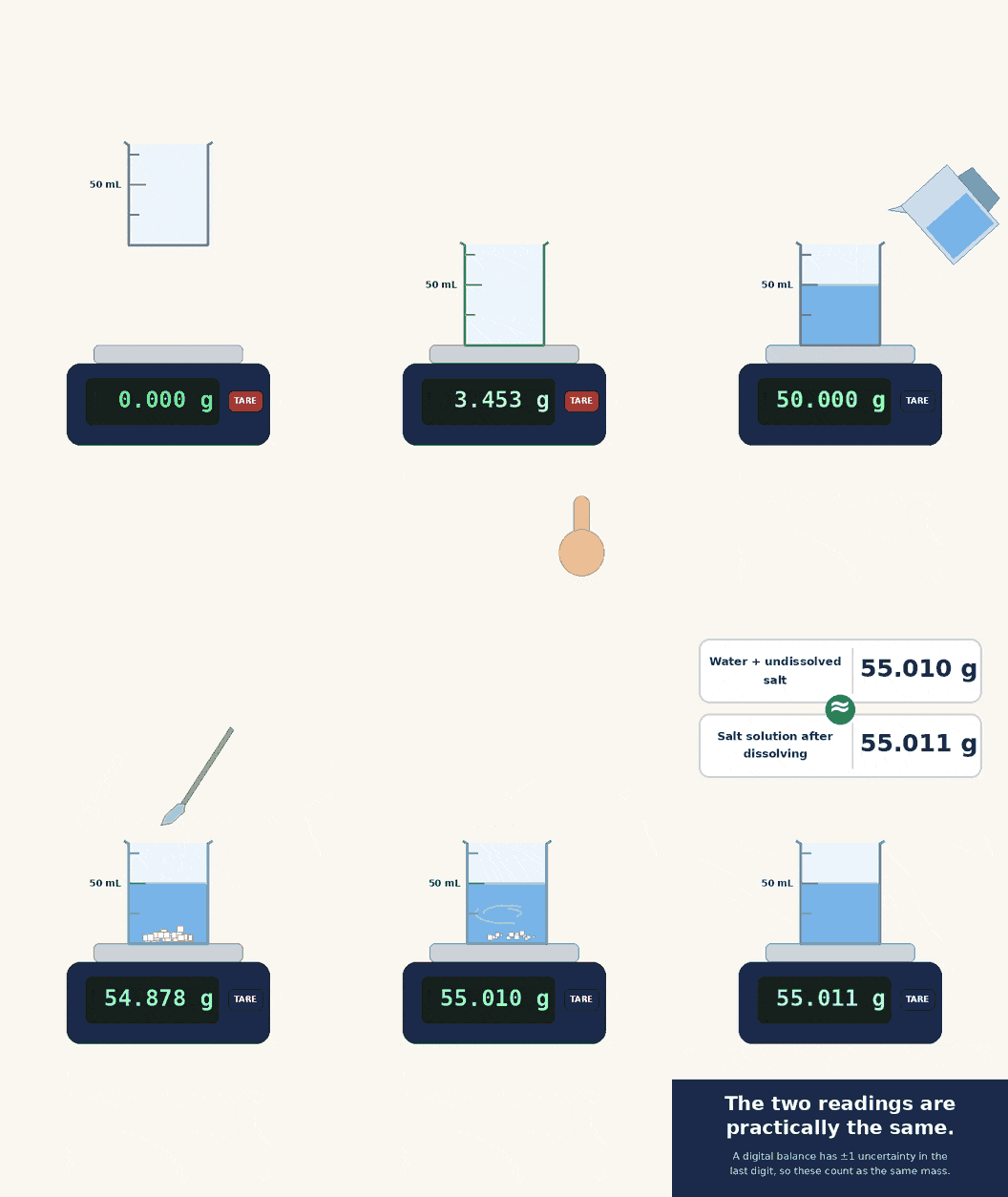
- Place the beaker on the balance.
-
Press the
tare
(reset) button to set the reading to zero.
- Tare means removing the weight of the container, so the balance shows only what we put inside.
- Pour about 50 mL of water into the beaker.
- Add a spatula full of salt. Record the reading.
- Swirl until the salt dissolves. Record the reading again.
What do we observe?
| Reading | |
|---|---|
| Water + undissolved salt | 55.010 g |
| Salt solution after dissolving | 55.011 g |
- The two readings are practically the same .
- Note: A digital balance usually has an uncertainty of ±1 in the last digit , so these count as the same mass.
What does this tell us?
- The mass of the solution equals the mass of water plus the mass of salt.
Summary
There is practically no change in the mass during the formation of a solution, which is a physical change. This is true for all physical changes.
What happens to mass in a chemical change?

- Example: when vinegar and baking soda react, carbon dioxide gas is formed. (You saw this in Class 7.)
Vinegar + Baking soda (Sodium hydrogencarbonate) → Carbon dioxide + Other substances
- Does the total mass stay the same? Activity 9.2 checks this in two ways.
Experimental set-up 1: flask left open
What do we need?
- A clean, dry 100 mL conical flask
- A medium-sized balloon
- About 20 mL of vinegar or lemon juice
- About 2 g of baking soda (sodium hydrogencarbonate)
- A digital weighing balance
What do we do?
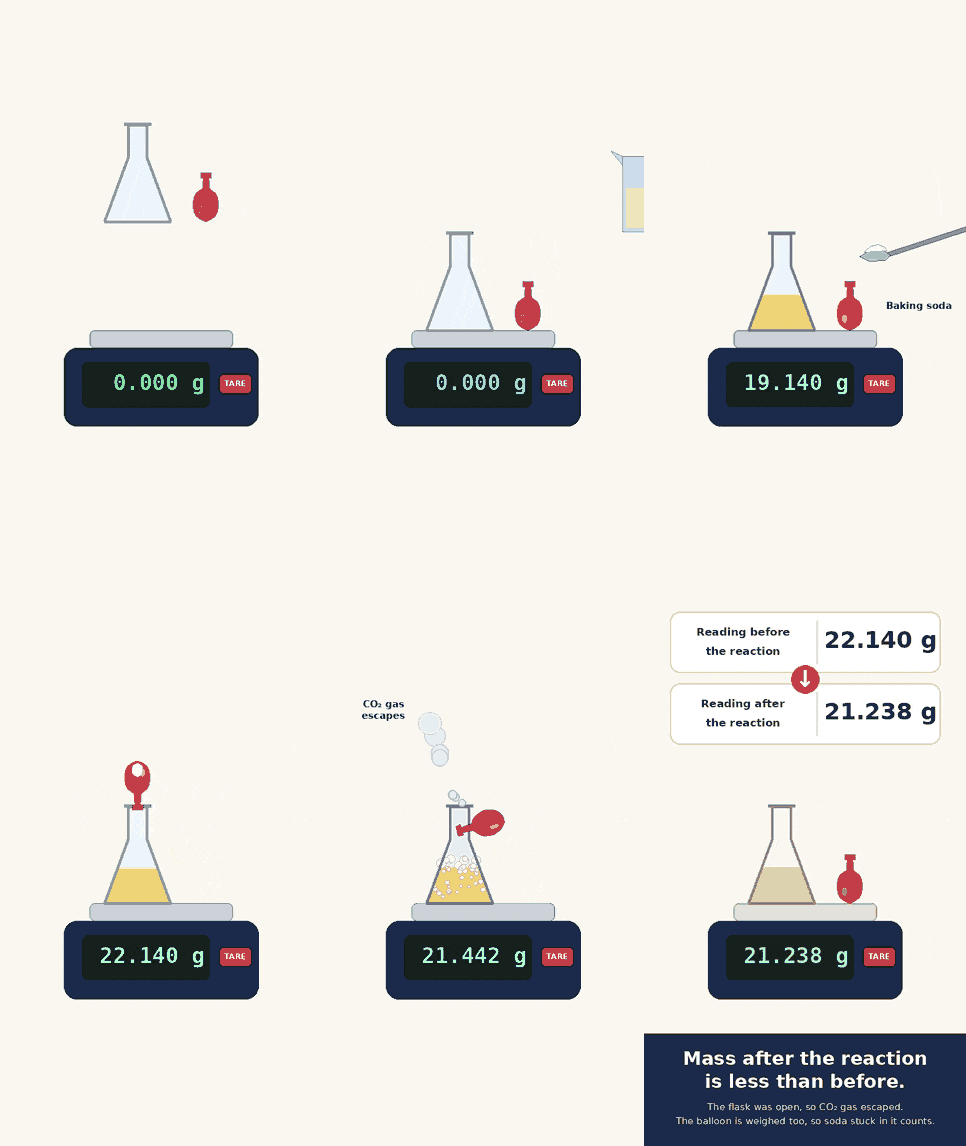
- Place the flask and balloon on the balance and press tare.
- Pour the vinegar into the flask. Put the baking soda into the balloon.
- Keep the balloon next to the flask on the balance. Record the reading.
- Pour the baking soda from the balloon into the flask. The flask stays open .
-
Put the flask and balloon back on the balance. Record the reading.
- Note: We weigh the balloon too, so any baking soda stuck inside it is still counted.
Experimental set-up 2: balloon tied on the flask
What do we need?
- The same things as set-up 1, plus a thread
What do we do?
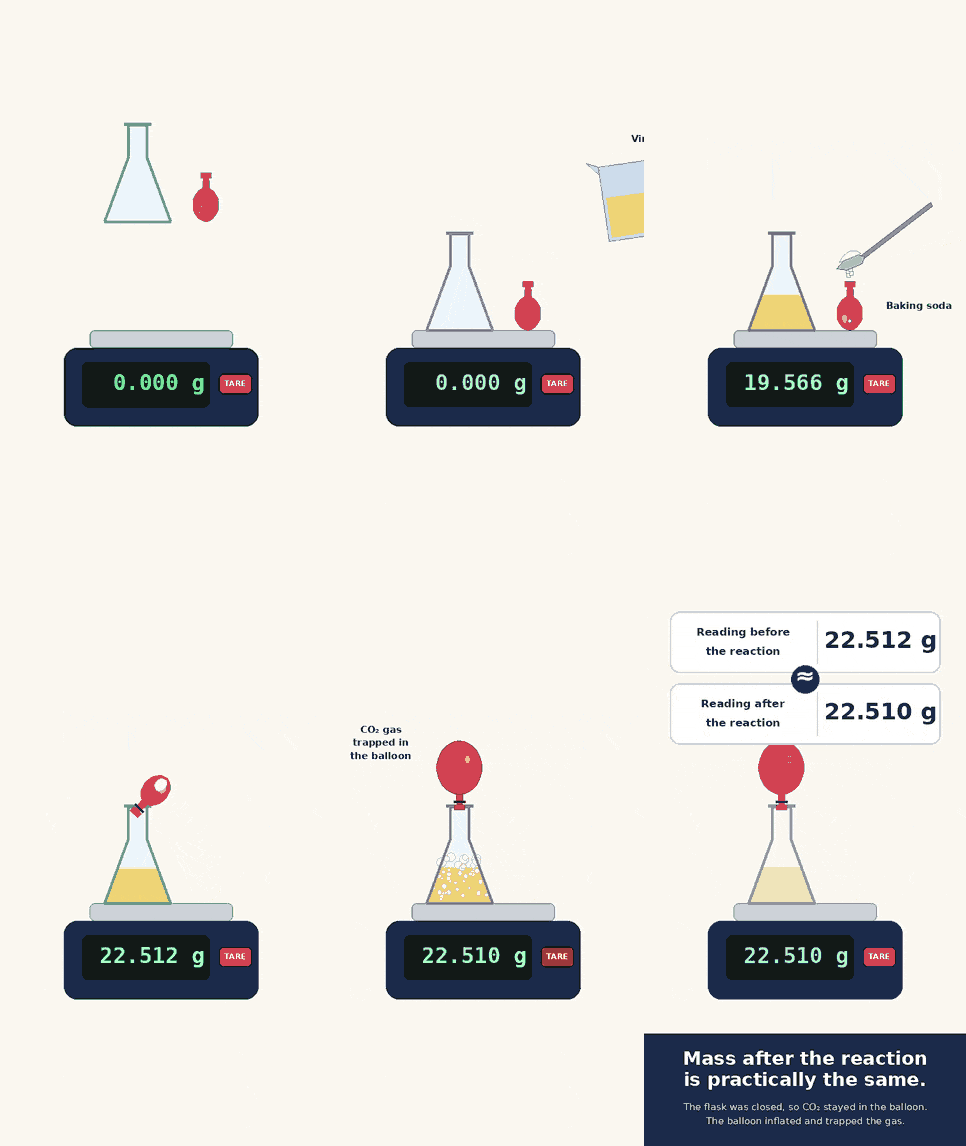
- Place the flask and balloon on the balance and press tare.
- Pour the vinegar into the flask. Put the baking soda into the balloon.
- Tie the balloon to the mouth of the flask with thread, without letting the baking soda fall in.
- Weigh the whole set-up. Record the reading.
- Lift the balloon so the baking soda falls into the vinegar.
- Record the reading after the reaction.
How do the two set-ups compare?
| Set-up 1 | Set-up 2 | |
|---|---|---|
| Flask | Open | Closed with a balloon tied on |
| What we see | Brisk effervescence | Brisk effervescence , and the balloon inflates |
| Carbon dioxide gas | Escapes into the air | Trapped in the balloon |
| Reading before | 22.140 g | 22.512 g |
| Reading after | 21.238 g | 22.510 g |
| Mass after reaction | Less than before | Practically the same |
What do we observe?
- In set-up 1, the final reading is less than the initial reading.
- In set-up 2, the final reading matches the initial reading.
What does this tell us?
- In experimental set-up 1, the mass difference occurs because the gas produced by the chemical reaction escapes.
- So mass was not destroyed . It went into the air as gas.
Summary
The total mass of vinegar and baking soda (sodium hydrogencarbonate) before the chemical reaction is equal to the total mass of carbon dioxide and other substances formed after the reaction.
Mass stays the
same
in a chemical change too.
- Remember the reverse rule: if a reaction seems to lose mass, check whether a gas escaped . If it seems to gain mass, check whether a gas from the air (like oxygen) joined in .
What is brisk effervescence?
-
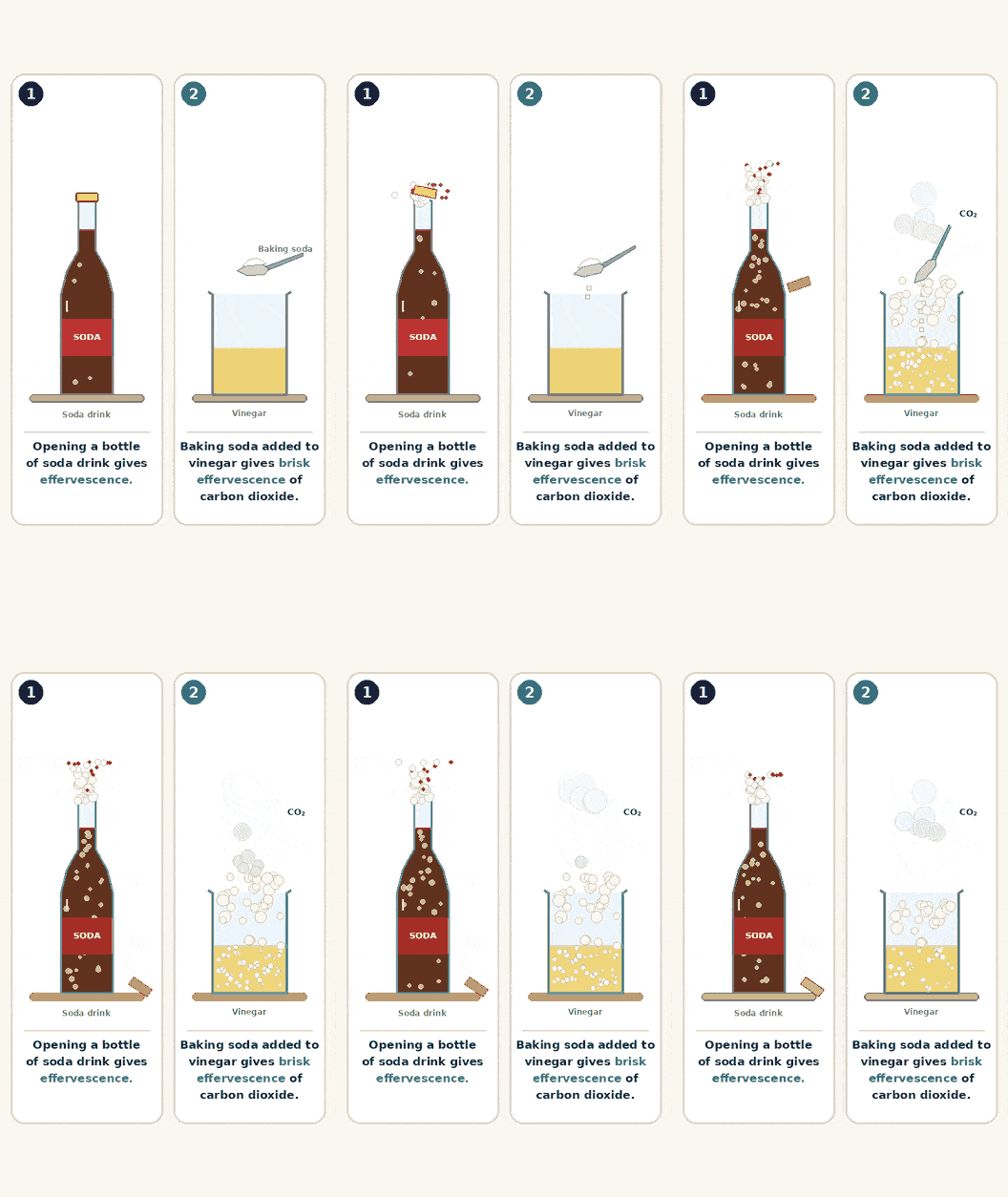
- Brisk means quick and strong.
- Opening a bottle of soda drink gives effervescence.
- Effervescence means bubbles of gas coming out of a liquid with fizzing.
- So brisk effervescence means fast, strong fizzing as gas bubbles out.
- Example: baking soda added to vinegar gives brisk effervescence of carbon dioxide .
What is a chemical reaction?
- A chemical reaction is a process in which substances react to form new substances .
- The substances we start with are called reactants .
- The new substances formed are called products .
- Examples:
| Reactants | Products | |
|---|---|---|
| Formation of water | Hydrogen + Oxygen | Water |
| Vinegar and baking soda | Vinegar + Baking soda | Carbon dioxide + Other substances |
What will we study in this chapter?
- Laws that tell us how substances combine:
| Law | Applies to |
|---|---|
| Law of Conservation of Mass (mass stays the same) | Both physical and chemical changes |
| Law of Constant Proportions (elements combine in a fixed ratio by mass) | Chemical changes (formation of compounds) |
What will we cover in this chapter?
Topics We Will Study
9.1
Law of Conservation of Mass
9.2
Law of Constant Proportions
9.3
Dalton's Atomic Theory
9.4
How Atoms Combine?
9.4.1
Bonding by Sharing of Electrons: Covalent Bond
9.4.1 A
Molecules of Elements
9.4.1 B
Molecules of Compounds
9.4.1 C
Naming Covalent Compounds
9.4.2
Bonding by Electron Transfer: Ionic Bond
9.4.2 A
Naming Ionic Compounds
9.5
Writing Chemical Formulae
9.5.1
Writing Chemical Formulae of Covalent Compounds
9.5.2
Writing Chemical Formulae of Ionic Compounds
9.6
Properties of the Ionic and the Covalent Compounds
9.7
Molecular Mass of Covalent Compounds
9.8
Formula Unit Mass of Ionic Compounds
