
 You are here
What is the Law of Conservation of Mass?
- In a chemical reaction, the total mass before is equal to the total mass after . Nothing is lost and nothing is added.
Matter can neither be created nor destroyed in a chemical reaction. This is known as the Law of Conservation of Mass.
Breaking it down:
| Part of the definition | Meaning |
|---|---|
| Matter | Anything that has mass and takes up space |
| Neither created | No new matter is made from nothing |
| Nor destroyed | No matter disappears |
| In a chemical reaction | When substances react, atoms only rearrange , so the total mass stays the same |
Let's suppose:
A + B → AB
- A and B are the reactants .
- AB is the product .
So,
Total mass of reactants (A and B) = Total mass of product (AB)
Example 1: Carbon and oxygen
- 12 g of carbon combines with 32 g of oxygen to form 44 g of carbon dioxide.
| Carbon | + | Oxygen | → | Carbon dioxide |
|---|---|---|---|---|
| 12 g | 32 g | 44 g |
- Mass of reactants = 12 g + 32 g = 44 g
- Mass of product = 44 g
- Mass of reactants = Mass of product , so the law is obeyed.
Example 2: Sodium sulfate and barium chloride
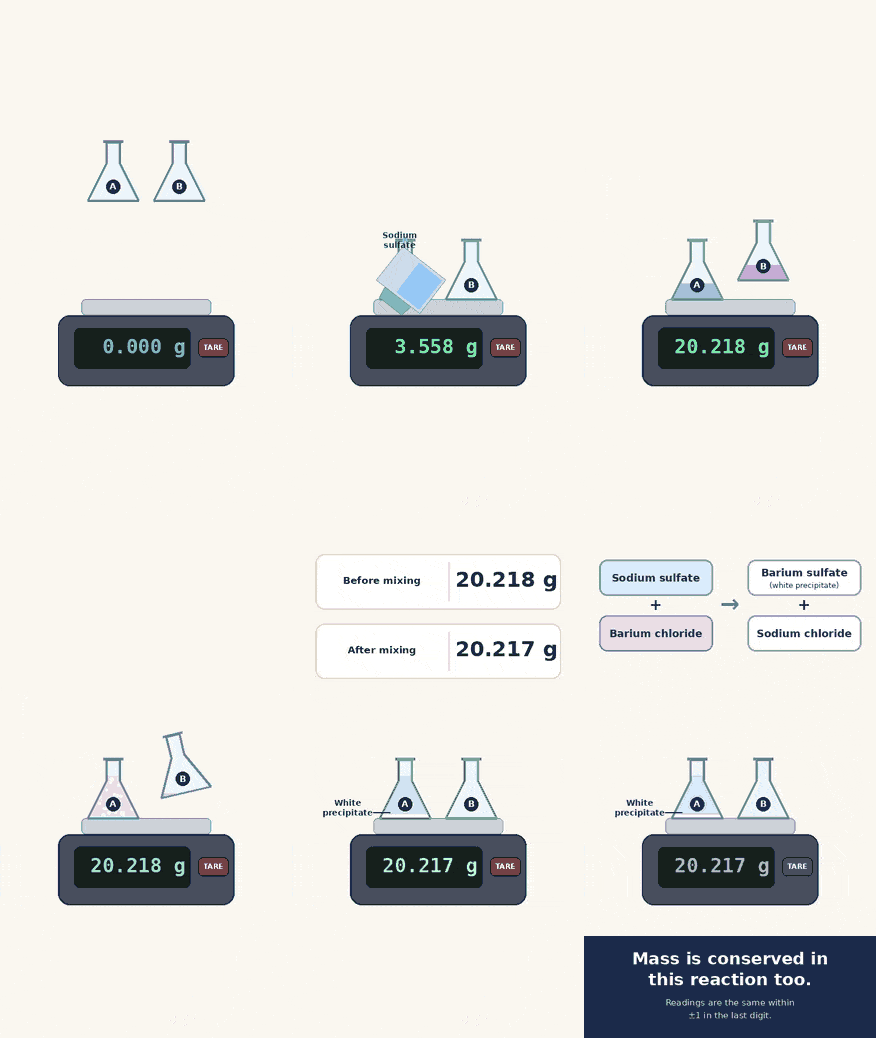
Sodium sulfate + Barium chloride → Barium sulfate + Sodium chloride
What do we need?
- Two clean, dry 100 mL conical flasks, marked A and B
- A digital weighing balance
- About 10 mL of 1% m/v sodium sulfate solution
-
About 10 mL of
1% m/v barium chloride
solution
- 1% m/v means 1 g of the substance dissolved to make 100 mL of solution.
What do we do?
- Place both flasks on the balance and press tare.
- Pour the sodium sulfate solution into flask A .
- Pour the barium chloride solution into flask B .
- Leave both flasks on the balance. Record the total mass.
- Pour the solution from flask B into flask A and mix carefully.
- Place both flasks back on the balance. Record the reading.
📝 Note
(from the book)
Keep both the conical flasks on the digital weighing balance. It prevents the error caused by a small amount of solution that may remain stuck to the walls of the conical flask during transfer.
What do we observe?
-
A
white precipitate
forms.
- A precipitate is an insoluble solid that forms inside a solution and settles down.
| Reading | |
|---|---|
| Before mixing | 20.218 g |
| After mixing | 20.217 g |
- The readings are practically the same .
📝 Note
(from the book)
Usually in any measurement, there is uncertainty of ±1 in the last digit. Therefore, the variation in readings of digital weighing balance is within experimental error and the weight can be taken as constant.
What does this tell us?
- When solutions of sodium sulfate and barium chloride are mixed, a white precipitate of barium sulfate is formed along with sodium chloride.
- Mass is conserved in this chemical reaction.
Why was Activity 9.3 done in an open flask, but Activity 9.2 needed a balloon?
📝 Note
(from the book)
This reaction has been carried out in the open system, since no gas is formed.
- An open system is a container that is not closed, so things can go in or out.
| Activity 9.2 (set-up 2) | Activity 9.3 | |
|---|---|---|
| Gas formed? | Yes (carbon dioxide) | No |
| Container | Closed with a balloon | Open flask is fine |
| Why? | To trap the gas , so its mass is counted | Nothing escapes , so no need to close it |
| Mass before and after | Same | Same |
Example 3: Zinc and dilute hydrochloric acid
Zinc + Hydrochloric acid (dilute) → Zinc chloride + Hydrogen
-
🔬 Think as a Scientist
You are given a chemical reaction in which zinc reacts with dilute hydrochloric acid to form zinc chloride and hydrogen gas.
Zinc + Hydrochloric acid (dilute) → Zinc chloride + Hydrogen
Design and perform an experiment to test the hypothesis that mass is conserved during the chemical reaction. You may use a set-up different from the one shown in Activity 9.2.
A hypothesis is an idea that we can test by doing an experiment.View answer
Answer- Since hydrogen gas is formed, the container must be closed , or the gas will escape.
-
Set-up:
- Pour dilute hydrochloric acid into a conical flask.
- Put a few zinc granules in a small test tube. Stand it upright inside the flask, so zinc does not touch the acid yet.
- Close the flask tightly with a rubber cork .
- Weigh the whole set-up and record the reading.
- Tilt the flask so the acid reaches the zinc. Bubbles of hydrogen form.
- When the bubbling stops, weigh again.
- What will the student find? The reading before and after is practically the same .
- Conclusion: The hypothesis is supported. Mass is conserved in this reaction.
Who stated the Law of Conservation of Mass?
-
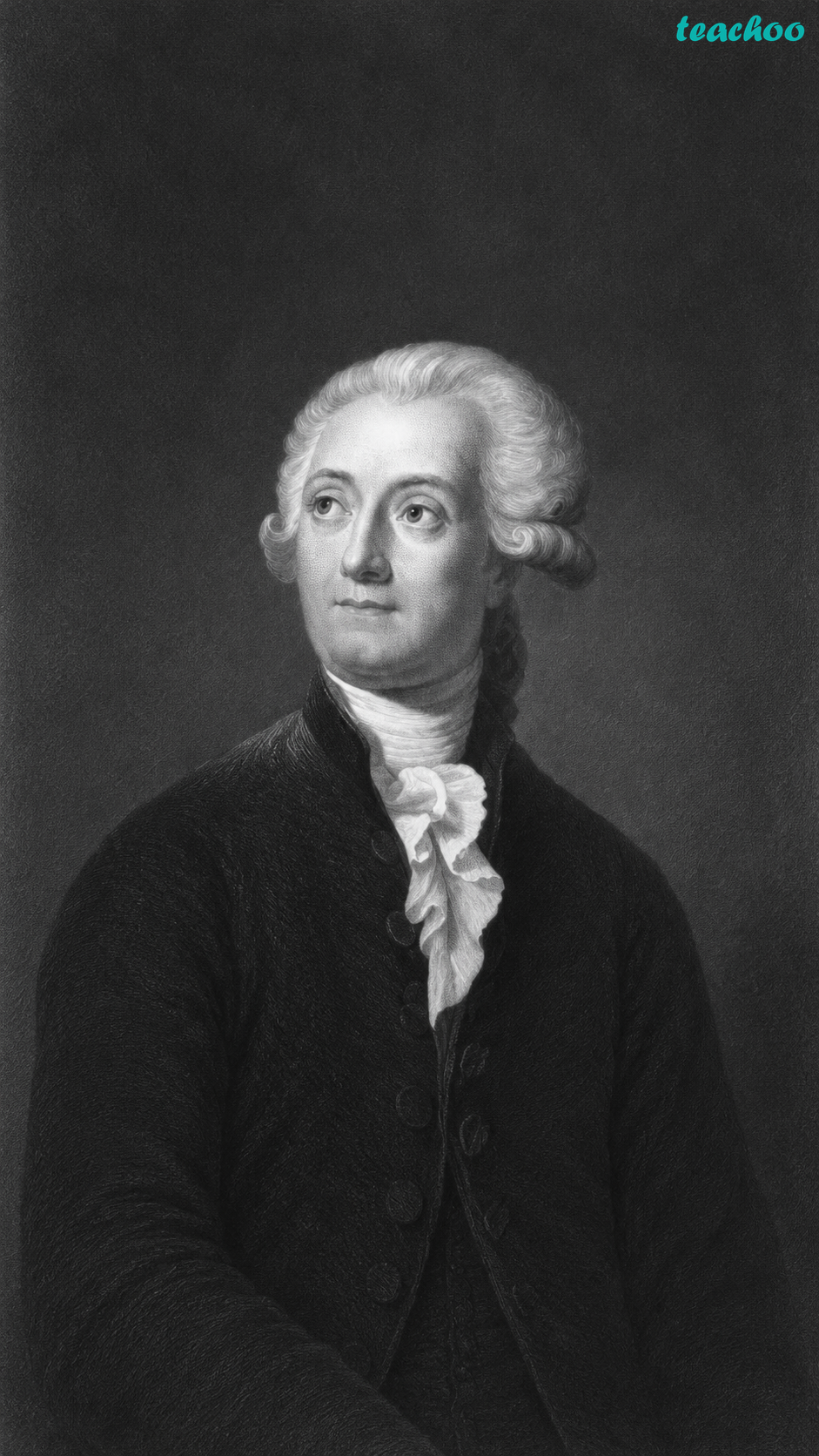
- Antoine Lavoisier proposed it in 1789 .
- He is known as the Father of Modern Chemistry .
- This law applies to every chemical reaction .
- He said: "...in every operation an equal quantity of matter exists both before and after the operation."
Questions from the book for this section
-
📘 Example 9.1
In a group activity, students place 4.0 g of calcium carbonate with 2.92 g of hydrochloric acid in a closed container. After the reaction is over, they measured 1.76 g of carbon dioxide, 0.72 g of water, and 4.44 g of calcium chloride. Verify whether the Law of Conservation of Mass is obeyed or not.View answer
Answer- Mass of calcium carbonate = 4.0 g
- Mass of hydrochloric acid = 2.92 g
- Total mass of reactants = 4.0 g + 2.92 g = 6.92 g
- Mass of carbon dioxide = 1.76 g
- Mass of water = 0.72 g
- Mass of calcium chloride = 4.44 g
- Total mass of products = 1.76 g + 0.72 g + 4.44 g = 6.92 g
- Comparing: Mass of reactants = Mass of products
- Hence, the Law of Conservation of Mass is obeyed.
-
📘 Example 9.2
12 g of carbon combines with 32 g of oxygen to form 44 g of carbon dioxide as per the given equation.
Carbon + Oxygen → Carbon dioxide
If 2.4 g of carbon reacts completely with oxygen, how much carbon dioxide will be produced?View answer
Answer- Given that 12 g of carbon reacts with 32 g of oxygen to give 44 g of carbon dioxide.
- So, 1 g of carbon will give = 44 ÷ 12 g of carbon dioxide
- Thus, 2.4 g of carbon will give = (44 ÷ 12) × 2.4 g = 8.8 g of carbon dioxide
- Hence, 8.8 g of carbon dioxide will be produced.
-
🤔 Pause and Ponder 1
A student burns 10 g of ethanol in an open beaker. After the reaction, no residue is left in the beaker. Does this mean the Law of Conservation of Mass is violated? Explain.View answer
Answer- No , the law is not violated .
- When ethanol burns, it reacts with oxygen from the air.
- The products are carbon dioxide and water vapour . Both are gases .
- The beaker is open , so these gases escape into the air. That is why no residue is left.
-
In a
closed
container:
- Mass of ethanol + mass of oxygen used = mass of carbon dioxide + mass of water vapour
-
🤔 Pause and Ponder 2
When 20 g of hydrogen reacts completely with 160 g of oxygen, how much water is formed according to the Law of Conservation of Mass?View answer
Answer- Total mass of reactants = 20 g + 160 g = 180 g
- By the Law of Conservation of Mass, mass of products = mass of reactants
- Water formed = 180 g
-
📋 Revise, Reflect, Refine, Q11
5.3 g of sodium carbonate and 6.0 g of acetic acid react to produce 2.2 g of carbon dioxide, 0.9 g of water, and 8.2 g of sodium acetate. Verify whether the law of conservation of mass is valid.View answer
Answer- Total mass of reactants = 5.3 g + 6.0 g = 11.3 g
- Total mass of products = 2.2 g + 0.9 g + 8.2 g = 11.3 g
- Mass of reactants = Mass of products
- Hence, the Law of Conservation of Mass is valid.
