
 You are here
- In 9.4.1 , we learnt that atoms make covalent compounds by sharing electrons.
- In 9.4.2 , we learn that atoms make ionic compounds by giving or taking electrons, i.e. by transferring electrons.
What is transfer of electrons?
- Transfer of electrons means one atom gives one or more of its valence electrons to another atom, and the other atom takes them.
- Book line: Transfer one or more of the valence electrons to another atom, or accept one or more electrons from some other atom.
Example: Sodium
| Sodium | |
|---|---|
| Before | 2, 8, 1 |
| What it does | Gives 1 electron |
| After | 2, 8 |
- So, as it gives its 1 electron, the atom will have 10 electrons and 11 protons .
- So it will have 1 extra proton , due to which it will have a +1 charge .
- These positively charged species are called cations .
What are cations?
- A cation is a positively charged atom, formed when an atom loses electrons.
- Book line: When sodium atom loses its valence electron, it becomes a positively charged species, called a sodium cation, represented as Na⁺.
Example 1: Sodium cation (Na⁺)
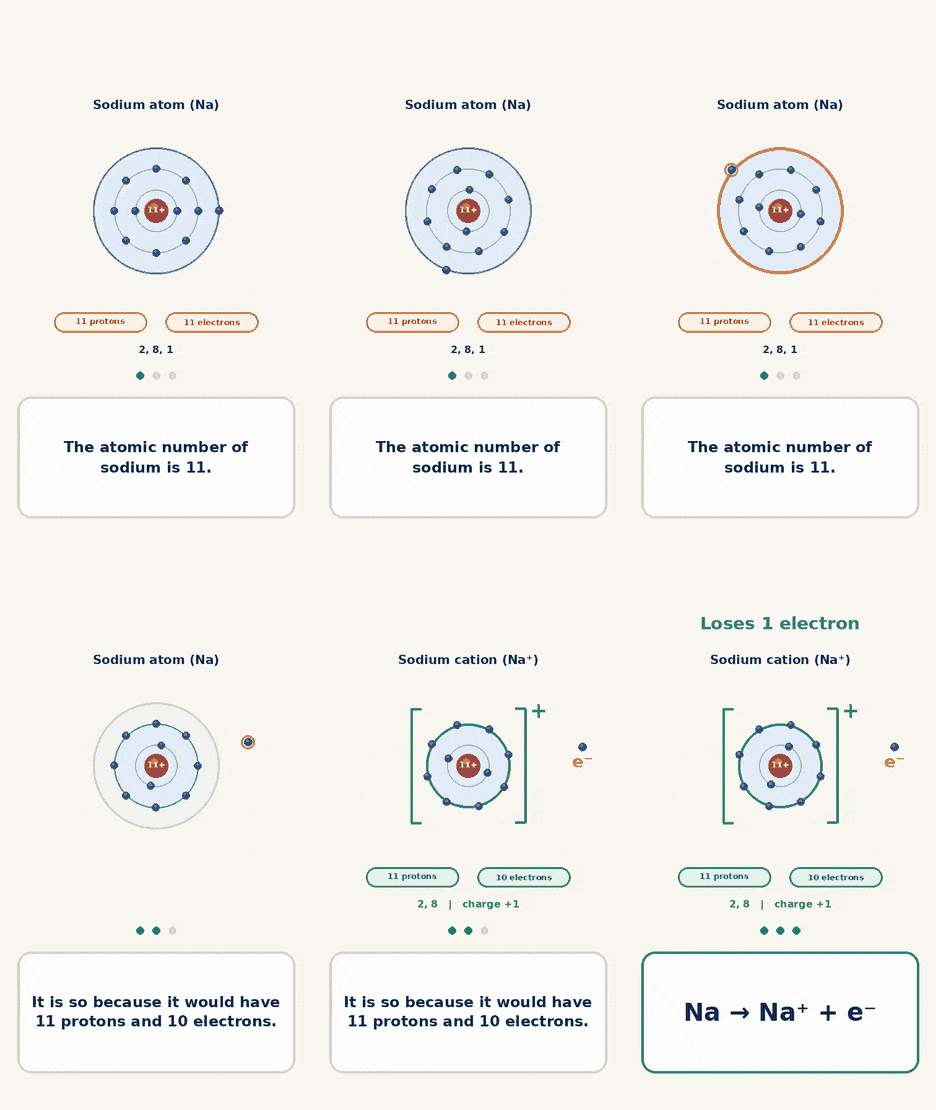
- The atomic number of sodium is 11.
- It is so because it would have 11 protons and 10 electrons.
| Sodium atom (Na) | Sodium cation (Na⁺) | |
|---|---|---|
| Protons | 11 | 11 |
| Electrons | 11 | 10 |
| Electronic configuration | 2, 8, 1 | 2, 8 |
| Charge | 0 (neutral) | +1 |
Na → Na⁺ + e⁻
Example 2: Calcium cation (Ca²⁺)
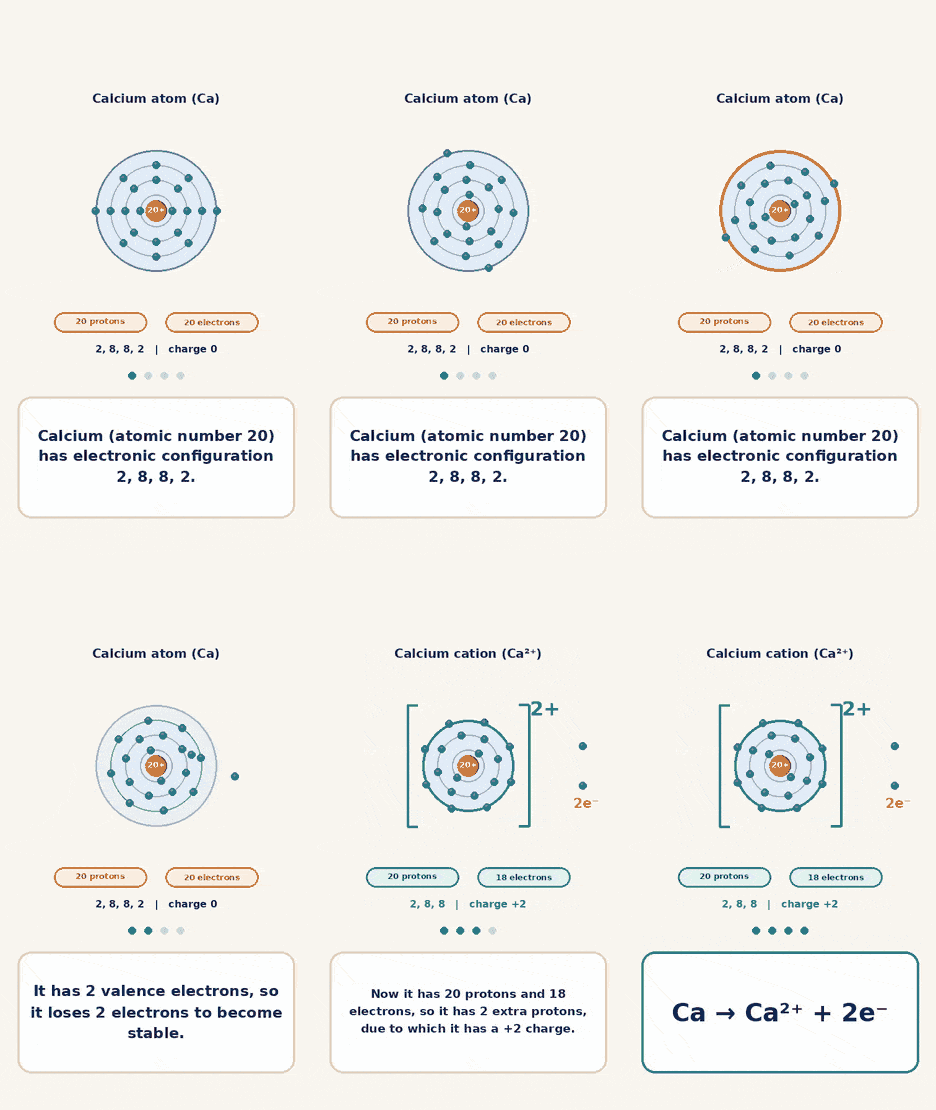
- Calcium (atomic number 20) has electronic configuration 2, 8, 8, 2 .
- It has 2 valence electrons, so it loses 2 electrons to become stable.
- Now it has 20 protons and 18 electrons , so it has 2 extra protons , due to which it has a +2 charge .
| Calcium atom (Ca) | Calcium cation (Ca²⁺) | |
|---|---|---|
| Protons | 20 | 20 |
| Electrons | 20 | 18 |
| Electronic configuration | 2, 8, 8, 2 | 2, 8, 8 |
| Charge | 0 (neutral) | +2 |
Ca → Ca²⁺ + 2e⁻
GIF
Watch: ca
What are anions?
Example: Chlorine
| Chlorine | |
|---|---|
| Before | 2, 8, 7 |
| What it does | Takes 1 electron |
| After | 2, 8, 8 |
- So, as it takes 1 electron, the atom will have 18 electrons and 17 protons .
- So it will have 1 extra electron , due to which it will have a −1 charge .
- These negatively charged species are called anions .
- An anion is a negatively charged atom, formed when an atom gains electrons.
- Book line: After gaining one extra electron, it acquires a negative charge and is called a chloride anion, represented as Cl⁻.
Example 1: Chloride anion (Cl⁻)
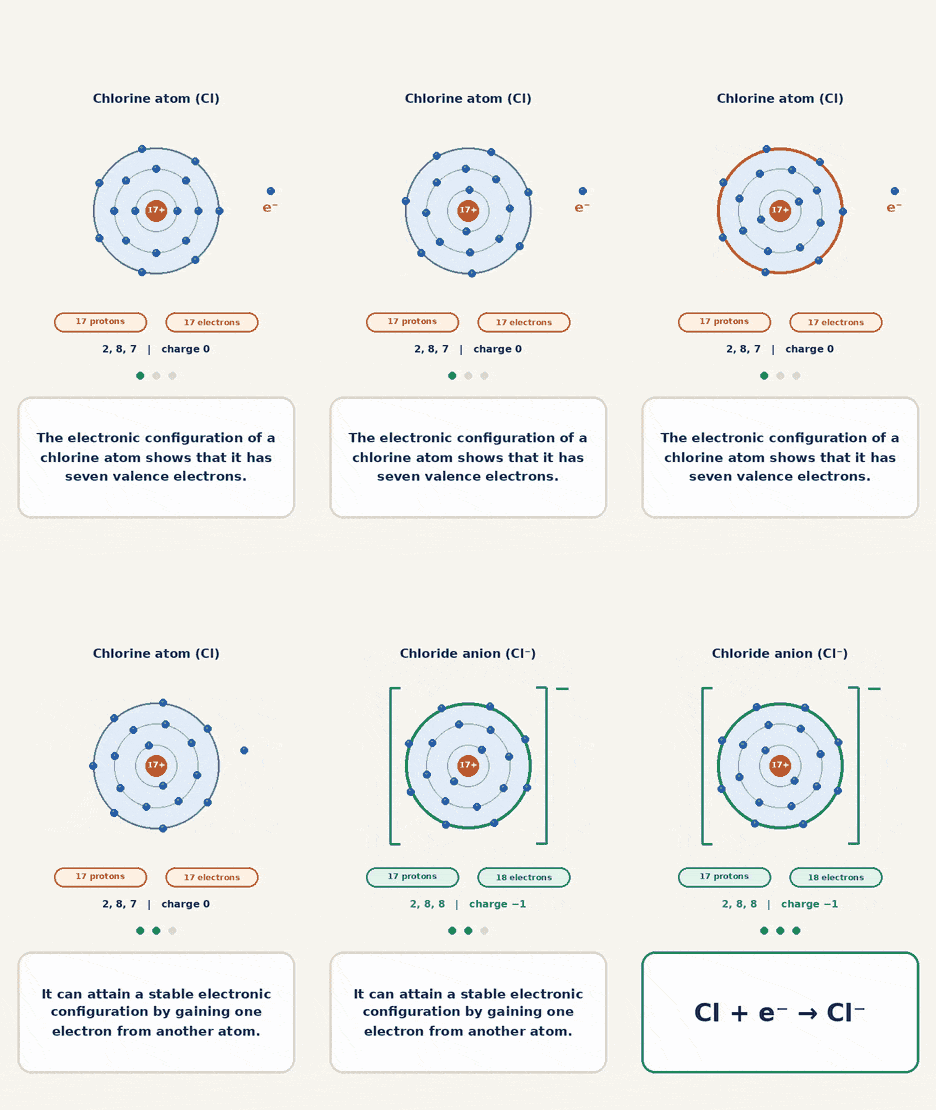
- The electronic configuration of a chlorine atom shows that it has seven valence electrons.
- It can attain a stable electronic configuration by gaining one electron from another atom.
| Chlorine atom (Cl) | Chloride anion (Cl⁻) | |
|---|---|---|
| Protons | 17 | 17 |
| Electrons | 17 | 18 |
| Electronic configuration | 2, 8, 7 | 2, 8, 8 |
| Charge | 0 (neutral) | −1 |
Cl + e⁻ → Cl⁻
Example 2: Sulfide anion (S²⁻)
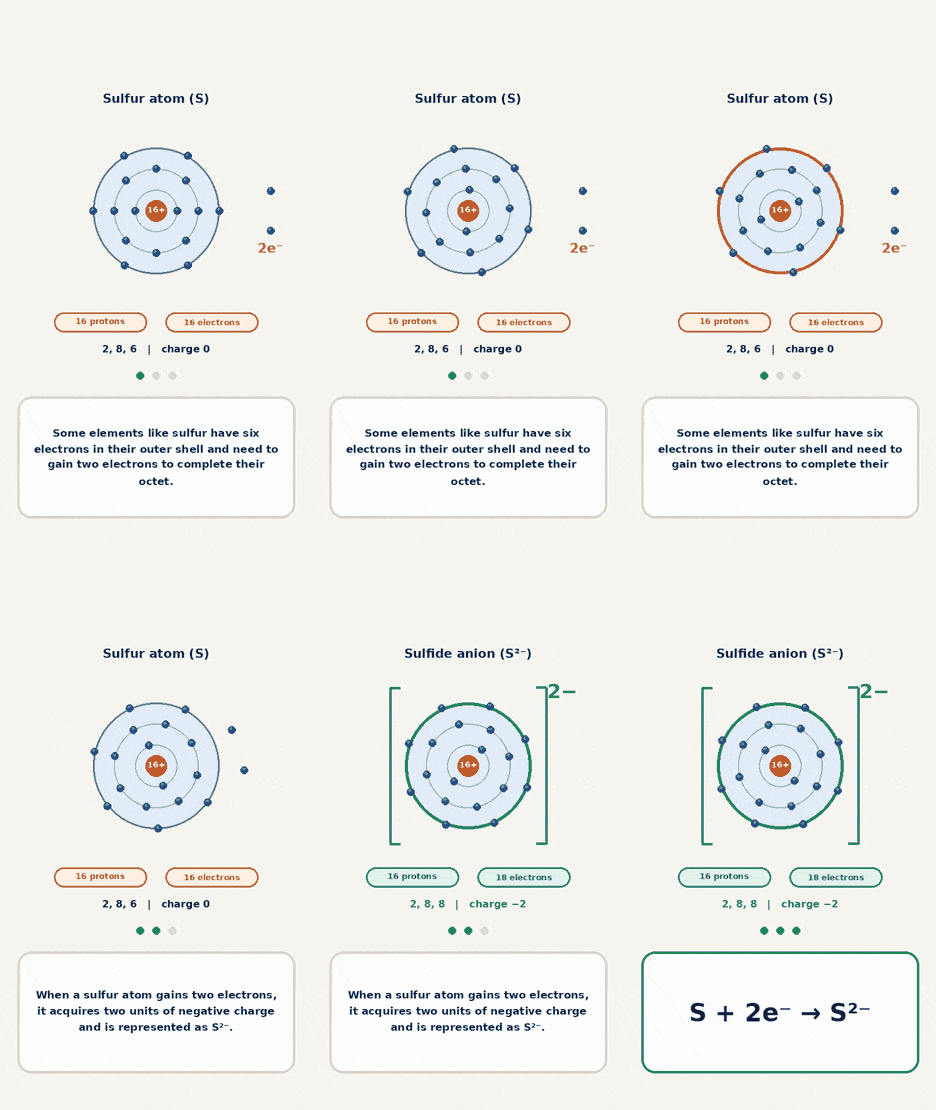
- Some elements like sulfur have six electrons in their outer shell and need to gain two electrons to complete their octet.
- When a sulfur atom gains two electrons, it acquires two units of negative charge and is represented as S²⁻.
S + 2e⁻ → S²⁻
GIF
Watch: s
What are ions?
- When an atom gives or takes electrons, the number of protons and electrons is no longer equal .
- So the atom gets a charge . A charged atom is called an ion .
- Cations (+) and anions (−) are collectively called ions.
| Cation | Anion | |
|---|---|---|
| How it forms | Atom gives (loses) electrons | Atom takes (gains) electrons |
| Charge | Positive (+) | Negative (−) |
| Why | More protons than electrons | More electrons than protons |
| Example | Na⁺ | Cl⁻ |
What is an ionic bond?
- When sodium gives its electron to chlorine, sodium becomes Na⁺ and chlorine becomes Cl⁻ . Opposite charges attract .
The electrostatic force of attraction between oppositely charged ions that holds them together is called an ionic bond.
Breaking it down:
| Part of the definition | Meaning |
|---|---|
| Electrostatic force | The force between charges . Opposite charges attract , like charges repel . |
| Attraction | A pull towards each other |
| Oppositely charged ions | A positive ion and a negative ion (like Na⁺ and Cl⁻) |
| Holds them together | Keeps the ions joined |
| Ionic bond | The name for this pull between opposite ions |
- A compound formed by an ionic bond is called an ionic compound .
Example: Sodium chloride (NaCl)
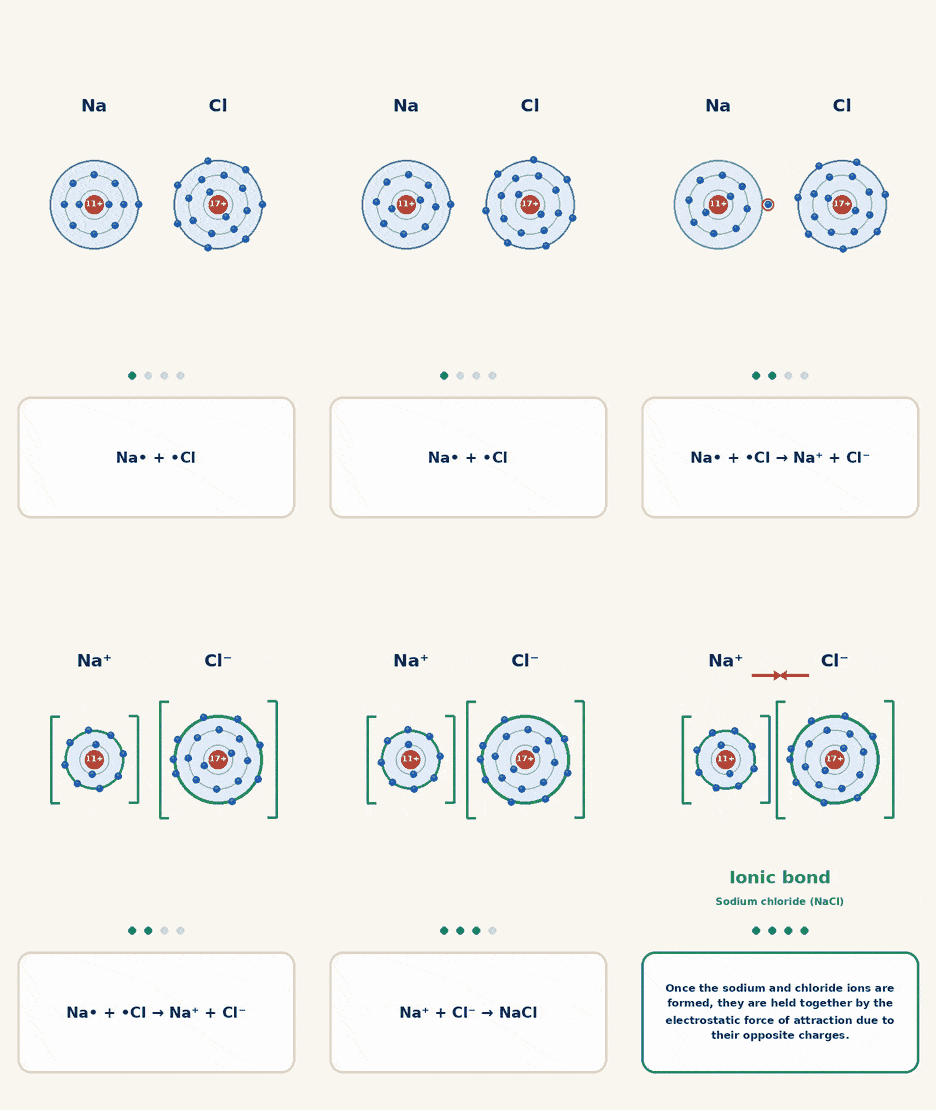
Na• + •Cl → Na⁺ + Cl⁻ → NaCl
- Once the sodium and chloride ions are formed, they are held together by the electrostatic force of attraction due to their opposite charges.
Which atoms give electrons and which atoms take electrons?
- If the valence shell of an atom has less than four electrons, it would generally donate its valence electrons to achieve a stable electronic configuration.
- Atoms with more than 4 valence electrons usually gain or share electrons to complete an octet.
- An atom does whatever is easier . Losing 1, 2 or 3 electrons is easier than gaining 5, 6 or 7.
| Valence electrons | What the atom usually does | Examples (from the first 18 elements) |
|---|---|---|
| 1, 2 or 3 | Gives / loses electrons | Lithium (2, 1), Sodium (2, 8, 1), Magnesium (2, 8, 2), Aluminium (2, 8, 3) |
| 5, 6 or 7 | Takes / gains or shares electrons | Nitrogen (2, 5), Oxygen (2, 6), Sulfur (2, 8, 6), Chlorine (2, 8, 7) |
📝 Note
(from the book)
Hydrogen
has only 1 electron, but it usually
shares
it (as in H₂, HCl and H₂O). So hydrogen is an exception to this rule.
How is an ionic bond different from a covalent bond?
| Covalent bond | Ionic bond | |
|---|---|---|
| How it forms | Sharing of electrons | Transfer of electrons |
| Particles formed | Molecules | Ions (cations and anions) |
| Charge on particles | No charge | Positive and negative |
| What holds them together | Shared pair of electrons | Attraction between opposite charges |
| Usually between | Non-metal + non-metal | Metal + non-metal |
| Examples | H₂, Cl₂, HCl, H₂O | NaCl |
Threads of Curiosity
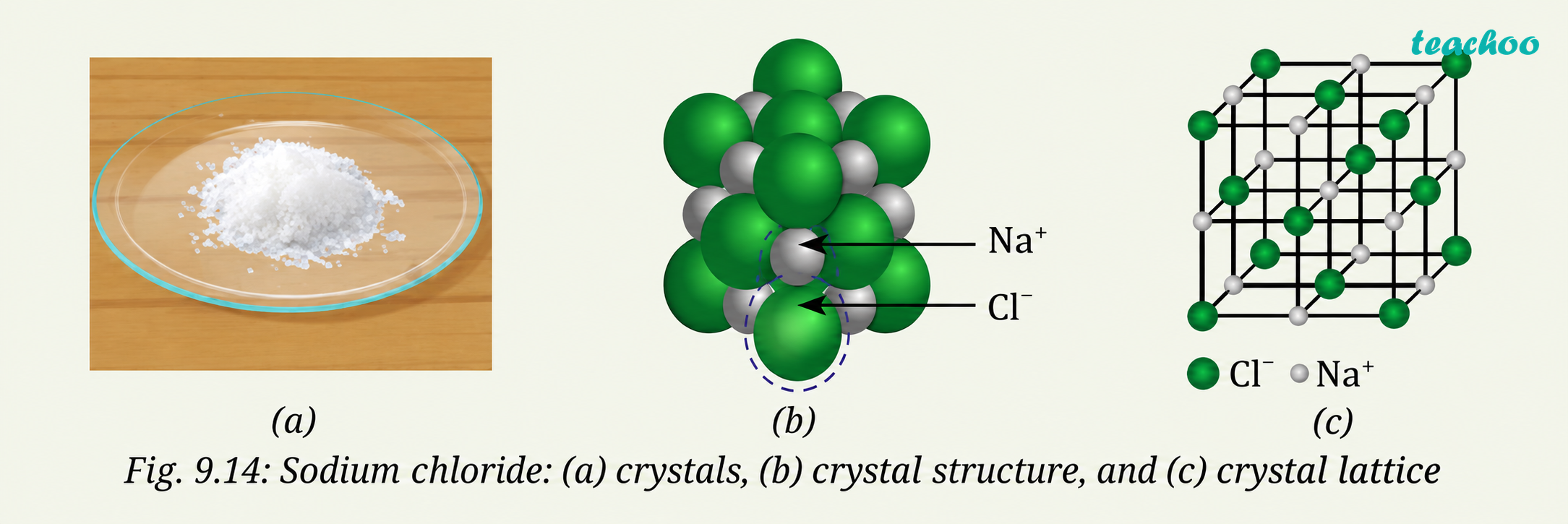
- Ionic compounds usually do not remain as single units. They form three-dimensional (3-D) crystals in which ions are arranged in a repeating pattern.
- In sodium chloride (NaCl), each sodium ion (Na⁺) is surrounded by six chloride ions (Cl⁻), and each chloride ion is surrounded by six sodium ions.
| Term | Meaning |
|---|---|
| Crystal structure | Oppositely charged ions arranged in a regular, repeating 3-D pattern |
| Crystal lattice | The crystal structure drawn with ions shown as points or dots . It helps us picture the arrangement. |
- You will learn more about the crystal structure in higher grades.
Questions from the book for this section
-
💭 What if...
What if we could see atoms directly? How would it help scientists and what challenges would it cause?View answer
Answer-
How it would help:
- Scientists could see exactly how atoms join and how bonds form.
- It would be easier to design new materials and medicines .
- Models of the atom could be checked directly.
-
Challenges:
- Atoms are extremely tiny and always moving .
- Ordinary light cannot show them, so special, costly instruments are needed.
- Looking at atoms very closely can disturb them.
-
How it would help:
-
🤔 Pause and Ponder 12
What kind of ion will oxygen (O) form?View answer
Answer- Oxygen (atomic number 8) = 2, 6
- It has 6 valence electrons, so it gains 2 electrons to complete its octet.
- It forms an anion : the oxide ion (O²⁻) .
-
🤔 Pause and Ponder 13
Fill in the blanks.
Among magnesium and chlorine, magnesium atom can give two electrons to become Mg²⁺. However, chlorine can take only one electron to become ____________. Now, __________ ion of magnesium and __________ ions of chlorine combine to give magnesium chloride.View answer
Answer- Chlorine can take only one electron to become Cl⁻ .
-
One
ion of magnesium and
two
ions of chlorine combine to give magnesium chloride.
- Magnesium gives 2 electrons, but each chlorine takes only 1, so two chlorine atoms are needed.
-
🤔 Pause and Ponder 14
Show the formation of cations of potassium (K) and calcium (Ca) atoms, and the formation of their corresponding chlorides using diagrams.View answer
AnswerFormation of cations:Atom Atomic number Electronic configuration Loses Cation formed Potassium (K) 19 2, 8, 8, 1 1 electron K⁺ (2, 8, 8) Calcium (Ca) 20 2, 8, 8, 2 2 electrons Ca²⁺ (2, 8, 8) K → K⁺ + e⁻ Ca → Ca²⁺ + 2e⁻Formation of potassium chloride (KCl):- Potassium gives 1 electron to 1 chlorine atom.
K• + •Cl → K⁺ + Cl⁻ → KClFormation of calcium chloride (CaCl₂):- Calcium gives 2 electrons, one each to two chlorine atoms.
•Cl Cl⁻ Ca: → Ca²⁺ → CaCl₂ •Cl Cl⁻
-
🤔 Pause and Ponder 15
Illustrate how sodium sulfide (Na₂S) is formed.View answer
Answer- Sodium (2, 8, 1) loses 1 electron → Na⁺
- Sulfur (2, 8, 6) needs 2 electrons → S²⁻
- One sodium can give only 1 electron, so two sodium atoms are needed.
Na• + S → 2Na⁺ + S²⁻ → Na₂S Na•- The ions are held together by an ionic bond .
-
📋 Revise, Reflect, Refine, Q1
A particular element (A) has one electron in its third shell. There is another element (B) with six electrons in its second shell.
(i) How many electrons does A tend to give or take to become stable?
(ii) What kind of ion would it form?
(iii) How many electrons does B tend to give or take to become stable?
(iv) What kind of ion would it form?
(v) If A and B were to combine, what kind of bond would be formed?
(vi) What would be the formula for the compound thus formed?View answer
Answer- A = 2, 8, 1 (sodium). B = 2, 6 (oxygen).
Part Answer (i) A tends to give 1 electron. (ii) A forms a cation , A⁺ . (iii) B tends to take 2 electrons. (iv) B forms an anion , B²⁻ . (v) An ionic bond (electrons are transferred from A to B). (vi) Two A⁺ are needed to balance one B²⁻, so the formula is A₂B (like Na₂O ).
-
📋 Revise, Reflect, Refine, Q2
An element X has six electrons in its outer shell and forms a diatomic molecule.
(i) Why would that be so?
(ii) What kind of bond would it form?
(iii) Draw the structure of the molecule it would form.
(iv) A certain other element Y has two electrons in its second shell. Draw the structure of the molecule that X would form with Y.View answer
Answer- (i) X has 6 valence electrons, so it needs 2 more. Two X atoms share 2 electrons each , and both get an octet. So X forms a diatomic molecule (2 atoms), like oxygen (O₂) .
- (ii) A covalent bond , specifically a double bond .
- (iii) X=X (like O=O)
-
(iv)
Y =
2, 2
. It has
2
valence electrons, so it
gives
2 electrons. X
takes
2 electrons.
- Y becomes Y²⁺ , X becomes X²⁻ .
- They are held by an ionic bond . Formula: YX
Y: + X → Y²⁺ + X²⁻ → YX
-
📋 Revise, Reflect, Refine, Q7
Which of the following correctly represents Cl⁻ ion (Atomic number of chlorine = 17).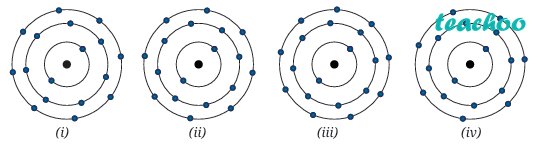
View answer
Answer- Chlorine atom = 2, 8, 7. Cl⁻ gains 1 electron, so it has 18 electrons.
- The correct diagram must show 2, 8, 8 : 2 electrons in the first shell, 8 in the second, 8 in the third.
- Correct option: (iv)
-
📋 Revise, Reflect, Refine, Q12
If a species has 11 protons, 12 neutrons and 10 electrons then
(i) what is its atomic number and mass number?
(ii) is it neutral, a cation or an anion? Explain.
(iii) write its electronic configuration.
(iv) name the species.View answer
Answer- (i) Atomic number = protons = 11 . Mass number = protons + neutrons = 11 + 12 = 23 .
- (ii) It is a cation . It has 11 protons (+) but only 10 electrons (−), so it has 1 extra positive charge .
- (iii) 2, 8
- (iv) Sodium ion (Na⁺)
-
📋 Revise, Reflect, Refine, Q13
Two elements, A and B, have the following configurations: A: 2, 8, 5 and B: 2, 8, 7
(i) Which element is more reactive?
(ii) Will A and B form ionic or covalent bonds when they combine? Explain using electron transfer or sharing.
(iii) Predict the formula of the compound they would form.View answer
Answer- A = phosphorus (needs 3 electrons). B = chlorine (needs 1 electron).
- (i) B is more reactive. It needs only 1 electron to complete its octet, which is easier than needing 3.
- (ii) Covalent bonds. Both A and B need electrons; neither wants to give them away. So they share electrons.
- (iii) A needs 3 electrons, so it shares 1 electron with each of 3 B atoms. Formula: AB₃ (like PCl₃ ).
-
📋 Revise, Reflect, Refine, Q15
The species ²⁷Al, ⁸⁰Br⁻ and ²⁰¹Hg²⁺ have 13, 35 and 80 protons, respectively. How many electrons and neutrons do they have?View answer
Answer- Neutrons = mass number − protons
- Electrons = protons − (positive charge), or protons + (negative charge)
Species Protons Electrons Neutrons ²⁷Al (neutral atom) 13 13 27 − 13 = 14 ⁸⁰Br⁻ (gained 1 electron) 35 35 + 1 = 36 80 − 35 = 45 ²⁰¹Hg²⁺ (lost 2 electrons) 80 80 − 2 = 78 201 − 80 = 121
