
 You are here
What is atomic number?
- All atoms of one element are alike , but they are different from the atoms of another element .
- The difference is in the number of protons and electrons they have.
- Definition: The number of protons present in the nucleus of an atom is called its atomic number .
- Atomic number = Number of protons
- Since an atom is neutral , the number of electrons is also the same as the number of protons.
- So, Atomic number = Number of protons = Number of electrons
-
Example
- Hydrogen has 1 proton and 1 electron , so its atomic number is 1 .
- Helium has 2 protons and 2 electrons , so its atomic number is 2 .
- Note - neutrons are not counted in the atomic number.
Atomic number of some elements
| Element | Protons | Neutrons | Electrons | Atomic number |
|---|---|---|---|---|
| Hydrogen | 1 | 0 | 1 | 1 |
| Helium | 2 | 2 | 2 | 2 |
| Lithium | 3 | 4 | 3 | 3 |
| Carbon | 6 | 6 | 6 | 6 |
| Oxygen | 8 | 8 | 8 | 8 |
-
Look at the table carefully:
- Protons and electrons are always equal .
- Neutrons can be different , but they do not change the atomic number.
What is Z?
- The atomic number is written with the symbol Z .
- Z comes from the German word "Zahl" , which means number .
- So wherever we see Z , it means the number of protons in the atom.
- Example - for oxygen, Z = 8 .
How does the atomic number define the identity of an atom?
- The atomic number decides which element the atom is.
- It also decides the chemical behaviour of the element.
-
Example
- If Z = 1 , the atom is always hydrogen .
- If Z = 2 , the atom is always helium .
- If Z = 8 , the atom is always oxygen .
- So the atomic number works like an identity card of an element.
- Two different elements can never have the same atomic number .
-
❓ In-text question (Page 150)
Can we say that elements with different atomic numbers are distinct from each other, and the atomic number uniquely identifies an element?View answer
Answer- Yes.
- Each element has its own atomic number , and no two elements share it.
-
If the number of protons changes, the
element itself changes
.
- 1 proton - hydrogen
- 2 protons - helium
- 3 protons - lithium
- So the atomic number uniquely identifies an element.
-
❓ In-text question (Page 150)
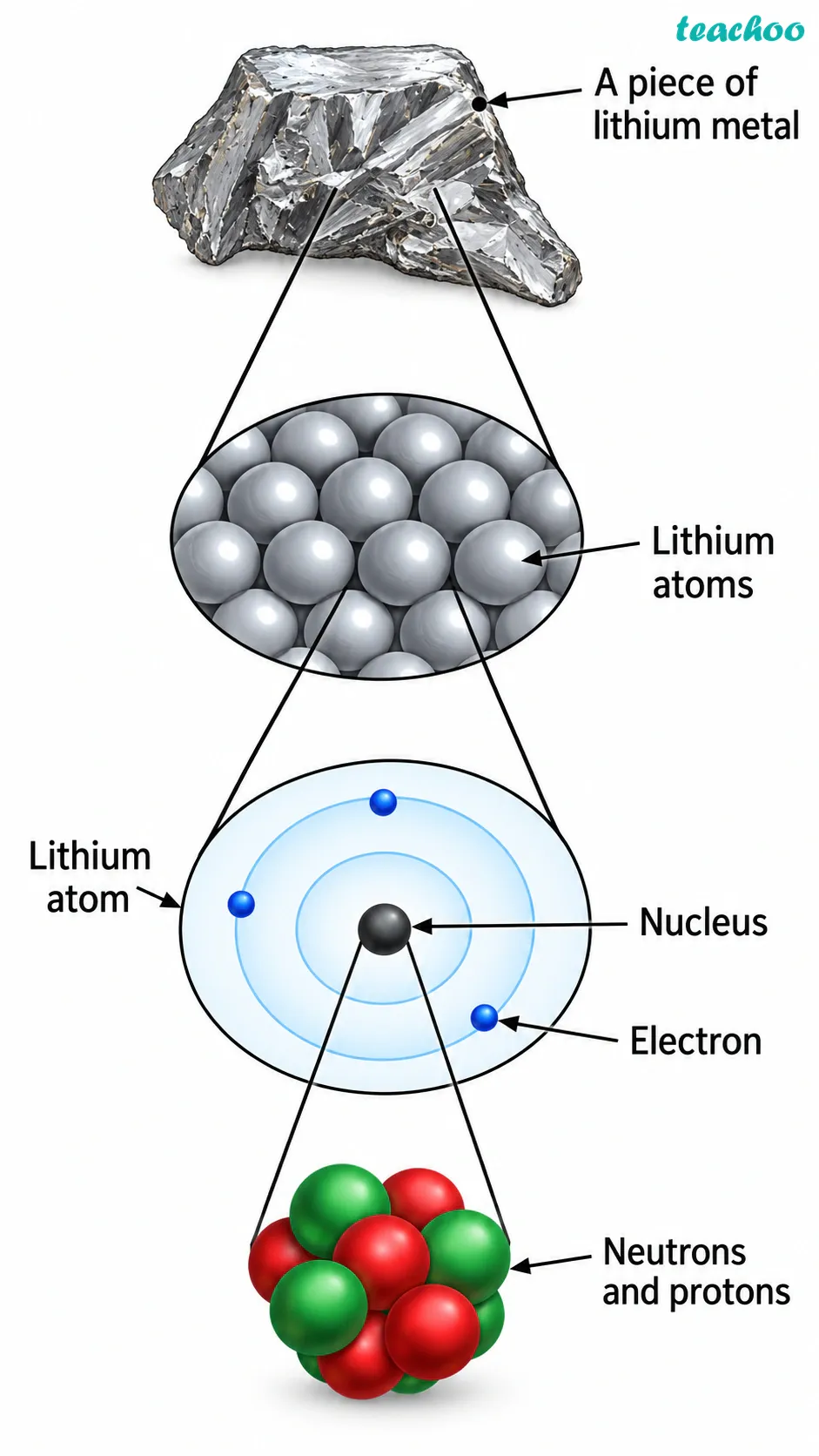
How many neutrons and protons are present in a lithium atom, and what is its atomic number?View answer
Answer- In the figure we see a piece of lithium metal , then the lithium atoms in it, and then one lithium atom opened up.
-
GIF Watch: what is the mass number of an atom
-
Inside that one atom we can see:
- the nucleus at the centre, holding protons and neutrons
- the electrons moving around the nucleus
In a lithium atom Number Protons 3 Neutrons 4 Electrons 3 Atomic number (Z) 3 - The atomic number is 3 , because the nucleus has 3 protons .
- The 4 neutrons are not counted in the atomic number.
Other points
- Atomic number is always a whole number . It is never a fraction.
- The smallest atomic number is 1 , which is hydrogen.
- Atomic number is counted from the protons , so it can never be zero .
- Changing the number of neutrons does not change the element.
- Changing the number of protons makes it a completely different element .
📝 Important points — 8.5 Atomic Number
| Point | What to remember |
|---|---|
| Atomic number | Number of protons in the nucleus |
| Symbol | Z (from the German word Zahl , meaning number) |
| In a neutral atom | Protons = Electrons = Atomic number |
| What it decides | The identity of the element and its chemical behaviour |
| Hydrogen | Z = 1 |
| Helium | Z = 2 |
| Lithium | Z = 3 (3 protons, 4 neutrons) |
| Neutrons | Not counted in the atomic number |
💡 Worth remembering
- Atomic number = number of protons , and nothing else.
- In a neutral atom it is also the number of electrons .
- Z is the symbol used for it.
- Every element has a different atomic number, so it works like an identity .
- Neutrons change, but the element stays the same .
✅ Quick self-check
-
What is the atomic number of an atom?
View Answer
- It is the number of protons in the nucleus of that atom.
- It is written as Z .
-
An atom has 11 protons, 12 neutrons and 11 electrons. What is its atomic number?
View Answer
- Atomic number = number of protons = 11 .
- Neutrons are not counted .
-
If two atoms have the same atomic number, are they of the same element?
View Answer
- Yes.
- The same atomic number means the same number of protons , so it is the same element .
-
Why is the number of electrons equal to the number of protons in an atom?
View Answer
- An atom as a whole is neutral , that is, it has no charge .
- So the positive charge of protons must be balanced by an equal negative charge of electrons.
Key terms
| Term | Meaning |
|---|---|
| Atomic number (Z) | The number of protons present in the nucleus of an atom |
| Zahl | The German word for number , from which the symbol Z comes |
| Neutral atom | An atom in which the number of protons equals the number of electrons |
| Chemical behaviour | How an element reacts with other elements |
