
 You are here
Was Thomson's model really correct?
- Thomson said the atom is a ball of positive charge with electrons inside it.
- But this was only his idea . It was not tested by any experiment.
- In science, an idea is accepted only after it is checked by an experiment .
- So in 1911 , Geiger and Marsden , working under Ernest Rutherford , tested it.
- They fired tiny particles at a very thin sheet of gold and watched what happened.
- This test is called the gold foil experiment .
What is the gold foil experiment?
- In this experiment, a beam of tiny positive particles (alpha particles) was fired at a very thin sheet of gold .
-
GIF Watch: what is the gold foil experiment
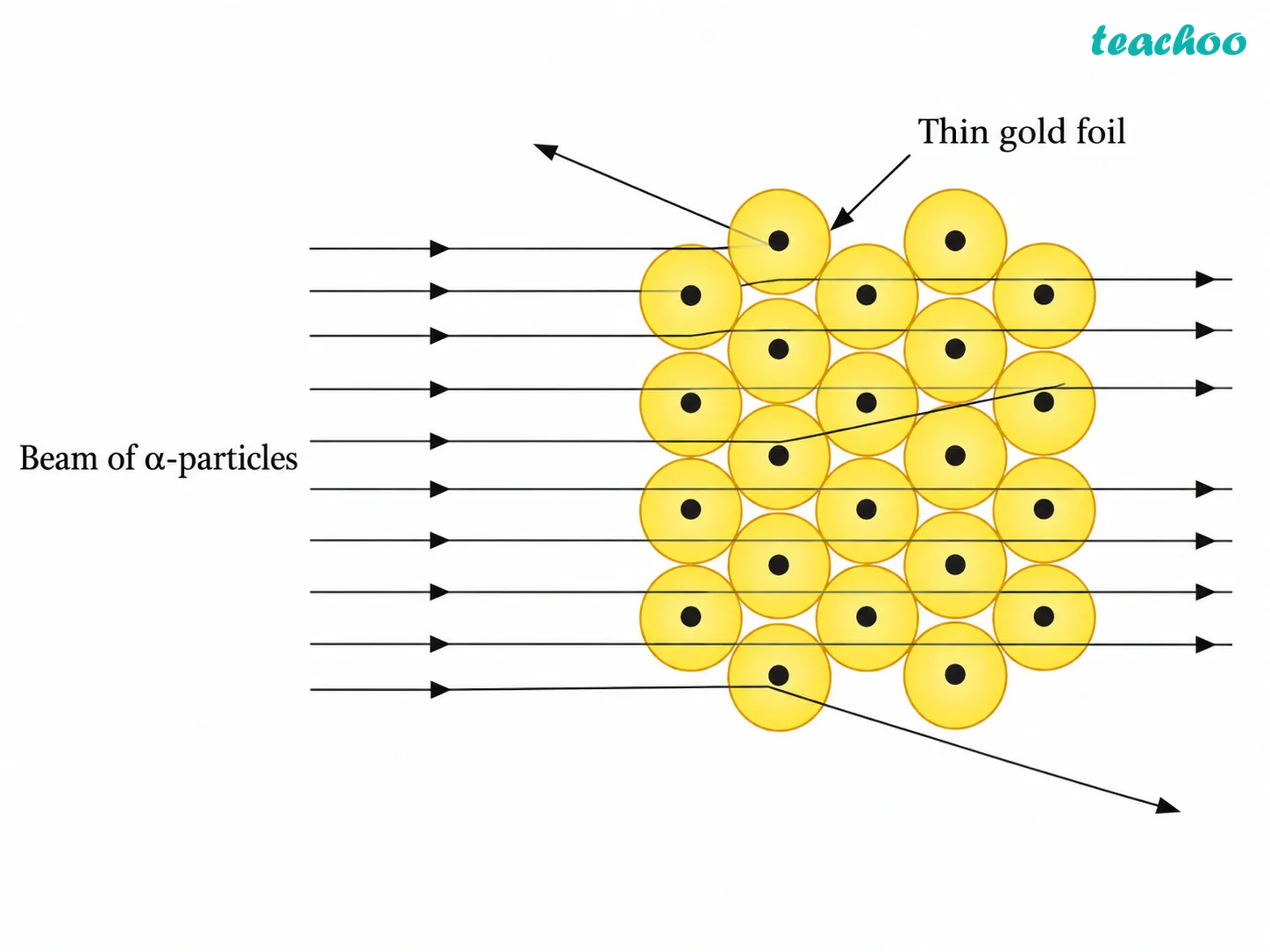
- The gold sheet is called the gold foil . It is so thin that particles can pass through it.
- Around the foil, a screen was kept to see where the particles went after hitting the foil.
- From this, scientists could tell whether the particles went straight , bent , or came back .
What are alpha particles?
- Alpha particles are very tiny particles. Their symbol is α .
- They carry a positive charge, and they come out of some radioactive elements .
-
What is an alpha particle really?
- We know an atom has a nucleus in its centre.
- An alpha particle is the nucleus of a helium atom , that is, a helium atom without its electrons .
- It has 2 protons and 2 neutrons. (We will learn about these particles later in this chapter.)
What did they expect and what actually happened?
-
What they expected
(using Thomson's model)
- In Thomson's model, the positive charge is spread evenly all over the atom.
- Such a weak, spread-out charge cannot push the alpha particles much.
- So the particles should pass straight through , or bend only a little .
- What actually happened
| Observation | How many particles |
|---|---|
| Passed straight through, with no bending | Most of them |
| Bent (deflected) by a large angle | Some |
| Came back towards the source | Very few |
GIF
Watch: what did they expect and what actually happened
- The bending of a particle from its straight path is called scattering .
- So this experiment is also called the α-ray scattering experiment .
Why did Thomson's model fail?
-
Thomson's model could
not
explain two results:
- Why did most particles pass straight through, without any bending?
- Why did some particles bend by a large angle and a few come back ?
- So a new model of the atom was needed.
NCERT Questions
-
🔬 Think as a Scientist
Observe Fig. 8.4 of the gold foil experiment. Predict the observations you would expect if the gold foil in the experiment were made thicker. Also, draw a simple diagram to show the observations you expect.View answer
Answer- A thicker foil has more layers of atoms .
- So an alpha particle now meets more atoms on its way.
- The chance of coming near a heavy positive centre becomes more .
-
So in a thicker foil:
- Fewer particles will pass straight through.
- More particles will be deflected.
- More particles will come back.
-
🤔 Pause and Ponder 4 (Page 144)
What do you think would happen if α-particles were replaced with negatively charged particles in Rutherford's gold foil experiment?View answer
Answer- Alpha particles are positive , so the positive centre of the atom pushes them away .
- A negative particle would instead be pulled towards that positive centre.
- So the particles would bend the other way , towards the centre, not away from it.
- Most particles would still pass through, because the atom is mostly empty space .
📝 Important points — 8.2.2 The Gold Foil Experiment
| Point | What to remember |
|---|---|
| Who and when | Geiger and Marsden, under Rutherford, in 1911 |
| What was used | A beam of alpha particles and a very thin gold foil |
| Alpha particle | A tiny, positively charged particle from a radioactive element |
| Expected result | All particles pass straight or bend only a little |
| Actual result | Most passed straight, some bent a lot, a few came back |
| Scattering | Bending of a particle from its straight path |
| Other name | α-ray scattering experiment |
| Conclusion | Thomson's model could not explain these results |
💡 Worth remembering
- The gold foil was very thin , and the particles used were positive .
- Most particles passed straight through.
- A few came straight back . This was the biggest surprise.
- These results failed Thomson's model and led to a new model .
✅ Quick self-check
-
Which particles were fired in the gold foil experiment?
View Answer
- Alpha particles .
- They are tiny and carry a positive charge.
-
What were the three observations of the experiment?
View Answer
- Most particles passed straight through.
- Some bent by a large angle.
- A few came back towards the source.
-
Why is it also called the α-ray scattering experiment?
View Answer
- The bending of particles from their straight path is called scattering .
- Here alpha (α) particles were scattered by the foil.
- So it is called the α-ray scattering experiment .
Key terms
| Term | Meaning |
|---|---|
| Alpha particle (α) | A tiny positive particle given out by some radioactive elements |
| Gold foil | A very thin sheet of gold used as the target |
| Scattering | Bending of a particle away from its straight path |
| Deflection | Change in the direction of a moving particle |
