
 You are here
What is an Atomic model ?
- An atomic model is a picture or idea of what an atom looks like from inside.
- Nobody can see an atom, so scientists imagined it and made such models.
What does this topic name mean?
- Historical journey means we will see these models one by one , in the order they came.
- Every time a new experiment gave a new result, the old model was changed .
- Main Idea: The early models were not fully correct , but each one took science one step forward .
Is the atom actually the smallest thing in the universe?
- Till the late 19th century , everyone believed that an atom cannot be divided .
-
Then scientists saw something strange in
some elements
.
- These elements give out something on their own , without doing anything to them.
- What comes out? Energy and some tiny particles .
- We cannot see this energy or these particles with our eyes.
- Two names to learn here:
| Word | What it means |
|---|---|
| Radiation | The invisible energy and particles that come out of such elements |
| Radioactivity | The property of these elements, that they keep giving out radiation on their own |
-
Now think
- These tiny particles come out of the atoms of that element.
- So they must have been inside the atom before.
- So the atom is not the smallest particle. There are smaller particles inside it.
- But radioactivity did not tell us which particle is inside the atom.
Which particle was found first inside the atom?
- The first particle inside the atom was found by J. J. Thomson , in an experiment on gases .
-
GIF Watch: which particle was found first inside the atom
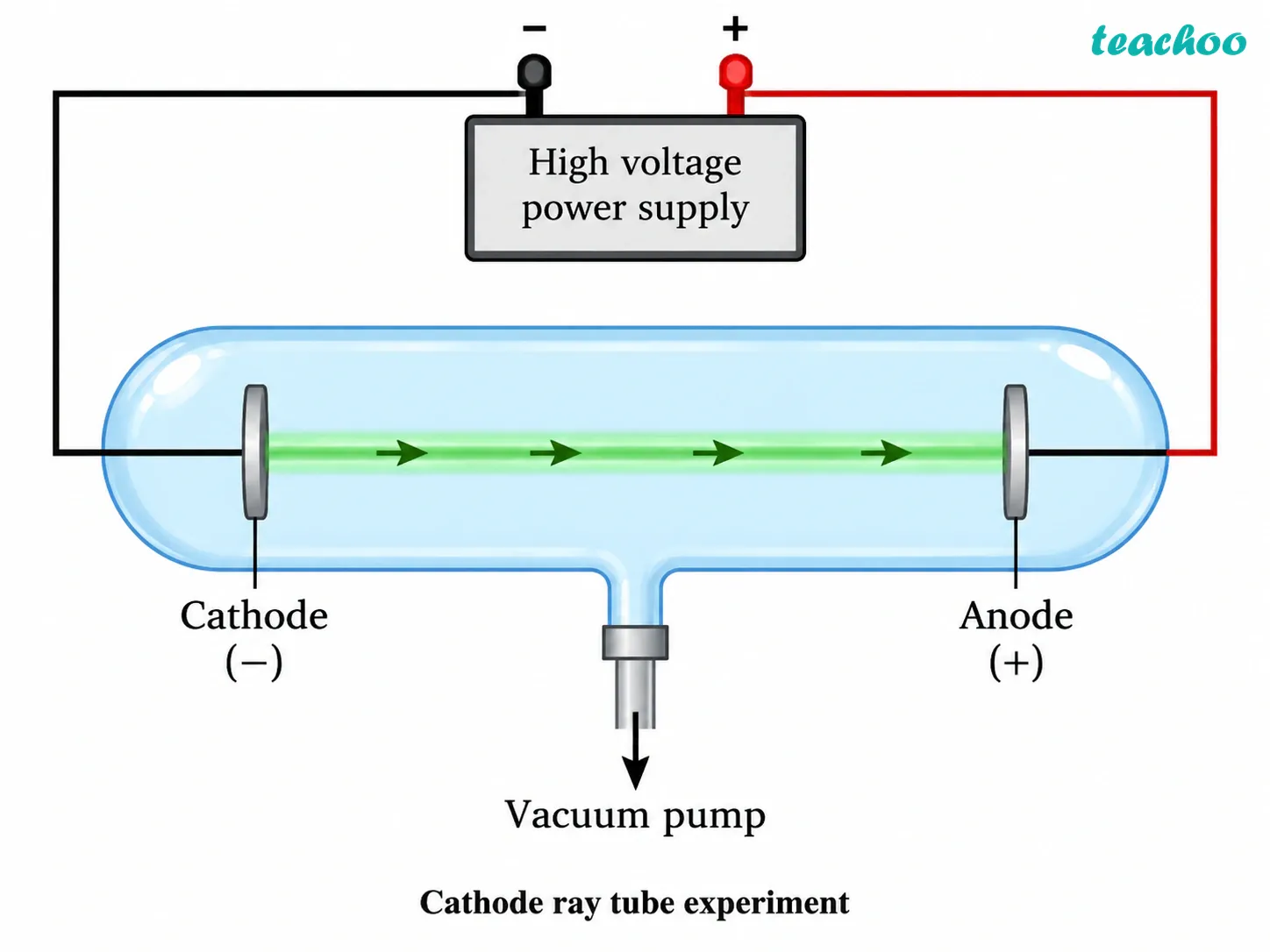
- In 1897 , J. J. Thomson passed electric current through a gas kept at very low pressure .
- He used a cathode ray tube .
| Part | What it is |
|---|---|
| Glass tube | Has a gas at very low pressure |
| Cathode | The negative end (–) |
| Anode | The positive end (+) |
| High voltage supply | Gives a very high voltage to the two ends |
-
What he saw
- Some rays moved from the cathode to the anode .
- These were named cathode rays .
-
GIF Watch: which particle was found first inside the atom
-
What he found
- The rays are a stream of particles with a negative charge .
- He checked these particles are much lighter than an atom.
- These particles were later called electrons .
- So, the electron was the first particle found inside an atom .
Are electrons present in every atom?
- The gas in the tube and the metal of the cathode were changed many times.
- But the cathode rays came out the same every time.
- So the rays do not depend on the gas or the metal used.
- This proves that every atom of every element has electrons .
What is the charge of an electron?
- Charge of an electron = –1.602 × 10⁻¹⁹ C (coulomb)
- This number is very small, so for easy use we simply write it as –1 .
📌 Note
(Page 142)
- Atoms have no colour .
- Colours are used in the diagrams only to make them easy to understand .
📝 Important points — 8.2 A Short Historical Journey Through Atomic Models
| Point | What to remember |
|---|---|
| Atomic model | A picture or idea of how an atom looks |
| Radiation | The invisible energy and tiny particles given out by some elements |
| Radioactivity | The property of such elements, that they give out radiation on their own |
| Cathode ray tube | Glass tube with a gas at very low pressure, a cathode (–), an anode (+) and high voltage |
| Cathode rays | Rays that travel from the cathode to the anode |
| Electron | Negatively charged particle, much lighter than an atom |
| Charge of electron | –1.602 × 10⁻¹⁹ C, written as –1 |
| Proof of electrons in all atoms | Same rays with every gas and every metal |
👩🔬 Meet a Scientist — J. J. Thomson
IMAGE
Photo: J. J. Thomson
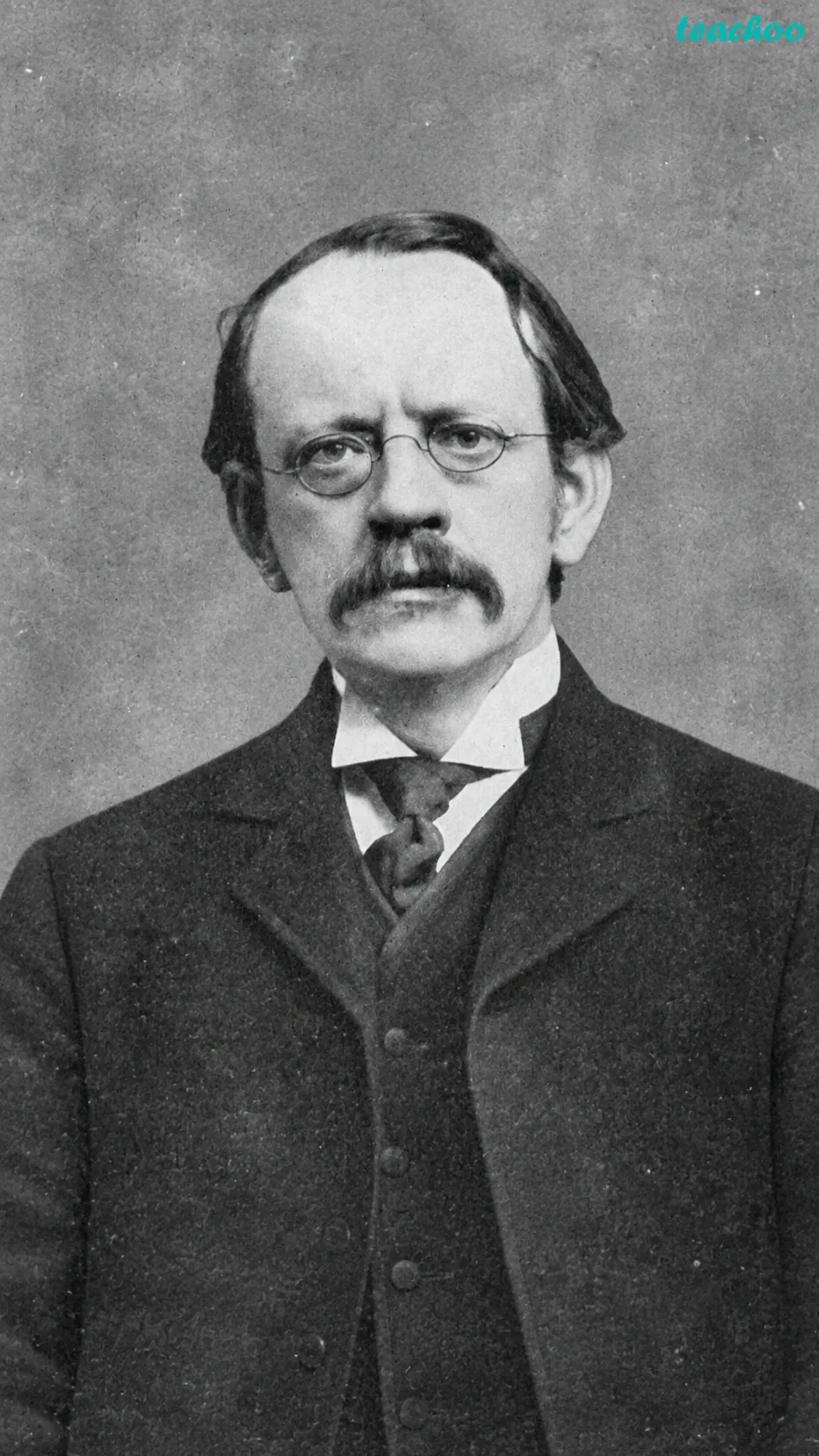
- He discovered the electron , the first particle found inside an atom .
- He got the Nobel Prize in Physics in 1906 .
- He was the head of the famous Cavendish Laboratory , Cambridge.
- He taught and guided many scientists, including Ernest Rutherford .
💡 Worth remembering
- Radioactivity first showed that an atom can be divided .
- Cathode rays move from cathode (–) to anode (+) .
- Electrons are negative and very light .
- Charge of an electron is taken as –1 .
- Electrons are found in all atoms .
✅ Quick self-check
-
Who discovered the electron and in which year?
View Answer
- J. J. Thomson , in 1897 .
- He used a cathode ray tube .
-
In a cathode ray tube, in which direction do the rays move?
View Answer
- From the cathode (–) to the anode (+) .
-
How did radioactivity change our idea of the atom?
View Answer
- Some elements throw out tiny particles on their own.
- These particles come from inside the atom .
- So the atom is not indivisible .
-
What is the charge of an electron?
View Answer
- It is –1.602 × 10⁻¹⁹ C .
- For easy use, we write it as –1 .
Key terms
| Term | Meaning |
|---|---|
| Atomic model | A picture or idea of how an atom looks |
| Radiation | Invisible energy and tiny particles coming out of some elements |
| Radioactivity | The property of giving out radiation on its own |
| Cathode | Negative end (–) |
| Anode | Positive end (+) |
| Cathode rays | Stream of negative particles going from cathode to anode |
| Electron | Negatively charged particle inside an atom, charge taken as –1 |
| Coulomb (C) | The unit of electric charge |
