
 You are here
Who solved the problem of the falling electron?
- We have now met two particles of the atom - the electron and the proton .
-
But one question was still left from Rutherford's model:
- Why does the electron not fall into the nucleus?
- In 1913 , a scientist named Niels Bohr gave a new model of the atom and answered this.
- His main aim was to explain why an atom is stable .
What did Bohr say about the path of electrons?
- Electrons do not move here and there in any way they like.
- Every electron moves in a fixed circular path around the nucleus.
- These fixed paths are called shells .
- They are also called orbits or stationary states .
-
GIF Watch: how are the shells named
- In one shell, an electron has a fixed amount of energy .
- Because of this, shells are also called energy levels .
- An electron can move only in these shells , never in the space between two shells.
How are the shells named?
- The shells are named by letters : K , L , M , N , ...
- They are also named by numbers : n = 1, 2, 3, 4, ...
- K is the first shell, the one closest to the nucleus .
-
GIF Watch: how are the shells named

| Shell | n | Distance from the nucleus | Energy |
|---|---|---|---|
| K | 1 | Nearest | Least |
| L | 2 | Farther | More than K |
| M | 3 | Still farther | More than L |
| N | 4 | Farthest of these | More than M |
- Rule: the farther a shell is from the nucleus, the higher its energy.
- Each shell can hold only a fixed number of electrons. (We will learn this counting in Topic 8.7.)
How does an electron move from one shell to another?
- An electron can jump from one shell to another shell.
- To go to a higher shell, it has to absorb energy.
- To come to a lower shell, it has to release energy.
- The energy absorbed or released is a fixed amount .
- This fixed amount is equal to the difference in energy of the two shells.
How does Bohr's model explain that the atom is stable?
- In Bohr's model, too, the electron revolves around the nucleus, just like in Rutherford's model.
- So why does it not lose energy here?
- Bohr said that these fixed shells are stationary states .
- In a stationary state, the energy of the electron stays the same , even though the electron is moving.
- So the electron does not lose energy , does not spiral in , and does not fall into the nucleus.
- The atom therefore stays stable .
- Note: Bohr did not prove this by an experiment. He assumed it as a rule, called a postulate .
- This model explained many experiments correctly and was a big step forward in understanding the atom.
| Rutherford's model | Bohr's model | |
|---|---|---|
| Path of electron | Circular path around the nucleus | Circular path around the nucleus |
| Are the paths fixed? | No , any path | Yes , only fixed shells |
| Energy of electron | Keeps decreasing | Stays constant in a shell |
| What should happen | Electron falls into the nucleus | Electron keeps revolving |
| Stability of atom | Could not explain | Explained |
🧵 Threads of Curiosity
(Page 146)
Why are Bohr's shells called K, L, M, N and not A, B, C, D?
- The names came from X-ray experiments done by the physicist Charles Barkla .
- He named the first X-ray line he saw as K .
- He did not begin from A , because he wanted to keep the earlier letters free , in case some series was found before K later on.
- No such earlier series was ever found.
- Bohr used the same letters for the shells of the atom.
📈 Next Level Up
(Page 146)
- Later, even Bohr's model was found to have some limitations .
- So one more model was given, the quantum mechanical model .
- We will study it in higher classes .
-
📋 Revise, Reflect, Refine, Q2
Which of the following statements are correct or incorrect according to the Bohr's atomic model? Give a reason for each statement.
(i) Electrons lose energy while moving in fixed orbits and slowly fall into the nucleus.
(ii) Electrons can exist anywhere around the nucleus with no fixed energy.
(iii) Electrons revolve around the nucleus in orbits of fixed energy without losing energy.
(iv) Electrons can be found between energy levels as they move around the nucleus.View answer
Answer- Correct statement: (iii) only
Statement Correct or incorrect Reason (i) Incorrect In a fixed shell the electron does not lose energy, so it does not fall into the nucleus. (ii) Incorrect An electron cannot be anywhere. It stays only in fixed shells , and each shell has a definite energy . (iii) Correct This is exactly what Bohr said - the electron revolves in a shell of fixed energy without losing energy. (iv) Incorrect Electrons move only in the allowed shells, never in the space between two shells.
-
📋 Revise, Reflect, Refine, Q10
Both Rutherford's and Bohr's models have electrons orbiting the nucleus. Why did Rutherford's model fail to explain atomic stability, while Bohr's model succeeded?View answer
Answer-
In Rutherford's model:
- The electron moves in a circle, so it is accelerating .
- An accelerating charged particle must lose energy .
- On losing energy it should spiral in and fall into the nucleus.
- Then the atom would collapse , but real atoms do not. So the model failed .
-
In Bohr's model:
- The electron can revolve only in certain fixed shells , called stationary states .
- In a stationary state its energy stays constant .
- So it loses no energy and never spirals in.
- The atom stays stable . So this model succeeded .
-
In Rutherford's model:
📝 Important points — 8.2.3 Bohr's Model of the Atom
| Point | What to remember |
|---|---|
| Year and scientist | 1913 , Niels Bohr |
| Aim of the model | To explain the stability of the atom |
| Shells | Fixed circular paths of electrons; also called orbits, stationary states or energy levels |
| Names of shells | K, L, M, N or n = 1, 2, 3, 4 |
| Lowest energy shell | K (n = 1), nearest to the nucleus |
| Energy order | Energy increases as we go away from the nucleus |
| Jumping shells | Electron absorbs energy to go up, releases energy to come down |
| Stationary state | A shell in which the electron's energy stays constant |
👩🔬 Meet a Scientist — Niels Bohr
IMAGE
Photo: Niels Bohr
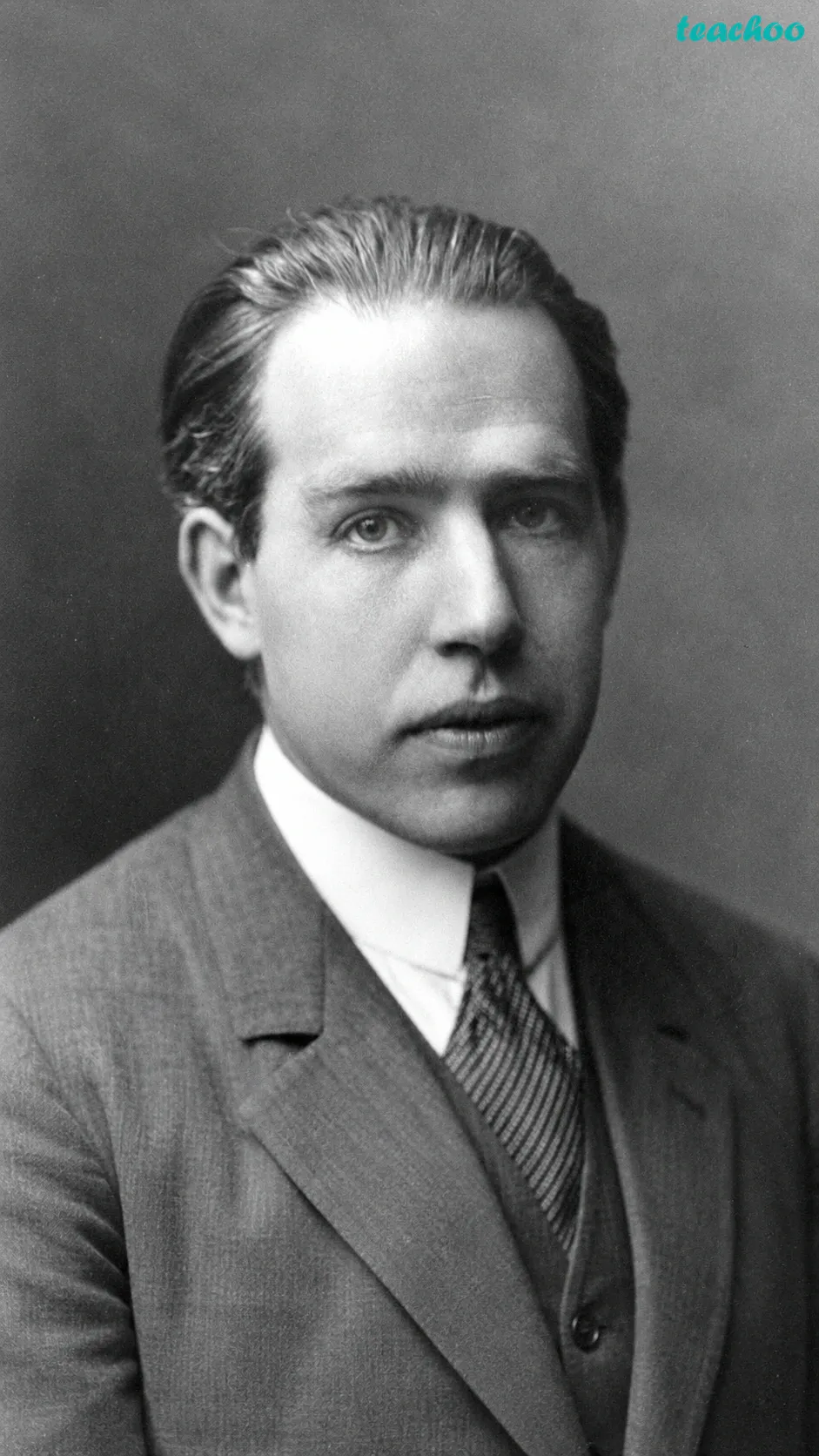
- He was a professor of physics at Copenhagen University , Denmark .
- He wanted to know how atoms exist, because the older models could not explain why electrons stay around the nucleus without collapsing.
- His explanation made the structure of the atom much clearer.
- He received the Nobel Prize in 1922 for his work on the structure of the atom.
💡 Worth remembering
- Electrons move only in fixed shells , not anywhere they like.
- Shell names: K, L, M, N = n = 1, 2, 3, 4 .
- K shell is nearest to the nucleus and has the least energy.
- In a shell, the electron does not lose energy . This is why the atom is stable .
- Energy is absorbed to jump up and released to come down.
✅ Quick self-check
-
Who gave the shell model of the atom, and in which year?
View Answer
- Niels Bohr , in 1913 .
- He gave it to explain why an atom is stable .
-
What are stationary states?
View Answer
- They are the fixed shells in which electrons revolve.
- In a stationary state, the energy of the electron does not change .
-
Which shell has the least energy, and why?
View Answer
- The K shell (n = 1).
- It is the closest to the nucleus, and energy increases as we move away from the nucleus.
-
What must an electron do to jump from the K shell to the L shell?
View Answer
- It must absorb energy.
- The energy absorbed is a fixed amount , equal to the difference in the energies of the K and L shells.
Key terms
| Term | Meaning |
|---|---|
| Shell (orbit) | A fixed circular path in which an electron revolves around the nucleus |
| Energy level | Another name for a shell, because each shell has a fixed energy |
| Stationary state | A shell in which the electron's energy remains constant |
| Postulate | A statement assumed to be true, without proof |
| Quantum mechanical model | The newer model of the atom, studied in higher classes |
