
 You are here
What did Rutherford conclude from the experiment?
- The results of the gold foil experiment did not match Thomson's model.
- So Rutherford thought again about how an atom must be built , and each result gave him a clue.
| What was seen | What it means |
|---|---|
| Most particles passed straight through | Most of the atom is empty space |
| Some particles bent by a large angle | There is something positive inside that pushes them away |
| A few came back | That positive part is very heavy and packed in a very small space |
- Rutherford called this small, heavy, positive centre the nucleus .
What is Rutherford's model of an atom?
- The atom has a tiny nucleus at its centre .
- The nucleus is heavy (it has most of the mass of the atom) and carries all the positive charge .
- Most of the atom is empty space .
- Electrons revolve around the nucleus.
-
This looks like
planets moving around the Sun
.
- So it is also called the planetary model of the atom.
-
GIF Watch: what is Rutherford's model of an atom
How small is the nucleus?
- Diameter of an atom ≈ 10⁻¹⁰ m
- Diameter of the nucleus ≈ 10⁻¹⁵ m
- So the nucleus is about 1 lakh (10⁵) times smaller than the atom.
-
Example
- Suppose an atom is as big as a cricket ground , about 100 m across .
- Then the nucleus would be like a grain of black pepper , only a few mm wide, kept at the centre.
- The rest of the ground would be empty .
NCERT Questions
-
🤔 Pause and Ponder 5 (Page 144)
Rutherford found that a few α-particles bounced back sharply. How does this single surprising result completely rule out Thomson's 'plum pudding model' of the atom?View answer
Answer- In Thomson's model, the positive charge is spread all over the atom.
- Such a spread-out charge is weak at every point.
- A fast, heavy alpha particle can never be pushed back by such a weak force.
- But a few particles did come back.
- So there must be something small , heavy and strongly positive inside the atom.
- Thomson's model has no such part, so this model is wrong .
-
🤔 Pause and Ponder 6 (Page 144)
If you could ask Rutherford one question about his work, what would it be?View answer
Answer- This question has no single right answer . Any good question is fine.
- Sample question: "When a few particles came back, did you think your experiment had gone wrong?"
- Another sample: "If the nucleus is so small, what keeps the electrons from falling into it?"
-
📋 Revise, Reflect, Refine, Q1
Choose the correct options and explain the reason for the correct and incorrect options in the context of Ernest Rutherford's gold foil experiment:
(i) The experiment clearly showed the existence of neutrons in the nucleus.
(ii) The results disproved the plum pudding model and led to the idea of a nucleus at the centre of the atom.
(iii) The large deflection of a few alpha particles indicated that most of the mass of the atom and positive charge are packed into a tiny centre.
(iv) The way alpha particles were deflected showed that electrons move around the nucleus.View answer
Answer- Correct options: (ii) and (iii)
Option Correct or wrong Reason (i) Wrong The neutron was found much later, by Chadwick in 1932. This experiment said nothing about neutrons. (ii) Correct Thomson's model could not explain the results, so it was rejected and the idea of a nucleus came. (iii) Correct Only a small, heavy, positive centre can push back a fast alpha particle. (iv) Wrong The bending happened because of the positive nucleus . Electrons are too light to bend an alpha particle.
-
📋 Revise, Reflect, Refine, Q4
What conclusion did Rutherford draw about the position and characteristics of the atom's positively charged part based on the few alpha particles that bounced back or were deflected at large angles in the gold foil experiment?View answer
Answer- Position : the positive charge is not spread all over. It is at the centre of the atom, in a very small space called the nucleus .
-
Characteristics
:
- It is very small in size.
- It is dense and heavy , having most of the mass of the atom.
- It carries the whole positive charge of the atom.
🚀 Ready to Go Beyond
Can you calculate how many atoms would be needed to make a sheet of paper that is 0.1 mm thick, like the one in your textbook?
Answer
- Thickness of the paper = 0.1 mm = 10⁻⁴ m
- Diameter of one atom = 10⁻¹⁰ m
- Number of atoms = 10⁻⁴ ÷ 10⁻¹⁰ = 10⁶
- So about one million (10 lakh) atoms are stacked one above another in the thickness of a single page.
📝 Important points — 8.2.2 A Rutherford's Model of an Atom
| Point | What to remember |
|---|---|
| Nucleus | Small, heavy, positive centre of the atom |
| Empty space | Most of the atom is empty |
| Electrons | Revolve around the nucleus |
| Other name | Planetary model |
| Diameter of atom | About 10⁻¹⁰ m |
| Diameter of nucleus | About 10⁻¹⁵ m, that is 1 lakh times smaller than the atom |
👩🔬 Meet a Scientist — Ernest Rutherford
IMAGE
Photo: Ernest Rutherford
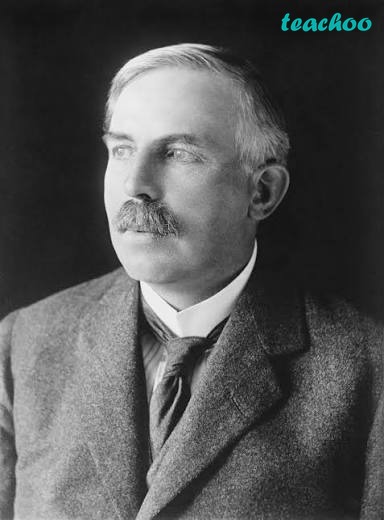
- He was born in New Zealand and came to Cambridge to work with J. J. Thomson .
- He is known as the Father of Nuclear Physics .
- He discovered the nucleus of the atom and explained how some elements break down on their own.
- He won the Nobel Prize in Chemistry in 1908 .
- In 1911 , he gave the nuclear model of the atom.
- His picture is printed on the $100 note of New Zealand .
💡 Worth remembering
- Most of the atom is empty space .
- All the positive charge and almost all the mass are in the nucleus .
- Electrons move around the nucleus, like planets around the Sun.
- The nucleus is about 1 lakh times smaller than the atom.
✅ Quick self-check
-
What is the nucleus of an atom?
View Answer
- It is the centre of the atom.
- It is very small , very heavy , and has all the positive charge .
-
Which observation showed that an atom is mostly empty?
View Answer
- Most of the alpha particles passed straight through the foil.
- They met nothing on the way, so the atom must be mostly empty space .
-
Why is Rutherford's model called the planetary model?
View Answer
- In it, electrons revolve around the nucleus.
- This is like planets revolving around the Sun .
Key terms
| Term | Meaning |
|---|---|
| Nucleus | The small, heavy, positively charged centre of an atom |
| Planetary model | Rutherford's model, in which electrons revolve around the nucleus |
| Dense | Having a lot of mass packed in a small space |
