
 You are here
What are elements?
- An element is a pure substance that is made of only one kind of atom .
- Every atom in an element is the same as the other atoms of that element.
- Atoms of one element are different from atoms of another element .
- Examples - oxygen , iron , gold , carbon , sodium .
- Today we know about 118 elements.
How are elements different from atoms?
-
Think of a packet of
Cadbury Gems
.
- One single gem = one atom .
- A packet that has only orange gems = an element (only one kind of gem).
- A packet with orange, green, red and yellow gems mixed = not an element.
- So an atom is a single particle , and an element is the whole substance made of many atoms of the same kind .
| Atom | Element | |
|---|---|---|
| Meaning | The smallest particle of matter | A pure substance made of only one kind of atom |
| What it is | One single particle | Many atoms of the same kind together |
| Can we see it? | No , it is too small | Yes , we can see and hold it |
| Example | One atom of oxygen ( O ) | Oxygen gas , iron , gold |
| Gems example | One single gem | A packet of only orange gems |
Names of some common elements and their symbols
| Name of the element | Symbol | Name of the element | Symbol | Name of the element | Symbol |
|---|---|---|---|---|---|
| Aluminium | Al | Copper (Cuprum) | Cu | Nitrogen | N |
| Argon | Ar | Fluorine | F | Oxygen | O |
| Barium | Ba | Gold (Aurum) | Au | Potassium (Kalium) | K |
| Boron | B | Hydrogen | H | Silicon | Si |
| Bromine | Br | Iodine | I | Silver (Argentum) | Ag |
| Calcium | Ca | Iron (Ferrum) | Fe | Sodium (Natrium) | Na |
| Carbon | C | Lead (Plumbum) | Pb | Sulfur | S |
| Chlorine | Cl | Magnesium | Mg | Uranium | U |
| Cobalt | Co | Neon | Ne | Zinc | Zn |
(Table 8.2, page 149)
Which authority approves the names and symbols of elements?
- The IUPAC approves the names and symbols of all elements.
- Full form - International Union of Pure and Applied Chemistry .
- It is an international scientific organisation .
- So no scientist can give a symbol on his own. IUPAC decides it, and the whole world follows it.
What are the rules for writing symbols?
| Rule | Example element | Symbol |
|---|---|---|
| Many symbols are the first letter of the name | Hydrogen | H |
| Some are the first two letters of the name | Aluminium | Al |
| The first letter is capital , the second letter is small | Cobalt | Co (not CO) |
| Some are the first letter + another letter of the name (not the second one) | Chlorine | Cl |
| Zinc | Zn | |
| Some come from the Latin name | Iron ( ferrum ) | Fe |
| Some come from the Greek name | Mercury ( hydrargyros ) | Hg |
| Some come from the German name | Tungsten ( wolfram ) | W |
- Remember: writing AL for aluminium or CO for cobalt is wrong .
What is the benefit of using symbols instead of full names?
- Symbols are short , so writing becomes quick and easy .
- Symbols are recognised all over the world .
- A scientist in any country reads the same symbol in the same way .
- So there is no language problem between scientists of different countries.
- Writing chemical formulas and equations also becomes simple .
History and timeline of the symbols of elements
- John Dalton felt that elements and compounds should be written in one standard way , so that chemistry becomes easier to study.
-
In
1803
, he gave the
first symbols
. These were
pictures
, not letters - small drawings for each element.
- He gave such picture symbols for hydrogen, carbon, oxygen, phosphorus, sulphur, iron, copper, lead, silver, gold, platina and mercury.
-
GIF Watch: other points
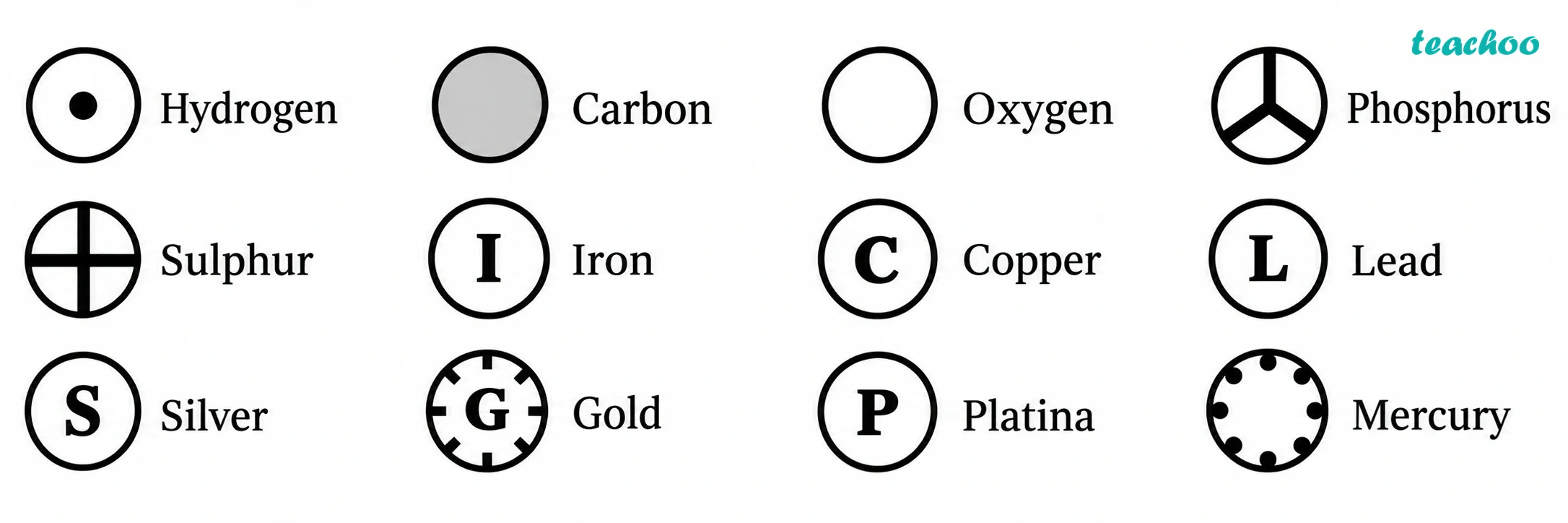
- But pictures were hard to draw and hard to remember .
- In 1813 , Berzelius gave a better idea. He said the symbol of an element should be taken from its Latin name .
- In this way, the letter symbols that we use today came into use.
- Today , the IUPAC approves the names and the symbols of all elements.
Other points
- By 1869 , scientists knew about 69 elements .
- Most of these were found naturally on the Earth .
- Today we know about 118 elements .
- Some of them are made artificially , and the search for new elements is still going on .
NCERT Questions
-
🤔 Pause and Ponder 8 (Page 149)
Imagine you are a scientist who has discovered a new element. Name this element after yourself and justify that the symbol you have chosen follows the IUPAC rules.View answer
Answer- This answer can be different for every student . Any name is fine if the symbol follows the rules.
-
Sample answer:
- Name of the element - Meeraium
- Symbol chosen - Me
-
Why this symbol follows the IUPAC rules:
- It is made from the first two letters of the name.
- The first letter is capital and the second letter is small .
- It is short and easy to write.
- It is not already used for any other element.
-
🤔 Pause and Ponder 9 (Page 149)
What problems could arise if every scientist used different symbols for the same element?View answer
Answer- The same element would have many different symbols , so there would be confusion .
- One scientist would not understand what another scientist has written.
- The same symbol could mean two different elements , which can cause serious mistakes in a laboratory.
- Chemical formulas and equations would be read wrongly.
- Sharing research between countries would become very difficult .
- This is why we need one common set of symbols approved by IUPAC .
📝 Important points — 8.4 Symbols of Elements
| Point | What to remember |
|---|---|
| Element | A pure substance made of only one kind of atom |
| Elements known today | 118 |
| Elements known in 1869 | About 69 |
| First symbols | Pictures , given by John Dalton in 1803 |
| Letter symbols | Idea given by Berzelius in 1813 , from Latin names |
| Who approves symbols today | IUPAC |
| Capital and small letters | First letter capital , second letter small (Al, Co) |
| Symbols from other languages | Fe (Latin), Hg (Greek), W (German) |
💡 Worth remembering
- Atom = one particle; element = the whole substance made of the same atoms.
- Symbols of elements are approved by IUPAC .
- First letter capital , second letter small . So Co , never CO .
- Some symbols do not match the English name - Fe, Hg, W, Na, K, Ag, Au, Pb, Cu .
- Symbols are used because they are short and understood worldwide .
✅ Quick self-check
-
Who gave the first symbols of elements, and in which year?
View Answer
- John Dalton , in 1803 .
- His symbols were pictures , not letters.
-
Why is the symbol of cobalt written as Co and not CO?
View Answer
- The rule is that the first letter of a symbol is capital and the second letter is small .
- Also, CO would be read as carbon monoxide , which is a compound, not cobalt.
-
Why is the symbol of iron Fe and not Ir?
View Answer
- The symbol is taken from the Latin name of iron, which is ferrum .
- So it is written as Fe .
-
Who decides the names and symbols of new elements?
View Answer
- IUPAC - the International Union of Pure and Applied Chemistry.
Key terms
| Term | Meaning |
|---|---|
| Element | A pure substance made of only one kind of atom |
| Symbol | The short letter form used to represent an element |
| IUPAC | The international body that approves the names and symbols of elements |
| Berzelius | The scientist who suggested letter symbols taken from Latin names (1813) |
| Latin name | The old name of an element from which many symbols are made, such as ferrum for iron |
