
 You are here
What puzzle did Thomson face after discovering the electron?
- Thomson found that every atom has electrons , which have a negative charge.
- But an atom as a whole has no charge . It is neutral .
-
So think
- There must be something positive inside the atom too.
- Only then can the two charges cancel out and make the atom neutral.
- So the question was: where is this positive charge in the atom?
- To answer this, Thomson gave his own model of the atom .
What is Thomson's model of an atom?
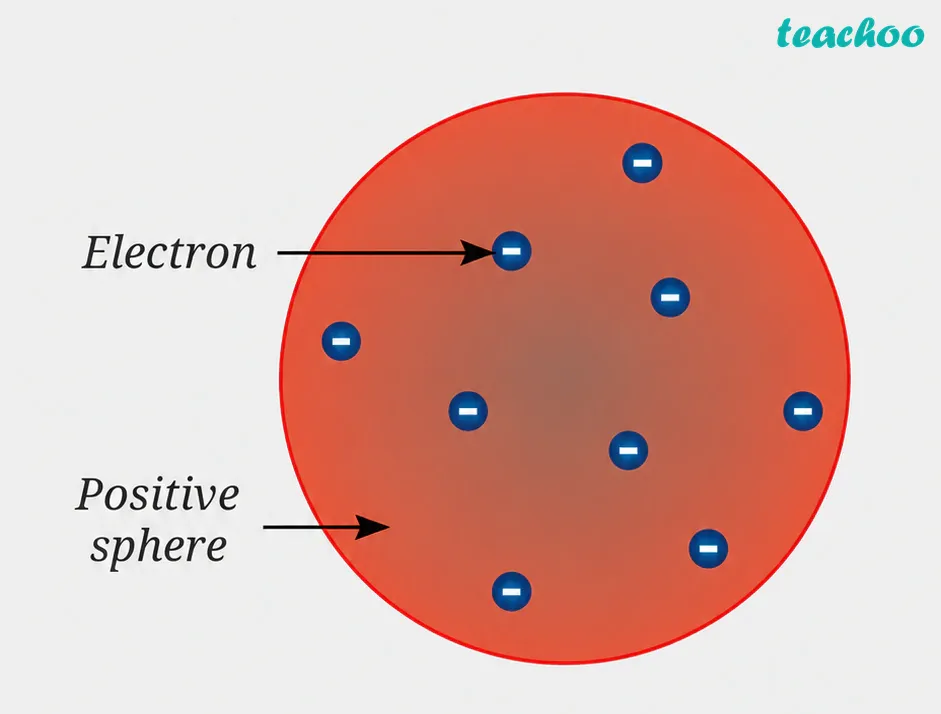
- Thomson said the atom is a ball of positive charge .
- The electrons are fixed inside this ball, spread all over it.
- The positive charge and the negative charge are equal , so the atom is neutral .
-
GIF Watch: what is Thomson's model of an atom
-
His atom looked like a
pudding
with
plums
fixed inside it.
- So this model is also called the plum pudding model .
- An easier picture for us is a watermelon .
-
GIF Watch: what is Thomson's model of an atom
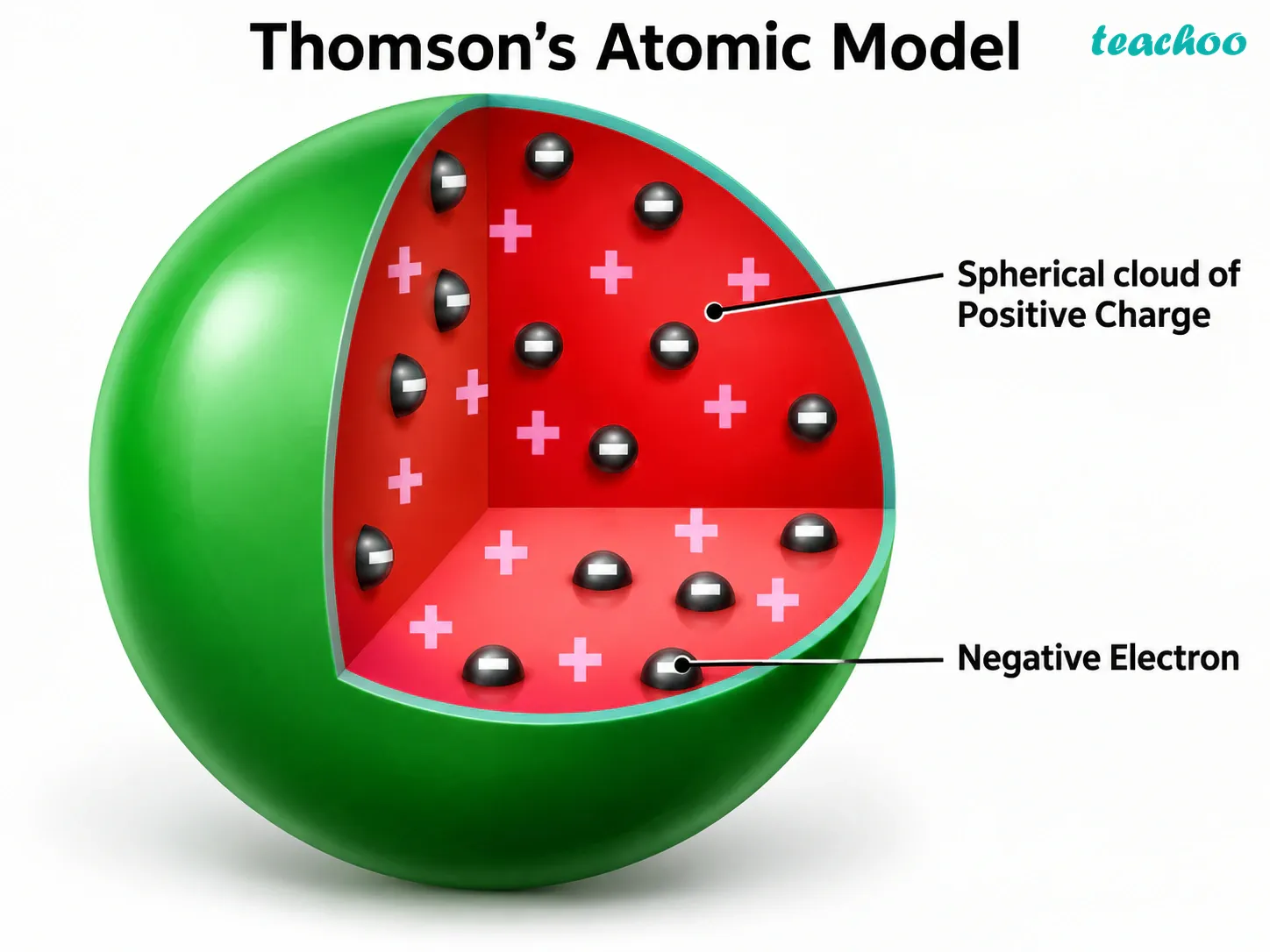
| In the watermelon | In the atom |
|---|---|
| Red pulp | The positive charge , spread everywhere |
| Seeds in the pulp | The electrons , spread inside |
- This model was changed later , but it was the first try to explain how the positive and negative charges in an atom stay balanced .
NCERT Questions
-
🤔 Pause and Ponder 1 (Page 143)
Suppose you made up your own 'atom', as Thomson described, using clay for the positive charge and small beads for the electrons spread through it. What will happen if:
(i) the positive charge on the clay is lesser than the total negative charge of the beads?
(ii) by mistake, the clay itself carries a bit of negative charge? Would your model still represent a neutral atom?View answer
Answer- Here, clay = positive charge and beads = electrons .
-
(i)
Positive charge is
less
than the negative charge of the beads.
- The negative charge is not fully cancelled.
- So the model has extra negative charge and is not neutral .
-
(ii)
The clay itself is
negative
.
- Now there is no positive charge left to cancel the beads.
- The whole model becomes negative .
- So it does not show a neutral atom.
-
🤔 Pause and Ponder 2 (Page 143)
Could an orange or a lemon, which also contain seeds inside soft pulp, be a good comparison? In what ways does it match Thomson's idea and where does it fall short?View answer
Answer-
It matches because
- It is round , like the atom.
- The pulp can show the positive charge .
- The seeds can show the electrons .
-
It falls short because
- The seeds sit only in the middle , not spread all over.
- The pulp is in separate pieces , but the positive charge in the atom is spread evenly .
- The seeds are few and big , but electrons are many and very light .
-
It matches because
-
🤔 Pause and Ponder 3
Why did Thomson conclude that electrons are present in all atoms?View answer
Answer- He changed the gas in the tube and the metal of the cathode.
- Still, the same cathode rays were formed every time.
- So these particles do not come from one special gas or metal.
- They come from every kind of atom .
- So electrons are present in all atoms .
📝 Important points — 8.2.1 Thomson's Model of an Atom
| Point | What to remember |
|---|---|
| Problem | Atoms have negative electrons, but the atom is neutral |
| Thomson's model | A ball of positive charge with electrons fixed inside it |
| Why neutral | Positive charge = negative charge |
| Other names | Plum pudding model, watermelon picture |
| Importance | First try to explain how the charges in an atom are balanced |
💡 Worth remembering
- In Thomson's atom, the positive charge is spread everywhere , not at one place.
- Pudding = positive charge , plums = electrons .
- Watermelon pulp = positive charge , seeds = electrons .
✅ Quick self-check
-
In Thomson's model, where are the electrons?
View Answer
- The atom is a ball of positive charge .
- The electrons are spread inside this ball.
-
Why is the atom neutral in this model?
View Answer
- The positive charge of the ball is equal to the negative charge of all the electrons.
- Equal and opposite charges cancel out , so the atom has no charge .
-
In the watermelon picture, what do the seeds show?
View Answer
- The seeds show the electrons .
- The red pulp shows the positive charge .
Key terms
| Term | Meaning |
|---|---|
| Neutral atom | An atom with no charge, because positive charge = negative charge |
| Plum pudding model | Thomson's model: electrons fixed inside a ball of positive charge |
