
 You are here
What we will learn here?
-
![6.7 Forces Acting on a System of - How Forces Affect Moti - [Teachoo] - Concepts](https://cdn.teachoo.com/03c8c7be-d9b2-42f9-a7e9-a548435ac147/sys-why-a-system.gif) GIF Watch: till now we studied Newton's three laws for one single object
GIF Watch: till now we studied Newton's three laws for one single object - Till now we studied Newton's three laws for one single object.
- Now we will learn how to apply the same three laws to two or more objects connected together.
Example
- While walking, our arms and legs move in a complex manner.
- Studying each part separately is very difficult.
- But the overall motion of the person can be studied easily by treating the whole body as one single object.
Main Idea:
Science often becomes simpler when we stop looking at the parts and start looking at the whole.
- The same idea is used for objects joined together. This is called the system method.
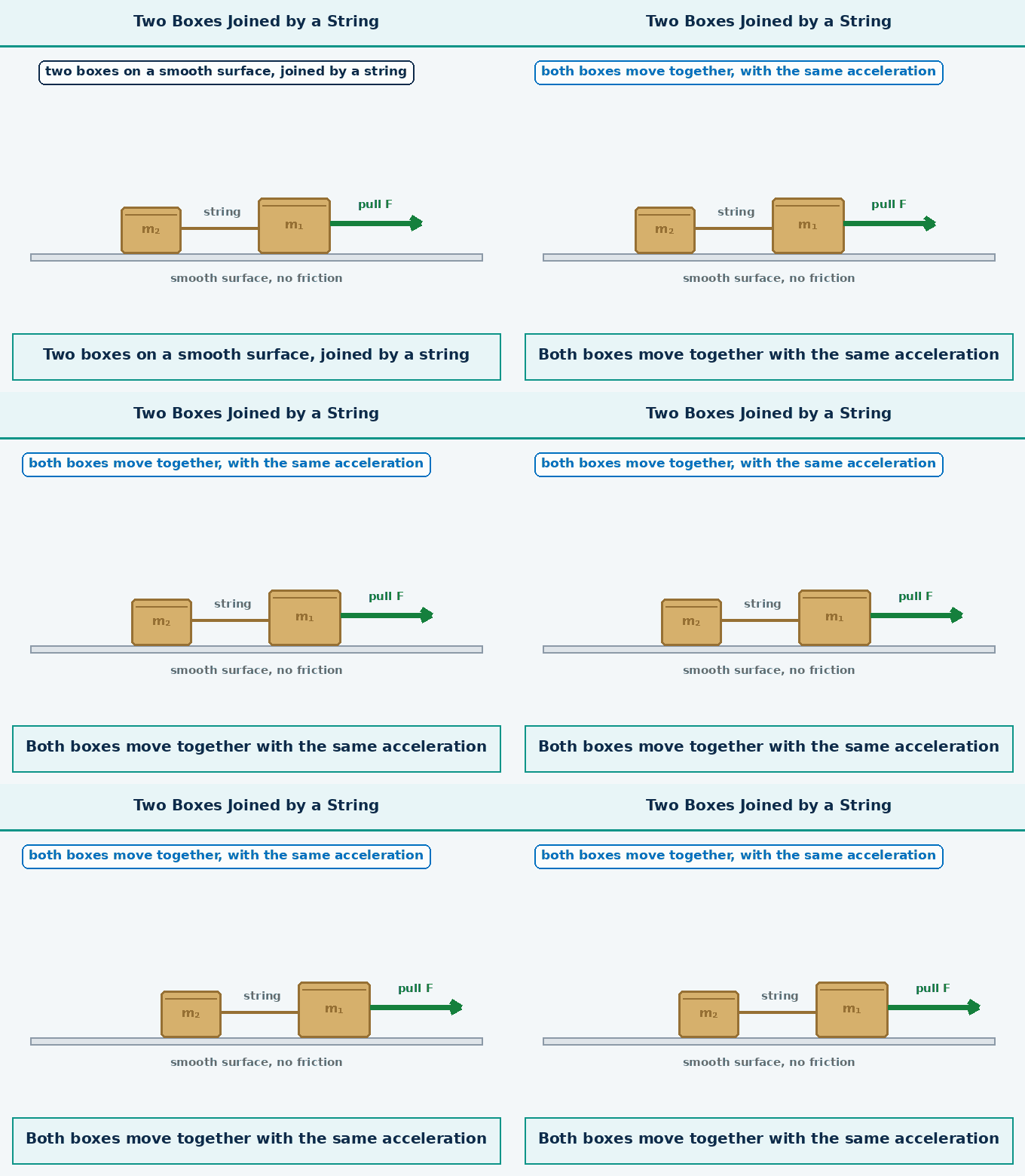
Let us understand the concept with an example in Fig. 6.34
Two boxes joined by a string
What do we have?
- Two boxes of masses m₁ and m₂
- A smooth (frictionless) horizontal surface
- A string joining the two boxes
What do we do?
- Place both boxes on the surface and join them with the string.
- Pull Box 1 towards the right with a force F.
What do we observe?
- Both boxes move together towards the right.
- They move with the same acceleration, because the string does not let them separate.
What does this tell us?
- Box 1 pulls Box 2 through the string, and by Newton's third law Box 2 pulls Box 1 back with an equal and opposite force.
- This force in the string is called tension (T).
- Since both boxes always move together, we can treat them as one single object — just like the walking person.
Which forces are acting on the two boxes?
| Object | Forces on it |
|---|---|
| Box 1 | Force F towards the right, tension T towards the left |
| Box 2 | Tension T towards the right |
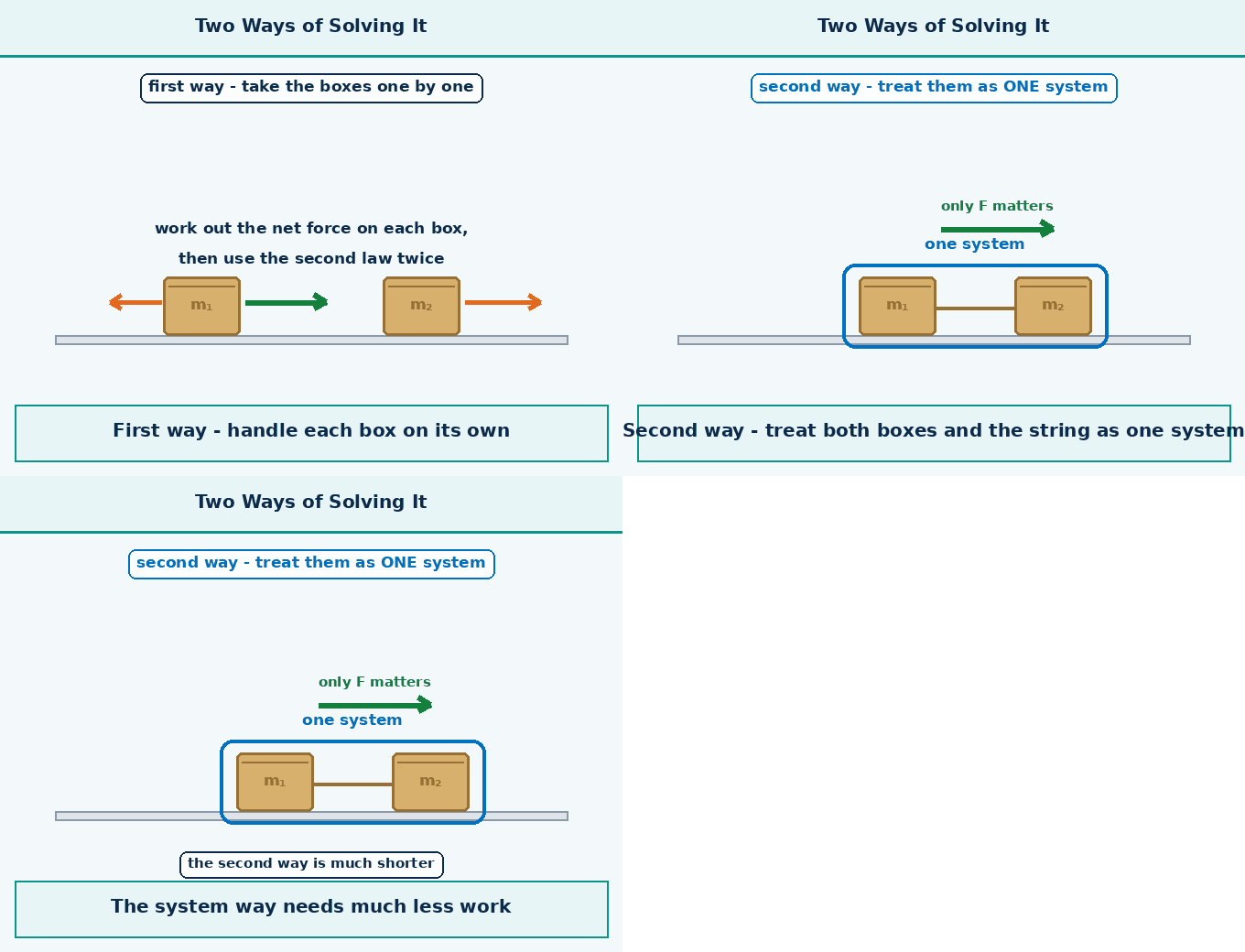
What are the two ways of solving this?
-
 GIF
Watch: first way - find the net force on each box separately, then apply Newton's second
GIF
Watch: first way - find the net force on each box separately, then apply Newton's second
- First way — find the net force on each box separately, then apply Newton's second law to each box.
- Second way (simpler) — treat Box 1, the string and Box 2 together as one system.
What is a system?
- A system means two or more objects taken together and treated as a single object.
- Here the system is Box 1 + string + Box 2.
Which internal and external forces are acting?
| Type | Meaning | In our example |
|---|---|---|
| Internal force | Force acting inside the system, between its own parts | The tension T |
| External force | Force acting on the system from outside | The pull F |
- In the system method, internal forces need not be considered.
- Only external forces matter.
Forces acting on the two boxes joined by a string
which of them decide the motion?
Internal force
Acts inside the system, between its own parts
Not counted
Example:
The tension T in the string
External force
Acts on the system from outside
Counted
Example:
The pull F on Box 1
What is the acceleration of the system?
-
Applying Newton's second law to the whole system:
a = F / (mass of the system) = F / (m₁ + m₂) - So the system moves just like a single object of mass m₁ + m₂.
- Solving the two boxes one by one gives exactly the same answer, but with longer working.
a
=
F
mass of the system
a
=
F
m₁ + m₂
The system moves just like a single object of mass m₁ + m₂
Example 1
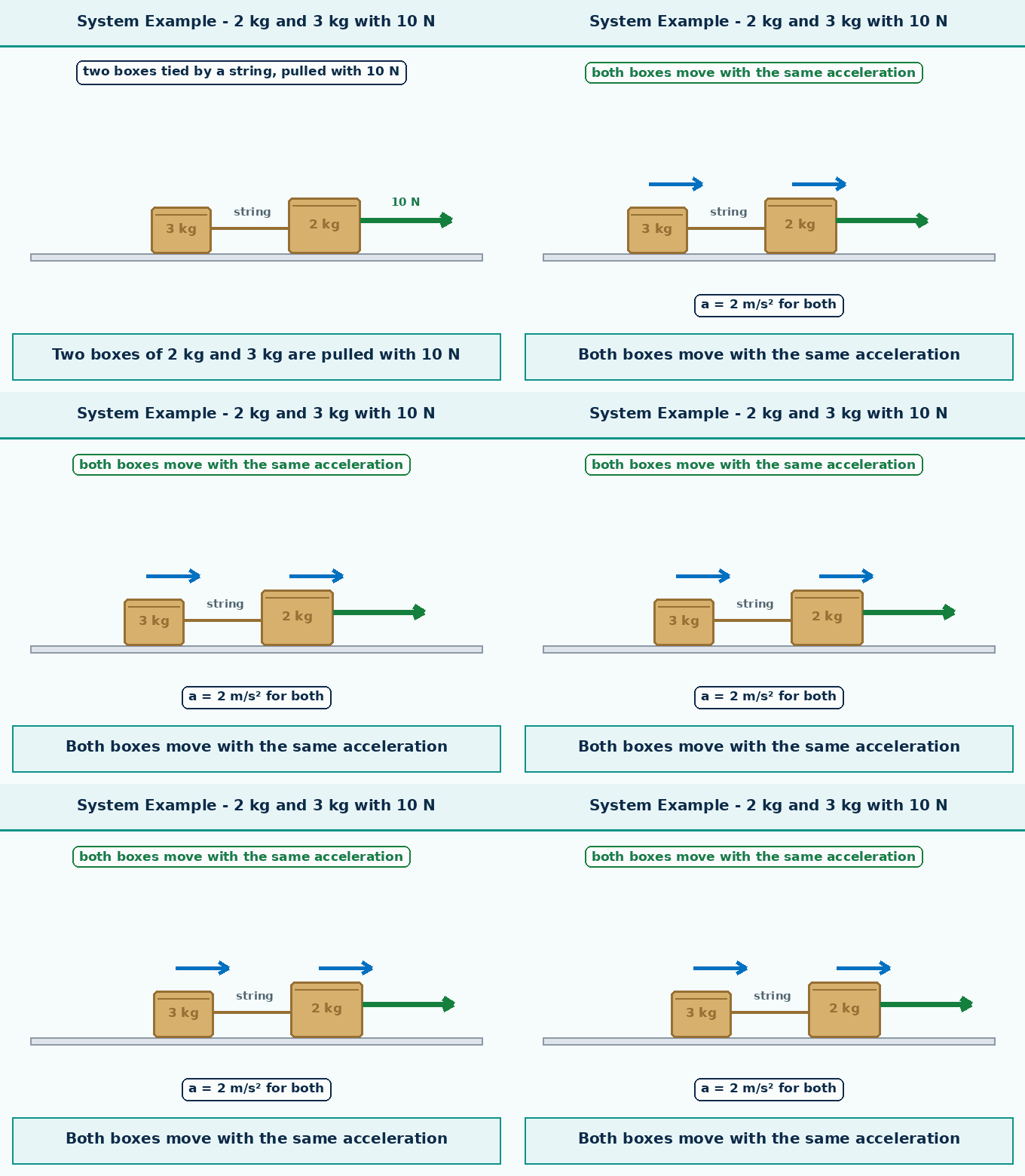
Two boxes of masses 2 kg and 3 kg tied by a string are pulled with a force of 10 N on a smooth surface. Find the acceleration.
-
 GIF
Watch: two boxes of masses 2 kg and 3 kg tied by a string are pulled with a force of 10
GIF
Watch: two boxes of masses 2 kg and 3 kg tied by a string are pulled with a force of 10
- Mass of the system = 2 kg + 3 kg = 5 kg
- a = F / (m₁ + m₂)
- a = 10 N / 5 kg
- a = 2 m s⁻²
- Both boxes move with this same acceleration.
Example 2
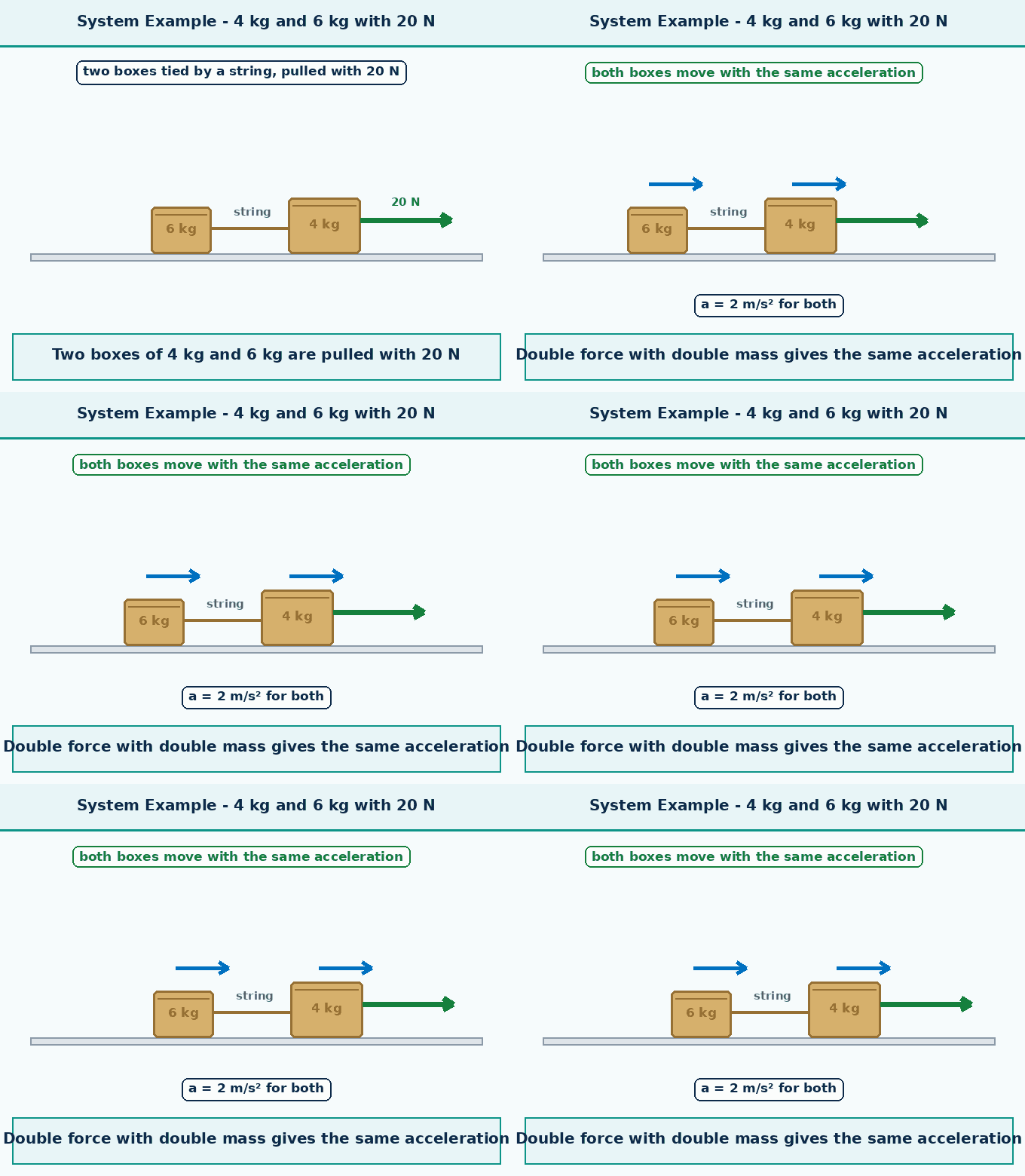
Two boxes of masses 4 kg and 6 kg tied by a string are pulled with a force of 20 N on a smooth surface. Find the acceleration.
-
 GIF
Watch: two boxes of masses 4 kg and 6 kg tied by a string are pulled with a force of 20
GIF
Watch: two boxes of masses 4 kg and 6 kg tied by a string are pulled with a force of 20
- Mass of the system = 4 kg + 6 kg = 10 kg
- a = F / (m₁ + m₂)
- a = 20 N / 10 kg
- a = 2 m s⁻²
- Here the force was doubled and the mass was also doubled, so the acceleration stayed the same.
Main Idea:
Treating connected objects as one system makes the working much shorter.
What are the important points of the system method?
- Joined objects are treated as one single object. (In our example, Box 1 + string + Box 2.)
- The mass of the system is the total mass. (In our example, m₁ + m₂.)
- Internal forces are ignored. (In our example, the tension T.)
- Only external forces are used. (In our example, the pull F.)
- All parts of the system have the same acceleration. (In our example, a = F/(m₁ + m₂).)
- The answer is the same as solving each object separately, only shorter.
Why can two objects be treated as one?
- The string keeps them joined, so they cannot move apart.
- Whatever happens to one box happens to the other at the same time.
Why do we add the masses?
- The pull F now has to move both boxes, not one.
- More total mass means less acceleration, because a = F/m.
Why is the tension ignored?
- The tension acts inside the system.
- The string pulls Box 1 leftwards and Box 2 rightwards with equal magnitude.
- This is a third-law pair inside the system, so it does not change the motion of the system as a whole.
Do both boxes have the same acceleration?
- Yes. They are tied together, so they cannot move with different accelerations.
Other Points
What other external forces act on this system?
- The gravitational force on the system, (m₁g + m₂g), acting downwards.
- The normal force from the ground, (N₁ + N₂), acting upwards.
- These two balance each other, so only F decides the acceleration.
NCERT Questions in this Section
📋 Revise, Reflect, Refine, Q15, page 114
A tractor pulls a harrow of mass m₁ with a net force F, giving acceleration a₁. The same tractor pulls a trolley of mass m₂ with force F, giving acceleration a₂. If the tractor now pulls the trolley with the harrow placed on it (same force F), find the resulting acceleration in terms of a₁ and a₂. Ignore friction.
View Answer →
📝 Important points about this Topic
| Point | Meaning |
|---|---|
| System | Two or more objects taken together as one object |
| Internal force | Force between the parts of the system (tension), not counted |
| External force | Force from outside the system (the pull F), counted |
| Mass of system | Sum of the masses of all parts |
| Acceleration | a = F / (m₁ + m₂), same for every part |
💡 Worth Remembering
- Newton's laws work for connected objects too, not only for a single object.
- a = F / (m₁ + m₂) for a system of two connected boxes.
- Internal forces are ignored, only external forces are used.
- All connected parts move with the same acceleration.
- On a horizontal surface, the gravitational force and the normal force on the system balance each other.
✅ Quick Self-Check
-
What is meant by a system of objects?
View Answer
- Two or more objects taken together and treated as one single object.
-
In the two-box example, which force is internal and which is external?
View Answer
- Tension T is the internal force, and the pull F is the external force.
-
Why is tension not used while finding the acceleration of the system?
View Answer
- It acts inside the system, as an equal and opposite pair on the two boxes, so it does not affect the motion of the system as a whole.
-
Does Box 1 move with a larger acceleration than Box 2?
View Answer
- No. Both are tied by the string, so both move with the same acceleration, a = F/(m₁ + m₂).
-
Which two other external forces act on the boxes, and why do they not change the acceleration?
View Answer
- The gravitational force (m₁g + m₂g) downwards and the normal force (N₁ + N₂) upwards.
- They are equal and opposite, so they balance each other.
Key Terms and Units
| Term | Meaning | Unit |
|---|---|---|
| System | Two or more connected objects treated as one object | - |
| Tension (T) | The force in the string joining two objects | newton (N) |
| Internal force | Force acting between parts inside the system | newton (N) |
| External force | Force acting on the system from outside | newton (N) |
| Normal force (N) | Upward force by the surface on an object placed on it | newton (N) |
