
 You are here
What happens when we kick the same ball with different forces?
![6.5 Newton's Second Law of Motio - How Forces Affect Moti - [Teachoo] - Concepts](https://cdn.teachoo.com/31a2ea73-dd0c-4104-8e81-7dd17a4f993f/animation-for-what-happens-when-we-kick-the-same-ball-with-different-forces-.-two-lanes-show-the-same-ball-kicked-twice.-a-short-arrow-mark.gif) GIF
Watch: kick the same football two times — first gently, then strongly
GIF
Watch: kick the same football two times — first gently, then strongly
-
Kick the same football two times — first gently, then strongly.
- Example :- When we kick the ball gently, it starts moving slowly. When we kick the same ball with a strong force, it starts moving fast. The ball is the same in both the kicks, only the force is different. Starting from rest and gaining speed means the ball is accelerating. So the gentle kick gave a small acceleration and the strong kick gave a large acceleration.
Main Idea
— for the same object, more force gives more acceleration.
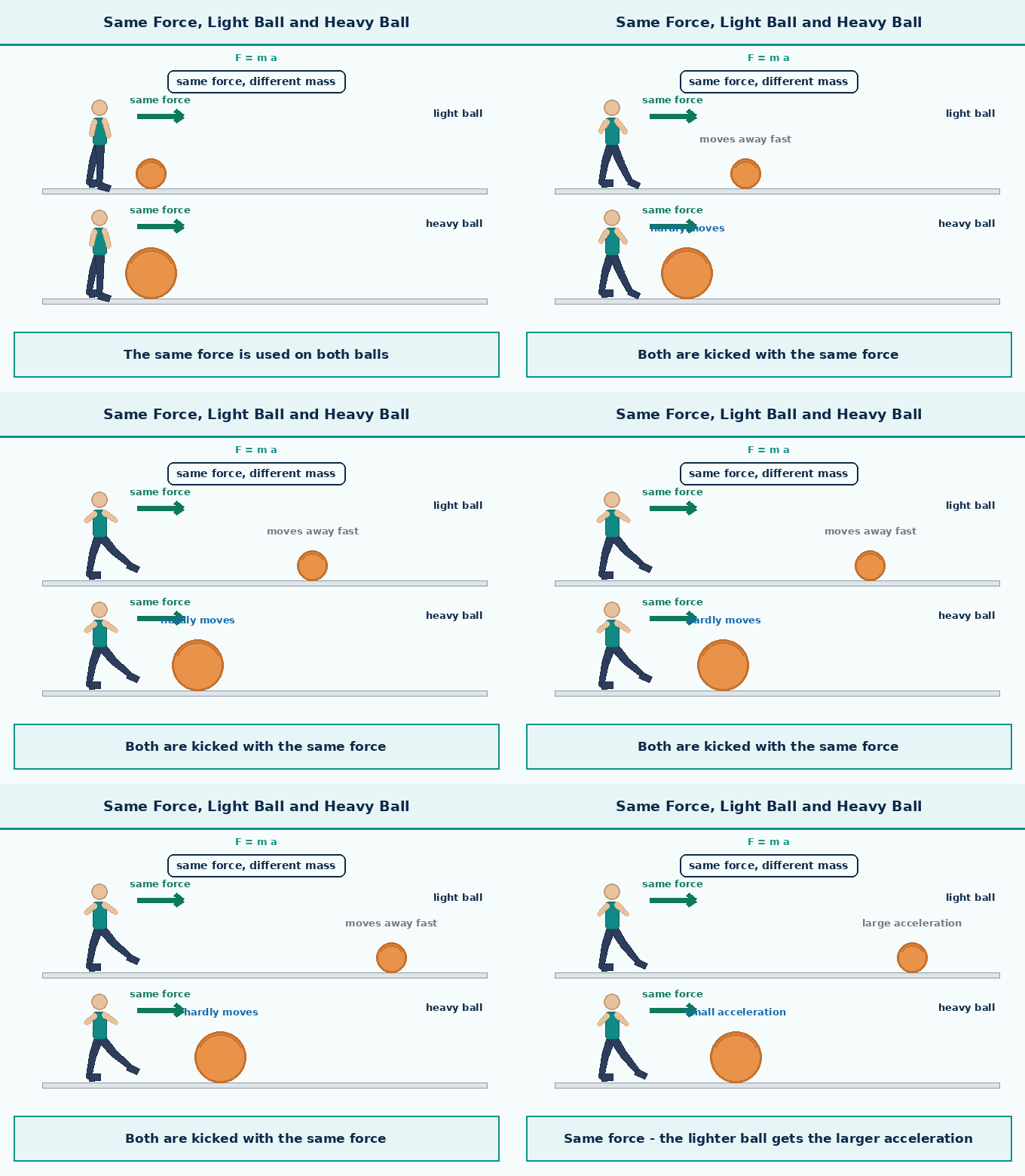
What happens when we kick a light ball and a heavy ball with the same force?
 GIF
Watch: kick two balls with the same force — one light, one heavy
GIF
Watch: kick two balls with the same force — one light, one heavy
-
Kick two balls with the same force — one light, one heavy.
- Example :- When we kick a light plastic ball, it moves away fast. When we kick a heavy ball with the same force, it hardly moves. The force is the same in both the kicks, only the mass is different. So the light ball got a large acceleration and the heavy ball got a small acceleration. This is why it is easier to set a light object in motion than a heavy one.
Main Idea
— for the same force, a smaller mass gets a larger acceleration and a larger mass gets a smaller acceleration.
What is Newton's second law of motion?
Definition
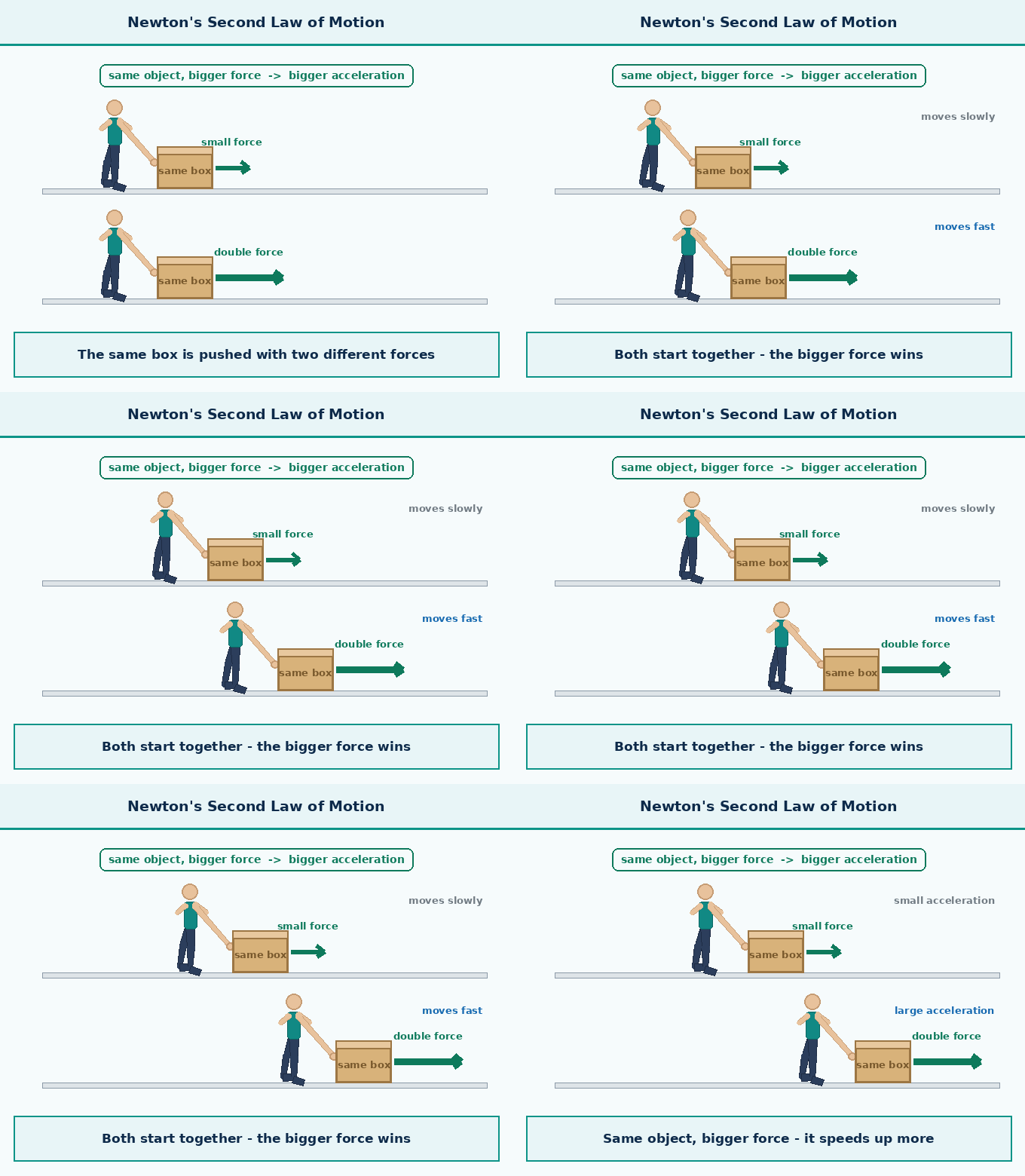
When a net force acts on an object, the object accelerates in the direction of the net force. The magnitude of the acceleration is proportional to the magnitude of the net force and is inversely proportional to the mass of the object.
GIF
Watch: both the ideas above are joined together in one law
Important points of Definition
-
The law talks about the net force, not each force separately.
- Net force is the single force left after adding up all the forces acting on the object.
-
The object accelerates — its velocity changes.
- The speed may change, or the direction may change, or both.
- The acceleration is in the same direction as the net force.
- Acceleration is proportional to the net force — keep the mass the same, make the force double, and the acceleration becomes double.
- Acceleration is inversely proportional to the mass — keep the force the same, make the mass double, and the acceleration becomes half.
- So one force alone does not decide the acceleration. Both force and mass decide it together.
What is the formula of Newton's second law?
-
The law written in maths form is
- a = F / m ... (6.1)
- or, F = m a ... (6.2)
- Here,
| Symbol | Meaning | Unit |
|---|---|---|
| F | Net force on the object | newton (N) |
| m | Mass of the object | kilogram (kg) |
| a | Acceleration of the object | m s⁻² |
- The direction of acceleration is the same as the direction of the net force.
a
=
F
m
F
=
m a
Direction of a
=
direction of the net force F
What is one newton of force?
-
Put m = 1 kg and a = 1 m s⁻² in F = ma
- F = (1 kg) × (1 m s⁻²) = 1 kg m s⁻² = 1 N
Definition
One newton of force is defined as the force that produces an acceleration of 1 m s⁻² on an object of mass 1 kg.
F
=
m a
F
=
(1 kg) × (1 m s⁻²)
F
=
1 kg m s⁻² =
1 N
How are force and acceleration related?
-
GIF Watch: now keep the force the same and change the mass
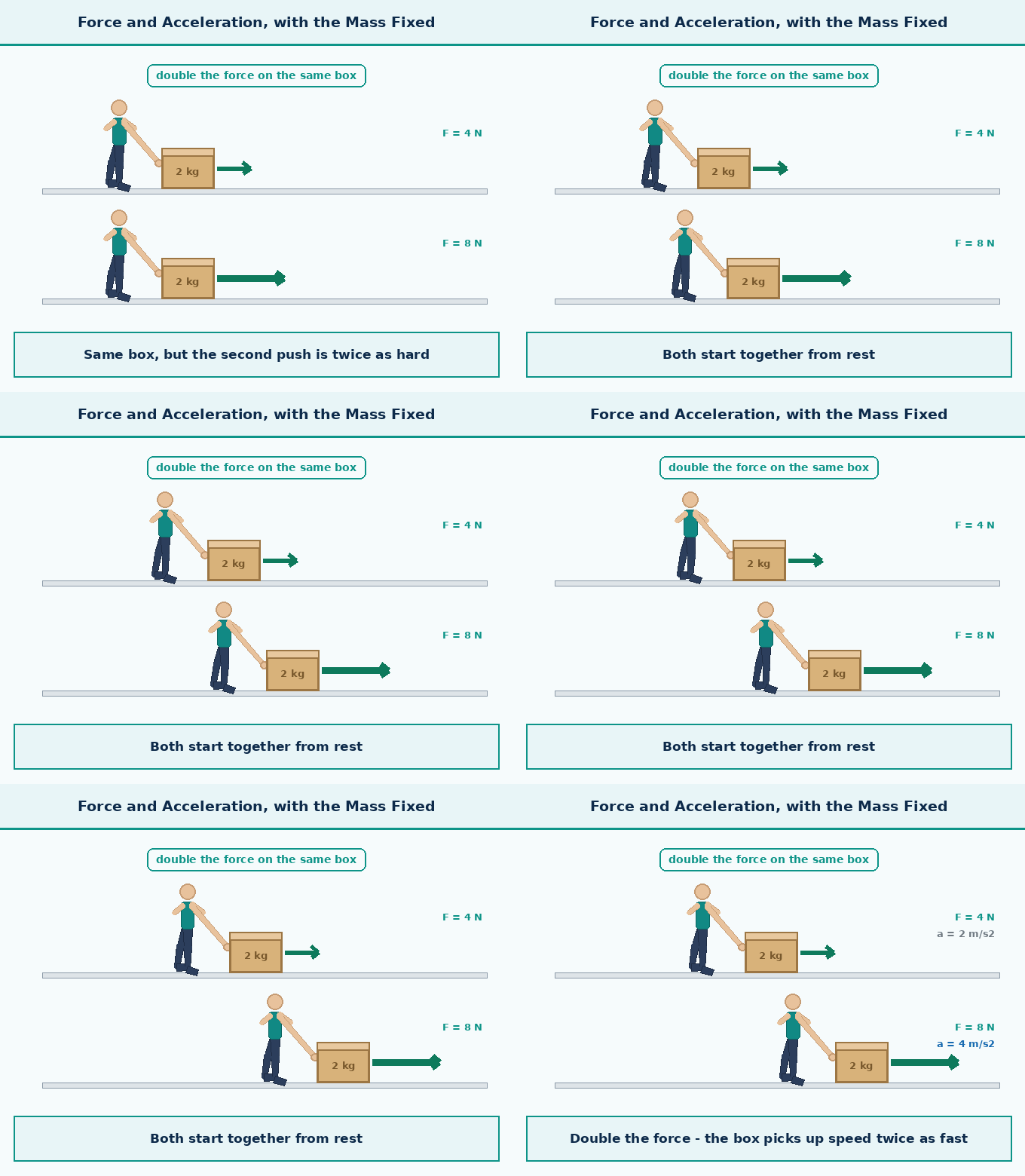
- Keep the mass the same and change the force.
- Use a = F / m. Here mass is fixed at 2 kg.
| Force F | Mass m | a = F / m |
|---|---|---|
| 4 N | 2 kg | 2 m s⁻² |
| 8 N | 2 kg | 4 m s⁻² |
| 12 N | 2 kg | 6 m s⁻² |
- Force became double, acceleration became double.
- Force became triple, acceleration became triple.
So force and acceleration are directly proportional, when mass is fixed.
What happens when only the force is changed?
Mass stays the same
2 kg every time
Force is made double
4 N becomes 8 N
↓
Acceleration becomes double, from 2 m s⁻² to 4 m s⁻²
How are mass and acceleration related?
GIF
Watch: now keep the force the same and change the mass
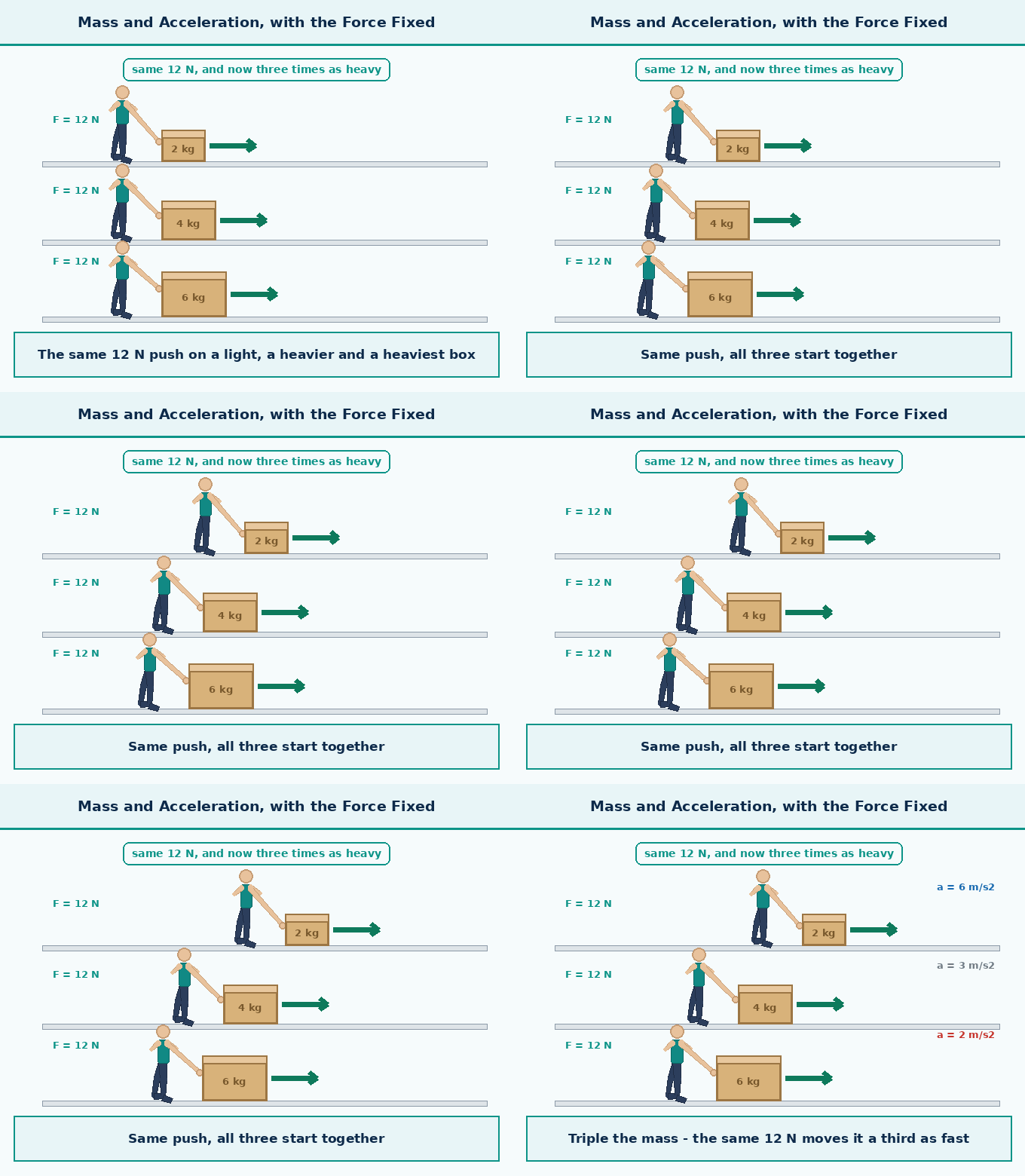
- Now keep the force the same and change the mass.
- Force is fixed at 12 N.
| Force F | Mass m | a = F / m |
|---|---|---|
| 12 N | 2 kg | 6 m s⁻² |
| 12 N | 4 kg | 3 m s⁻² |
| 12 N | 6 kg | 2 m s⁻² |
- Mass became double, acceleration became half.
- Mass became triple, acceleration became one-third.
So mass and acceleration are inversely proportional, when force is fixed.
What happens when only the mass is changed?
Force stays the same
12 N every time
Mass is made double
2 kg becomes 4 kg
↓
Acceleration becomes half, from 6 m s⁻² to 3 m s⁻²
What is acceleration due to the gravitational force by the Earth?
-
GIF Watch: the Earth pulls every object towards itself. This pull is the gravitational force
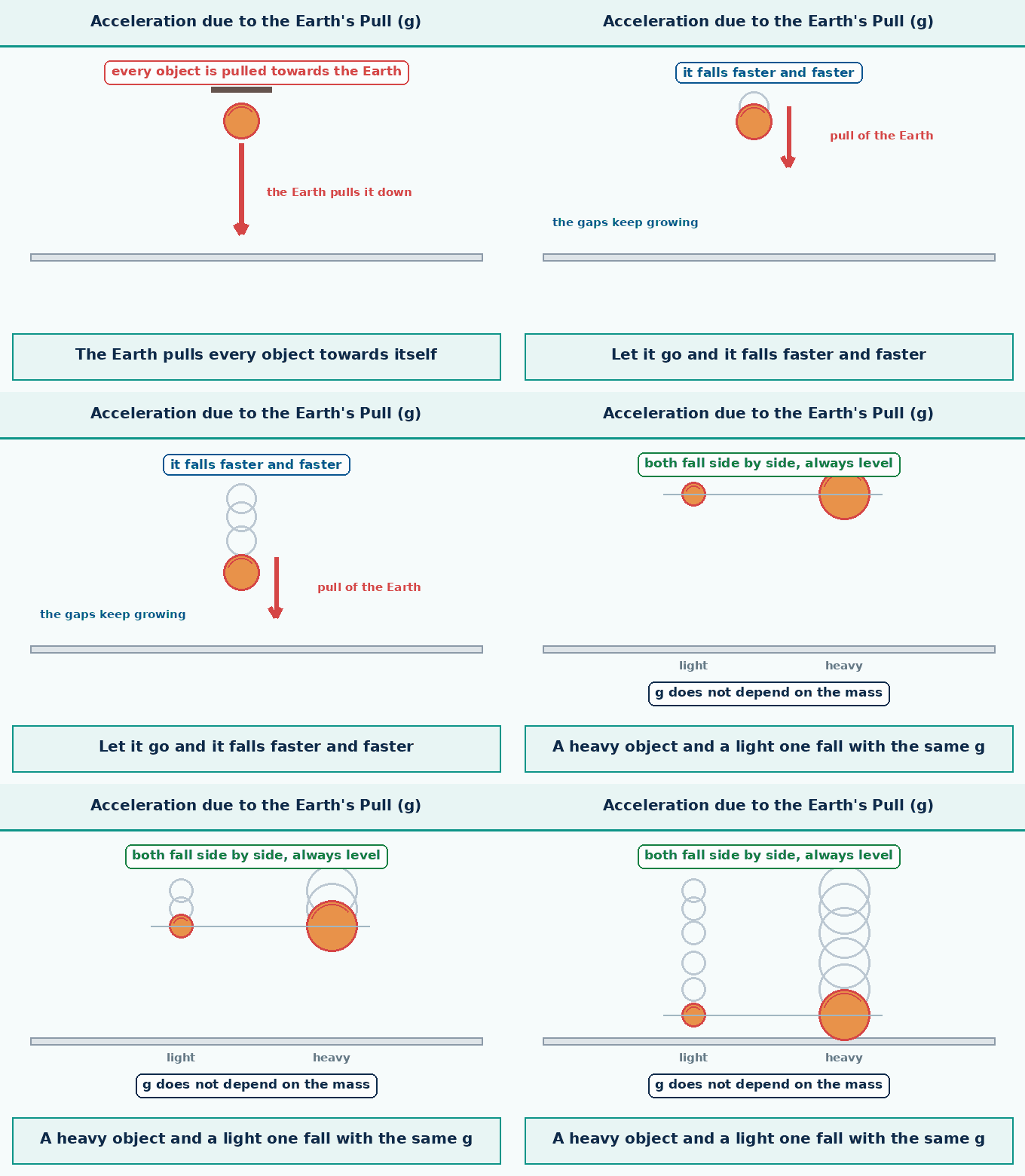
- The Earth pulls every object towards itself. This pull is the gravitational force.
- Because of this pull, a falling object accelerates towards the Earth.
- This acceleration is called acceleration due to the gravitational force by the Earth, written as g.
- Its unit is the same as that of acceleration, m s⁻².
-
Putting a = g in F = ma, the gravitational force on an object of mass m is
- F = m g
- Value of g near the surface of the Earth is g = 9.8 m s⁻².
- For quick estimation, g = 10 m s⁻² can be taken.
Note
— the value of g does not depend on the mass of the object. A heavy object and a light object have the same g.
F
=
m g
g
=
9.8 m s⁻² near the surface of the Earth
g
=
10 m s⁻² for quick estimation
Where do we see Newton's second law in daily life?
-
A fielder catching a fast cricket ball pulls their hands backwards along with the ball.
- This increases the time in which the ball's velocity falls to zero.
- More time means smaller acceleration.
- Smaller acceleration means a smaller force is needed to stop the ball.
- The fielder's hands are also saved from injury.
-
Airbags in a vehicle work in the same way.
- In a crash, the airbag fills up into a soft cushion.
- The head and chest push into the bag instead of the hard dashboard.
- The hitting takes place over a longer time, so acceleration is smaller.
- Smaller acceleration means a smaller force on the person, so injury is less. It works best along with the seat belt.
-
Cracking a coconut in one go is the opposite case.
- The coconut hits the ground at a very high velocity and stops in a very short time.
- To change the velocity so quickly, the ground applies a very large force on it.
- This large force breaks the shell.
Why does a fielder pull the hands back while catching?
The hands move back with the ball
the ball takes longer to stop
↓
More time to change the velocity
so the acceleration is smaller
↓
A smaller force is needed to stop the ball, so the hands are not hurt
The airbag in a car does the same job. The coconut is the opposite case — it stops in a very short time, so the force on it is very large.
🔧
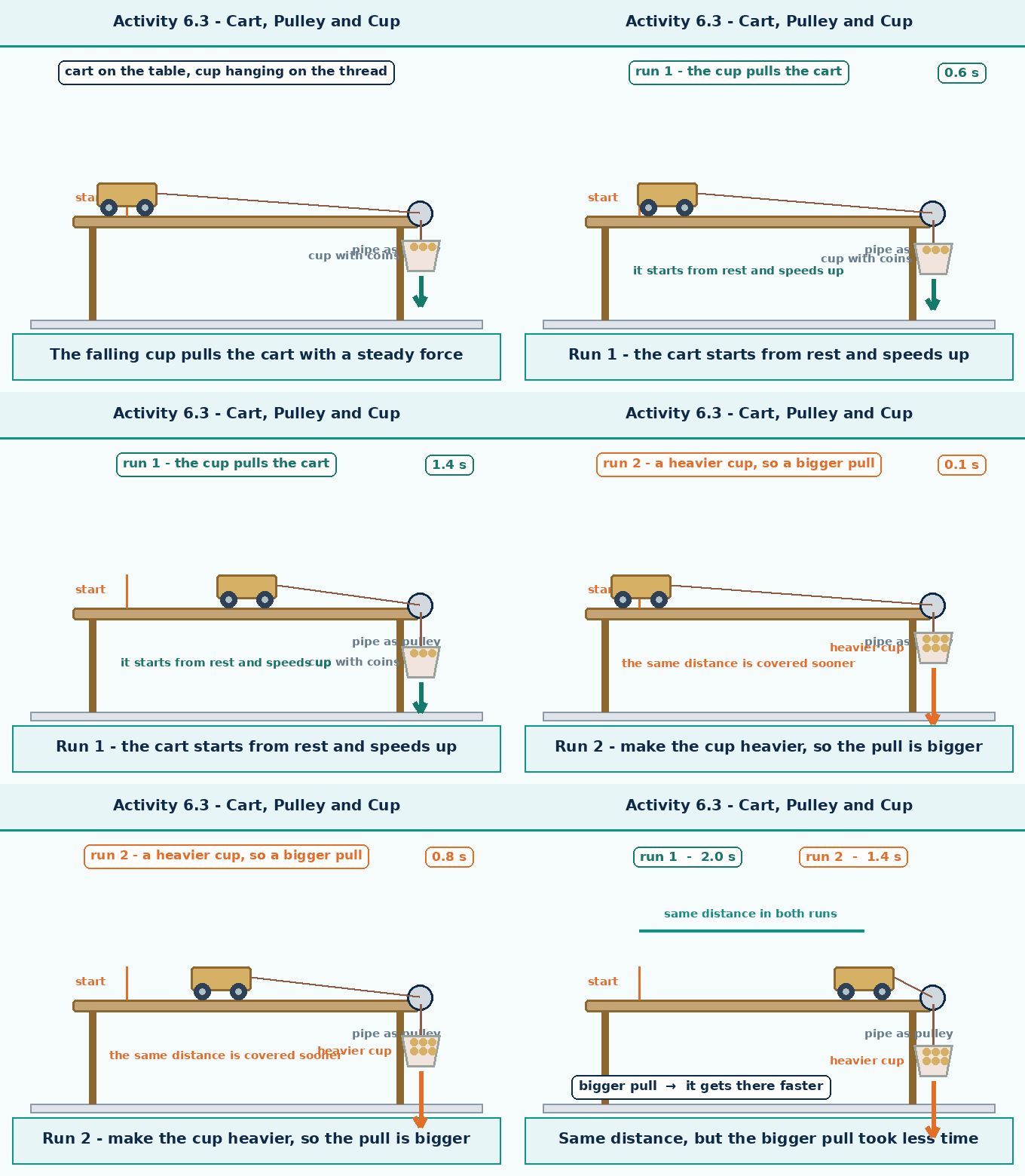
Activity 6.3: Let us experiment (Demonstration activity)
This activity checks the first idea — for the same cart, does more force give more acceleration? It is done as a group activity with the teacher.
GIF
Watch: the same setup as Activity 6.3
What do we need?
- Four ball bearing wheels
- Two pencils
- An empty cardboard box (to make the cart)
- A paper cup
- A piece of pipe (to use as a pulley)
- A length of thread
- Some coins or other objects to put in the cup
- A weighing scale
What do we do?
- Insert two pencils through the sides of the box near the bottom. They work as axles. Fix one wheel on each free end. Wrap tape on the pencil ends if the wheels are loose.
- Tie a thread to the front of the box. This is the cart.
- Draw a line at one end of the table. This is the starting point.
- Fix a small pipe at the other end of the table and pass the thread over it. Tie a paper cup to the hanging end of the thread and put some objects in it.
- Measure the mass of the cup along with the objects inside it.
- Record a slow-motion video. Release the cart from the start line and record till it reaches the pipe.
- From the video, find the time taken. Call it T₁.
- Now double the mass of the cup with the objects inside it, and repeat. Call this time T₂.
What do we observe?
- The cup falls down because the Earth pulls it. The thread pulls the cart with a constant force.
- The cart starts from rest and gains speed — so it is accelerating.
- When the cup is made heavier, the cart covers the same distance in less time. So T₂ is smaller than T₁.
What does F = ma predict here?
- The weight of the cup is what pulls the cart. Doubling the mass in the cup doubles the pulling force.
- The cart is not changed, so mass m is the same.
- From a = F / m, if F becomes double and m stays the same, acceleration should become double.
-
More acceleration means the same distance is finished in less time.
- Example :- Suppose the cart took 2.0 seconds in the first run. In the second run the force is double, so the acceleration should become double, and the same distance should now take about 1.4 seconds.
How does the book check it, without using the formula?
- In both runs the cart starts from rest, so u = 0, and travels the same distance s.
-
Using the kinematic equation s = ut + ½ at² with u = 0,
- s = ½ a₁ T₁² and s = ½ a₂ T₂²
-
The distance is the same in both runs, so the two right sides are equal
- a₁ / a₂ = T₂² / T₁²
- Putting in the measured values of T₁ and T₂, we find that a₂ is bigger than a₁.
What does this tell us?
The acceleration of an object of fixed mass increases as the net force applied on it increases.
🔧
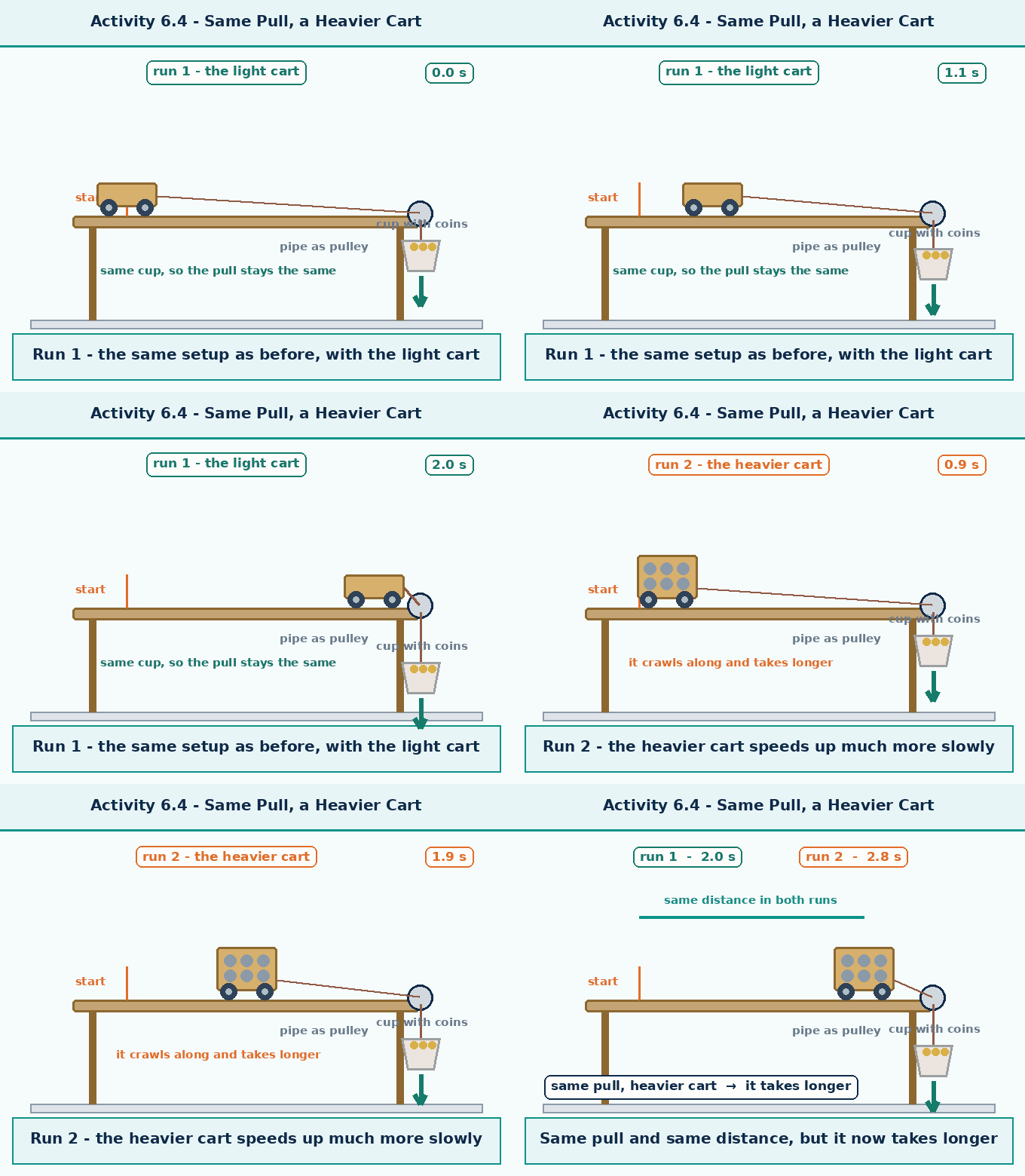
Activity 6.4: Let us experiment (Demonstration activity)
This activity checks the second idea — for the same force, does a bigger mass give less acceleration?
GIF
Watch: the same setup as Activity 6.3
What do we need?
- The same setup as Activity 6.3
- Extra objects to put inside the cart
- A weighing scale
What do we do?
- Repeat Activity 6.3 with one change. Keep the mass of the cup and the objects inside it the same, so the pulling force does not change.
- Double the mass of the cart by adding more objects inside it.
- Measure the mass of the cart along with the objects inside it.
- Carry out steps 5 and 6 of Activity 6.3 — record the slow-motion video and note the time.
What do we observe?
- The cart now takes more time to cover the same distance.
- Using the ratio of the times, we find the ratio of the accelerations, and the acceleration has decreased.
What does F = ma predict here?
- The cup is unchanged, so the force F is the same.
- The cart is made heavier, so m becomes double.
- From a = F / m, if m becomes double and F stays the same, the acceleration should become half.
- Less acceleration means the same distance takes more time.
(this prediction is worked out by us — the book does not print it)
How does the book check it?
-
The same relation is used, because u = 0 and the distance s is the same again
- a₁ / a₂ = T₂² / T₁²
- The measured times show that the acceleration became smaller when the mass was increased.
What does this tell us?
For a given magnitude of force, the acceleration produced is inversely related to the mass of the object.
Solved Examples
🔢 Example 6.4
What is given?
- A barbell with 10 kg fixed on each side of the bar
- Mass of the bar itself = 10 kg
- The weight lifter is holding it steady
What is asked?
— How much force is she applying?
Steps
- Total mass of the barbell = 10 + 10 + 10 = 30 kg
-
Gravitational force on it, using F = mg
- F = 30 kg × 9.8 m s⁻² = 294 N, acting downwards
- To keep the barbell steady, she must apply an equal force in the opposite direction.
What does the answer mean?
— She applies 294 N in the upward direction. The two forces balance, net force is zero, so the barbell does not move.
🔢 Example 6.5
What is given?
- Mass of block = 25 kg, at rest on a horizontal floor
- Maximum force of friction = 50 N
- Time = 2 s
What is asked?
— The displacement of the block when pushed with (i) 50 N and (ii) 55 N.
Steps — case (i), force 50 N
- Applied force = friction force = 50 N
- The two forces are balanced, so net force = 0
- The block remains stationary. Displacement = 0.
Steps — case (ii), force 55 N
- Net force = 55 N − 50 N = 5 N
- Acceleration, a = F / m = 5 / 25 = 0.2 m s⁻²
- Displacement, s = ut + ½ at² = (0 × 2) + (½ × 0.2 × 2²) = 0.4 m in the forward direction
What does the answer mean?
— Pushing is not enough by itself. The push must be larger than friction before the block moves at all.
🔢 Example 6.6
What is given?
- Sports car of mass 1500 kg moving towards the east
- Its velocity-time graph (Fig. 6.21)
What is asked?
— The force acting on the car during 0–5 s, 5–10 s and 10–15 s.
Steps — 0 s to 5 s
- The graph is a straight line sloping upwards, so acceleration is constant
- u = 0 m s⁻¹, v = 10 m s⁻¹, t = 5 s
- v = u + at → 10 = 0 + (a × 5) → a = 2 m s⁻²
- F = ma = 1500 × 2 = 3000 N towards the east
Steps — 5 s to 10 s
- The graph is a straight line parallel to the time axis, so velocity is constant
- No change in velocity means no acceleration
- No force is acting on the car
Steps — 10 s to 15 s
- The graph slopes downwards, so the car is slowing down
- u = 10 m s⁻¹, v = 0 m s⁻¹, t = 5 s
- v = u + at → 0 = 10 + (a × 5) → a = −2 m s⁻²
- F = 1500 × (−2) = −3000 N
What does the answer mean?
— The minus sign only shows direction. The force is 3000 N towards the west, that is, opposite to the motion.
Pause and Ponder (Page 106) — Questions 6, 7 and 8
-
6. A toy car of mass 100 g is moving with a constant velocity of 0.5 m s⁻¹. What is the net force acting on the toy car?
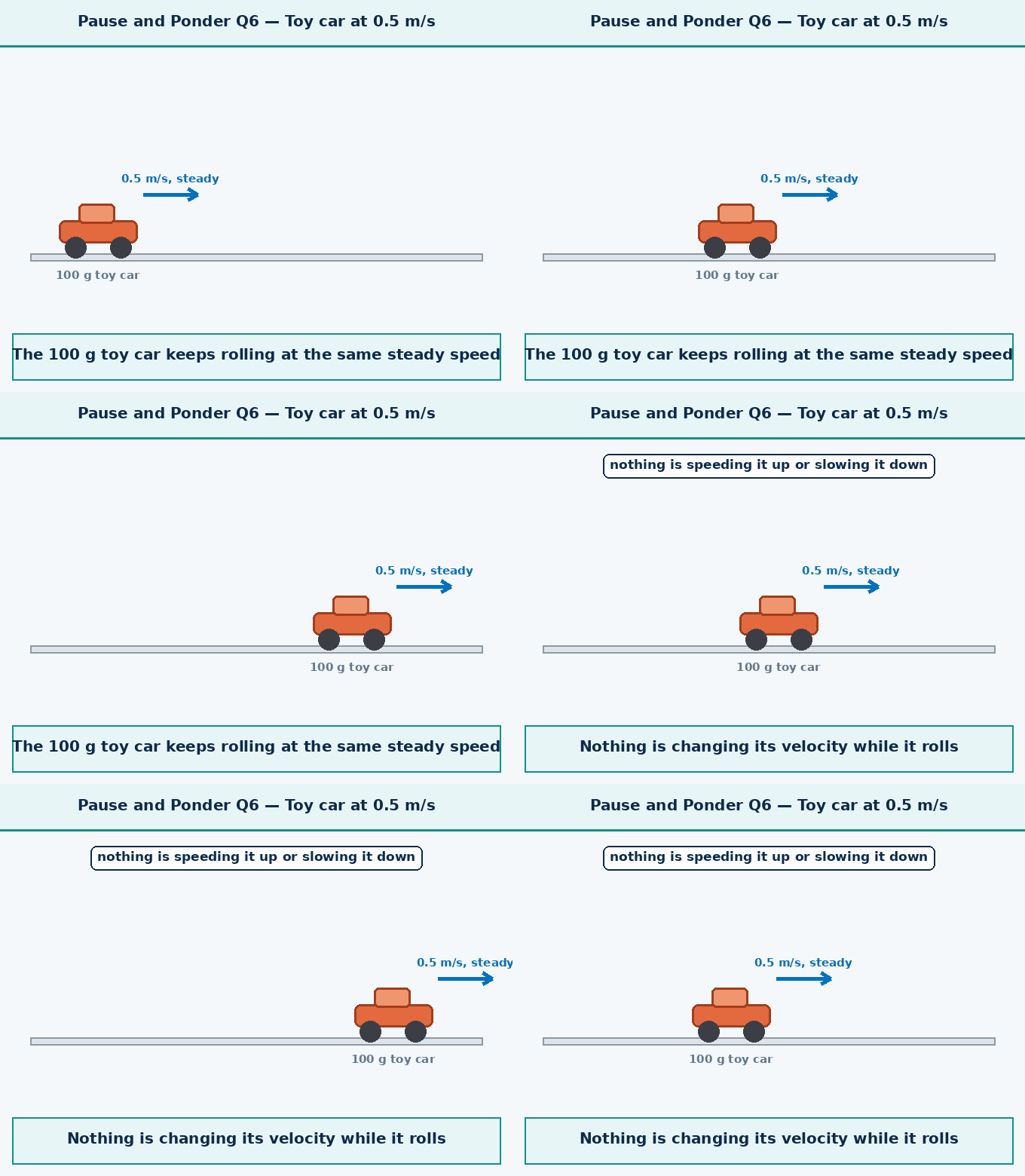 GIF
Watch: a toy car of mass 100 g is moving with a constant velocity of 0.5 m s⁻¹. What is
GIF
Watch: a toy car of mass 100 g is moving with a constant velocity of 0.5 m s⁻¹. What is
View answer
Answer- Constant velocity means there is no change in velocity, so acceleration a = 0
- F = ma = 0.1 kg × 0 = 0 N
- The net force on the toy car is zero. Forces may still be acting on it, but they cancel out.
-
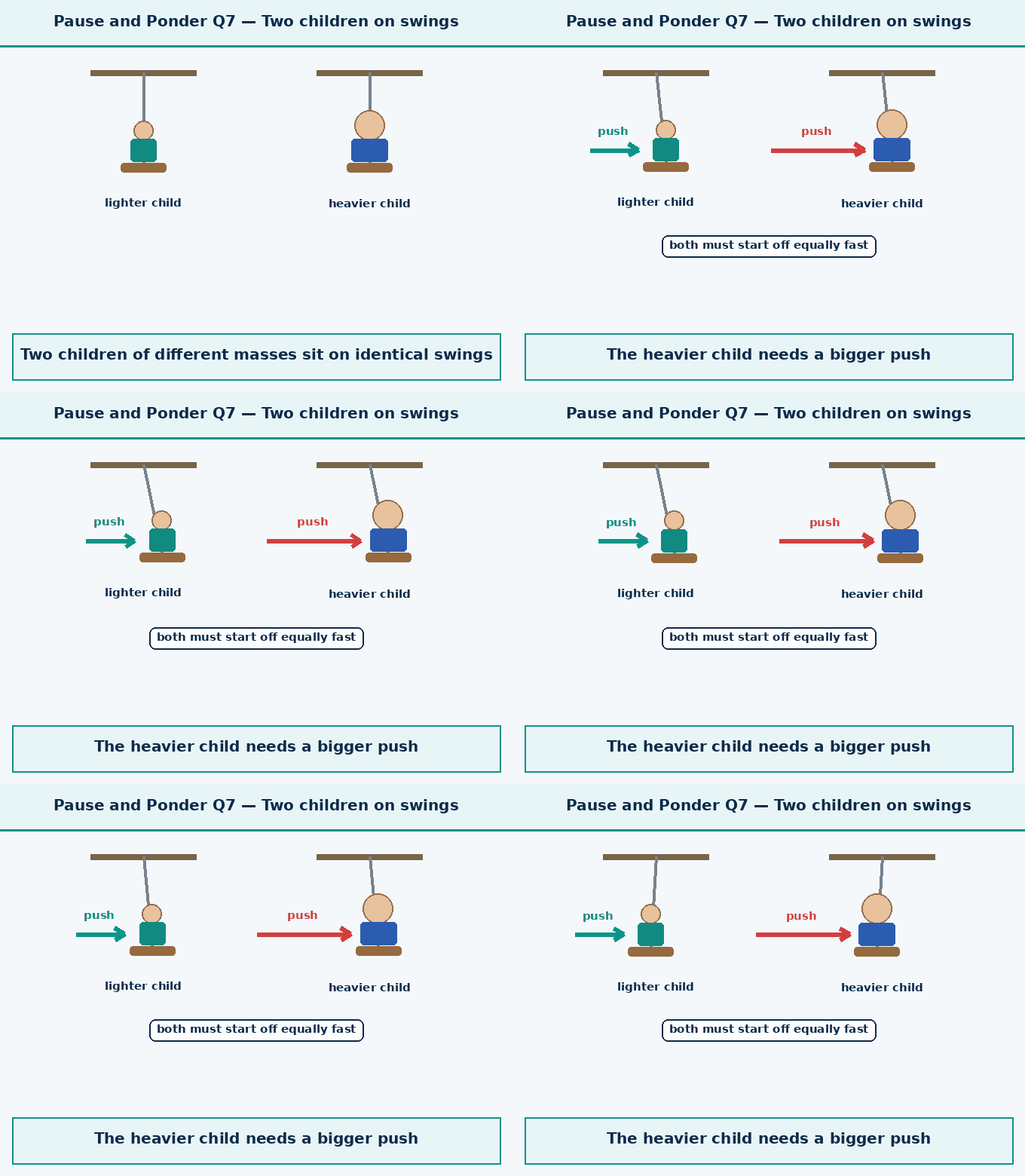
7. Two children of different masses are sitting on identical swings. To impart identical initial acceleration, for which child would you require to apply a larger force? Explain why.
 GIF
Watch: two children of different masses are sitting on identical swings. To impart
GIF
Watch: two children of different masses are sitting on identical swings. To impart
View answer
Answer- The heavier child needs the larger force.
- From F = ma, if the acceleration a is to be the same for both, the force needed is more for the bigger mass.
-
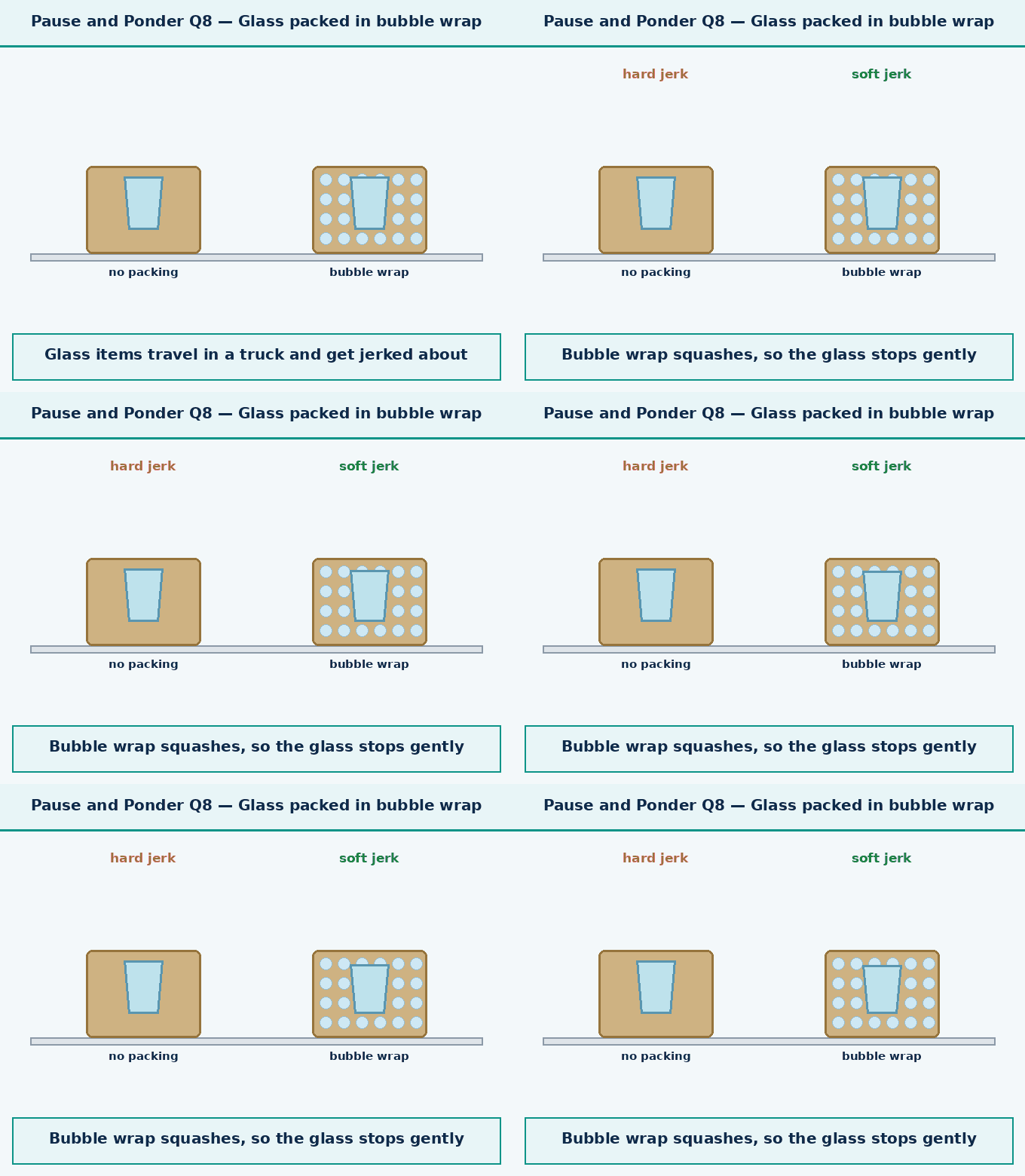
8. How are glass items packed for transportation using a bubble wrap or hay protected from damage?
 GIF
Watch: how are glass items packed for transportation using a bubble wrap or hay
GIF
Watch: how are glass items packed for transportation using a bubble wrap or hay
View answer
Answer- During a jerk, the bubble wrap or hay squashes and the glass item slows down over a longer time.
- More time to change velocity means smaller acceleration.
- Smaller acceleration means a smaller force acts on the glass item, so it does not break.
(Pause and Ponder, page 106)
📋 Revise, Reflect, Refine, Q5, page 113
When a net force acts on an object, we observe that the object accelerates: (i) opposite to the direction of force, with acceleration proportional to the force acting on the object. (ii) opposite to the direction of force, with acceleration proportional to the mass of the object. (iii) in the direction of force, with acceleration inversely proportional to the force acting on the object. (iv) in the direction of force, with acceleration proportional to the force acting on the object.
View Answer →
📋 Revise, Reflect, Refine, Q8, page 113
During a high jump event, a landing mat or sand bed is placed for the athlete to fall upon (Fig. 6.39). Explain the reason behind it.
View Answer →
📋 Revise, Reflect, Refine, Q10, page 113
The acceleration-mass graph for the acceleration produced by a force on objects of different masses is plotted in Fig. 6.40. Plot the force-mass graph for this case.
View Answer →
📋 Revise, Reflect, Refine, Q11, page 113
The velocity-time graph of an object of mass 10 kg moving along a straight line is shown in Fig. 6.41. Calculate the force acting on the object by using the graph.
View Answer →
📋 Revise, Reflect, Refine, Q12, page 113
A bullet of mass 50 g moving with a speed of 100 m s⁻¹ enters a heavy stationary wooden block and stops after penetrating a distance of 50 cm. Estimate the stopping force acting on the bullet (assume that the bullet undergoes constant acceleration within the block).
View Answer →
📋 Revise, Reflect, Refine, Q13, page 113
An ace footballer converted a penalty shot by kicking the football with a speed of 108 km h⁻¹. The force they imparted was 800 N. The mass of the football was 0.4 kg. Calculate the time of contact between their foot and the ball.
View Answer →
📋 Revise, Reflect, Refine, Q14, page 113
An object of mass 2 kg moving with a constant velocity of 10 m s⁻¹ encounters a rough patch where the force of friction on the object is 7 N. At the same time, an additional constant force of 3 N opposing the motion is applied on the object. After entering the rough patch, how much distance does the object travel before coming to rest?
View Answer →
📝 Important points about this topic
| Point | What it means |
|---|---|
| A force produces acceleration | Force does not create motion by itself — it changes velocity |
| F = ma | Net force = mass × acceleration |
| a = F / m | Acceleration depends on both force and mass |
| Direction | Acceleration is always in the direction of the net force |
| Fixed mass | More force → more acceleration |
| Fixed force | More mass → less acceleration |
| Zero net force | Zero acceleration, whatever the mass |
| 1 N | Force that gives 1 m s⁻² to a mass of 1 kg |
| F = mg | Gravitational force by the Earth, with g = 9.8 m s⁻² |
🧵 Threads of Curiosity
- In Activity 6.3, doubling the force should have exactly doubled the acceleration, but the measured increase is usually a little less than double. In Activity 6.4, doubling the mass should have exactly halved the acceleration, but the value found is slightly different.
- Two reasons — measurement errors, and the friction between the cart's wheels and the surface.
- Also, holding a 100 g mass in your palm tells you how much 1 N feels like. The upward force your palm applies is around 1 N.
🚀 Ready to Go Beyond
- The fuller form of Newton's second law uses momentum.
- Momentum of an object = mass × velocity. Its direction is the same as that of the velocity.
- In this form, the law says: the rate of change of momentum of an object is proportional to the net force, and takes place in the direction of the net force.
- The advantage is that this form works even when the mass of the object is not constant.
💡 Worth remembering
- Force is the cause, acceleration is the effect. Time is only what we measure.
- Constant velocity means zero acceleration, so zero net force — even if the object is moving fast.
- In numericals, always find the net force first, then use a = F / m.
- A negative answer for force means the direction is opposite to the motion, not that the force is small.
- Write the unit as newton (small n) but the symbol as N (capital).
✅ Quick self-check
-
A 5 kg object has a net force of 20 N on it. What is its acceleration? — 4 m s⁻²
View Answer
-
Force is doubled and mass is doubled together. What happens to acceleration? — It stays the same
View Answer
-
A truck and a bike are pushed with the same force. Which one accelerates more? — The bike, because it has less mass
View Answer
-
What is the net force on a car moving with constant velocity? — Zero
View Answer
-
What force does the Earth apply on a 3 kg bag? — F = mg = 3 × 9.8 = 29.4 N, downwards
View Answer
Key terms and units
| Term | Meaning | Unit |
|---|---|---|
| Net force (F) | The single force left after adding all forces on the object | newton, N |
| Mass (m) | The quantity of matter in the object | kilogram, kg |
| Acceleration (a) | Rate of change of velocity | m s⁻² |
| g | Acceleration due to the gravitational force by the Earth, 9.8 m s⁻² | m s⁻² |
| Weight (mg) | Gravitational force with which the Earth pulls the object | newton, N |
| Momentum | Mass × velocity | kg m s⁻¹ |
