
 You are here
Let's take an example of a ball
-
GIF Watch: an object at rest remains at rest, and an object in motion continues to move with
![6.4 Newton's First Law of Motion - How Forces Affect Moti - [Teachoo] - Concepts](https://cdn.teachoo.com/a7ad3abb-3457-4784-a0b7-1f6ee1779314/animation-for-what-is-newton-s-first-law-of-motion-.-a-short-looping-gif-three-or-four-beats-drawn-in-the-flat-classroom-style-of-the-cha.gif)
- A ball lying on the ground stays there. It moves only when you kick it.
- Once rolling, nothing pushes it, but it keeps going till friction stops it.
- So a ball never changes its motion on its own. A force has to act on it.
What is Newton's first law of motion?
- An object at rest remains at rest, and an object in motion continues to move with a constant velocity, unless a net force acts upon the object.
The net force on an object is zero
what does the first law allow?
The object was at rest
It stays at rest
It cannot start moving on its own
Example:
A box lying on the floor
The object was moving
It keeps moving with the same constant velocity
Its acceleration is zero
Example:
A box sliding at a steady speed
Let us understand the law step by step
- Take one box on the floor and follow it through four stages.
Part 1 — The box is at rest
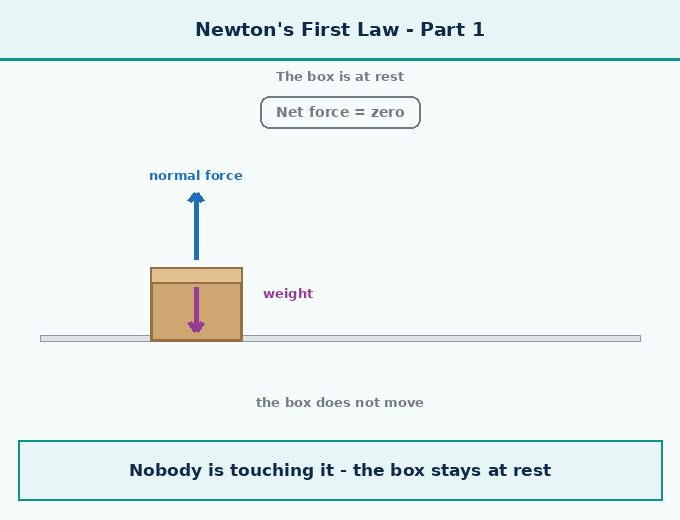
- What is happening: The box is lying still on the floor. Nobody is touching it.
-
Forces acting:
- Gravitational force, pulling the box down towards the Earth
- Normal force, the floor pushing the box up with equal strength
- No horizontal force at all
- Net force: Zero. The upward force cancels the downward force, and there is nothing sideways.
- What the first law says: An object at rest stays at rest unless a net force acts on it. The net force is zero, so the box cannot start moving on its own.
GIF
Watch: the box is at rest - weight and normal force are balanced
Part 2 — You push the box hard
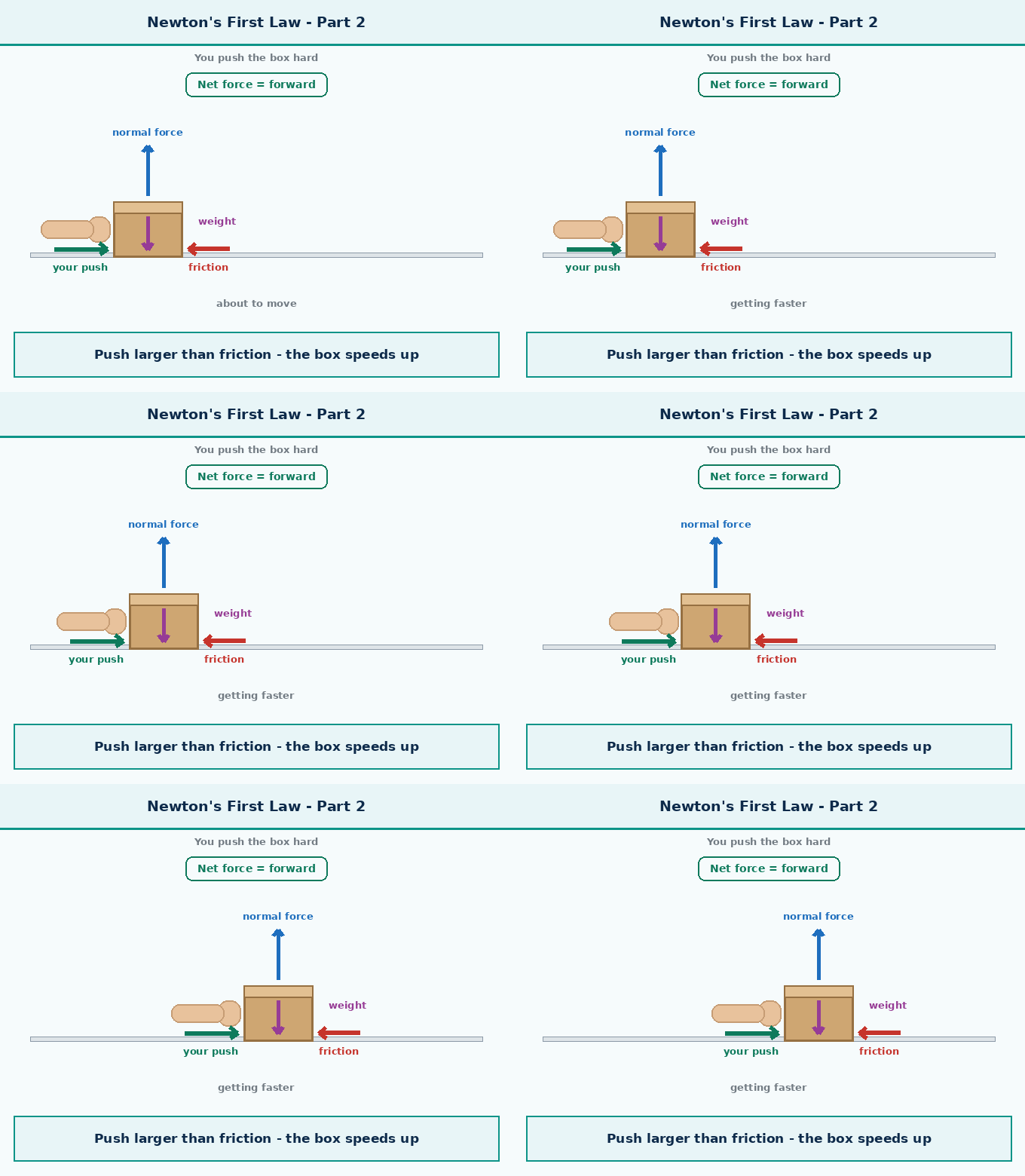
- What is happening: You push the stationary box hard. The box starts moving and speeds up.
-
Forces acting:
- Gravitational force down and normal force up, still balanced
- Your push, in the forward direction
- Force of friction, in the backward direction
- Net force: Forward. Your push is larger than friction, so the two do not cancel.
- What the first law says: An object changes its state of motion only when a net force acts on it. Here the net force is forward, so the box starts moving and speeds up.
GIF
Watch: you push the box hard - the net force is forward
Part 3 — You keep pushing steadily
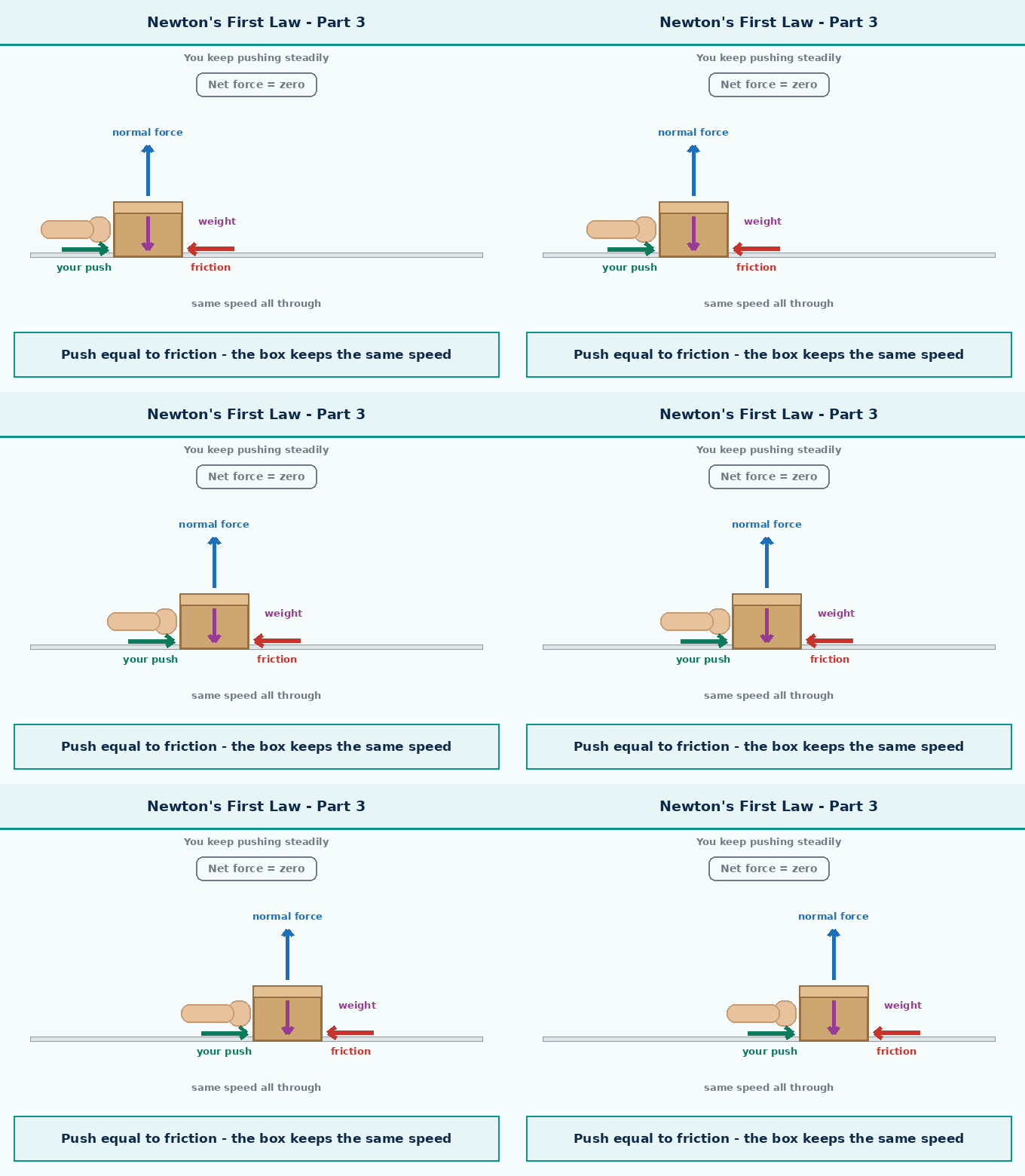
- What is happening: The box is already sliding. You ease your push so that the box keeps moving at the same speed.
-
Forces acting:
- Gravitational force down and normal force up, still balanced
- Your push forward
- Force of friction backward, now exactly equal to your push
- Net force: Zero. The forward push and the backward friction cancel each other.
- What the first law says: An object in motion keeps moving with a constant velocity when the net force is zero. So the box keeps sliding at the same speed, neither faster nor slower.
GIF
Watch: you push steadily - push equals friction, so the speed stays the same
Part 4 — You stop pushing
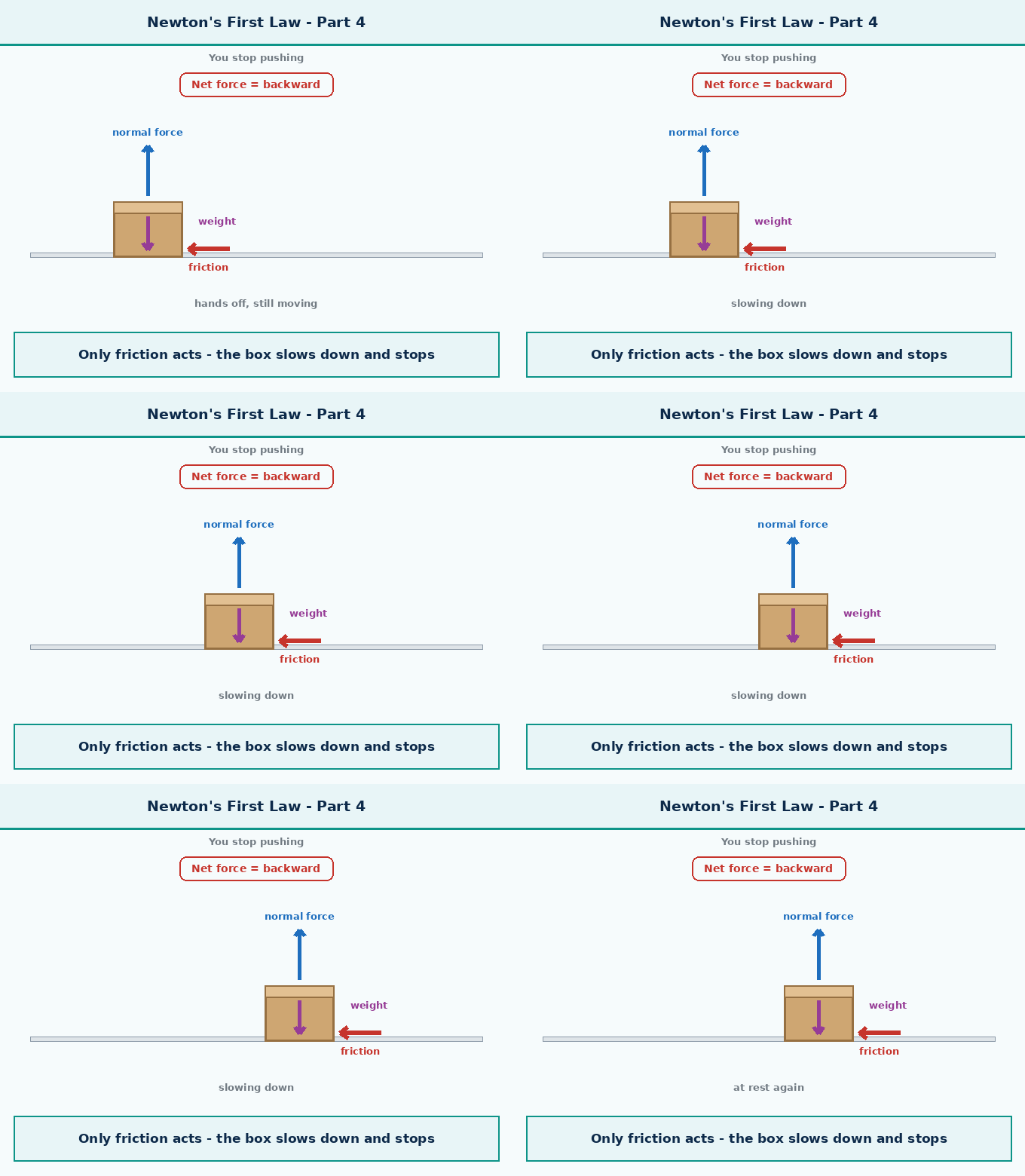
- What is happening: You take your hands off. The box slides a little, slows down, and stops.
-
Forces acting:
- Gravitational force down and normal force up, still balanced
- Your push is now zero
- Force of friction, still acting backward
- Net force: Backward. Friction is now the only horizontal force.
- What the first law says: The box would keep moving unless a net force acts on it. Friction is that net force, so it slows the box down and brings it to rest.
GIF
Watch: you stop pushing - friction alone brings the box to rest
All four stages together
| Stage | Motion of the box | Horizontal forces | Net force | What the first law gives |
|---|---|---|---|---|
| 1. At rest | Stationary | None | Zero | Stays at rest |
| 2. Hard push | Speeding up | Push larger than friction | Forward | Starts moving and speeds up |
| 3. Steady push | Constant speed | Push equal to friction | Zero | Keeps moving at the same velocity |
| 4. You let go | Slowing down | Friction only | Backward | Slows down and comes to rest |
🔢 Example 6.2, page 101
A person is exerting a force on a moving box in the forward direction which is equal to the force of friction acting between the bottom surface of the box and the floor. Will the box continue moving or will it come to rest after some time?
- This is exactly Part 3 above.
- The force of friction acts on the box in the backward direction.
- The two forces acting on the box are equal and opposite, so they balance each other.
- The net force acting on the box is zero.
- As per Newton's first law of motion, the box will continue moving with constant velocity.
Drawing Part 1 and Part 3 as charts
- Part 1 and Part 3 are the two stages where the net force is zero.
- In Part 1 the box is at rest. In Part 3 it moves with a constant velocity.
- Both look different on a chart, so let us draw them.
Part 1 — the box at rest
Position-time and velocity-time graphs
- Position does not change with time, so the line is flat and drawn along the time axis.
- Velocity stays zero, so this line also lies on the time axis.
📌 Note
- The position line is flat because the position does not change, not because the position is zero.
- Here the starting position is taken as zero, so the flat line sits on the axis.
- The velocity line is different. It must lie on the axis, because zero velocity is the physics of an object at rest.
Part 3 — the box moving with constant velocity
Position-time and velocity-time graphs
- Position keeps increasing steadily, so the line is a straight slanting line.
- Velocity does not change, so the line is flat and above the time axis.
🔢 Example 6.3, page 101
Draw (i) position-time, and (ii) velocity-time graphs for an object on which no net force is acting.
- When no net force acts on an object, there are two possibilities. Either the object is at rest, or it is moving with a constant velocity.
| Case | Position-time graph | Velocity-time graph |
|---|---|---|
| Object at rest | Position does not change with time, so the line is flat along the time axis | Velocity remains zero, so the line lies on the time axis |
| Object moving with constant velocity | Position changes steadily, so the line is a straight slanting line | Velocity does not change, so the line is flat and above the time axis |
- These are the same two charts you drew for Part 1 and Part 3.
📌 Note
-
If the force of friction is zero, a net force will have to be applied to an object at rest to set it moving.
- This is Part 2. Without friction, even a gentle push starts the box moving.
-
But once the object is moving, no further force is required to keep it moving with a constant velocity.
- This is Part 3. Without friction you would not have to push at all to keep it going.
-
However, to change the velocity, in magnitude or direction, or to stop a moving object, a force will have to be applied.
- This is Part 4. Something must act on the box to slow it or stop it.
Pause and Ponder (Page 101) — Questions 3, 4 and 5
-
3. An object is moving with a constant velocity. Is there a net force acting upon it?
View answer
Answer- This is Part 3.
- Constant velocity means the velocity is not changing.
- By the first law, a net force is needed only to change the velocity.
- So no, there is no net force acting on it.
-
4. Suppose, no net force is acting on an object. Which of the following situations are possible? (i) Object remains at rest if at rest. (ii) Object keeps moving with a constant velocity if already moving. (iii) Object is moving with a constant acceleration.
View answer
Answer- Situation (i) is Part 1. With zero net force the box stays at rest, so it is possible.
- Situation (ii) is Part 3. With zero net force the box keeps its constant velocity, so it is possible.
- Situation (iii) is like Part 2 or Part 4, where the velocity changes. That needs a net force, so it is not possible here.
- Answer: (i) and (ii)
-
5. In the real world, it is difficult to find a situation where no forces are acting on an object. But by applying additional forces, a condition can be achieved where the net force on the object is zero. Explain with the help of an example.
View answer
Answer- This is Part 3 again.
- Friction is always acting on the sliding box, so the forces never really vanish.
- But you can push forward with a force exactly equal to friction.
- The two then cancel, the net force becomes zero, and the box keeps moving with a constant velocity.
- Suggested answer. The book does not print an answer for this question.
📋 Revise, Reflect, Refine, Q2, page 112
For a ball moving on a smooth frictionless surface, choose the appropriate option that will make the following statements physically correct. (i) If no net force is applied on the ball, the velocity of the ball will remain the same / increase / decrease. (ii) If a net force is applied on the ball in the direction of its motion, the magnitude of the velocity of the ball will remain the same / increase / decrease. (iii) If a net force is applied on the ball in a direction opposite to the direction of its motion, the magnitude of the velocity of the ball will remain the same / increase / decrease.
View Answer →
📋 Revise, Reflect, Refine, Q6, page 113
The position-time graph for four objects A, B, C and D moving along a straight line are given in Fig. 6.37. A net force acts on: (i) Object A (ii) Object B (iii) Object C (iv) Object D
View Answer →
📝 Important points about Newton's first law
| Point | Detail |
|---|---|
| The law | An object at rest stays at rest, and an object in motion keeps moving with constant velocity, unless a net force acts on it |
| When net force is zero | The object cannot start moving, and cannot change its velocity |
| Acceleration then | Zero |
| Meaning of at rest | Zero velocity |
| Meaning of constant velocity | No change in magnitude and no change in direction |
| Force needed to keep moving | None, if friction is zero |
| Force needed to change or stop motion | Yes, always |
💡 Worth remembering
A moving object does not need a force to keep moving. It needs one only to speed up, slow down, turn, or stop.
✅ Quick self-check
-
State Newton's first law of motion.
View Answer
An object at rest remains at rest, and an object in motion continues to move with a constant velocity, unless a net force acts upon the object. -
An object is moving with constant velocity. What is its acceleration?
View Answer
Zero. -
A box moves at constant velocity while being pushed with 12 N. What is the net force on it?
View Answer
Zero.
Key terms and units
| Term | Meaning | Unit |
|---|---|---|
| Newton's first law of motion | An object keeps its state of rest or of constant velocity unless a net force acts on it | - |
| Constant velocity | Velocity with no change in magnitude and no change in direction | m/s |
| Acceleration | How fast the velocity of the object changes | m/s2 |
