
 You are here
Do all organisms have cells?
Is every living body made of cells?
Every organism
Whether a plant, an animal or a microbe
↓
Is made of cells
One cell, or many cells
↓
The cell is the basic unit of life
- Yes — every living body is built from cells .
- The cell is the basic unit of life .
What is the difference between unicellular and multicellular organisms?
![2.5 Why Is Cell Considered to Be - The Invisible Living W - [Teachoo] - Concepts](https://cdn.teachoo.com/dc8edf0b-2332-46d5-a561-aa58b540fae7/image-a-single-bacterium-shown-eating-growing-and-dividing-on-its-own-showing-that-one-cell-can-carry-out-all-the-processes-of-life.webp)
Unicellular
Multicellular
One single cell
Many cells
That cell does everything
Cells specialise and share the work
Example: bacteria,
Amoeba
, yeast
Example: plants, animals, mould
Feeding
Growing
Dividing
Reproducing
Single Cell carrying out functions
needed for life
- A unicellular organism is one cell that does everything.
- A multicellular organism shares the work between many cells.
Are microorganisms unicellular or multicellular?
Is a microbe one cell or many?
Microorganisms
One cell or many
Unicellular microbes
Made of one cell
Example:
Bacteria
Protozoa
Yeast
Multicellular microbes
Made of many cells
Example:
Mould
Some algae
- Both — some microbes are unicellular, some multicellular.
- Unicellular: bacteria, protozoa, yeast. Multicellular: mould, some algae.
Compare the cells of plants, animals, fungi and bacteria.
| Feature | Animal Cell | Plant Cell | Fungal Cell | Bacterial Cell |
|---|---|---|---|---|
| Cell membrane | ✓ | ✓ | ✓ | ✓ |
| Cell wall | ✗ | ✓ | ✓ | ✓ |
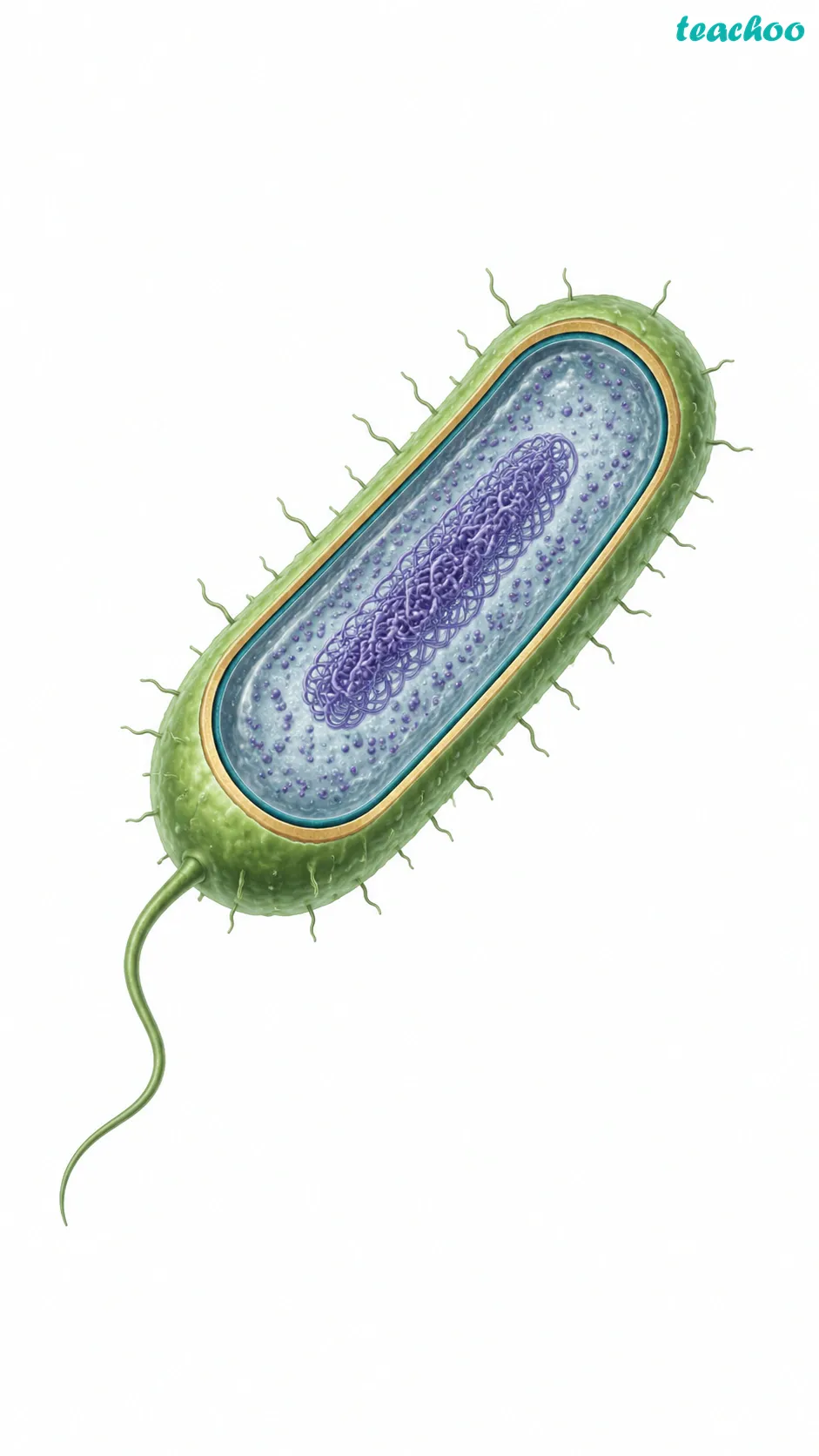
| Well-defined nucleus | ✓ | ✓ | ✓ | ✗ (has nucleoid) |
| Chloroplast | ✗ | ✓ | ✗ | ✗ |
Nucleoid
Bacterial Cell
Can we see all parts of a cell using a normal microscope?
A normal microscope shows
It cannot show
The basic parts of a cell
The tiny sub-parts inside
Membrane, cytoplasm, nucleus
Fine structures that need higher magnification
- No — a normal microscope shows only the basic parts .
- The tiny sub-parts need much higher magnification .
What is an electron microscope? Why is it used?
Electron microscope
A powerful microscope
far stronger than a light microscope
Magnifies about 10,00,000×
reveals the tiniest parts of a cell
↓
An electron microscope magnifies a cell about 10,00,000 times to show its tiniest parts.
- An electron microscope is far more powerful than a light one.
- It magnifies a cell about 10,00,000 times.
✅ Test Yourself
-
Which microbe makes dough rise, and which gas causes it?
View Answer
Yeast; the gas is carbon dioxide. -
Rhizobium
in root nodules traps ______ from the air.
View Answer
Nitrogen. -
Name one everyday food made with the help of bacteria.
View Answer
Curd (also idli, dosa or bhatura ).
📋 NCERT Question 1 — Various parts of a cell
Various parts of a cell are given below. Write them in the appropriate places in the following diagram.
View Answer →
📖 Important Definitions
- Nucleoid — The region in a bacterial cell holding genetic material, without a nuclear membrane.
- Electron microscope — A microscope that magnifies a cell about 10,00,000 times.
📝 Summary - What we have learnt
- Every living body is built from cells.
- Unicellular organisms do everything in one cell; multicellular ones share the work.
- Bacteria have a nucleoid, not a true nucleus.
- An electron microscope shows the tiniest parts.

