
 You are here
💬 Think about it
- A building is built from bricks.
- What is a living body built from?
- Just as bricks stack to make a wall, tiny units stack to make a body.
What is a cell?
![2.1 What Is a Cell? - The Invisible Living W - [Teachoo] - Concepts](https://cdn.teachoo.com/d2090b99-9983-44dd-8200-7efc86b9d14d/image-onion-peel-viewed-under-a-microscope-showing-many-small-rectangular-box-like-cells-packed-closely-together-like-bricks-in-a-wall.webp)
Cell
Small empty space
What Hooke saw in a
thin slice of cork
Basic unit of life
the smallest building block of every living body
↓
A cell is the basic unit of life and every living body
is made of one or more cells.
Structure of Cell
A wall made of Brick
Same resemblance
- A cell is the basic unit of life.
- Our human body is made of billions of cells.
Are cells found in plants or animals?
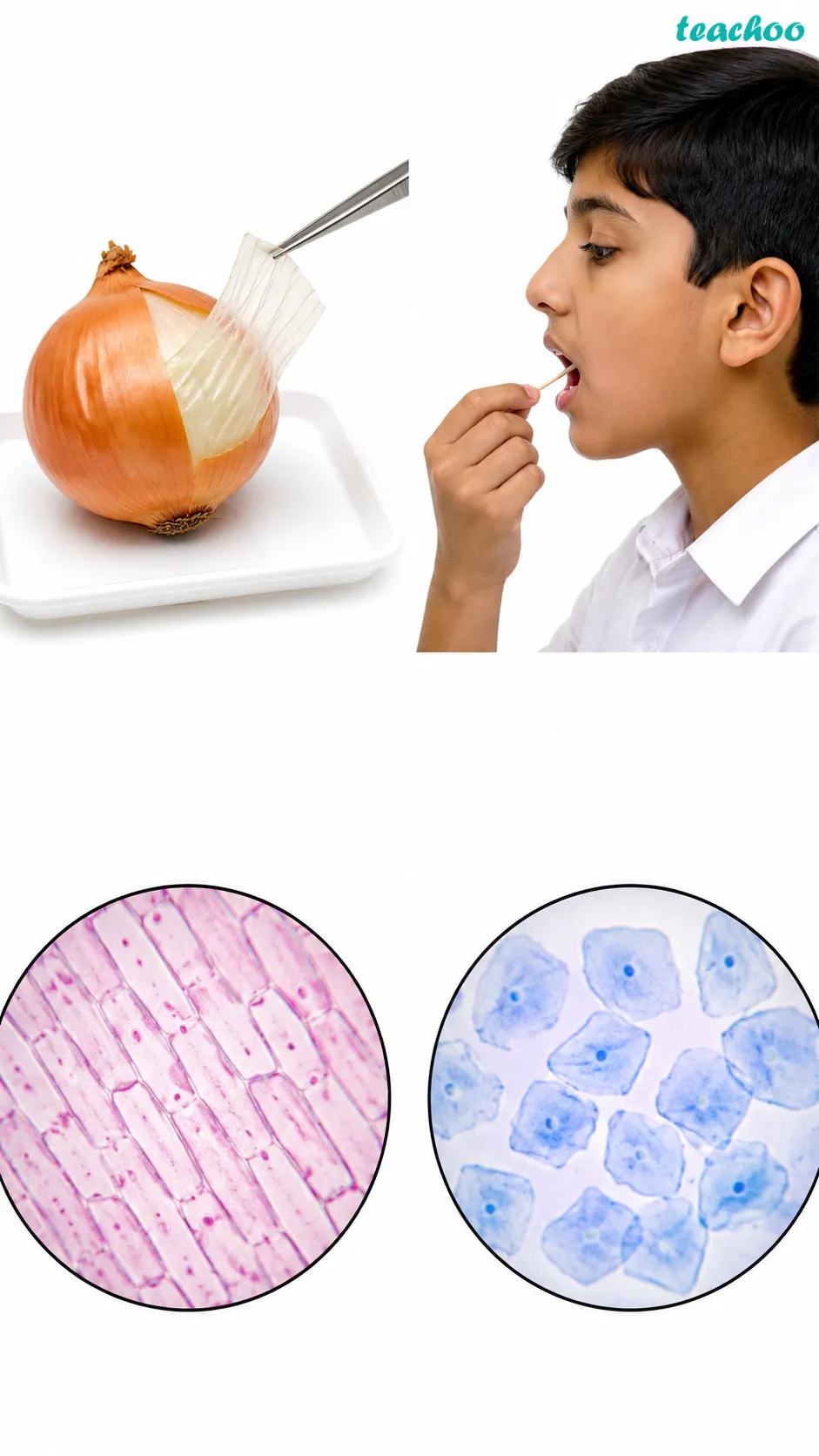
In plants
In animals
Onion-peel cells are plant cells
Cheek cells are animal cells
Nearly rectangular, with a cell wall
Polygon-shaped, no cell wall
Plant Cell
Animal Cell
Onion Peel Cells
Cheek Cells
- Cells are present in both plants and animals.
- Onion-peel cells are plant cells; cheek cells are animal cells.
🔬
Activity 2.2 — Let us study a cell (Teacher demonstration activity)
How do we prepare an onion peel slide?
Wash an onion and cut it
Cut the bulb vertically into pieces
↓
Pull out the thin inner peel
Use forceps to lift the transparent layer
↓
Stain it with safranin
30 seconds in the red stain, then rinse in water
↓
Mount it in glycerin
Lower a coverslip at 45°, then blot the extra glycerin
↓
Under the microscope: nearly rectangular cells, packed with no space — like bricks in a wall
In this Activity, we will prepare an onion peel slide and look at plant cells under a microscope.
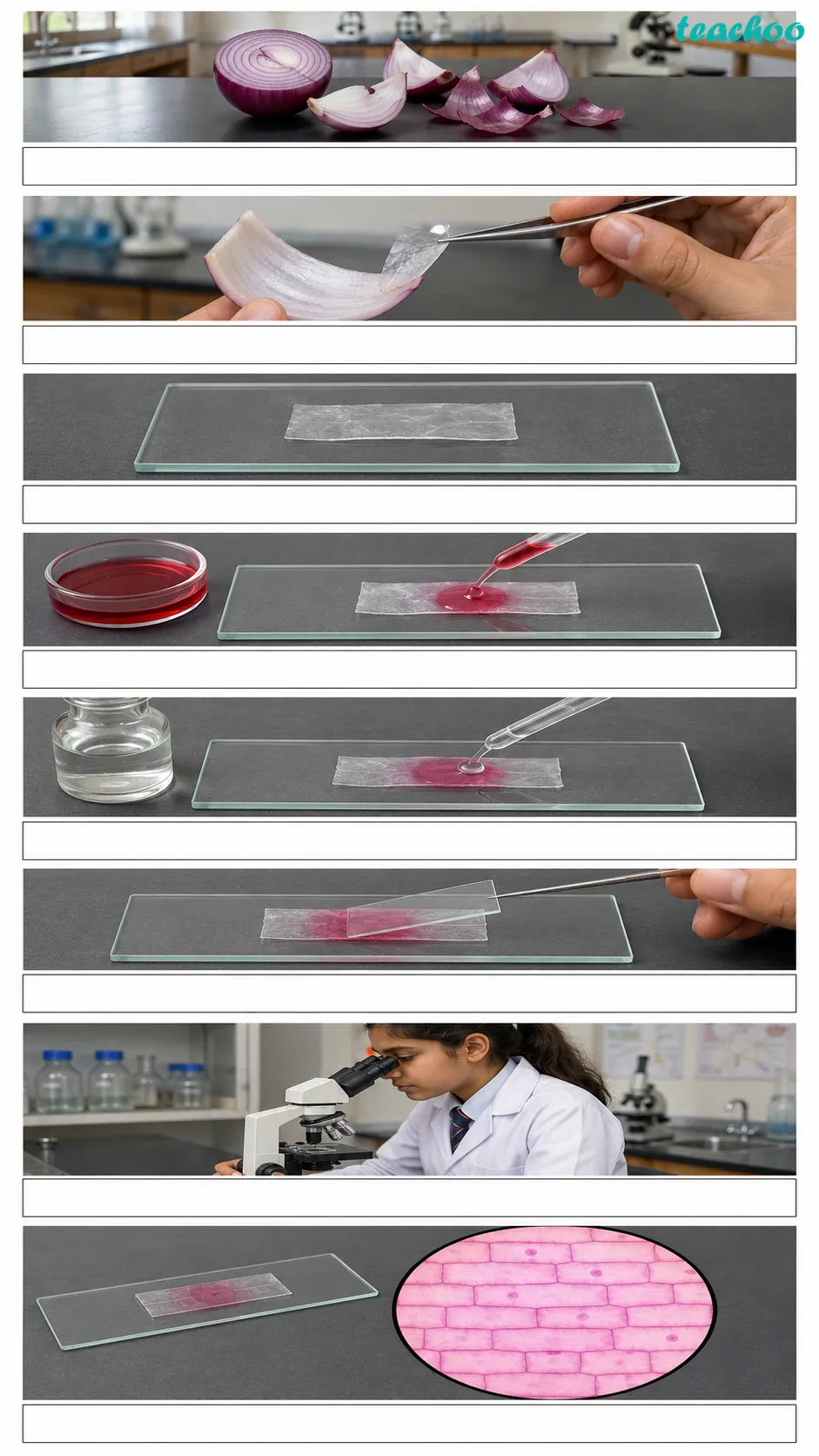
Take an onion and break it into pieces.
Peel a thin, transparent layer from the inner side of a piece.
Place this peel flat on a clean glass slide.
Gently lower a coverslip with a needle, avoiding air bubbles.
Place the slide under the microscope and focus.
Add a drop of glycerin over the peel.
Put one or two drops of safranin stain on it.
You see nearly rectangular cells packed closely together, like bricks in a wall.
Materials needed
An onion, a blade, safranin stain, glycerin, a glass slide, a coverslip, a needle, and a microscope.
Procedure
1. Take an onion and break it into pieces.
2. Peel a thin, transparent layer from the inner side of a piece.
3. Place this peel flat on a clean glass slide.
4. Put one or two drops of safranin stain on it.
5. Add a drop of glycerin over the peel.
6. Gently lower a coverslip with a needle, avoiding air bubbles.
7. Place the slide under the microscope and focus.
2. Peel a thin, transparent layer from the inner side of a piece.
3. Place this peel flat on a clean glass slide.
4. Put one or two drops of safranin stain on it.
5. Add a drop of glycerin over the peel.
6. Gently lower a coverslip with a needle, avoiding air bubbles.
7. Place the slide under the microscope and focus.
Observation
You see nearly rectangular cells packed closely together, like bricks in a wall.
Explanation
The onion peel is made of many cells, which shows that all plants are made of cells.
Onion peel cells are nearly rectangular and packed with no space between them — like bricks in a wall.
◆ Summary
- Onion peel shows packed cells
- Cells look like bricks in a wall
- Confirms plants are made of cells
🔬
Activity 2.3 — Let us investigate
How do we prepare a cheek cell slide?
Rinse your mouth with clean water
Then scrape the inner cheek with a blunt toothpick
↓
Spread the scraping on a slide
In a drop of water, spread evenly
↓
Add a drop of methylene blue
The blue stain increases the contrast
↓
Add glycerin and a coverslip
After a minute; blot off the excess
↓
Under the microscope: polygon-shaped cheek cells — a membrane, cytoplasm and nucleus, but no cell wall
In this Activity, we will prepare a slide of our own cheek cells and compare them with onion peel cells.
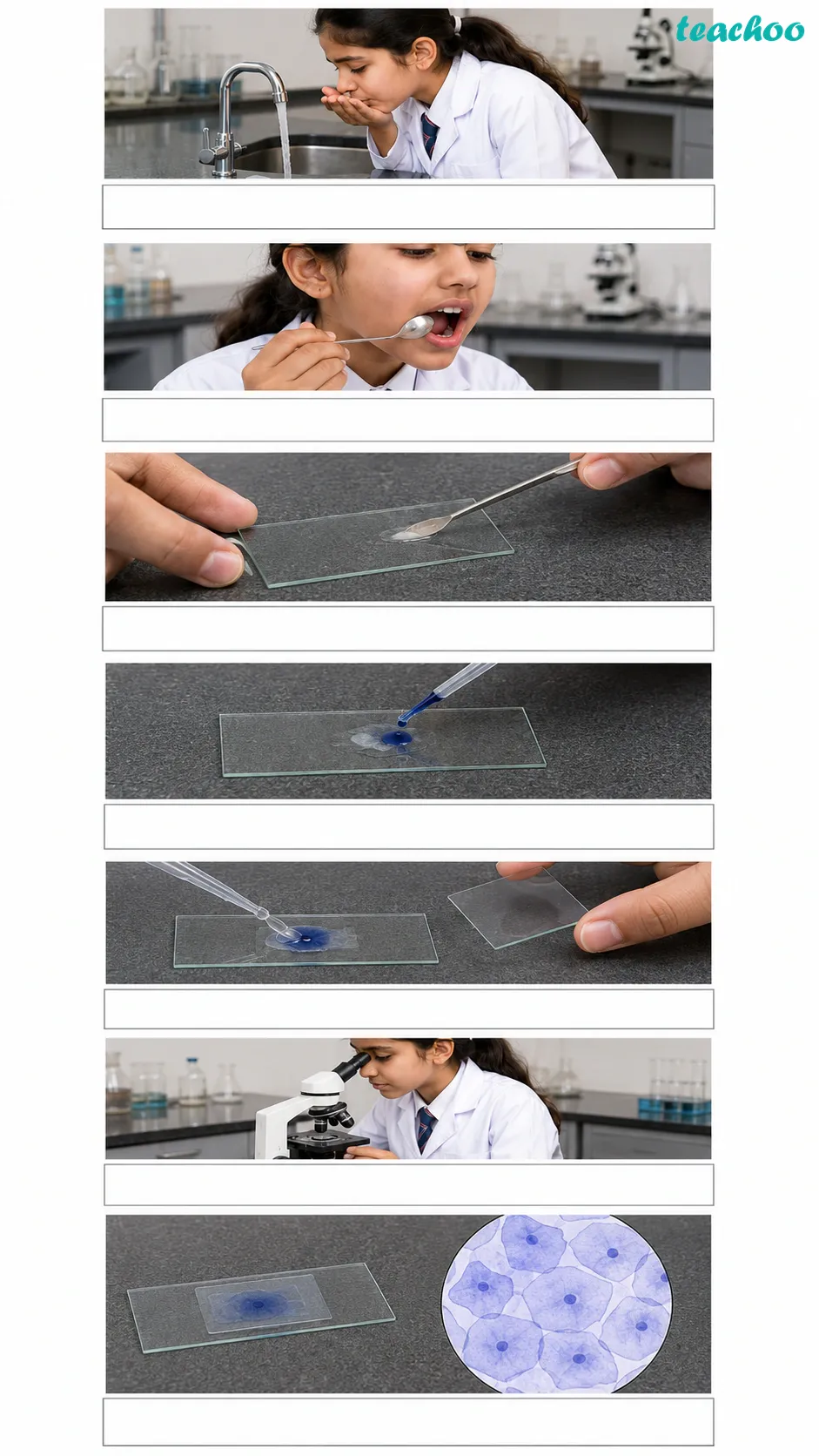
Rinse your mouth well with clean water.
Gently scape the inside of your cheek with the spoon.
Add a drop of glycerin and place a coverslip over it.
Add a drop of methylene blue stain.
Spread the scraping on a clean glass slide.
You see polygon - shaped cells.
Observe the slide under the microscope.
Materials needed
A clean spoon or ice-cream stick, methylene blue stain, glycerin, a glass slide, a coverslip, and a microscope.
Procedure
1. Rinse your mouth well with clean water.
2. Gently scrape the inside of your cheek with the flat side of a clean spoon.
3. Spread the scraping on a clean glass slide.
4. Add a drop of methylene blue stain.
5. Add a drop of glycerin and place a coverslip over it.
6. Observe the slide under the microscope.
2. Gently scrape the inside of your cheek with the flat side of a clean spoon.
3. Spread the scraping on a clean glass slide.
4. Add a drop of methylene blue stain.
5. Add a drop of glycerin and place a coverslip over it.
6. Observe the slide under the microscope.
Observation
You see polygon-shaped cells that form the lining of the mouth. They have a membrane, cytoplasm, and nucleus, but no cell wall.
Explanation
Animal cells like cheek cells have the basic parts but lack a cell wall, unlike plant cells.
Cheek cells are polygon-shaped and have no cell wall — only a membrane, cytoplasm and nucleus.
◆ Summary
- Cheek cells are an animal cell example
- They have membrane, cytoplasm, nucleus
- They have no cell wall
What are the parts common to ALL cells?
Which parts does every cell have?
Every cell
Three basic parts
Cell membrane
The outer boundary
Example:
Lets materials in and
waste out
Cytoplasm
Fills the cell
Example:
Where most life processes happen
Nucleus
The control centre
Example:
Controls all activities and growth
- Every cell has three basic parts: cell membrane , cytoplasm and nucleus .
- Some cells, like plant cells, have an extra layer — the cell wall — on top of these three.
What are the different parts of an animal cell?
| Part | Description | Function |
|---|---|---|
| Cell membrane | The porous outer boundary | Lets materials in and waste out |
| Cytoplasm | Jelly-like material filling the cell | Where most life processes happen |
| Nucleus | Round body in the centre | Controls all activities and growth |
- An animal cell has a cell membrane, cytoplasm and a nucleus.
- It has no cell wall, no chloroplast and no large vacuole.
What are the different parts of a plant cell?
| Part | Description | Function |
|---|---|---|
| Cell wall | Strong outer layer outside the membrane | Gives the plant rigidity and strength |
| Cell membrane | Porous boundary inside the wall | Lets materials in and waste out |
| Cytoplasm | Jelly-like material filling the cell | Where most life processes happen |
| Nucleus | Round body in the centre | Controls all activities and growth |
| Chloroplast | Green structure with chlorophyll | Makes food by photosynthesis |
| Large vacuole | Big fluid-filled space | Stores substances and keeps shape |
- A plant cell has all three basic parts plus a cell wall .
- It also has chloroplasts and a large vacuole .
How do plant and animal cells differ?
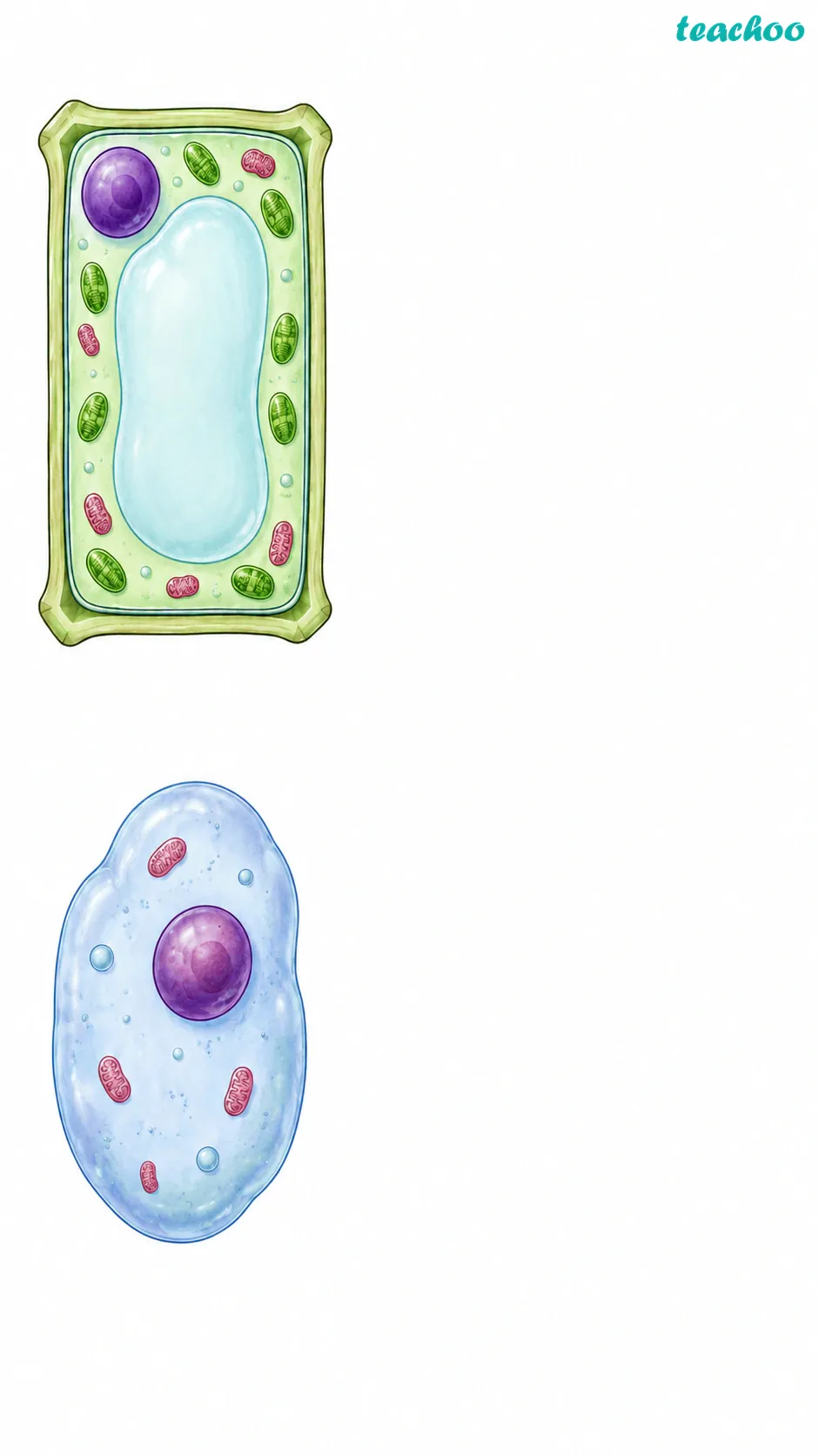
Animal cell
Plant cell
No cell wall
Has a cell wall
No chloroplast
Has chloroplasts
Small or no vacuole
Has a large vacuole
Plant Cell
Animal Cell
Cell Membrane
Vacuole
Nucleus
Cell wall
Chloroplast
Cytoplasm
Cytoplasm
Nucleus
Cell Membrane
- A plant cell has a cell wall, chloroplasts and a large vacuole.
- An animal cell has none of these extras.
📚 A step further
- Plant cells have tiny rod-shaped structures called plastids .
- Some plastids, like chloroplasts , hold chlorophyll — this makes them green and helps in photosynthesis.
- In the non-green parts of a plant, plastids store substances instead.
- Plant cells also have a large, empty-looking space called a vacuole , which stores substances, removes waste, and keeps the cell’s shape.
- In animal cells vacuoles are usually absent; if present, they are small.
- So a cell is not a simple bag of liquid — it is a complex structure whose many parts each do a special job.
✅ Test Yourself
-
Name the three basic parts of a cell.
View Answer
Cell membrane, cytoplasm and nucleus. -
Which part controls all the cell’s activities?
View Answer
The nucleus. -
Why is a nerve cell long and branched?
View Answer
So it can reach far and carry messages quickly across the body.
📝 Summary - What we have learnt
- A cell is the basic unit of life.
- Every cell has a membrane, cytoplasm and nucleus.
- Plant cells have an extra cell wall, chloroplasts and a vacuole.
- Cells are found in both plants and animals.

