
 You are here
What are microalgae, and why do they matter?
![2.4.3 Amazing microalgae: tiny h - The Invisible Living W - [Teachoo] - Concepts](https://cdn.teachoo.com/262b793f-a7ab-423f-9d0b-5262d8a967a0/image-green-microalgae-like-spirulina-and-chlorella-floating-in-water-and-releasing-oxygen-bubbles-in-sunlight.webp)
Microalgae
micro
very small
algae
plant-like, makes its own food
↓
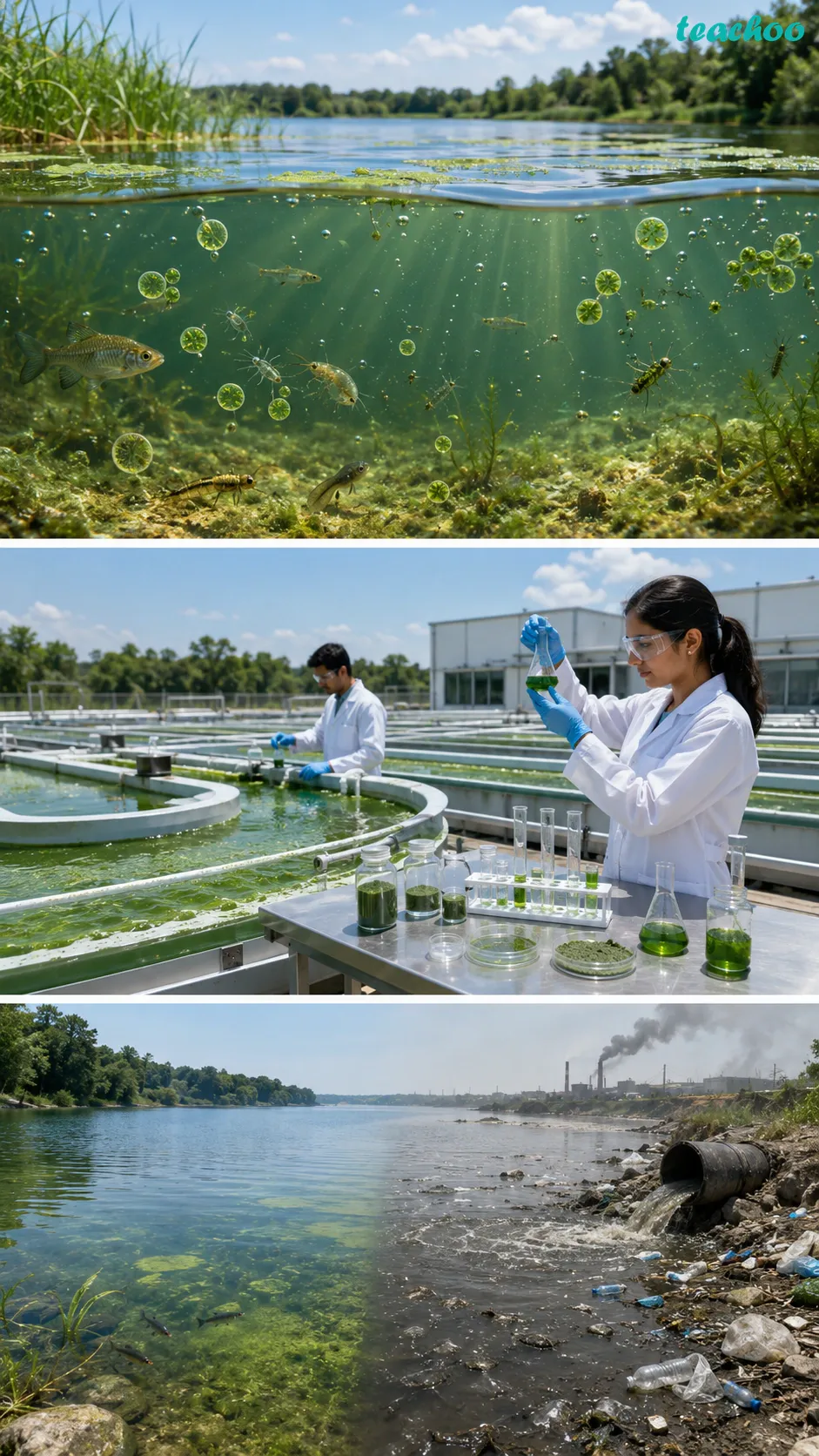
Microalgae are microscopic plant-like organisms that make their own food using sunlight.
- They are microscopic plant-like organisms.
- They make their own food using sunlight and release oxygen.
- They produce more than half of Earth's oxygen.
What are the benefits of microalgae?
Why do microalgae matter to us?
Microalgae
Tiny plant-like organisms
They give oxygen
Half of Earth's oxygen
Example:
Oxygen released in water
They feed and heal us
Rich in nutrients
Example:
Spirulina
Chlorella
Diatoms
They clean and fuel
Clean water, make biofuel
Example:
Biofuel
Feed water animals and clean water
We must conserve them
Used to make Biofuel and Medicines
- Microalgae give oxygen — more than half of Earth’s oxygen.
- They feed and heal us as food, supplements and medicine.
- They clean water and give biofuel .
What is affecting microalgae diversity?
| Threat | Effect |
|---|---|
| Pollution | Poisons the water they live in |
| Climate change | Warms and disturbs their habitat |
| Habitat destruction | Leaves them nowhere to live |
Why should we conserve microalgae?
| Reason to conserve | Why it matters |
|---|---|
| They balance Earth’s oxygen | Most life depends on this oxygen |
| They support food security | They feed people and animals |
🎉 Ever heard of ...
- Spirulina is a microalga called a "superfood".
- It is over 60% protein and rich in vitamin B12.
- It has very little fat or sugar.
- It can be grown easily in tanks of pond water.
What are the benefits of microorganisms? (a quick recap)
| Benefit | Example |
|---|---|
| Clean the environment | Decompose waste, make manure |
| Give us food | Curd, bread, idli, dosa |
| Enrich the soil | Rhizobium fixes nitrogen |
| Give fuel | Biogas |
| Give oxygen | Microalgae |
What are the disadvantages of microorganisms?
Helpful
Harmful
Clean waste, make food, fix nitrogen
Spoil food if it is left out
Give biogas and oxygen
Cause various diseases (studied next chapter)
- Microbes can also spoil food if it is left out.
- Some can cause diseases — which we will study in the next chapter.
📖 Important Definitions
- Microalgae — Microscopic plant-like organisms that make food using sunlight and release oxygen.
📝 Summary - What we have learnt
- Microalgae make their own food and release over half of Earth’s oxygen.
- They are used as supplements, medicine and biofuel.
- Pollution threatens them, so they must be conserved.

