 You are here

Understanding the Name of the Chapter
Invisible
Too small for our eyes to see.
Living World
The living things around us.
Beyond Our Naked Eye
What we can see only with a microscope.
What are the different living things around us?
![Introduction - The Invisible Living W - [Teachoo] - Concepts](https://cdn.teachoo.com/4bcd9cbb-f8ac-4c50-840e-4552a31fd8e4/image-a-variety-of-living-beings-tall-trees-animals-small-insects-and-tiny-invisible-microbes-all-called-organisms-shown-by-size-fr.webp)
How do living things around us differ?
Living things
All around us
Big ones
We can see them easily
Example:
Trees
Cows
Humans
Tiny ones
Hard or impossible to see
Example:
Insects
Tinier life
- Living beings come in all shapes, sizes and colours.
- Some are really big; some are so tiny we cannot see them.
- All these living beings, whether plants or animals, are called organisms .
Can we see all living things with our naked eye?
We can see
We cannot see
Plants and trees
Living things far too small
Animals and birds
They hide from the naked eye
Humans and insects
We need a tool to see them
- The human eye can see only things above a certain size.
- Anything smaller stays hidden until we use a lens.
What are microorganisms?
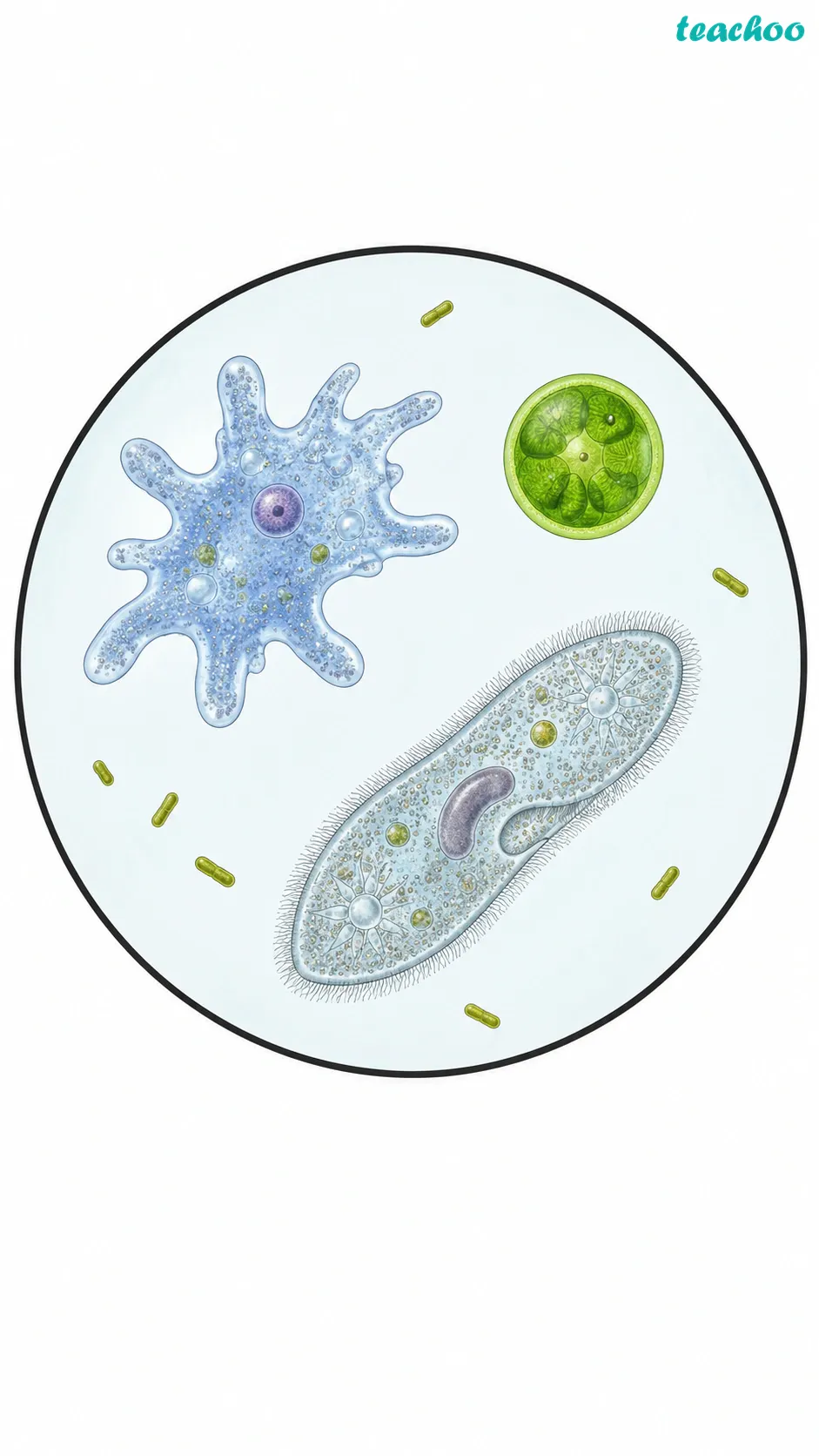
Microorganism
micro
very small
organism
a living being
↓
The tiny living things we cannot see with our eyes are called microorganisms.
What makes a living thing a microbe?
Microorganisms
Too small to see
Too small to see
Needs a microscope
One or very few cells
Example:
Bacteria
Amoeba
Still fully alive
Grows and multiplies
Lives in water, soil, air
Example:
Fungi
Algae
- The tiny living things we cannot see with our eyes are called microorganisms (or microbes).
- We will meet the different kinds later in the chapter.
- These are also called microbes .
How can we see microorganisms?
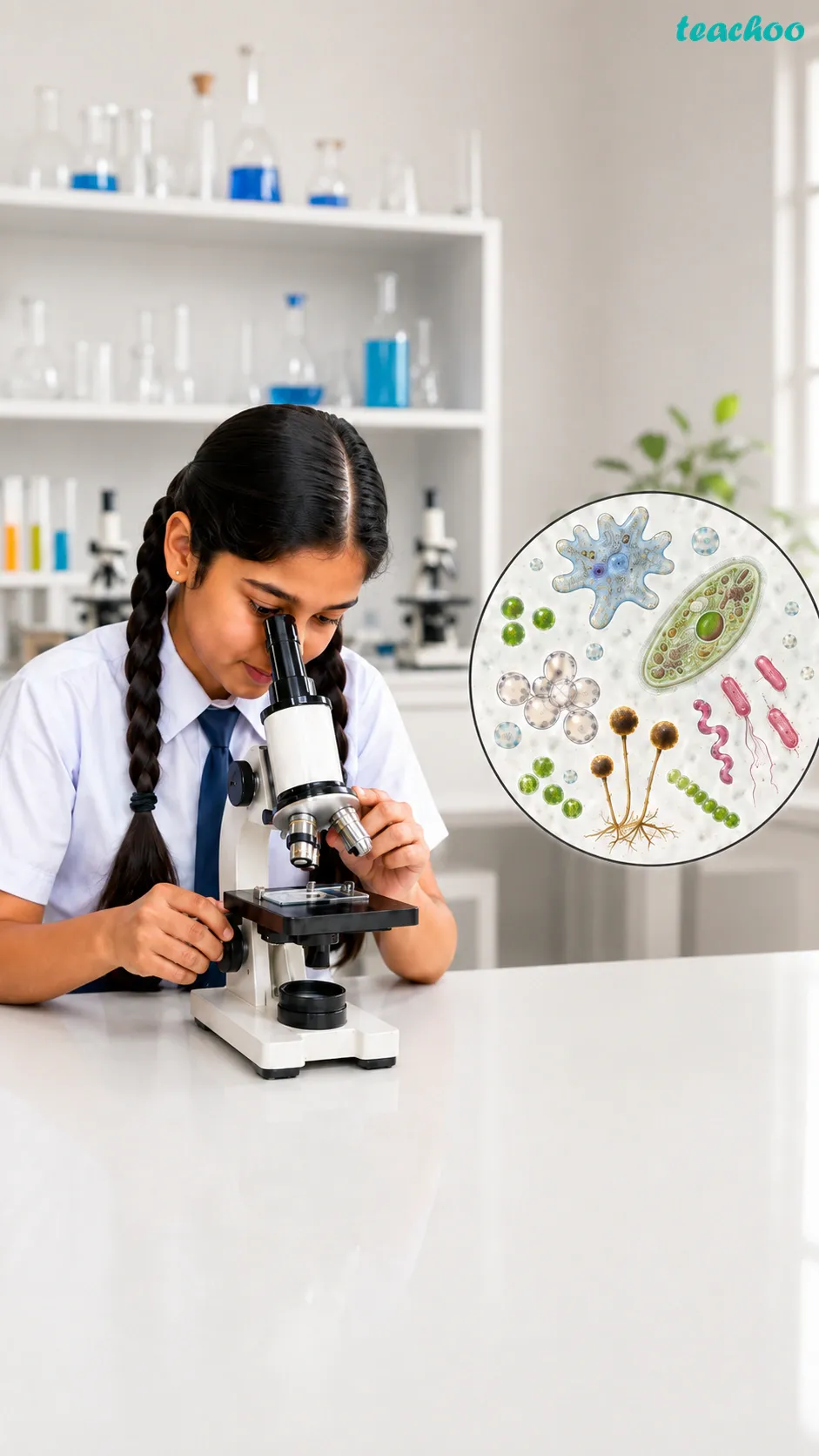
- We can use a microscope to see the basic shapes of microorganisms.
- We use a laboratory microscope to look at them in detail.
How can we see microorganisms?
They are far too small
the naked eye cannot catch them
↓
Use a microscope
it magnifies their size
↓
The microscope makes the invisible visible
How were microscopes invented?
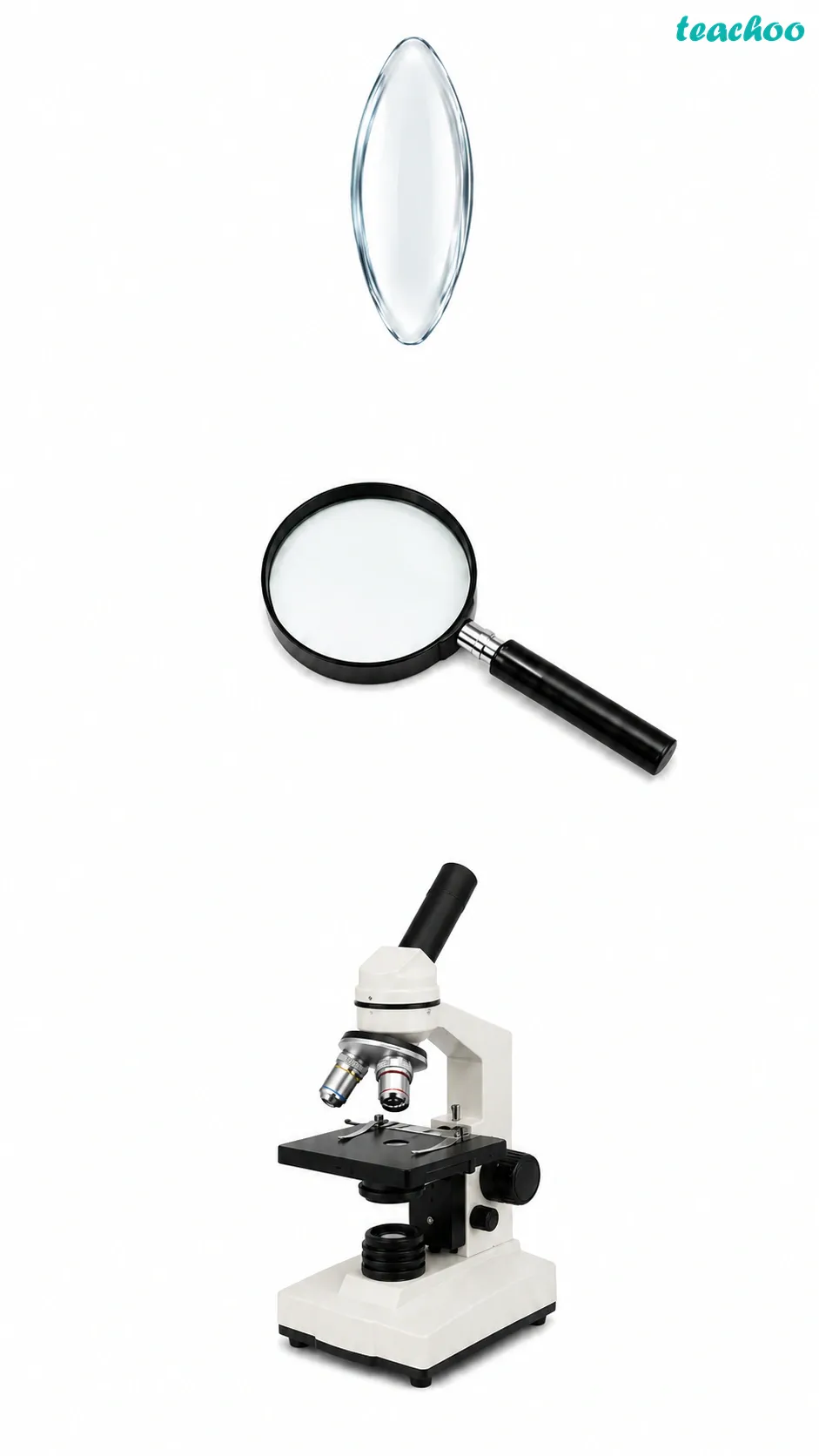
Which invention finally let us see the tiny world?
The naked eye
Sees only things above a certain size
↓
A simple lens
Curved glass makes small things look bigger
↓
The magnifying glass
A stronger lens for a closer look
↓
The microscope
Opened a hidden world of tiny living things
↓
The microscope revealed the invisible living world
LENS
MAGNIFYING GLASS
MICROSCOPE
- People found a curved piece of glass makes small things look bigger.
- It was shaped like a lentil seed, so it was called a lens.
- Better lenses led to magnifying glasses and then the microscope.
- Lenses grew stronger over time.
-
The microscope finally opened the hidden world of tiny living things.
How are we able to see things large using a lens, magnifying glass or microscope?
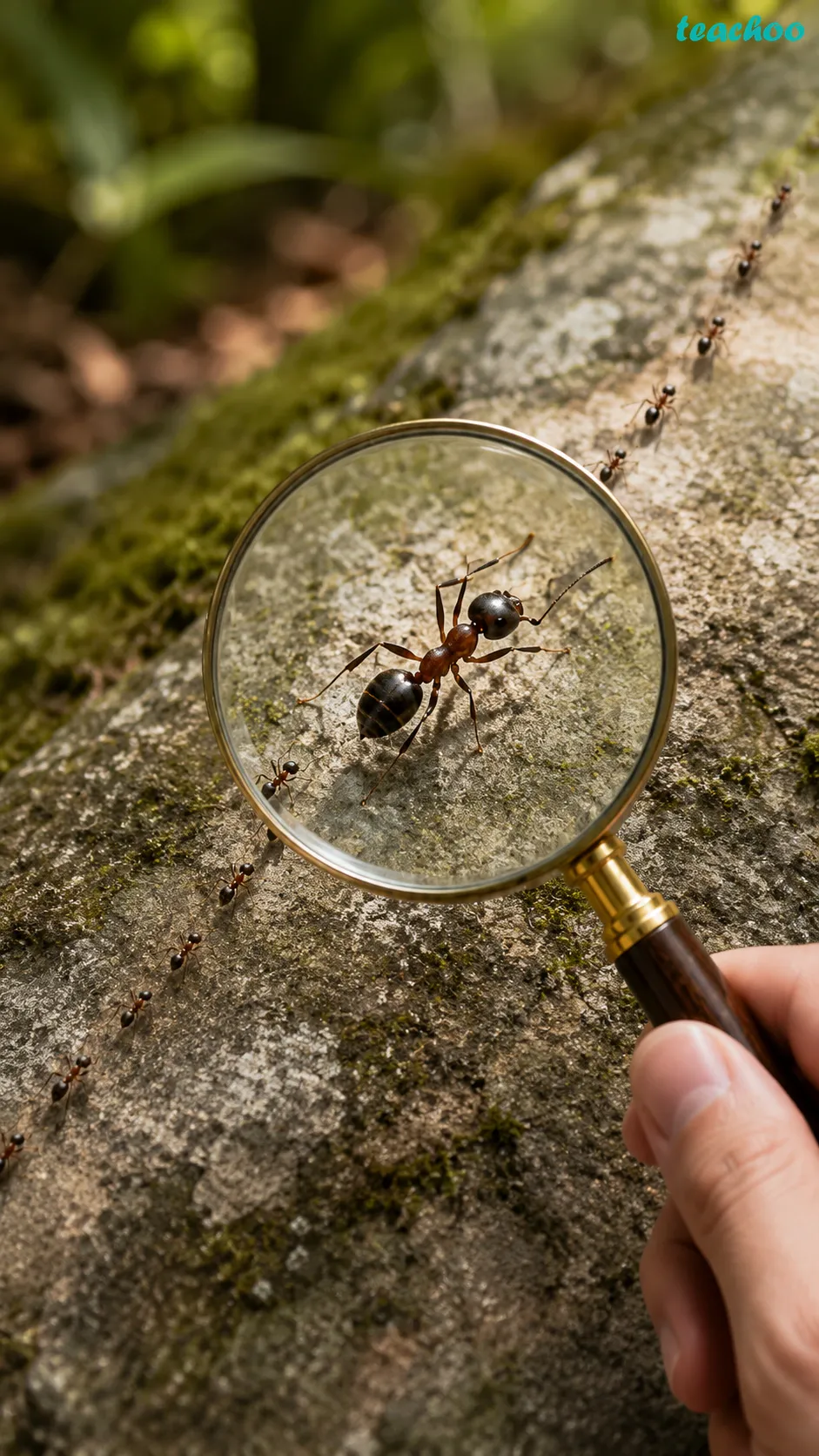
How does a lens make things look bigger?
Curved glass
Thick in the middle, thin at the edge
↓
It bends the light
The rays coming from the object are bent
↓
The object looks larger than it really is
- A lens is a curved piece of glass, shaped like a lentil seed — thick in the middle and thin at the edge.
- A lens magnifies — it makes small objects look larger.
- A magnifying glass and a microscope both use lenses to do this.
Example:
Looking at an ant through a magnifying glass, you can see the fine details of its body clearly.
🔬
Activity 2.1 — Let us observe
How do we make the letters look bigger?
Fill a round-bottom flask with water
A glass flask, filled right up
↓
Close its mouth with a cork
So the water cannot spill
↓
Stand the flask on an open book
And look at the letters through it
↓
The letters look larger — the water-filled flask acts like a magnifying glass
In this Activity, we will observe how a water-filled flask makes letters look larger, and see what a lens really does.
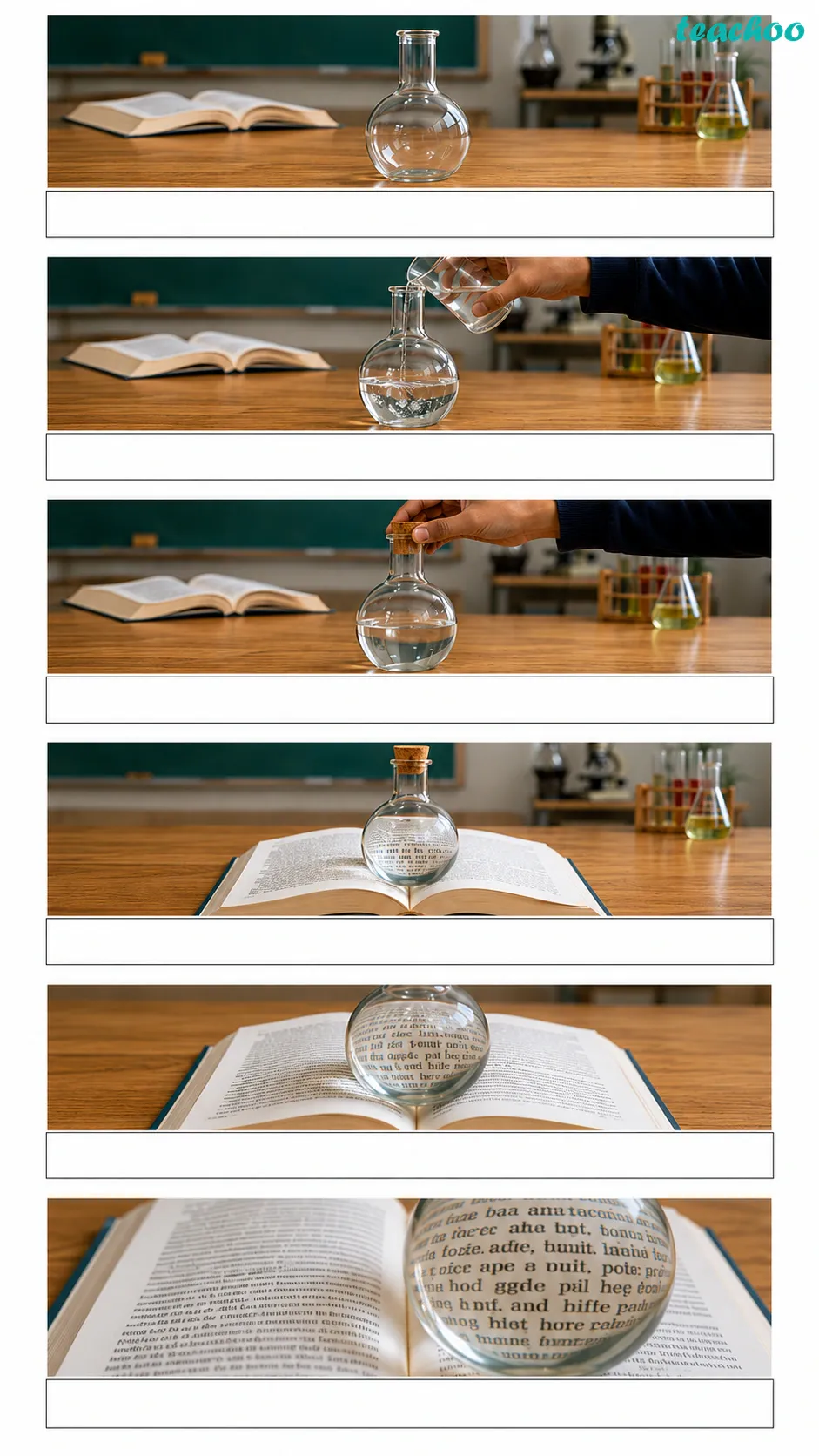
Take a clean round - bottom glass.
Fill it with water.
Close the mouth of the flask with a Cork.
The letters of the book look larger.
Look at the letters of the book through the flask.
Place the flask on an open book.
Materials needed
A round-bottom glass flask, water, a cork, and an open book.
Procedure
1. Take a round-bottom glass flask and fill it with water.
2. Close the mouth of the flask with a cork.
3. Place the flask on an open book.
4. Look at the letters of the book through the flask.
2. Close the mouth of the flask with a cork.
3. Place the flask on an open book.
4. Look at the letters of the book through the flask.
Observation
The letters of the book look larger when seen through the water-filled flask.
Explanation
The water-filled flask acts like a magnifying glass. A curved lens bends light to make small things look bigger — the same idea used in a microscope.
A flask full of water bends light and acts like a magnifying glass, so the letters look larger.
◆ Summary
- A water flask acts as a lens
- A lens makes small things bigger
- This idea led to the microscope
Which scientists invented the microscope?
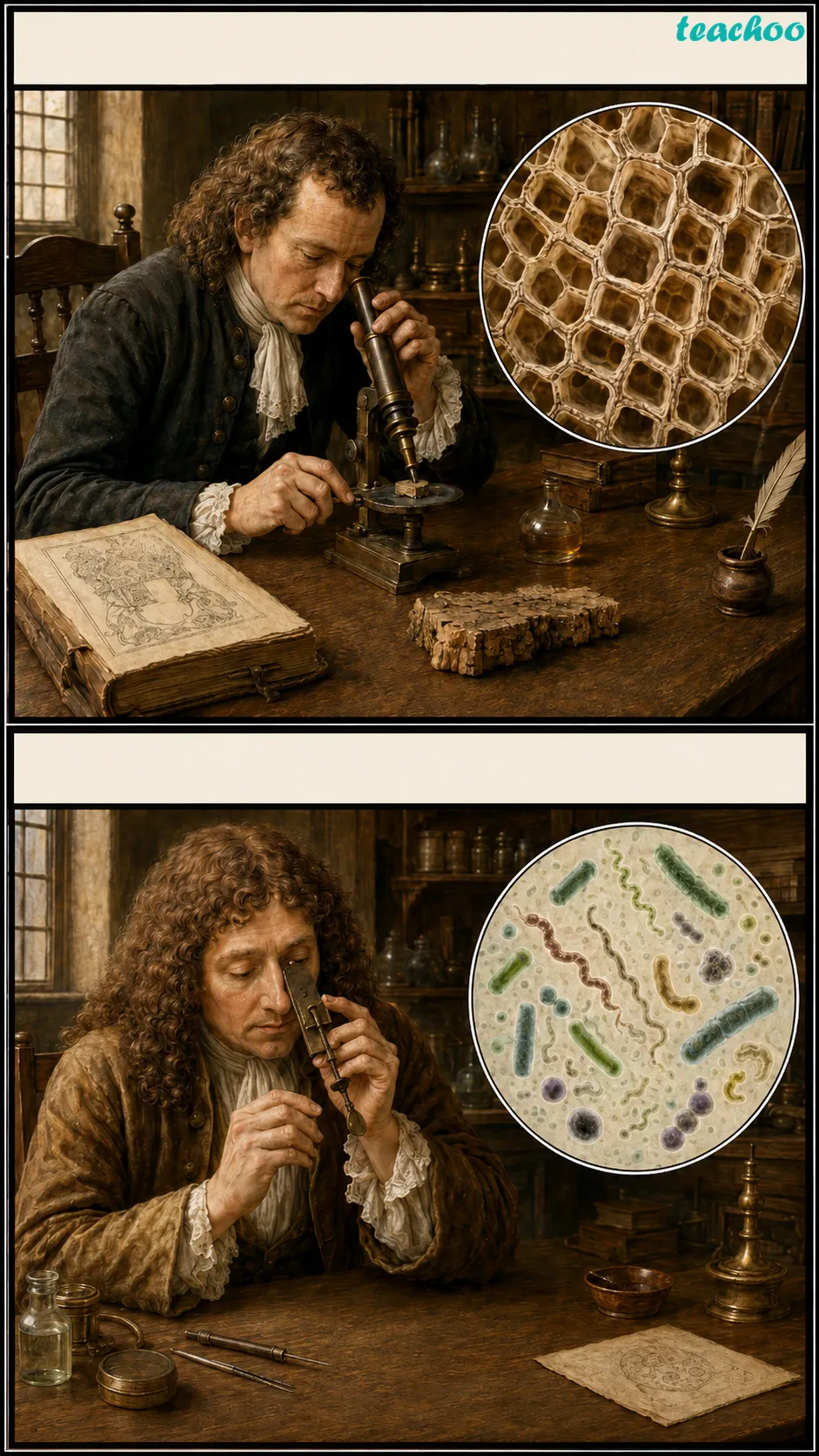
Who first opened the invisible world?
The microscope
Opened a hidden world
Robert Hooke
Looked at a slice of cork
Saw tiny empty boxes
Published a book called:
Micrographia (1665)
Van Leeuwenhoek
Built sharper lenses
Saw tiny living things
He is known as the:
Father of Microbiology
Robert Hooke saw tiny boxes and named each a 'cell'
Van Leeuwenhook is called the Father of Microbiology because he first saw Bacteria
- Hooke and Leeuwenhoek were the scientists who invented microscope.
- In 1665, Robert Hooke published a book called Micrographia.
-
His microscope made things look 200 - 300 times bigger.
- In a slice of cork he saw tiny boxes and named each a "cell".
- Around the same time, Van Leeuwenhoek first saw bacteria.
-
So he is called the Father of Microbiology.
📝 Summary - What we have learnt
- The living things around us come in all sizes; all are called organisms .
- Our naked eye can see only things above a certain size .
- The tiny ones we cannot see are called microorganisms .
- A lens magnifies; the microscope grew from the lens and opened the hidden world.
- Hooke and Leeuwenhoek were the scientists behind the microscope.
Topics we will study in this chapter
Topics We Will Study
Intro
Introduction
2.1
What Is a Cell?
2.2
What Are the Levels of Organisation in the Body of a Living Organism?
2.3
What Are Microorganisms?
2.4
How Are We Connected to Microbes?
2.4.1
Key players in cleaning the environment
2.4.2
Microorganisms and food
2.4.3
Amazing microalgae: tiny helpers in water
2.5
Why Is Cell Considered to Be a Basic Unit of Life?
💬 Think about it
- Look around you.
- You see different living things — plants, animals and human beings.
- But there are many we cannot see , because they are very small.
- To see them, we use a microscope .

