You are here
End-of-Chapter Exercises
End-of-Chapter Exercises
Last updated at August 14, 2026 by Teachoo
Transcript
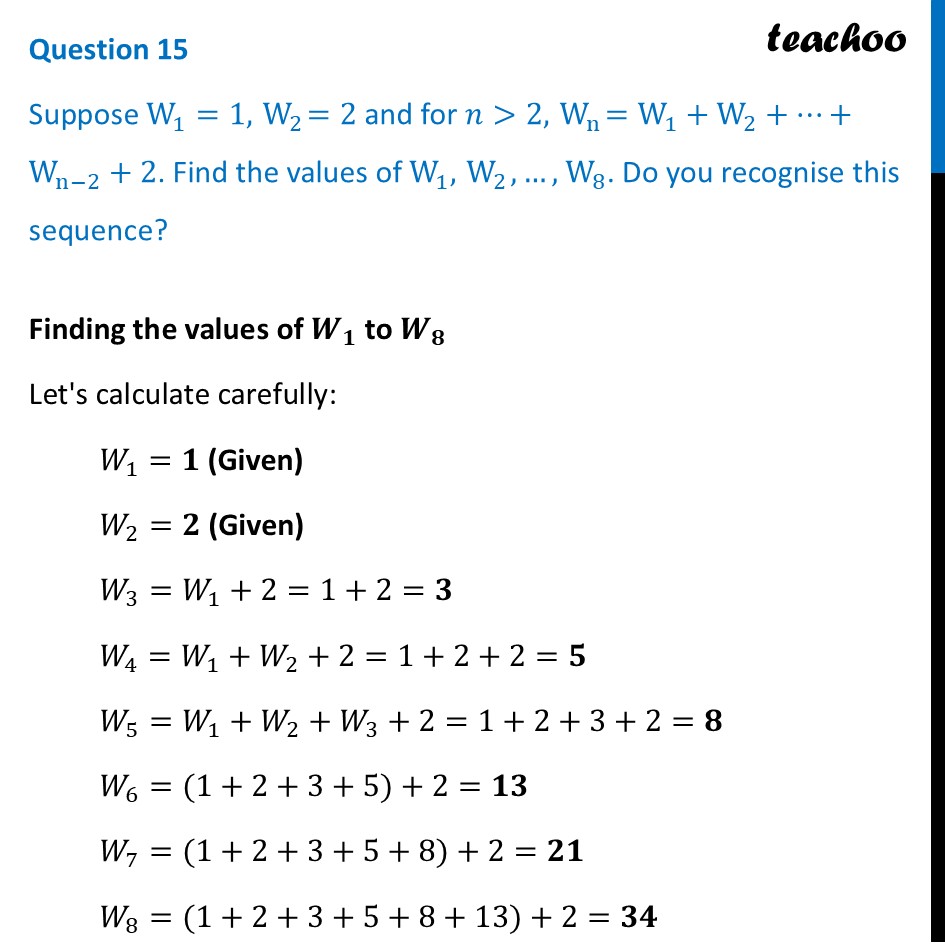
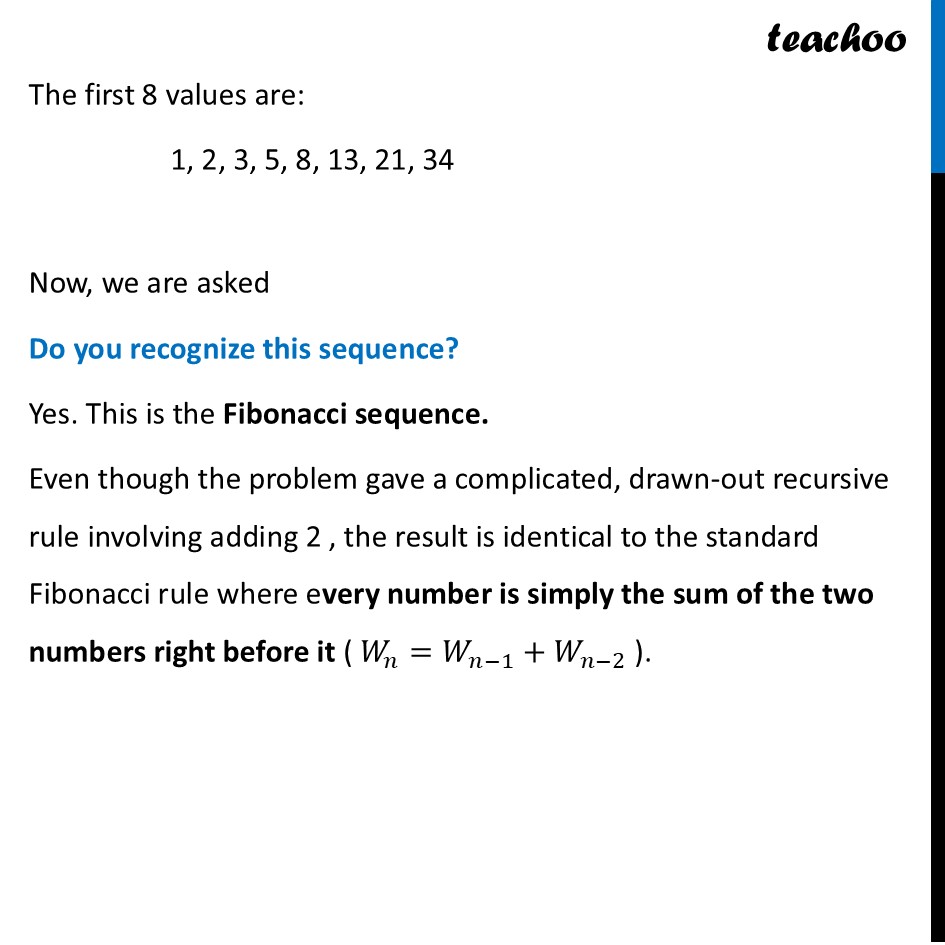
Question 15 Suppose W_1=1,〖" " W〗_2=2 and for 𝑛>2,〖" " W〗_n=W_1+W_2+⋯+W_(n−2)+2. Find the values of W_1,〖" " W〗_2,…,〖" " W〗_8. Do you recognise this sequence? Finding the values of 𝑾_𝟏 to 𝑾_𝟖 Let's calculate carefully: 𝑊_1=𝟏 (Given) 𝑊_2=𝟐 (Given) 𝑊_3=𝑊_1+2=1+2=𝟑 𝑊_4=𝑊_1+𝑊_2+2=1+2+2=𝟓 𝑊_5=𝑊_1+𝑊_2+𝑊_3+2=1+2+3+2=𝟖 𝑊_6=(1+2+3+5)+2=𝟏𝟑 𝑊_7=(1+2+3+5+8)+2=𝟐𝟏 𝑊_8=(1+2+3+5+8+13)+2=𝟑𝟒 The first 8 values are: 1,2,3,5,8,13,21,34 2. Do you recognize this sequence? Yes. This is the Fibonacci sequence. Even though the problem gave a complicated, drawn-out recursive rule involving adding 2 , the result is identical to the standard Fibonacci rule where every number is simply the sum of the two numbers right before it ( 𝑊_𝑛=𝑊_(𝑛−1)+𝑊_(𝑛−2) ).