You are here
End-of-Chapter Exercises
End-of-Chapter Exercises
Last updated at August 14, 2026 by Teachoo
Transcript
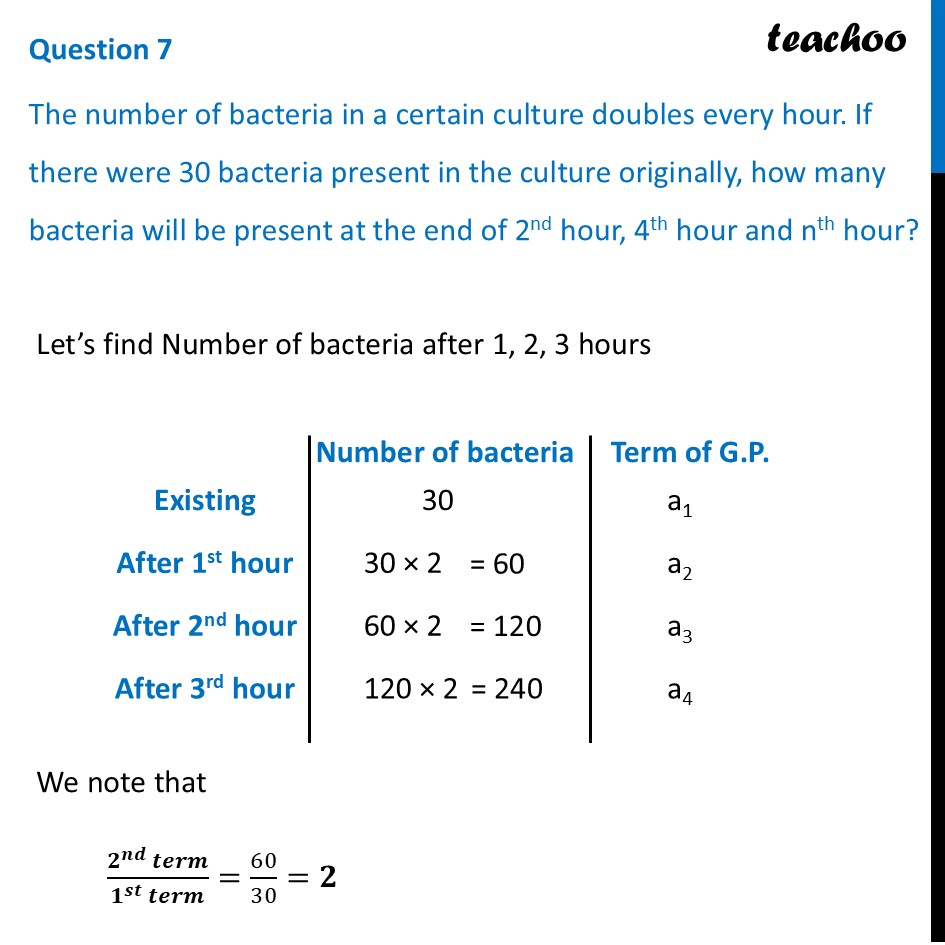
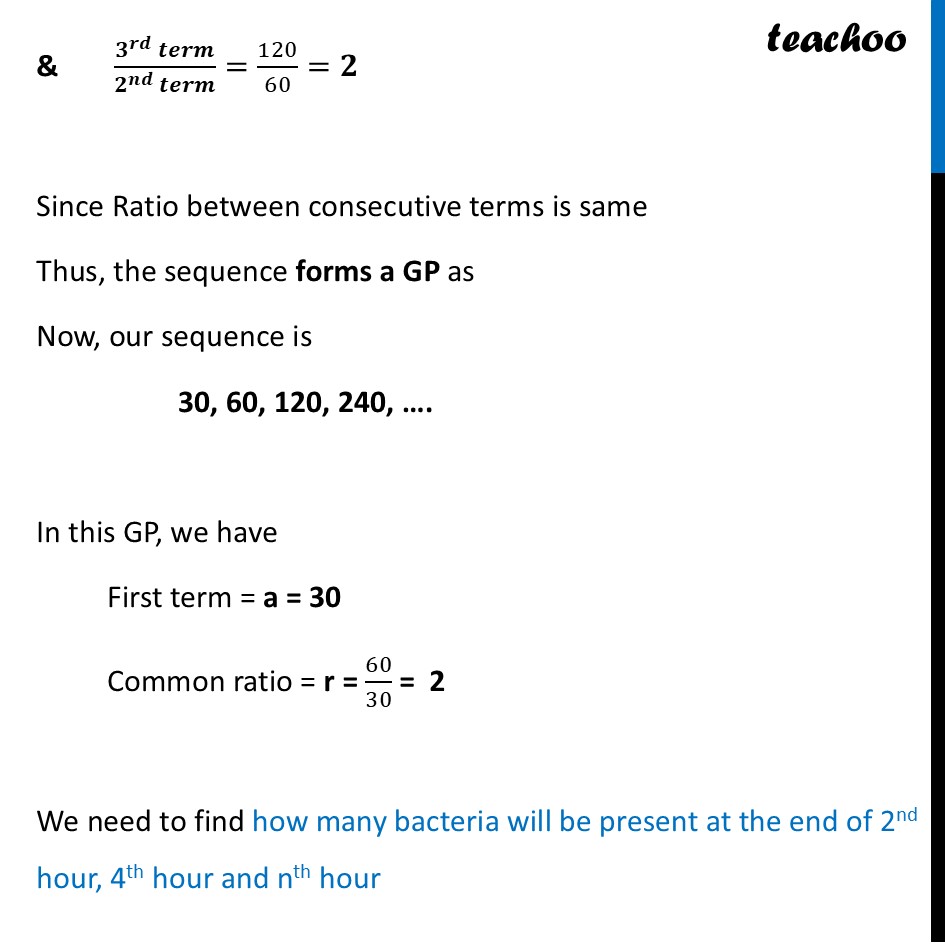
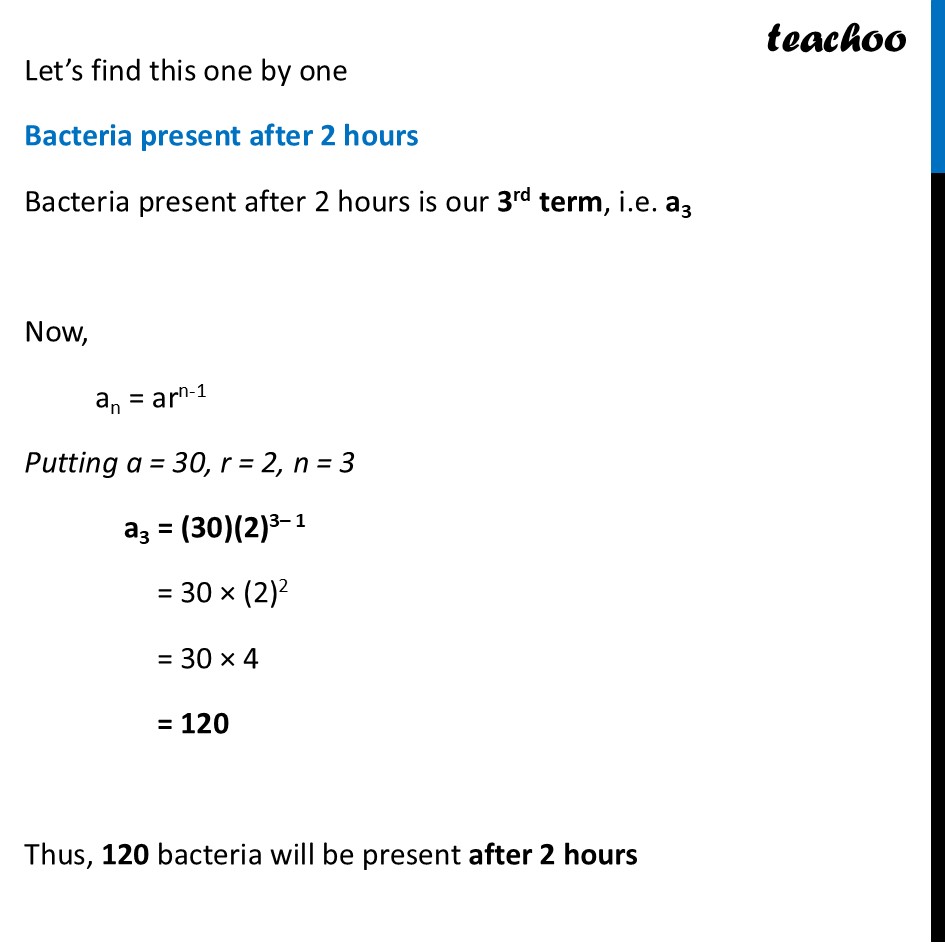
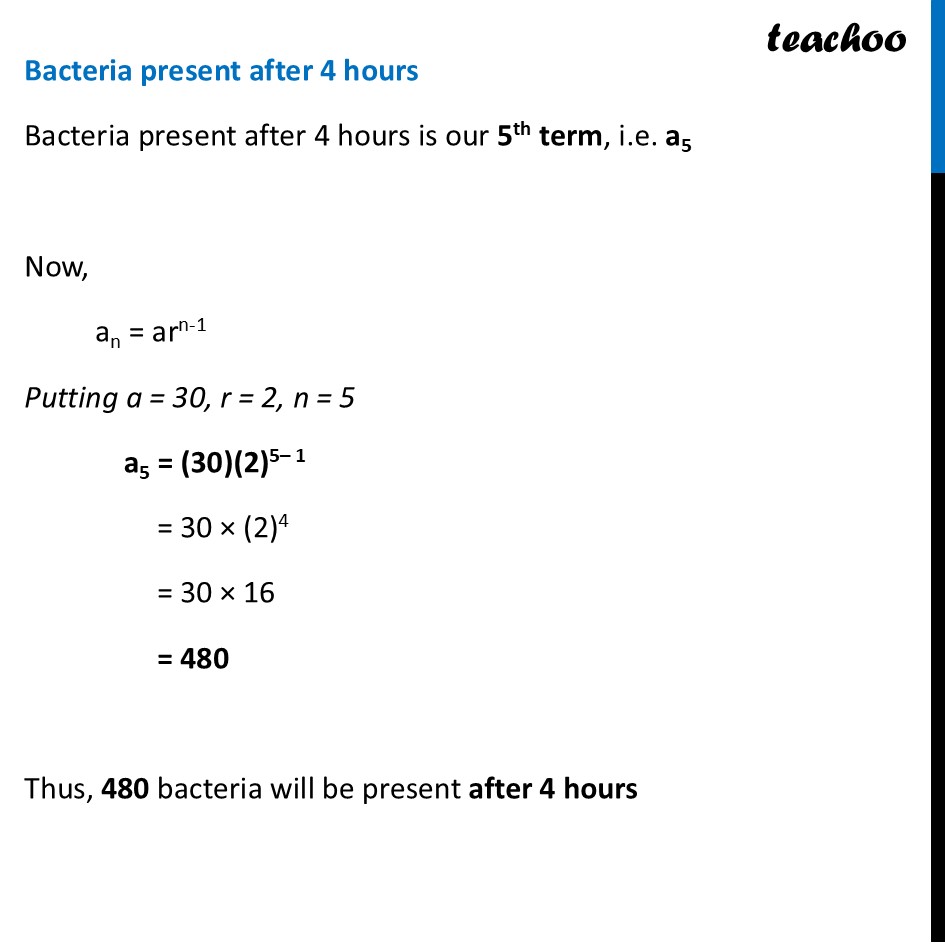
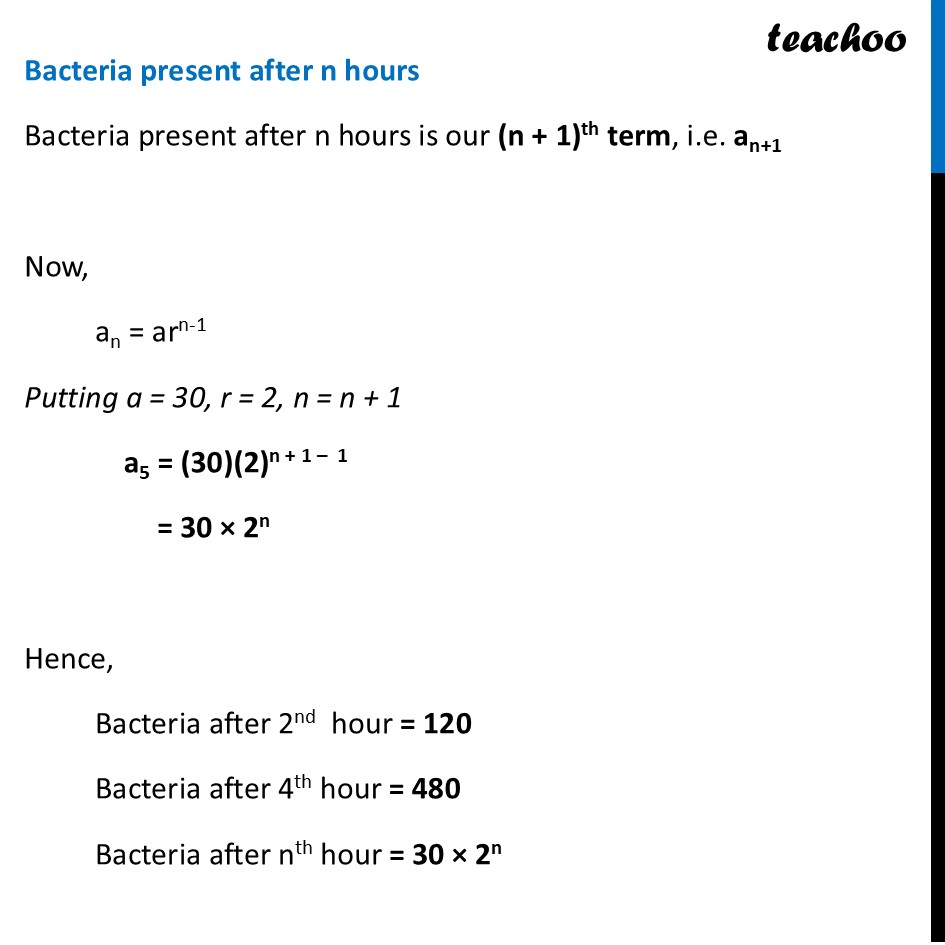
Question 7 The number of bacteria in a certain culture doubles every hour. If there were 30 bacteria present in the culture originally, how many bacteria will be present at the end of 2nd hour, 4th hour and nth hour? Let’s find Number of bacteria after 1, 2, 3 hours We note that (𝟐^𝒏𝒅 𝒕𝒆𝒓𝒎)/(𝟏^𝒔𝒕 𝒕𝒆𝒓𝒎)=60/30=𝟐 & (𝟑^𝒓𝒅 𝒕𝒆𝒓𝒎)/(𝟐^𝒏𝒅 𝒕𝒆𝒓𝒎)=120/60=𝟐 Since Ratio between consecutive terms is same Thus, the sequence forms a GP as Now, our sequence is 30, 60, 120, 240, …. In this GP, we have First term = a = 30 Common ratio = r = 60/30 = 2 We need to find how many bacteria will be present at the end of 2nd hour, 4th hour and nth hour Let’s find this one by one Bacteria present after 2 hours Bacteria present after 2 hours is our 3rd term, i.e. a3 Now, an = arn-1 Putting a = 30, r = 2, n = 3 a3 = (30)(2)3– 1 = 30 × (2)2 = 30 × 4 = 120 Thus, 120 bacteria will be present after 2 hours Bacteria present after 4 hours Bacteria present after 4 hours is our 5th term, i.e. a5 Now, an = arn-1 Putting a = 30, r = 2, n = 5 a5 = (30)(2)5– 1 = 30 × (2)4 = 30 × 16 = 480 Thus, 480 bacteria will be present after 4 hours Bacteria present after n hours Bacteria present after n hours is our (n + 1)th term, i.e. an+1 Now, an = arn-1 Putting a = 30, r = 2, n = n + 1 a5 = (30)(2)n + 1 – 1 = 30 × 2n Hence, Bacteria after 2nd hour = 120 Bacteria after 4th hour = 480 Bacteria after nth hour = 30 × 2n