You are here
End-of-Chapter Exercises
End-of-Chapter Exercises
Last updated at August 14, 2026 by Teachoo
Transcript
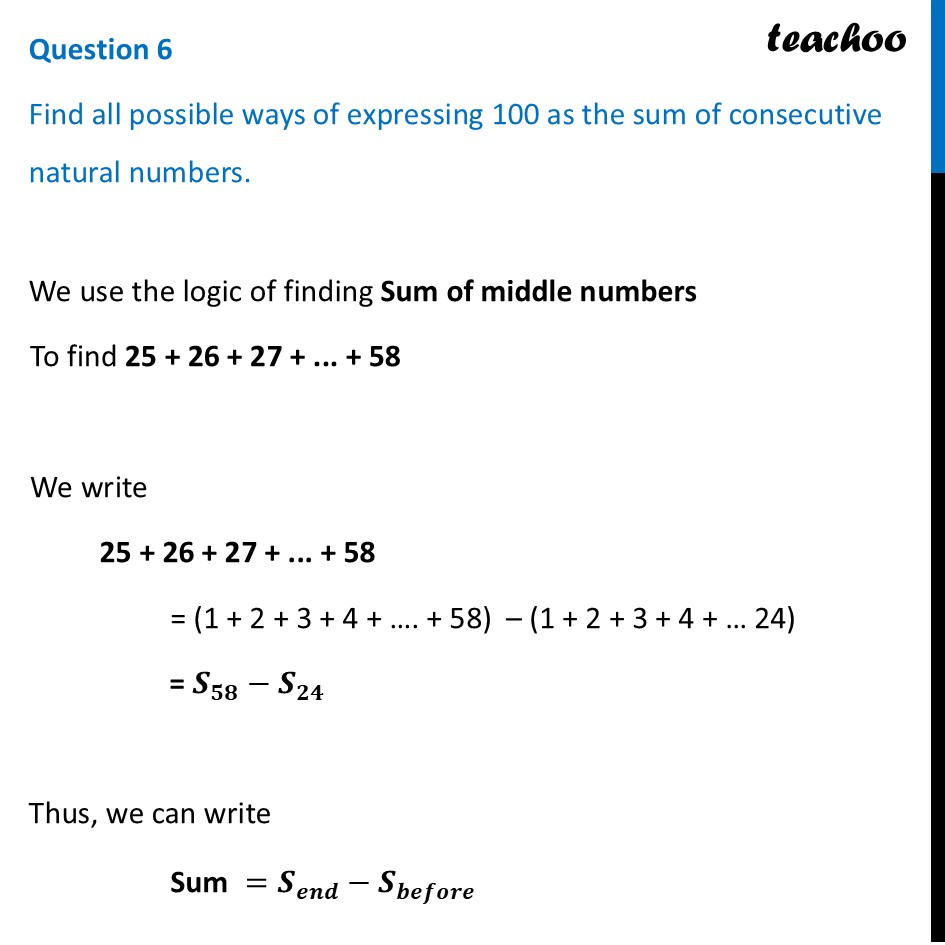
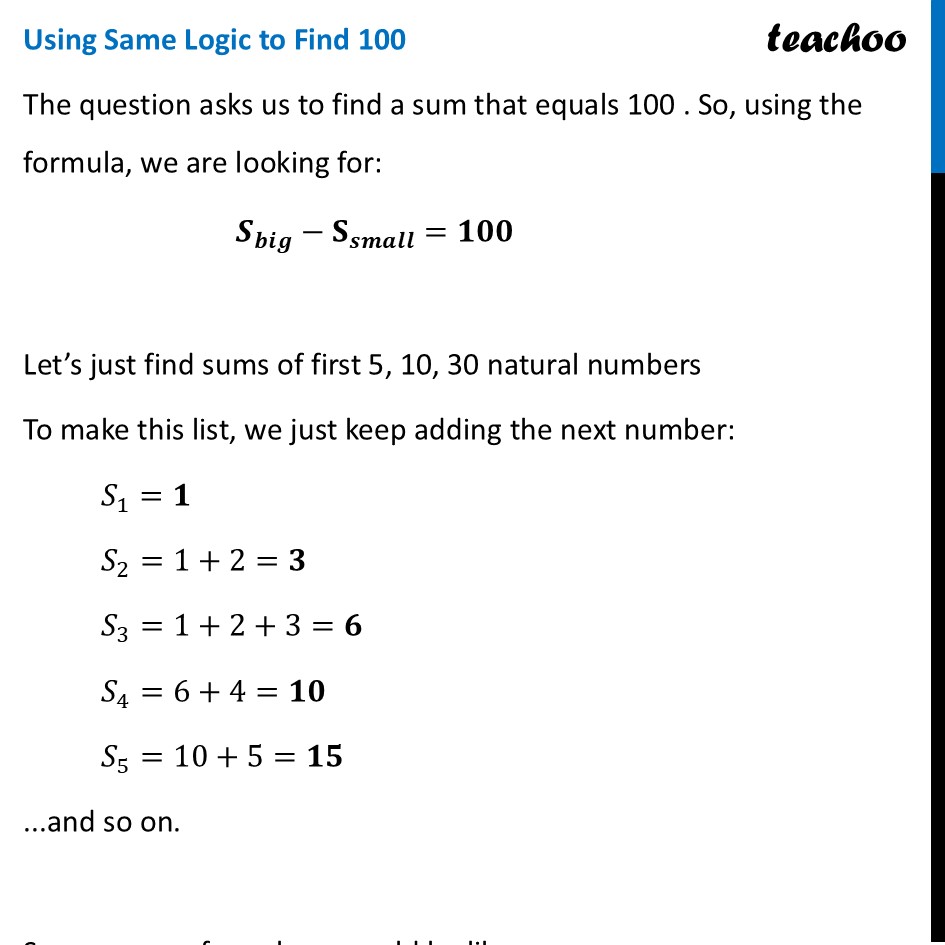
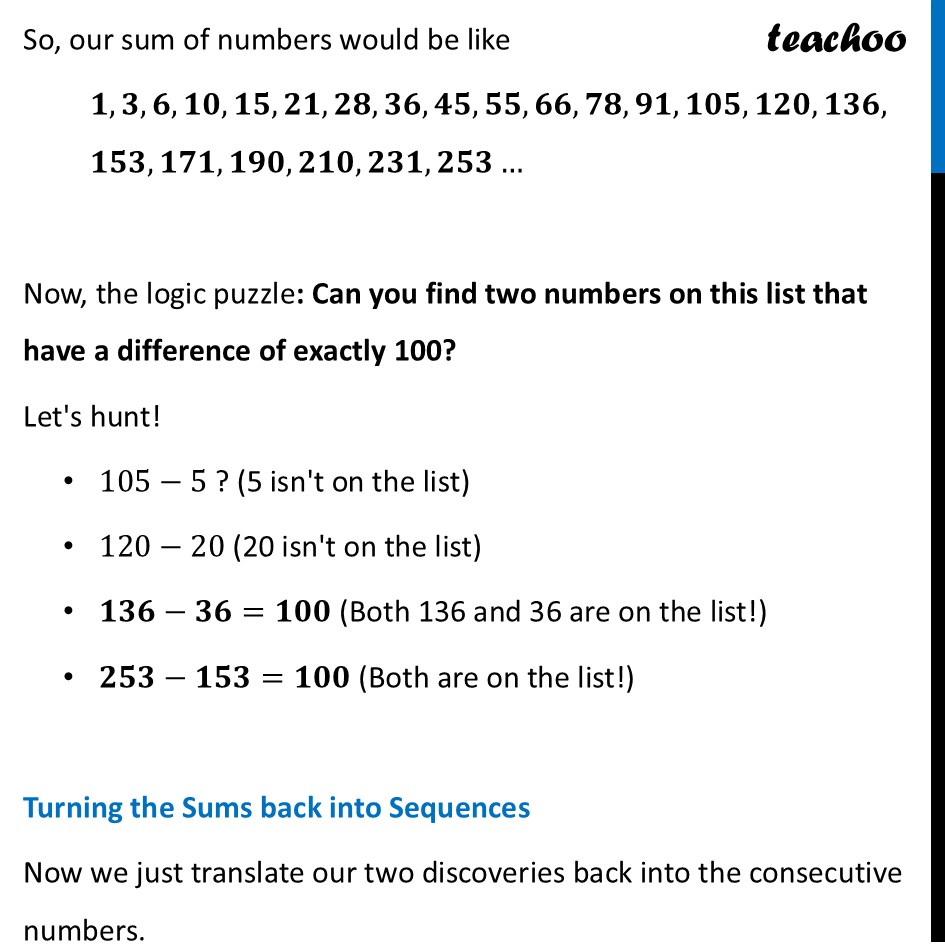
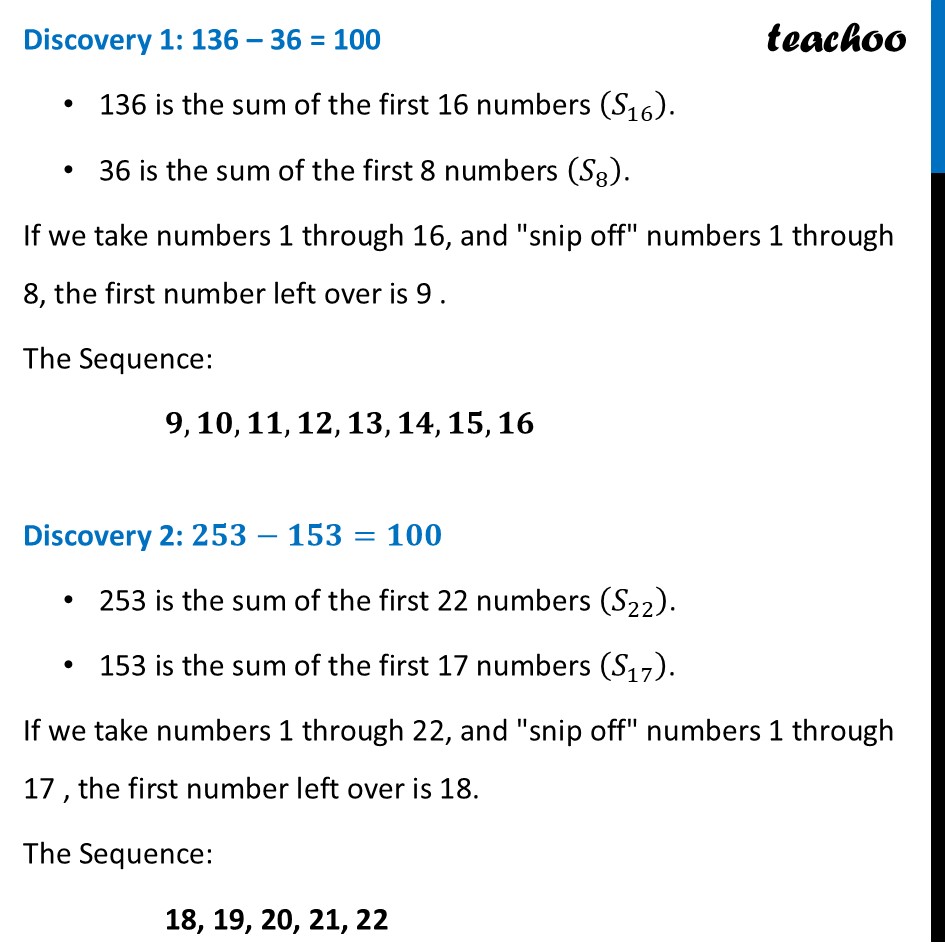
Question 6 Find all possible ways of expressing 100 as the sum of consecutive natural numbers. We use the logic of finding Sum of middle numbers To find 25 + 26 + 27 + ... + 58 We write 25 + 26 + 27 + ... + 58 = (1 + 2 + 3 + 4 + …. + 58) – (1 + 2 + 3 + 4 + … 24) = 𝑺_𝟓𝟖−𝑺_𝟐𝟒 Thus, we can write "Sum "=𝑺_𝒆𝒏𝒅−𝑺_𝒃𝒆𝒇𝒐𝒓𝒆 Using Same Logic to Find 100 The question asks us to find a sum that equals 100 . So, using the formula, we are looking for: 𝑺_𝒃𝒊𝒈−𝐒_𝒔𝒎𝒂𝒍𝒍=𝟏𝟎𝟎 Instead of doing algebra, let's just make a quick list of these total sums (these are called Triangular Numbers). To make this list, we just keep adding the next number: 𝑆_1=1 □ 𝑆_2=1+2=3 𝑆_3=1+2+3=6 𝑆_4=6+4=𝟏𝟎 𝑆_5=10+5=𝟏𝟓 ...and so on. Let's look at a bigger piece of that list: 1,3,6,10,15,21,28,36,45,55,66,78,91,105,120,136,153,171,190,210,231,253... Now, the logic puzzle: Can you find two numbers on this list that have a difference of exactly 100? Let's hunt! 105−5 ? (5 isn't on the list) 120−20 (20 isn't on the list) 136−36=100 ! (Both 136 and 36 are on the list!) 253−153=100 !(Both are on the list!) Turning the Sums back into Sequences Now we just translate our two discoveries back into the consecutive numbers. Discovery 1: 136-36=100 136 is the sum of the first 16 numbers (𝑆_16 ). 36 is the sum of the first 8 numbers (𝑆_8 ). If we take numbers 1 through 16, and "snip off" numbers 1 through 8, the first number left over is 9 . The Sequence: 9,10,11,12,13,14,15,16 Discovery 2: 253−153=100 253 is the sum of the first 22 numbers (𝑆_22 ). 153 is the sum of the first 17 numbers (𝑆_17 ). If we take numbers 1 through 22, and "snip off" numbers 1 through 17 , the first number left over is 18. The Sequence: 18, 19, 20, 21, 22 You can explore how these consecutive chunks add up using the tool below!