You are here
End-of-Chapter Exercises
End-of-Chapter Exercises
Last updated at August 14, 2026 by Teachoo
Transcript
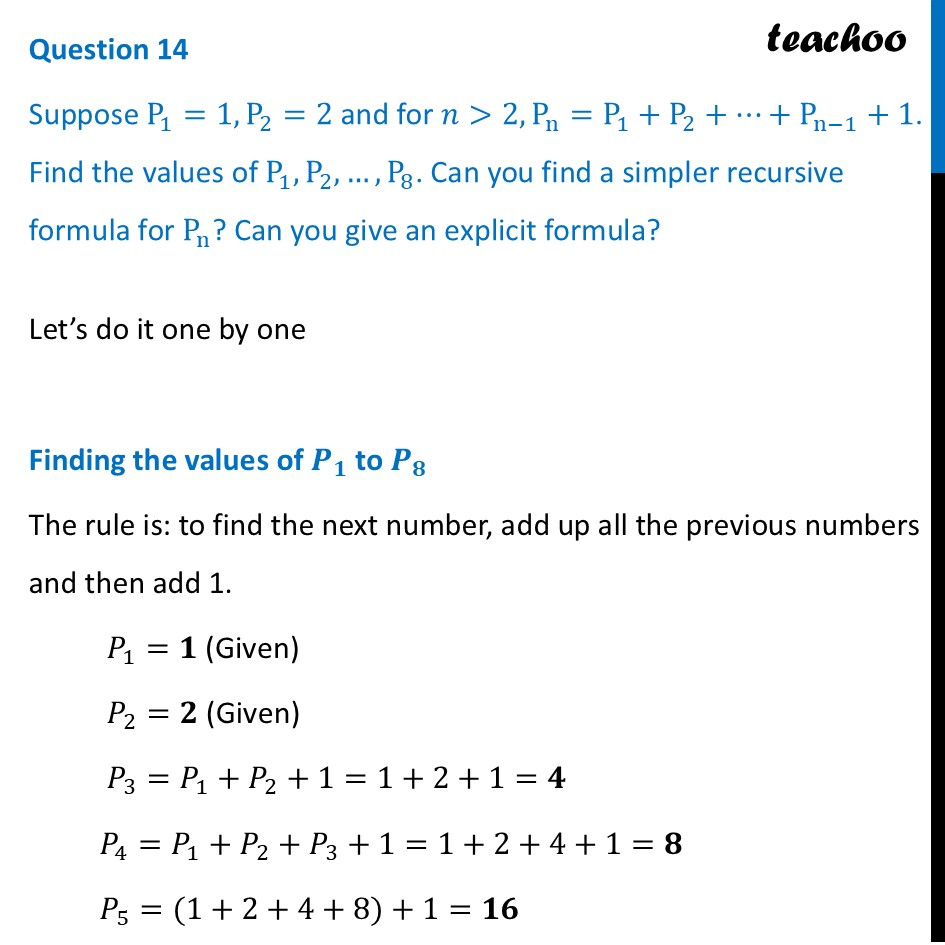
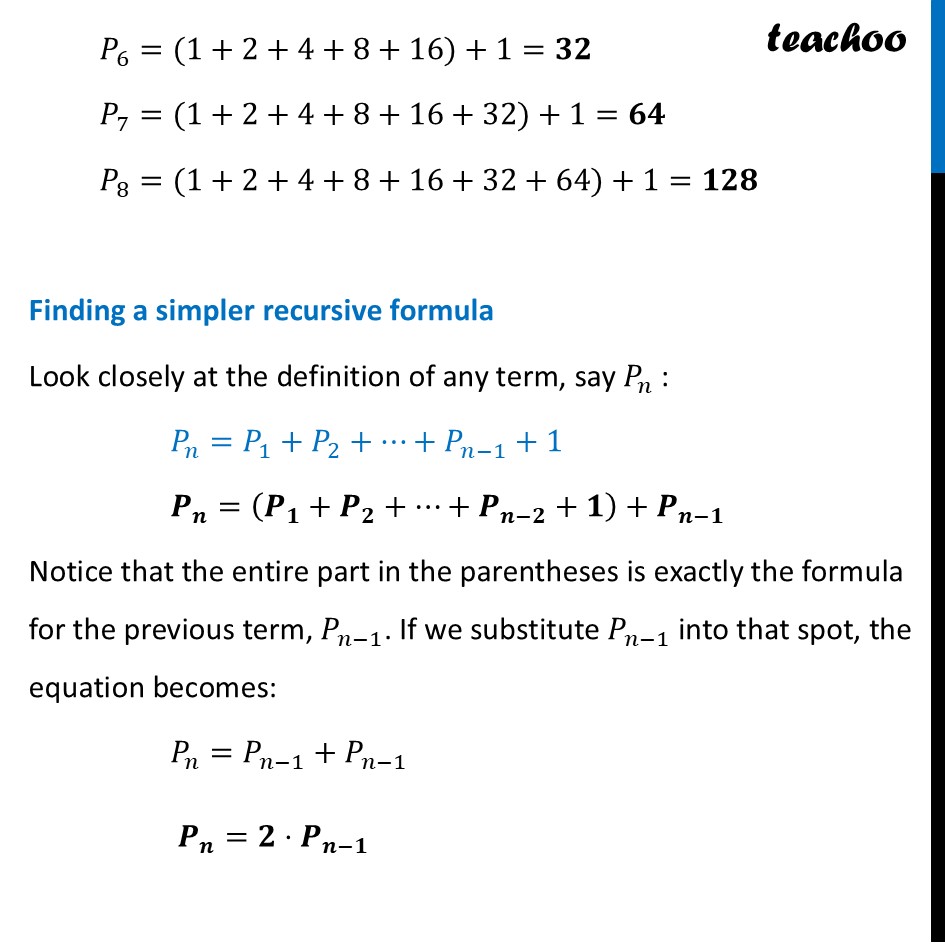
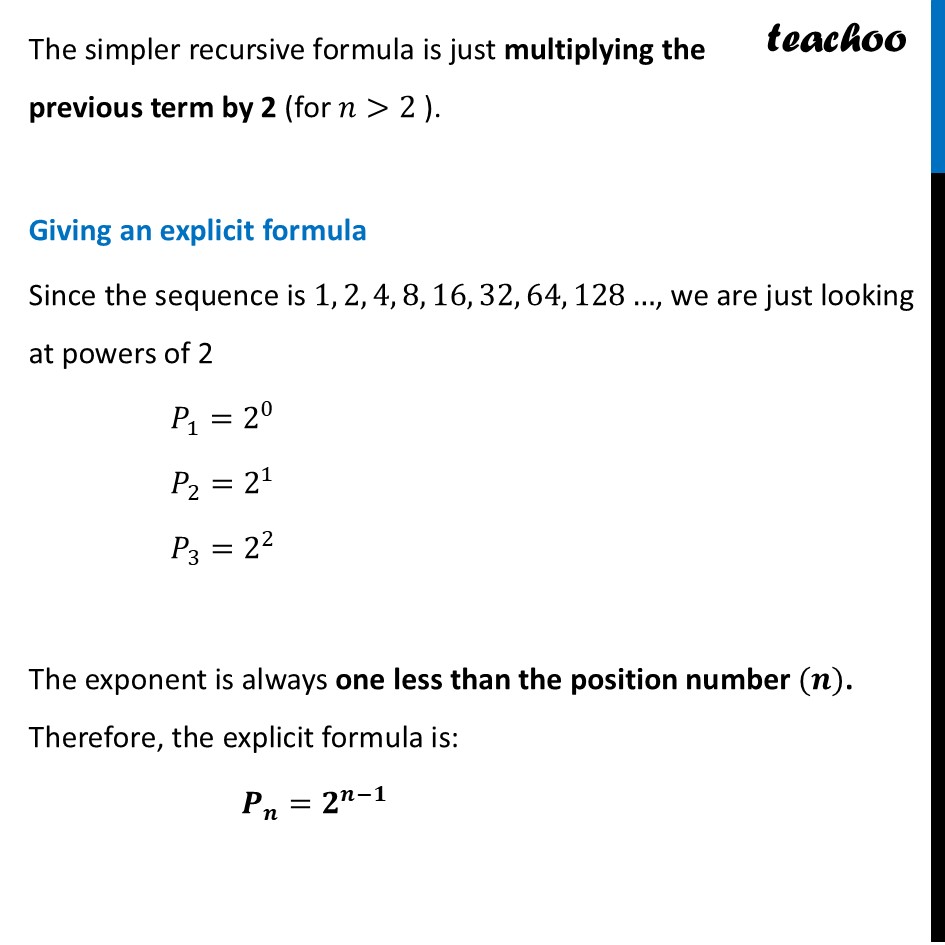
Question 14 Suppose P_1=1,P_2=2 and for 𝑛>2,P_n=P_1+P_2+⋯+P_(n−1)+1. Find the values of P_1,P_2,…,P_8. Can you find a simpler recursive formula for P_n? Can you give an explicit formula? Let’s do it one by one Finding the values of 𝑷_𝟏 to 𝑷_𝟖 The rule is: to find the next number, add up all the previous numbers and then add 1. 𝑃_1=𝟏" (Given)" 𝑃_2=𝟐" (Given)" 𝑃_3=𝑃_1+𝑃_2+1=1+2+1=𝟒 𝑃_4=𝑃_1+𝑃_2+𝑃_3+1=1+2+4+1=𝟖 𝑃_5=(1+2+4+8)+1=𝟏𝟔 𝑃_6=(1+2+4+8+16)+1=𝟑𝟐 𝑃_7=(1+2+4+8+16+32)+1=𝟔𝟒 𝑃_8=(1+2+4+8+16+32+64)+1=𝟏𝟐𝟖 Finding a simpler recursive formula Look closely at the definition of any term, say 𝑃_𝑛 : 𝑃_𝑛=(𝑃_1+𝑃_2+⋯+𝑃_(𝑛−2)+1)+𝑃_(𝑛−1) Notice that the entire part in the parentheses is exactly the formula for the previous term, 𝑃_(𝑛−1). If we substitute 𝑃_(𝑛−1) into that spot, the equation becomes: ■(𝑃_𝑛=𝑃_(𝑛−1)+𝑃_(𝑛−1)@𝑃_𝑛=2⋅𝑃_(𝑛−1) ) The simpler recursive formula is just multiplying the previous term by 2 (for 𝑛>2 ). 3. Giving an explicit formula Since the sequence is 1,2,4,8,16,32,64,128…, we are just looking at powers of 2 . ■(&∘@& ∘@& ∘@& ∘@& ∘@&𝑃_2=2^0@&𝑃_3=2^2 ) The exponent is always one less than the position number (𝑛). Therefore, the explicit formula is: 𝑃_𝑛=2^(𝑛−1)