You are here
Analysing Statistical Data Using Probability
Analysing Statistical Data Using Probability
Last updated at August 14, 2026 by Teachoo
Transcript
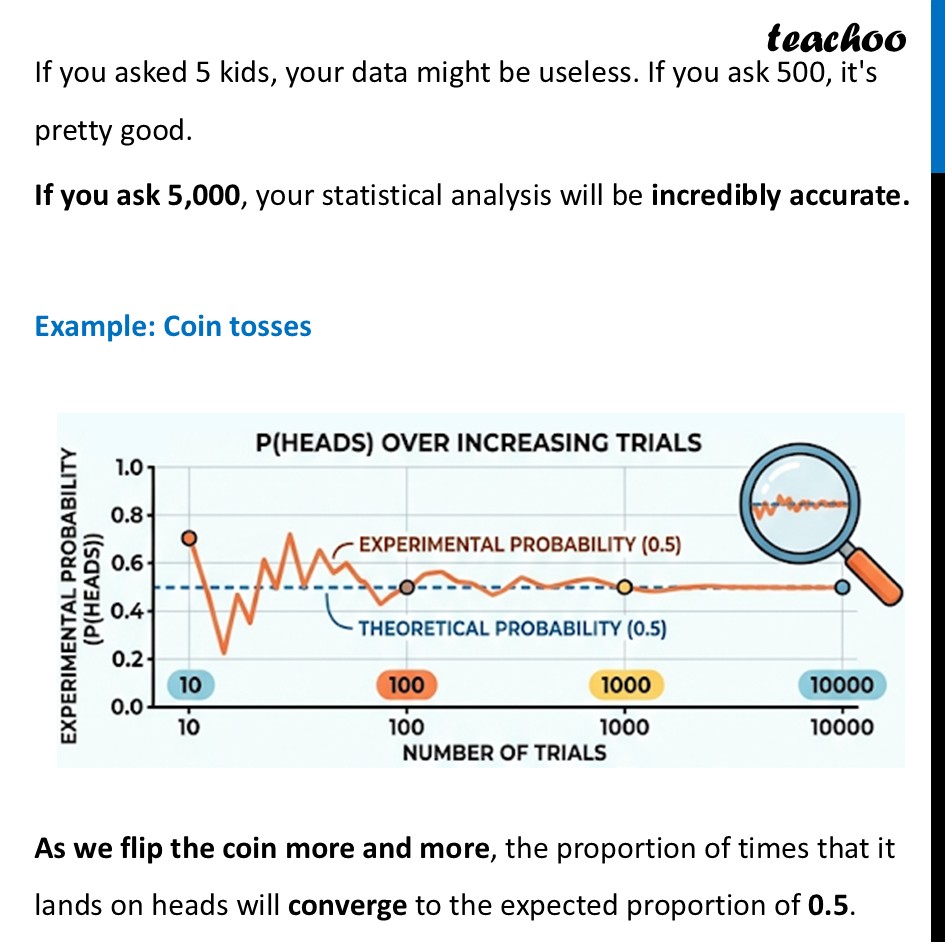
Law of Large Numbers Earlier we used a set of 500 kids to find out what their favourite fruit is. But wait—how do you know your sample of 500 kids wasn't just a weird fluke? What if you accidentally asked a bunch of kids who really hate Mangos? This is where the Law of Large Numbers saves the day. This law states that if you only run a few trials (or take a very small sample), your experimental results might be wild and far away from the true, theoretical reality. But as your sample size gets larger and larger, your experimental probability will smooth out and perfectly match the theoretical probability. If you asked 5 kids, your data might be useless. If you ask 500, it's pretty good. If you ask 5,000, your statistical analysis will be incredibly accurate. Example: Coin tosses As we flip the coin more and more, the proportion of times that it lands on heads will converge to the expected proportion of 0.5.