You are here
Brahmagupta’s Formula for the Area of a Cyclic 4-gon
Brahmagupta’s Formula for the Area of a Cyclic 4-gon
Last updated at May 31, 2026 by Teachoo
Transcript
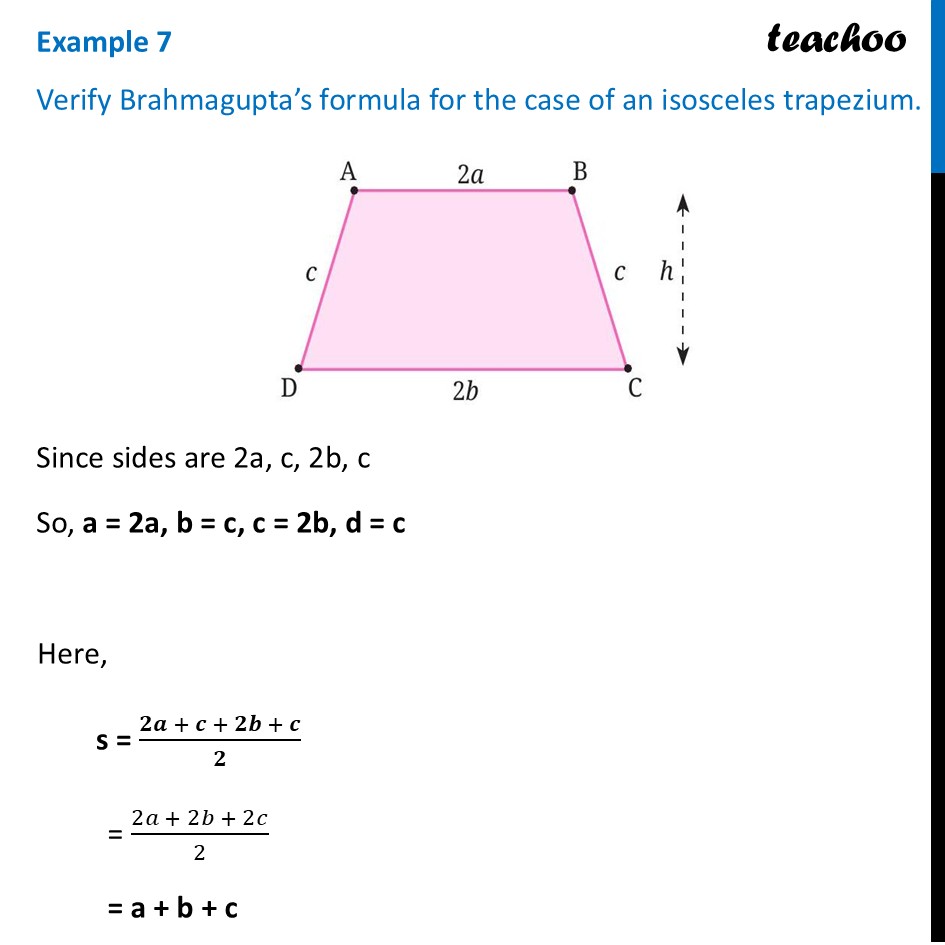
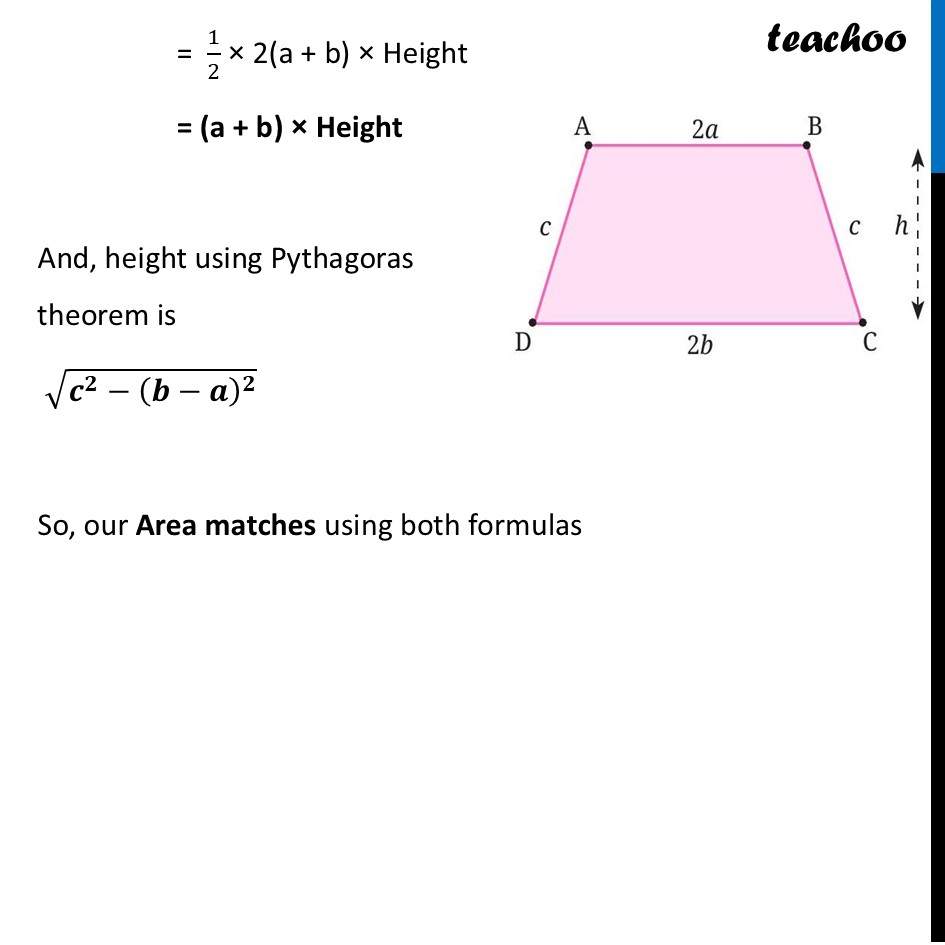
Example 7 Verify Brahmagupta’s formula for the case of an isosceles trapezium. Since sides are 2a, c, 2b, c So, a = 2a, b = c, c = 2b, d = c Here, s = (𝟐𝒂 + 𝒄 + 𝟐𝒃 + 𝒄)/𝟐 = (2𝑎 + 2𝑏 + 2𝑐)/2 = a + b + c Now , Area of 4-gon = √((𝑠−𝑎)(𝑠−𝑏)(𝑠−𝑐)(𝑠−𝑑)) = √((𝑎+𝑏+𝑐−2𝑎)"(𝑎+𝑏+𝑐−c)(𝑎+𝑏+𝑐−2b)(𝑎+𝑏+𝑐−c)" ) = √((𝒃+𝒄−𝒂)(𝒂+𝒃)(𝒂+𝒄−𝒃)(𝒂+𝒃) ) = √((𝑏+𝑐−𝑎)(𝑎+𝑐−𝑏) × (𝑎−𝑏)^2 ) = √((𝑐+[𝑏−𝑎])(𝑐−[𝑏−𝑎] ) )× √((𝑎−𝑏)^2 " " ) = √(𝒄^𝟐−(𝒃−𝒂)^𝟐 )× (𝒂−𝒃) Now, formula of Trapezium is Area = 𝟏/𝟐 × Sum of non-parallel sides × Height = 1/2 × (2a + 2b) × Height = 1/2 × 2(a + b) × Height = (a + b) × Height And, height using Pythagoras theorem is √(𝒄^𝟐−(𝒃−𝒂)^𝟐 ) So, our Area matches using both formulas = 1/2 × 2(a + b) × Height = (a + b) × Height And, height using Pythagoras theorem is √(𝒄^𝟐−(𝒃−𝒂)^𝟐 ) So, our Area matches using both formulas