You are here
![[Ganita Manjari] A triangle with sides 3 units, 4 units and 5 units - Heron's Formula](https://cdn.teachoo.com/299144b2-da83-4ed9-870a-3ab3404ce0da/slide156.jpg)
Heron's Formula
Last updated at May 31, 2026 by Teachoo
Transcript
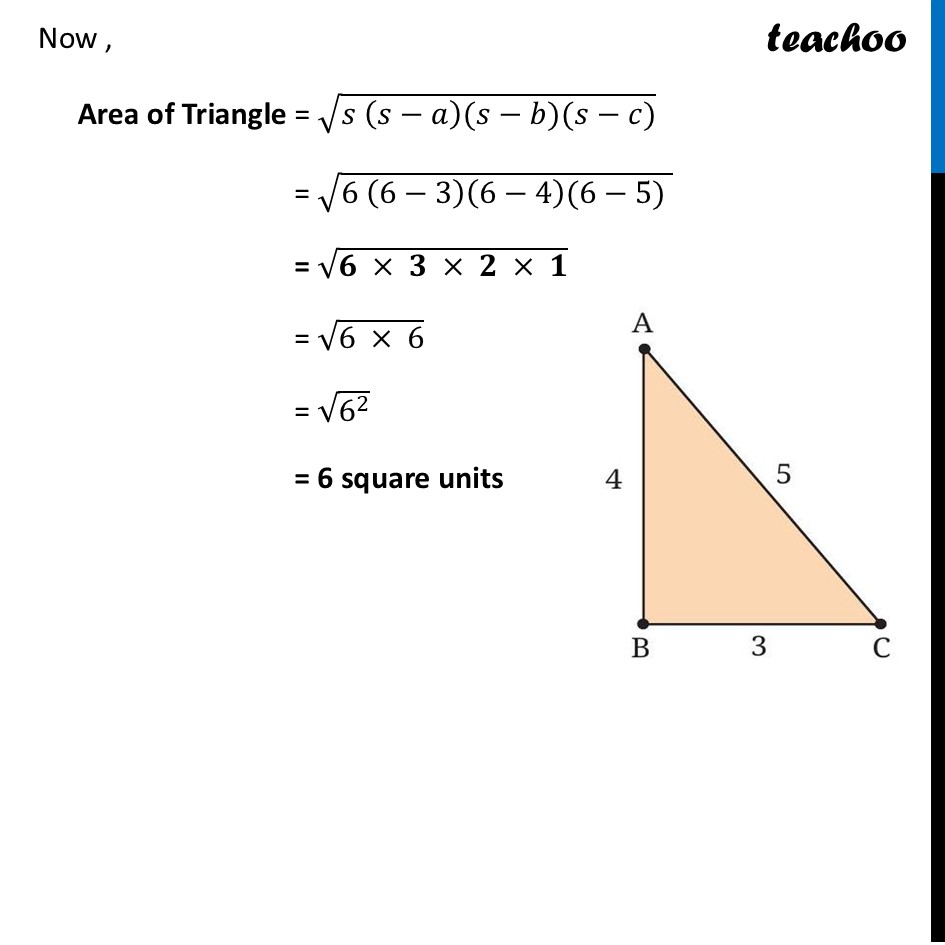
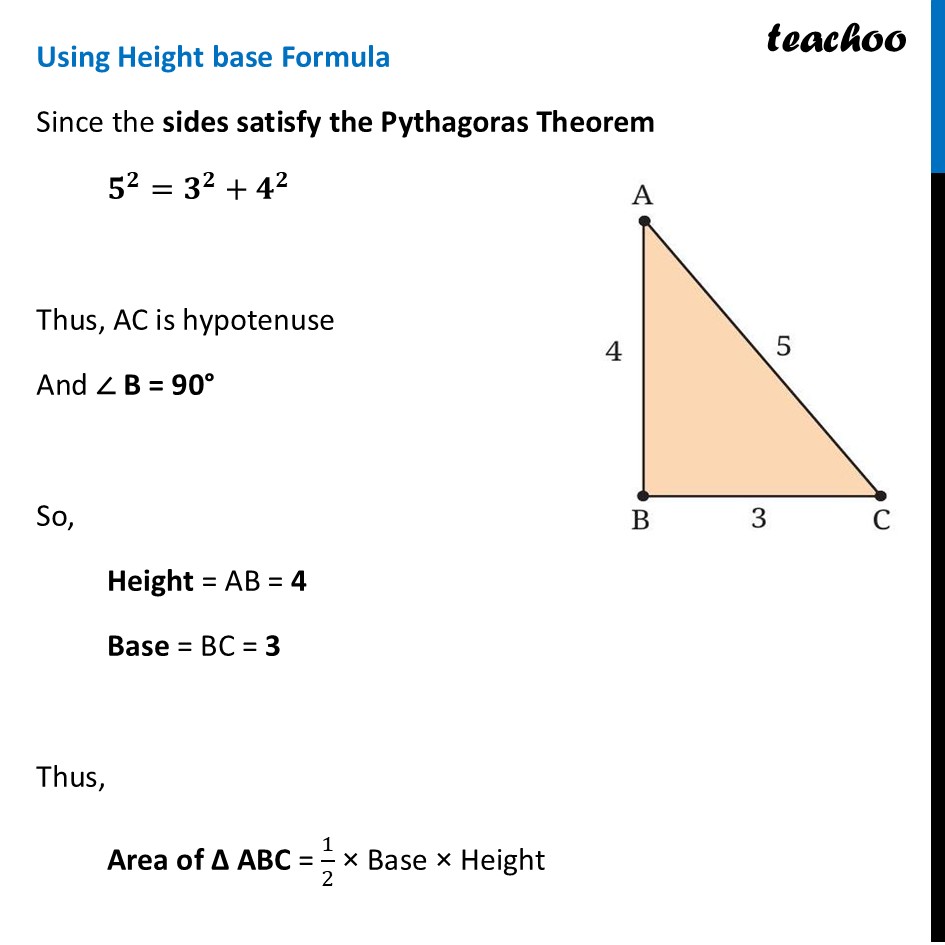
Example 5 A triangle with sides 3 units, 4 units and 5 units. Let’s find Area of Triangle using both Herons formula and Height base formula Herons formula Since sides are 3, 4, 5 So, a = 3, b = 4, c = 5 Here, s = (𝟑 + 𝟒 + 𝟓)/𝟐 = 12/2 = 6 Now , Area of Triangle = √(𝑠 (𝑠−𝑎)(𝑠−𝑏)(𝑠−𝑐)) = √(6 (6−3)(6−4)(6−5) ) = √(𝟔 × 𝟑 × 𝟐 × 𝟏) = √(6 × 6) = √(6^2 ) = 6 square units Using Height base Formula Since the sides satisfy the Pythagoras Theorem 𝟓^𝟐=𝟑^𝟐+𝟒^𝟐 Thus, AC is hypotenuse And ∠ B = 90° So, Height = AB = 4 Base = BC = 3 Thus, Area of ∆ ABC = 1/2 × Base × Height = 1/2 × 3 × 4 = 3 × 2 = 6 square units Thus, we found same area using both formulas