You are here
Area of a Parallelogram
Area of a Parallelogram
Last updated at May 29, 2026 by Teachoo
Transcript
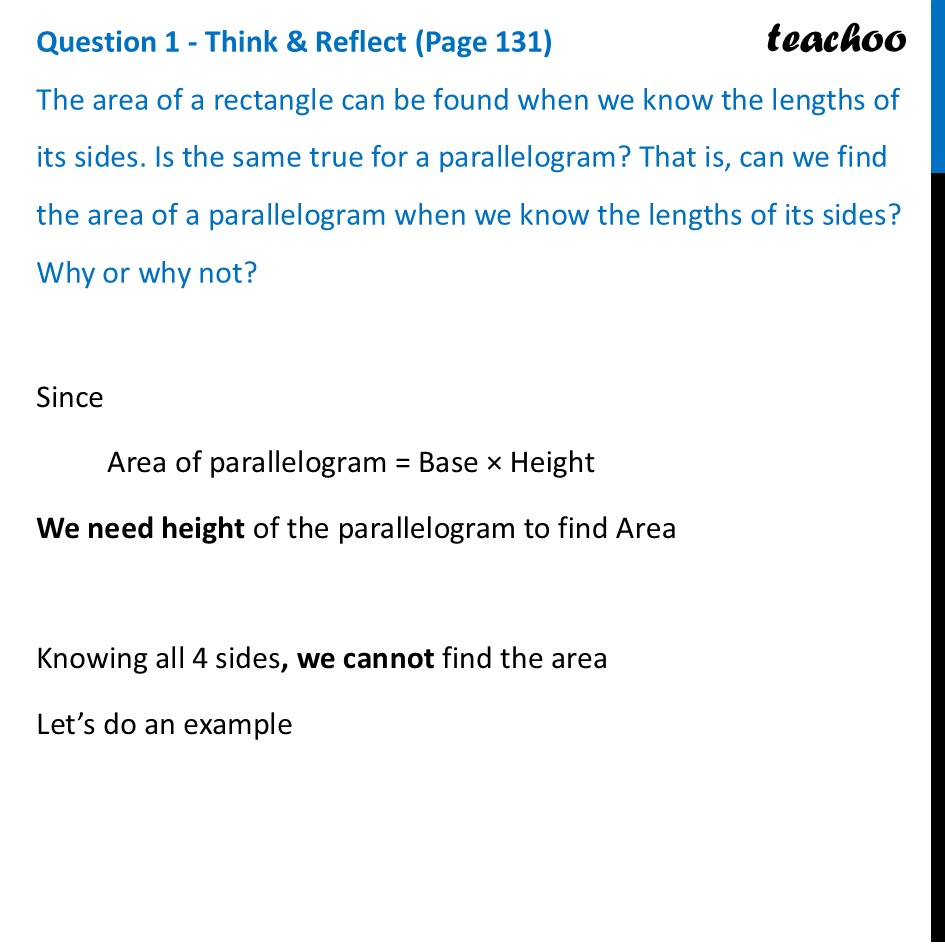
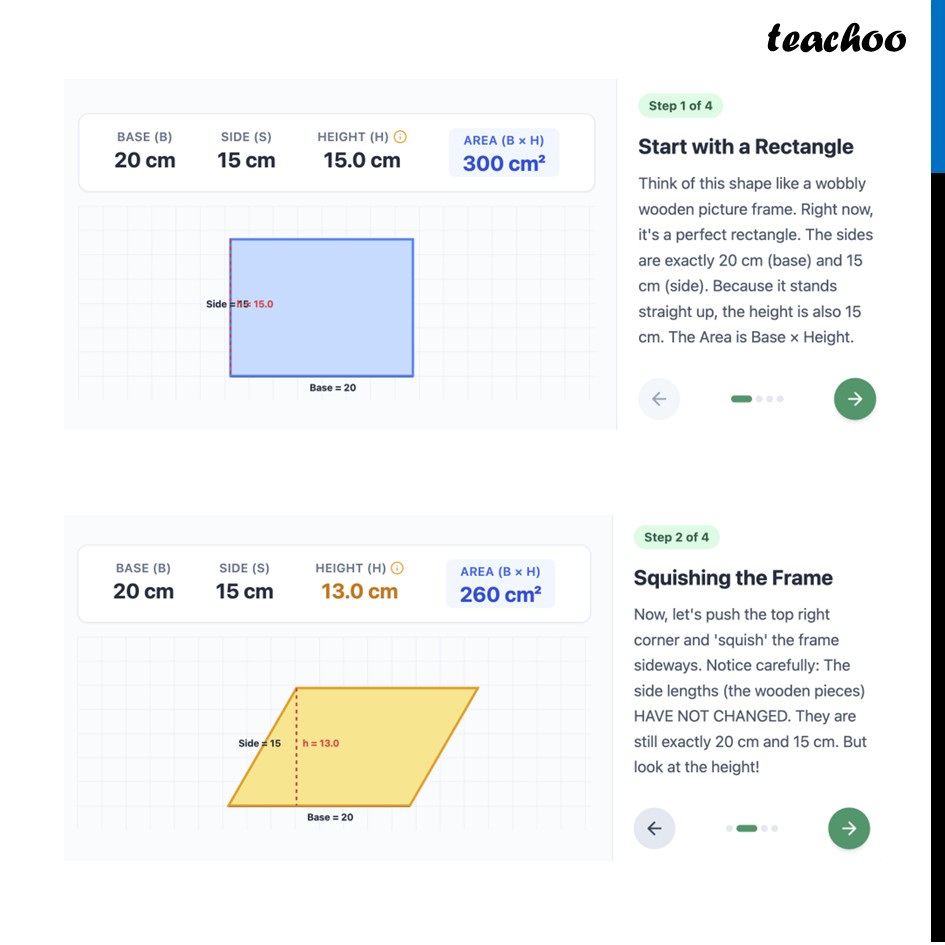
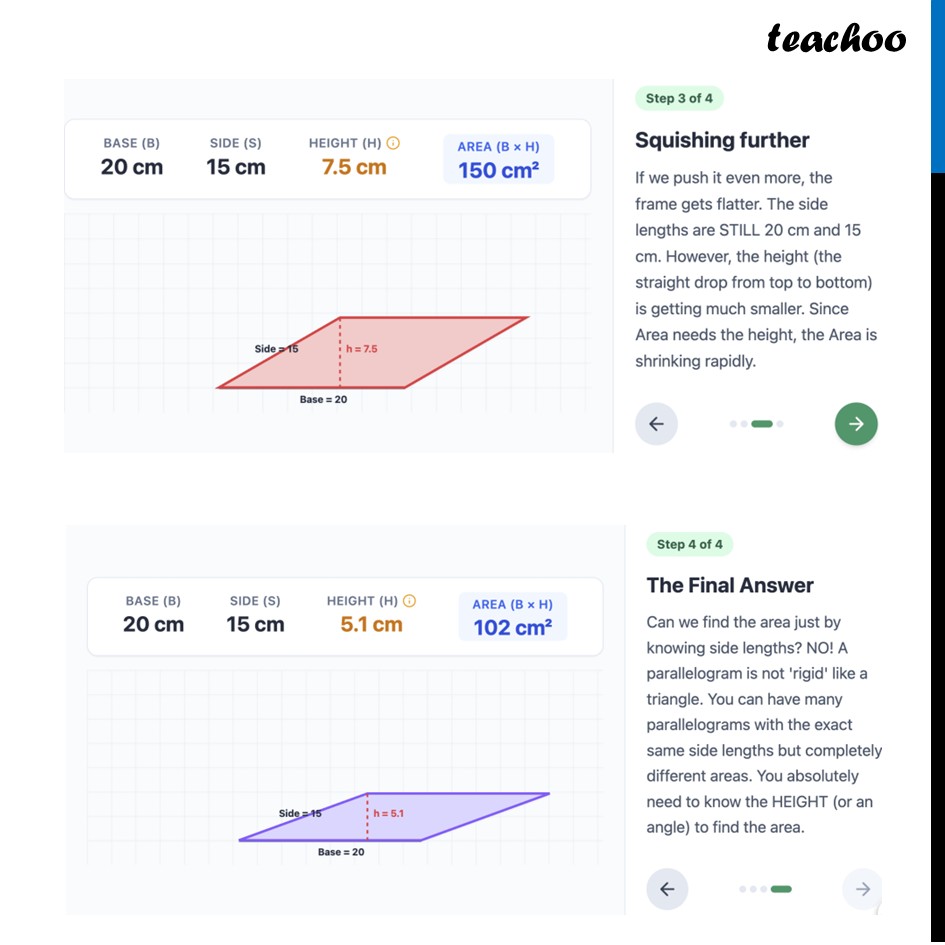
Question 1 - Think & Reflect (Page 131) The area of a rectangle can be found when we know the lengths of its sides. Is the same true for a parallelogram? That is, can we find the area of a parallelogram when we know the lengths of its sides? Why or why not? Since Area of parallelogram = Base × Height We need height of the parallelogram to find Area Knowing all 4 sides, we cannot find the area Let’s do an example Step 1 of 4 Start with a Rectangle Think of this shape like a wobbly wooden picture frame. Right now, it's a perfect rectangle. The sides are exactly 20 cm (base) and 15 cm (side). Because it stands straight up, the height is also 15 cm . The Area is Base × Height. Step 2 of 4 Squishing the Frame Now, let's push the top right corner and 'squish' the frame sideways. Notice carefully: The side lengths (the wooden pieces) HAVE NOT CHANGED. They are still exactly 20 cm and 15 cm . But look at the height!Step 3 of 4 Squishing further If we push it even more, the frame gets flatter. The side lengths are STILL 20 cm and 15 cm . However, the height (the straight drop from top to bottom) is getting much smaller. Since Area needs the height, the Area is shrinking rapidly. Step 4 of 4 The Final Answer Can we find the area just by knowing side lengths? NO! A parallelogram is not 'rigid' like a triangle. You can have many parallelograms with the exact same side lengths but completely different areas. You absolutely need to know the HEIGHT (or an angle) to find the area.