You are here
![Example 2 - In Fig. 6.13, we see points P and Q and two paths [Video] - Problems, Puzzles, and Paradoxes on Perimeter](https://cdn.teachoo.com/1ca723bc-493b-4521-8935-3aa200104d2d/slide52.jpg)
Problems, Puzzles, and Paradoxes on Perimeter
Problems, Puzzles, and Paradoxes on Perimeter
Last updated at August 14, 2026 by Teachoo
Transcript
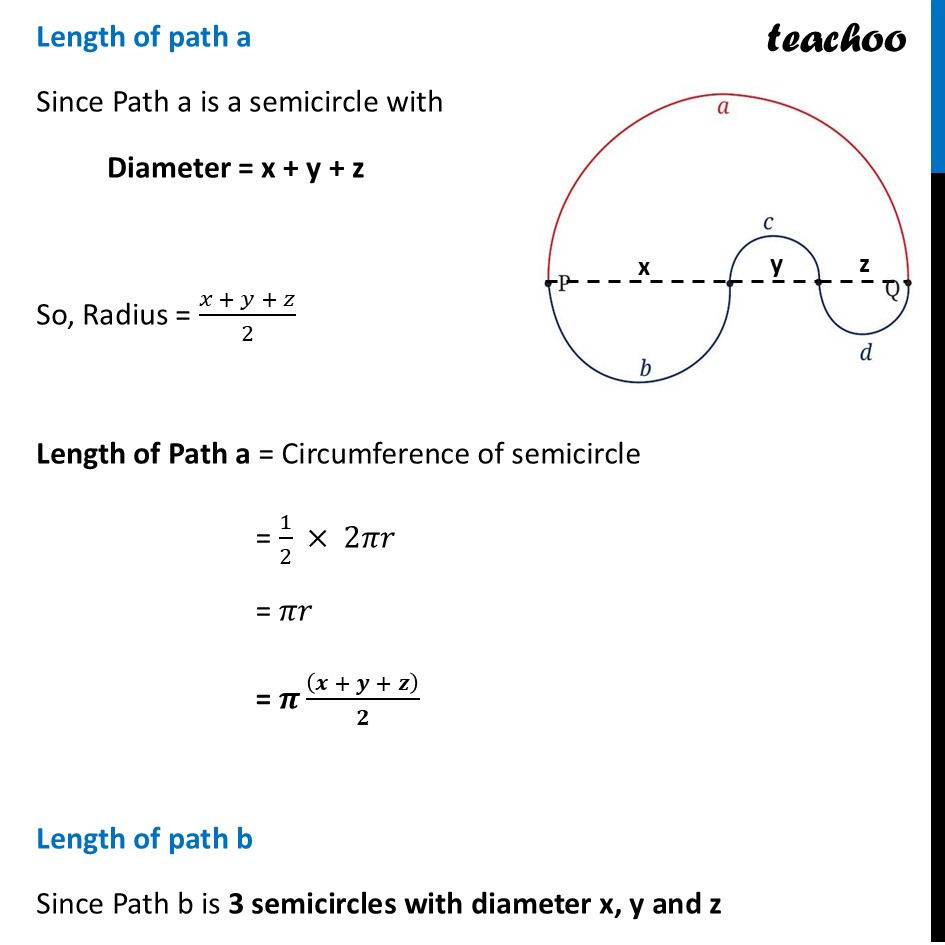
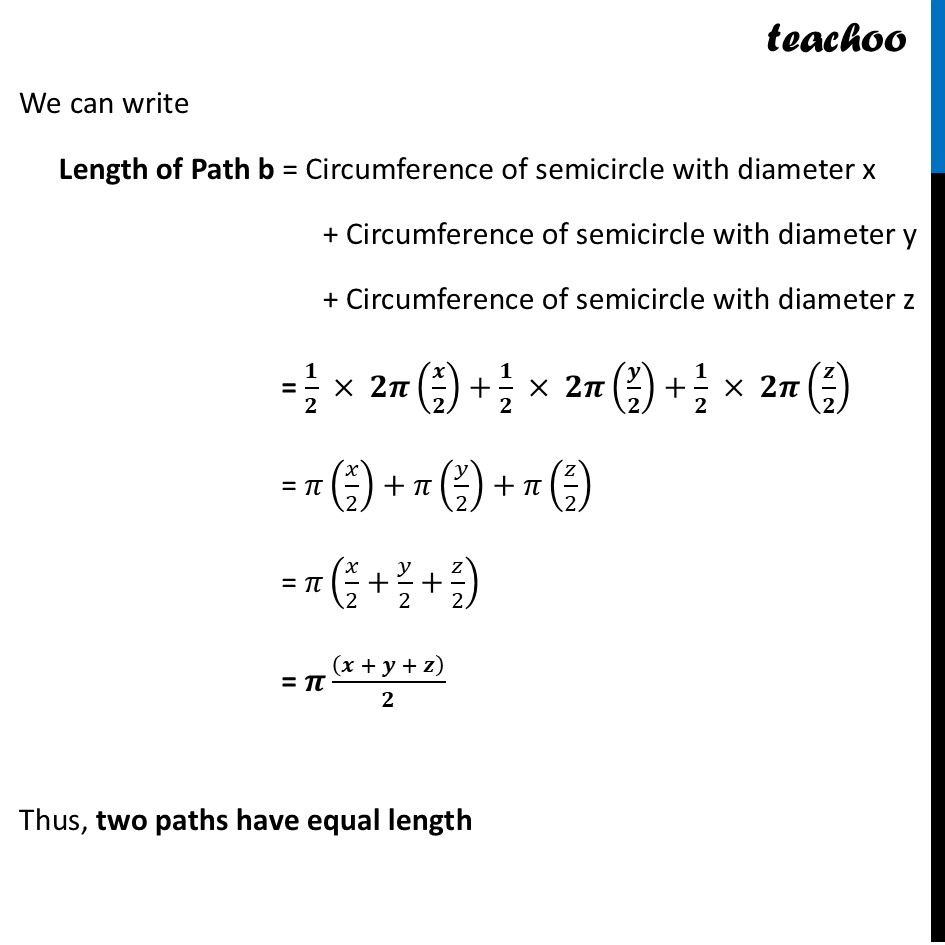
Example 2 In Fig. 6.13, we see points P and Q and two paths connecting them. The first path is made up of the semicircle a. The other path is made up of three semicircles (b, c and d). Which path is longer? Choose one: (i) Path a is longer. (ii) Path b + c + d is longer. (iii) The two paths have equal length. L Let’s find Length of both paths First we label our distance between two points Length of path a Since Path a is a semicircle with Diameter = x + y + z So, Radius = (𝑥 + 𝑦 + 𝑧)/2 Length of Path a = Circumference of semicircle = 1/2 × 2𝜋𝑟 = 𝜋𝑟 = 𝝅 ((𝒙 + 𝒚 + 𝒛))/𝟐 Length of path b Since Path b is 3 semicircles with diameter x, y and z We can write Length of Path b = Circumference of semicircle with diameter x + Circumference of semicircle with diameter y + Circumference of semicircle with diameter z = 𝟏/𝟐 × 𝟐𝝅(𝒙/𝟐)+𝟏/𝟐 × 𝟐𝝅(𝒙/𝟐)+𝟏/𝟐 × 𝟐𝝅(𝒙/𝟐)+ We can write Length of Path b = Circumference of semicircle with diameter x + Circumference of semicircle with diameter y + Circumference of semicircle with diameter z = 𝟏/𝟐 × 𝟐𝝅(𝒙/𝟐)+𝟏/𝟐 × 𝟐𝝅(𝒚/𝟐)+𝟏/𝟐 × 𝟐𝝅(𝒛/𝟐) = 𝜋(𝑥/2)+𝜋(𝑦/2)+𝜋(𝑧/2) = 𝜋(𝑥/2+𝑦/2+𝑧/2) = 𝝅 ((𝒙 + 𝒚 + 𝒛))/𝟐 Thus, two paths have equal length