You are here
![C/D’s Adventurous Journey [Chapter 3 Class 9 Ganita Manjari Part 1] - Perimeter of a Circle - C/D Ratio](https://cdn.teachoo.com/71cf6f48-638b-42b6-8a88-d13f0d46214d/slide22.jpg)
Perimeter of a Circle - C/D Ratio
Perimeter of a Circle - C/D Ratio
Last updated at May 29, 2026 by Teachoo
Transcript
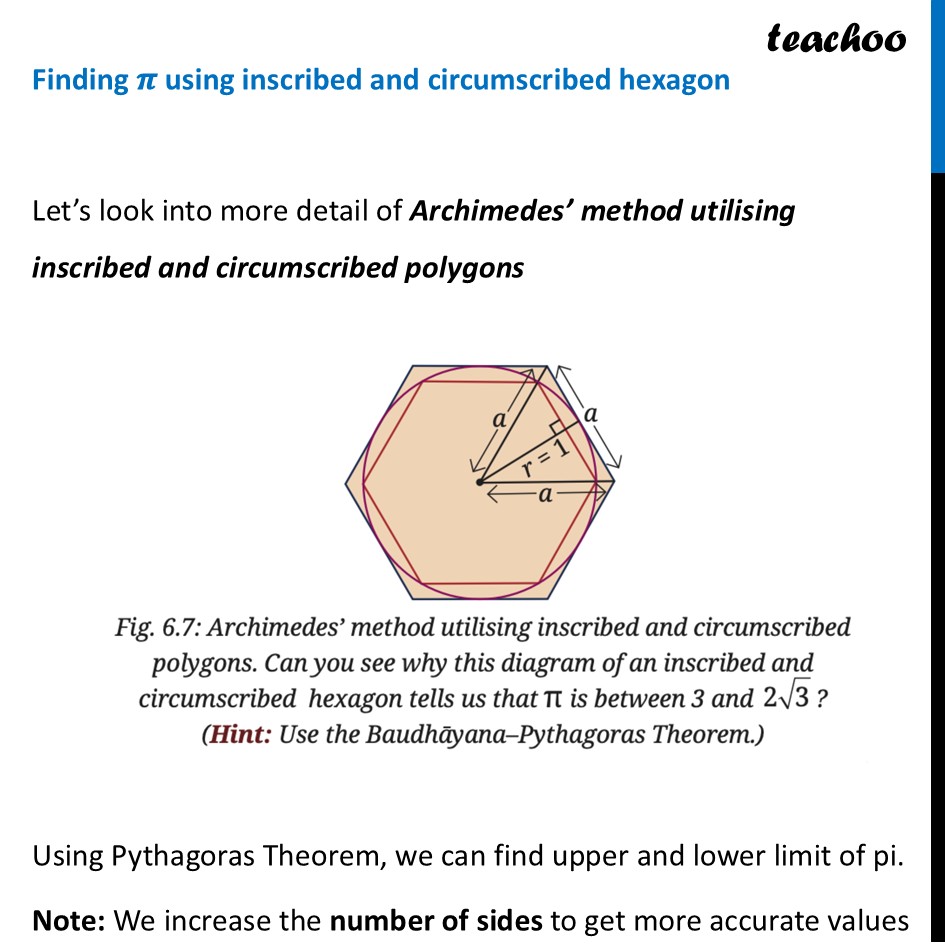
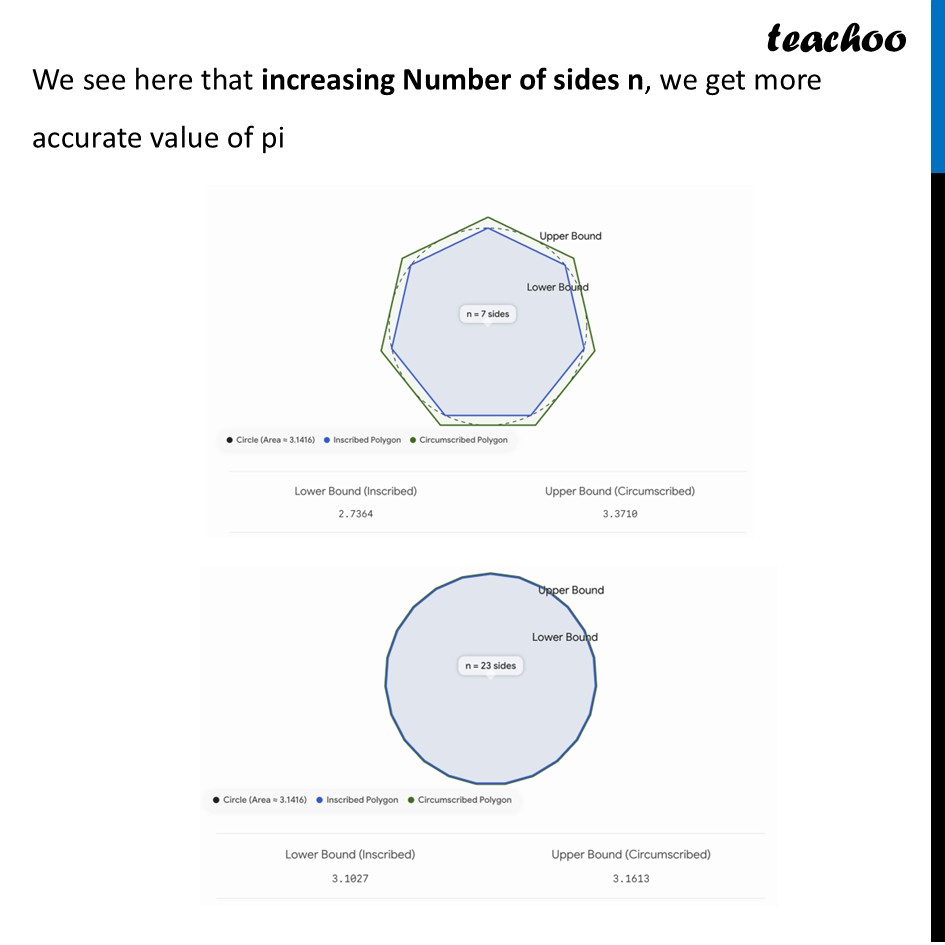
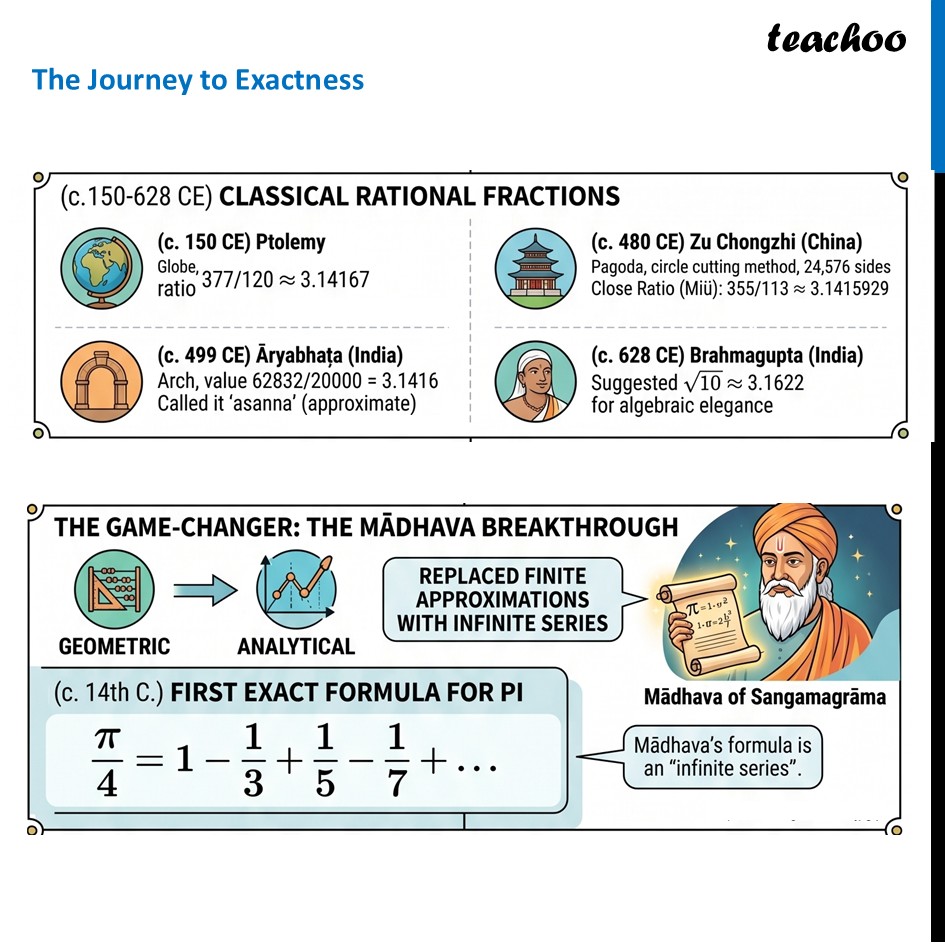
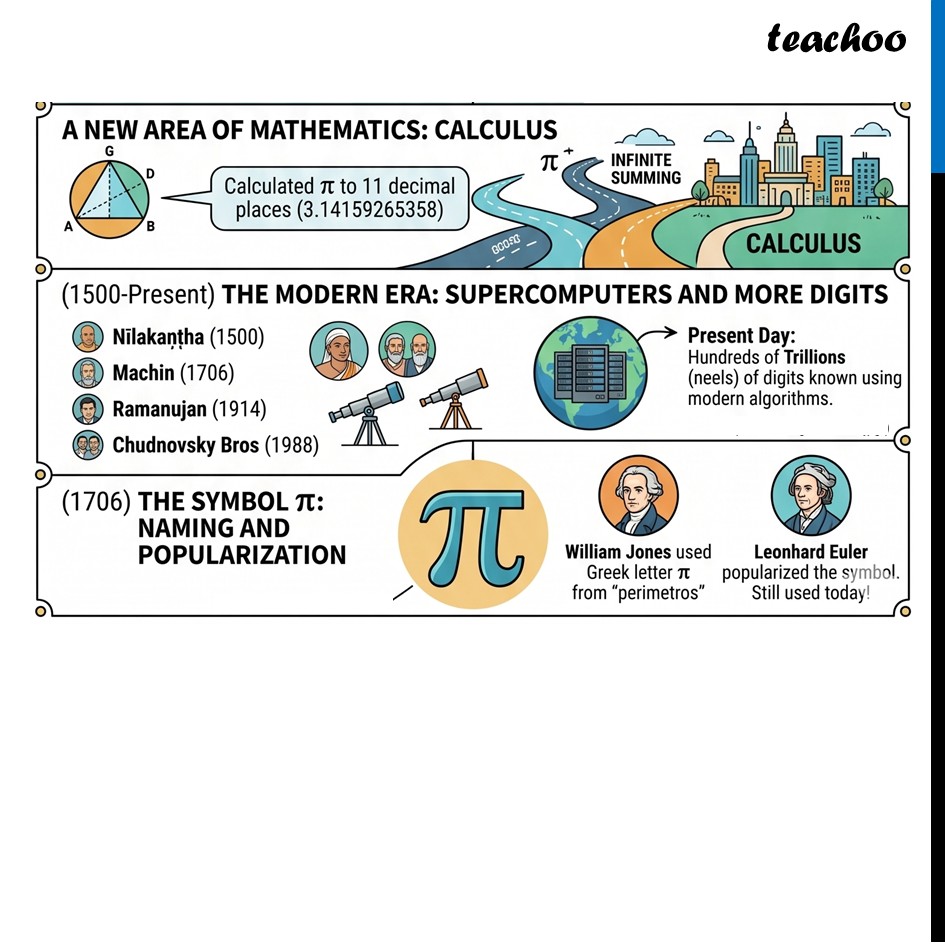
C/D’s Adventurous Journey 'THE EVOLUTION OF PI : A HISTORY OF THE C/D RATIO' FROM ANCIENT APPROXIMATIONS TO MĀDHAVA'S EXACT FORMULA The Mesopotamian Approximation (c. 1900 BCE) MESOPOTAMIA: CRUDE INTEGER VALUE 3 Archimedes' Method of Bounds (c. 250 BCE) ARCHIMEDES OF SYRACUSE: TRAPPING PI Result with 96-sided polygons:Finding 𝝅 using inscribed and circumscribed hexagon Let’s look into more detail of Archimedes’ method utilising inscribed and circumscribed polygons Using Pythagoras Theorem, we can find upper and lower limit of pi. Note: We increase the number of sides to get more accurate values Fig. 6.7: Archimedes' method utilising inscribed and circumscribed polygons. Can you see why this diagram of an inscribed and circumscribed hexagon tells us that is between 3 and ? (Hint: Use the Baudhāyana-Pythagoras Theorem.)We see here that increasing Number of sides n, we get more accurate value of pi The Journey to Exactness c.150-628 CE) CLASSICAL RATIONAL FRACTIONS (c. 150 CE) Ptolemy Globe, ratio (c. 499 CE) Äryabhața (India) Arch, value Called it 'asanna' (approximate) (c. 480 CE) Zu Chongzhi (China) Pagoda, circle cutting method, 24,576 sides Close Ratio (Miü): (c. 628 CE) Brahmagupta (India) Suggested for algebraic elegance THE GAME-CHANGER: THE MĀDHAVA BREAKTHROUGH (c. 14th C.) FIRST EXACT FORMULA FOR PI REPLACED FINITE APPROXIMATIONS WITH INFINITE SERIES(1500-Present) THE MODERN ERA: SUPERCOMPUTERS AND MORE DIGITS Nilakantha (1500) ◯ Machin (1706) Ramanujan (1914) Present Day: Hundreds of Trillions (neels) of digits known using modern algorithms. Chudnovsky Bros (1988) (1706) THE SYMBOL : NAMING AND POPULARIZATION William Jones used Greek letter from "perimetros" Leonhard Euler popularized the symbol. Still used today!