
 You are here
What is Erosion?
It means the moving of broken-down rocks, soil, and sediments from one place to another.
The moving is done by natural forces — mainly flowing water and wind .
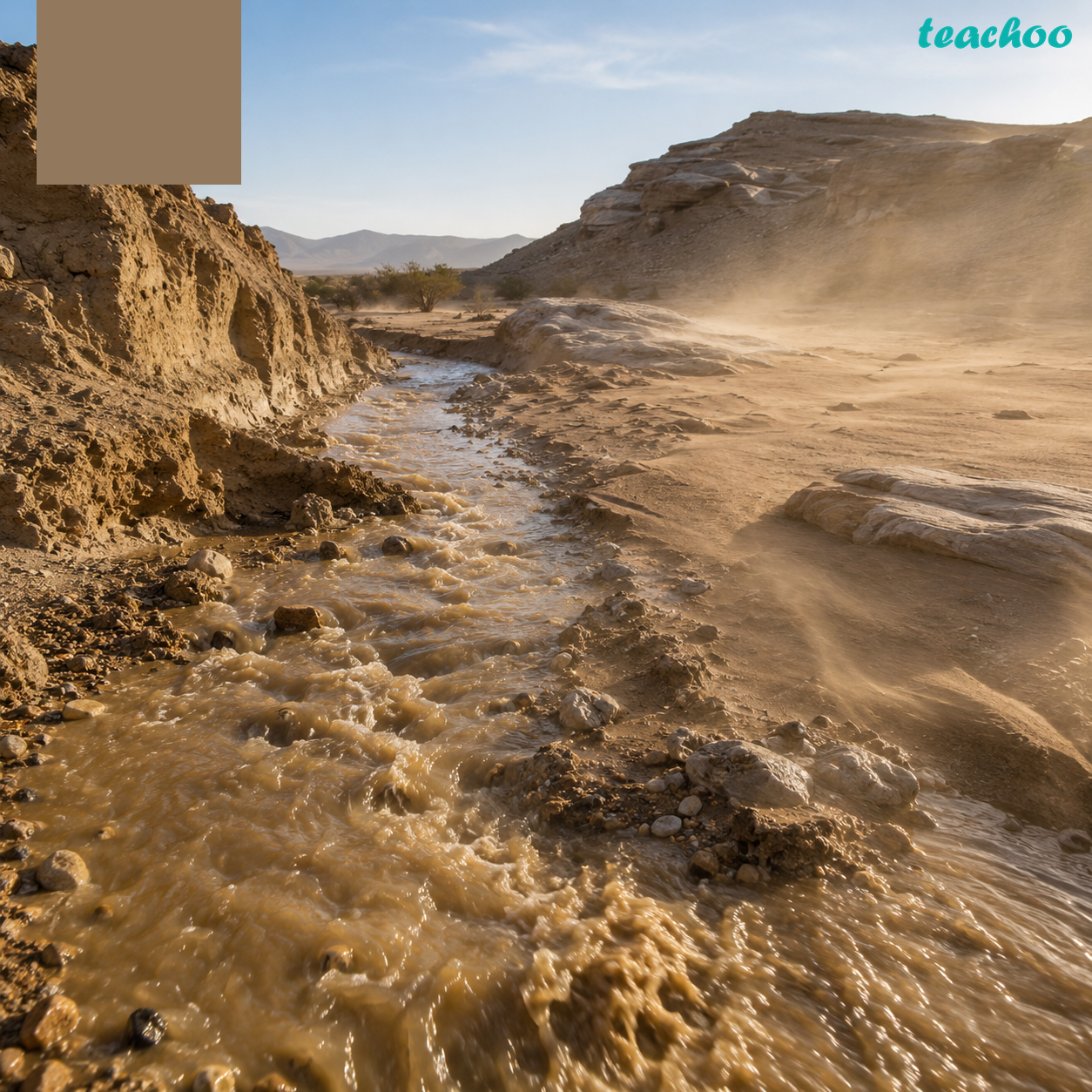
Example
- Have you noticed fine sand on riverbeds or in lakes?
- This sand did not appear by accident.
- It was formed elsewhere and then moved here by flowing water.
- The whole process is called erosion .
Erosion is the process by which rock pebbles, soil, and sediments are broken down and moved from one location to another.
The natural forces that cause erosion are mainly wind and flowing water .
Why Erosion is a Physical Change
During erosion, no new substance is formed .
The rocks and soil only move from one place to another.
Their shape may also wear down.
So erosion is a physical change .
Examples of erosion
-
A landslide
- Soil and rocks slide down a hill in a single moment.
- This is a dramatic example of erosion.
-
Smooth river pebbles
- Pebbles in a river look smooth and rounded.
- Flowing water keeps rubbing them against each other.
- Rough edges slowly wear off over years.
-
Sand on beaches
- Wind and waves carry sand grains and deposit them along coasts.
How Erosion Eventually Forms New Rocks
The journey of broken-down material has many steps.
Step-by-step process
-
Step 1 — Wind or water slows down.
- For example, where a river meets the sea, the water slows.
- Where wind speed drops, the wind also slows.
-
Step 2 — The carried material settles.
- Sand, soil, and small pebbles drop to the bottom.
- This is called deposition .
-
Step 3 — The settled sediments harden.
- Over thousands of years, layers pile up.
- The pressure from the layers above compresses the lower layers.
-
Step 4 — New rocks are formed.
- The hardened sediments slowly become new rocks.
The full cycle
- Weathering → Erosion → Deposition → New rocks.
- The full cycle takes millions of years .
- It cannot be reversed at any human timescale.
- Weathering = the breakdown of rocks into smaller pieces, in place. Physical + chemical.
- Erosion = the movement of those broken-down pieces from one place to another by wind or water. Physical only.
-
Define erosion.
View Answer
The process by which rock pebbles, soil, and sediments are broken down and moved from one place to another by natural forces like wind and flowing water. -
Is erosion a physical or chemical change?
View Answer
Physical change — only movement and shape change, no new substance is formed. -
Why are river pebbles smooth?
View Answer
Constant erosion by flowing water rubs them against each other and the riverbed, gradually wearing off rough edges. -
What is the difference between weathering and erosion?
View Answer
Weathering is the breakdown of rocks in place ; erosion is the movement of those broken pieces from one place to another. -
How are new rocks formed from sediments?
View Answer
When wind or water slows, sediments settle and accumulate; over thousands of years, they harden under pressure to form new rocks.
