
 You are here
What is Combustion?
It means burning .
A substance burns by reacting with oxygen from air, and gives out heat and light .
Examples
- Burning of wood in a fire.
- Burning of paper with a matchstick.
- Burning of LPG on a gas stove.
- Burning of a candle.
- Burning of magnesium ribbon in air.
Key features of combustion
- The substance reacts with oxygen from the air.
- Heat is produced.
- Often, light is also produced.
- A new substance is formed (so it is always a chemical change).
Combustible substances
- The substance that burns is called a combustible substance .
- It is also called a fuel .
-
Common combustible substances:
- Wood.
- Paper.
- Cotton.
- Kerosene.
- LPG (cooking gas).
- Coal.
Combustion is a chemical reaction in which a substance reacts with oxygen and produces heat and/or light.
Substances that undergo combustion are called combustible substances .
Example — Burning a Magnesium Ribbon
This is one of the clearest examples of combustion.
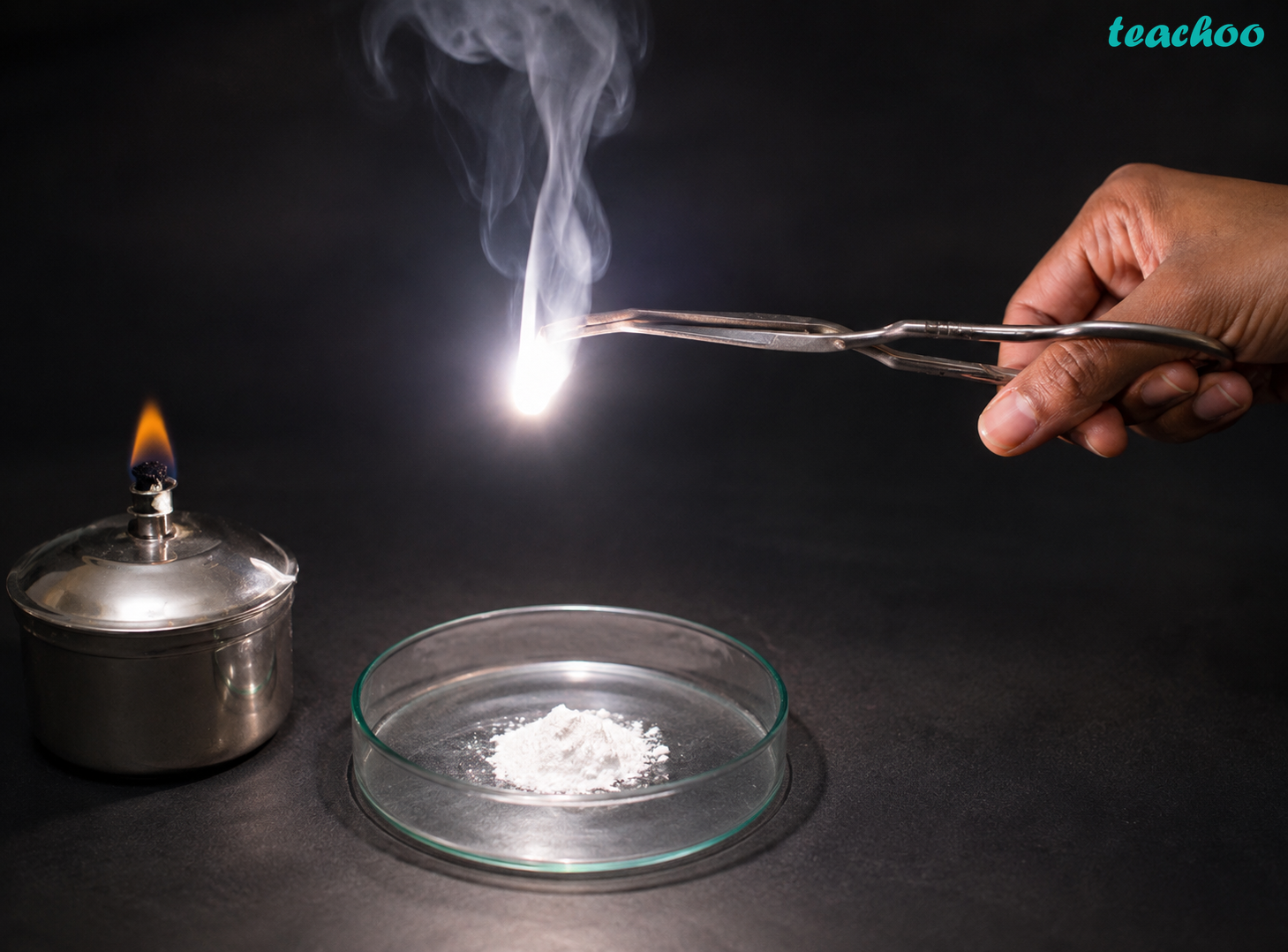
What you observe
- A magnesium ribbon is burnt in air.
- It produces a brilliant white flame .
- A white powder is left behind.
- This white powder is a new substance — magnesium oxide .
- Heat and light are also given out.
Why this is a chemical change
- A new substance (magnesium oxide) has been formed.
- So this burning is a chemical change — specifically, it is combustion.
(ribbon) (from air) (white powder)
The Three Requirements for Combustion (The Fire Triangle)
For burning to happen, three things must be present together.
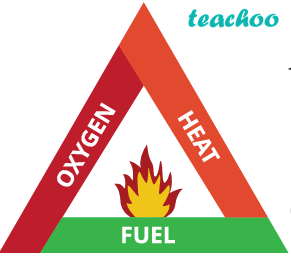
The three requirements
-
(i) Fuel
- This is the combustible substance — the thing that burns.
- Examples: wood, paper, kerosene, LPG.
-
(ii) Oxygen
- It is taken from the surrounding air.
- Without oxygen, the fuel cannot burn.
-
(iii) Heat
- Enough heat to raise the fuel to its ignition temperature .
- Below this temperature, the fuel will not catch fire.
What happens if any one is missing
- Take away the fuel — the fire dies out.
- Take away the oxygen — the fire goes out (this is how a fire blanket works).
- Take away the heat — the fire never starts.
What is Ignition Temperature?
It means the lowest temperature at which a substance catches fire.
Examples
- Paper has a low ignition temperature, so a matchstick lights it instantly.
- Wood has a higher ignition temperature, so it takes longer to catch fire.
- Coal has an even higher ignition temperature.
Key idea about ignition temperature
- Below this temperature, the substance will not catch fire on its own.
- Even paper will sit safely in air at room temperature.
- A burning matchstick is hotter than the ignition temperature of paper.
- So paper catches fire immediately when touched by a matchstick.
Ignition temperature is the lowest temperature at which a substance catches fire.
- Combustion = chemical reaction with oxygen that releases heat and/or light .
- Other chemical changes may not involve oxygen (e.g., curdling of milk) and may not release heat/light (e.g., rusting, which is very slow).
👀 Activity 5.5 — Is Oxygen Needed for Combustion?
- Two identical candles .
- Two petri dishes (or any flat plates).
- A glass tumbler .
- Optional: a small amount of lime water .
- Place the two candles on separate petri dishes and light them both.
- Cover one of the candles with the inverted glass tumbler.
- Leave the other candle uncovered.
- Observe what happens to both flames over the next minute.
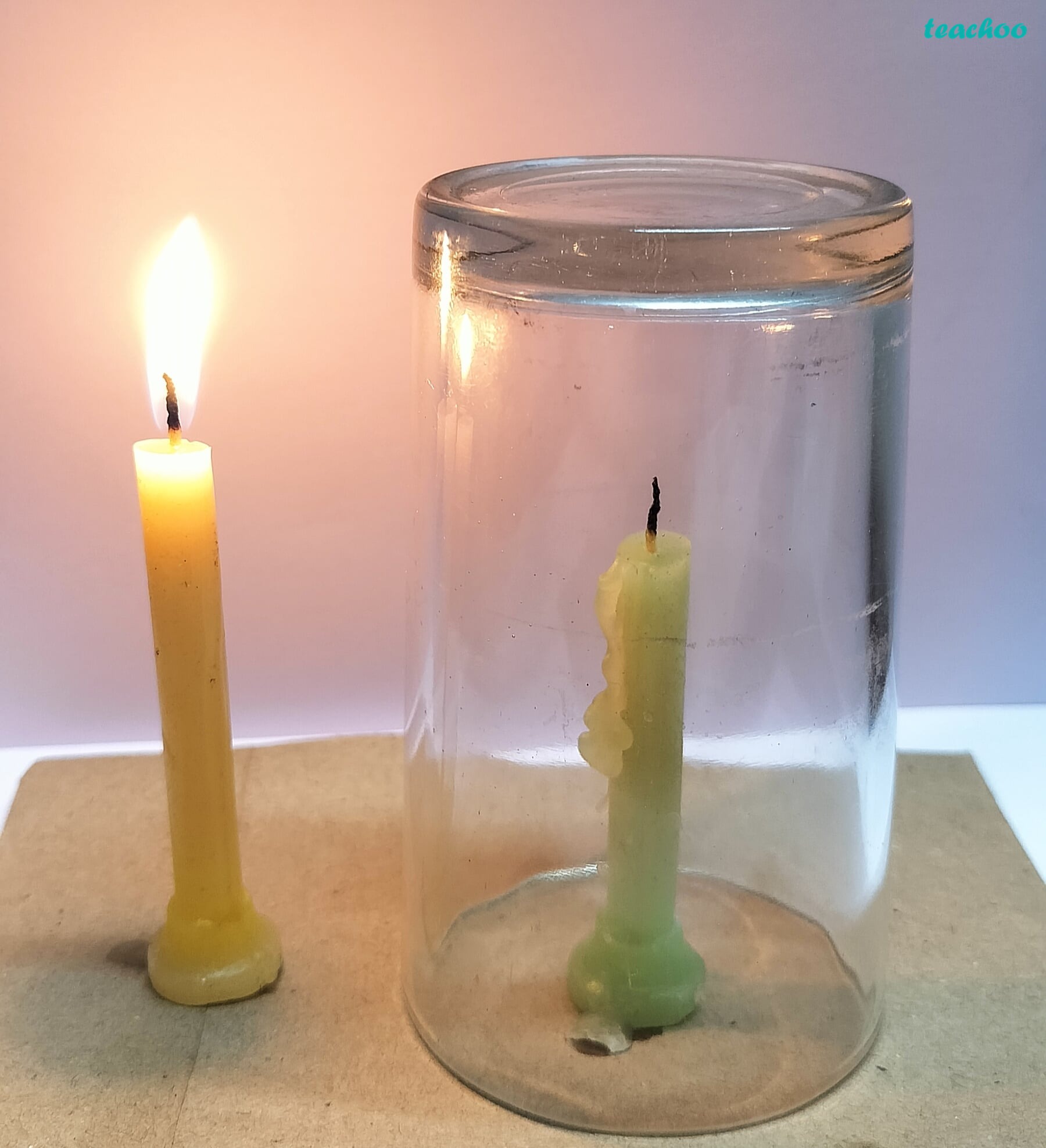
- The uncovered candle keeps burning .
- The covered candle stops burning after a short time.
- If you add a few drops of lime water inside the inverted tumbler afterwards, it turns milky .
- The covered candle uses up the oxygen in the trapped air.
- Without continuous oxygen supply, combustion stops — the flame goes out.
- The lime water turning milky shows that carbon dioxide was produced inside — from the carbon in the wax reacting with the oxygen in the trapped air.
- Conclusion: Oxygen is required for combustion.
👀 Activity 5.6 — Heat is Also Needed: Sunrays Through a Magnifying Glass
- A piece of paper .
- A pair of tongs .
- A lighted matchstick .
- A magnifying glass .
- A sunny day.
- Step 1: Hold a piece of paper with the tongs and bring a lighted matchstick close to it. The paper catches fire immediately.
- Step 2: Take another piece of paper. Use the magnifying glass to focus sunrays into the smallest, brightest spot on the paper.
- Hold the focus there for some time and observe.
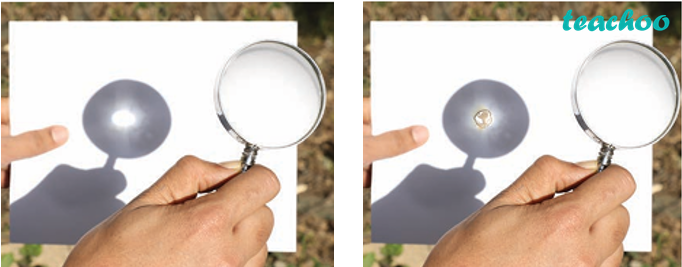
- Step 1: The matchstick fire instantly ignites the paper.
- Step 2: After holding the focused sunrays on one spot for a while, the paper starts emitting smoke and then catches fire — even without any flame nearby .
- Focusing sunrays heats the paper at one spot.
- The temperature of that spot rises with time.
- When the temperature crosses the paper's ignition temperature , it catches fire on its own.
- The matchstick was already much hotter than paper's ignition temperature, so it ignited the paper instantly.
- Conclusion: A combustible substance + oxygen is not enough — you also need heat to reach the ignition temperature.
- Wrap a cotton or woollen blanket (or thick cloth) around the person.
- This cuts off the supply of air (oxygen) to the fire.
- Without oxygen, combustion stops and the fire is extinguished.
- This is exactly the principle of Activity 5.5 — remove the oxygen, the flame dies.
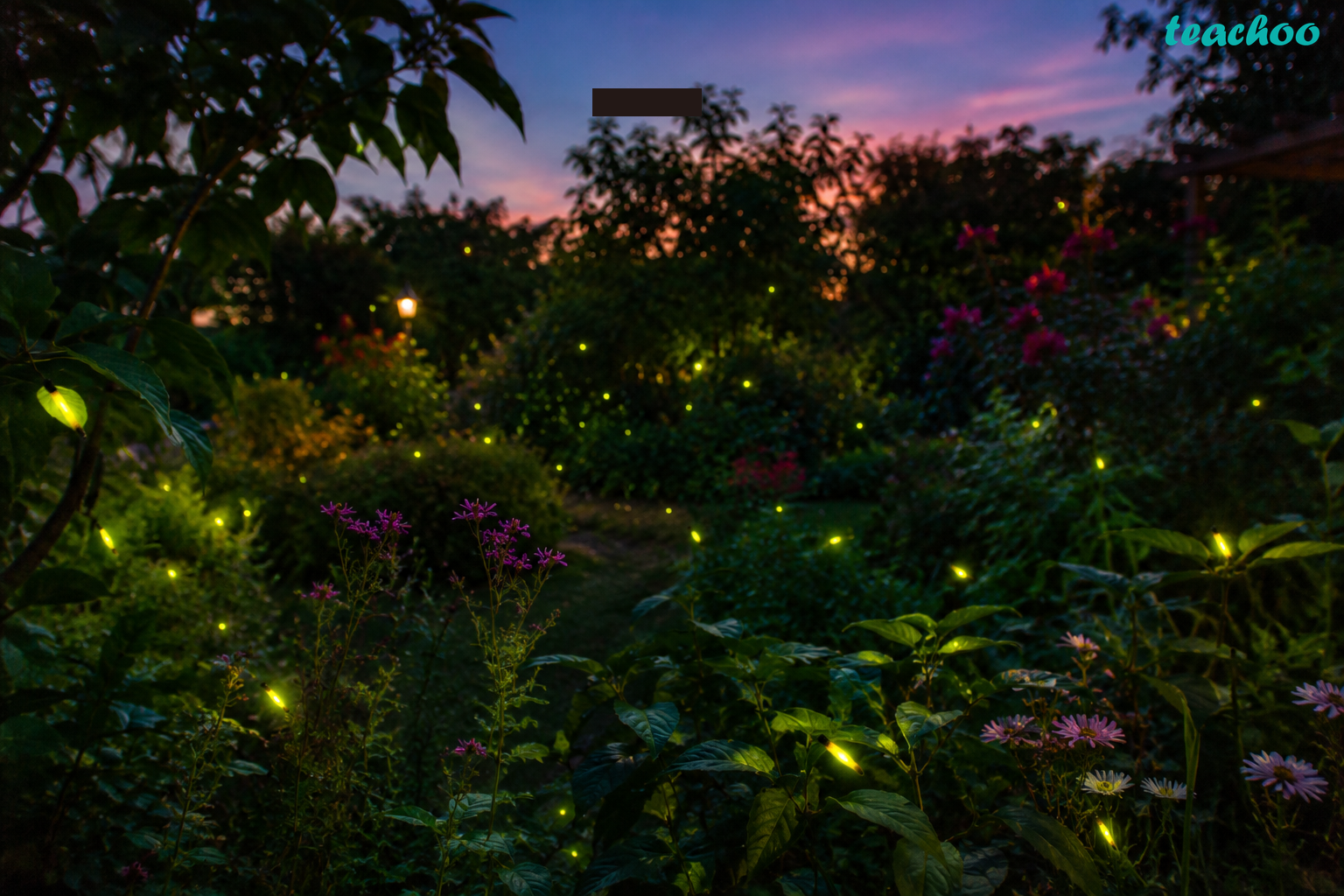
- You may have seen tiny insects emitting light in a garden or field on a late evening.
- These are fireflies .
- The light is produced by a chemical change inside the insect's body.
- Light produced by a chemical change in a living organism — without heat — is called bioluminescence .
- So this is a chemical change that gives off light only , no heat — very different from combustion.
-
Define combustion.
View Answer
A chemical reaction in which a substance reacts with oxygen and produces heat and/or light . -
Name the three things needed for combustion (the fire triangle).
View Answer
Fuel (a combustible substance), oxygen , and heat to reach the ignition temperature. -
What is ignition temperature?
View Answer
The lowest temperature at which a substance catches fire. -
Why does a candle covered by a glass tumbler stop burning after a while?
View Answer
The trapped oxygen gets used up; without a continuous supply of oxygen, combustion cannot continue. -
Why should a synthetic blanket NOT be used to put out a fire on a person?
View Answer
Synthetic cloth can melt and stick to the skin , causing severe burns.
