
 You are here
What is a Reversible Change?
It means a change where we can get the original substance back .
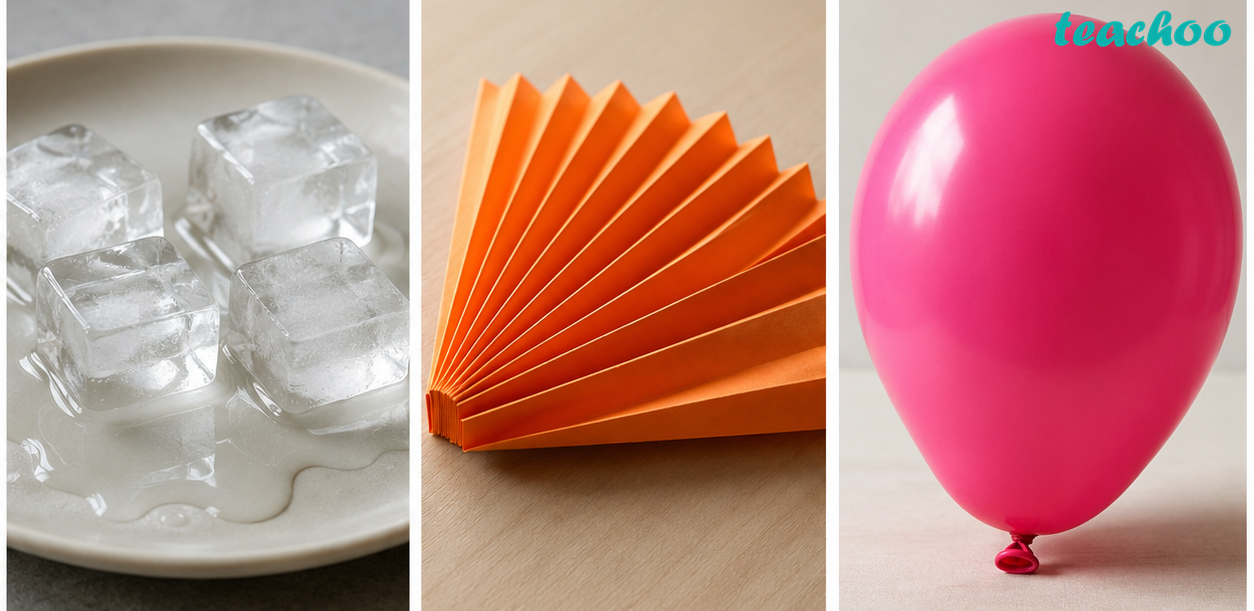
Examples of reversible changes
- Melting an ice cube — we can refreeze the water back into ice.
- Boiling water — the steam can be condensed back into water.
- Folding a paper — we can unfold it.
- Inflating a balloon — we can let the air out.
What is an Irreversible Change?
It means a change where we cannot get the original substance back .
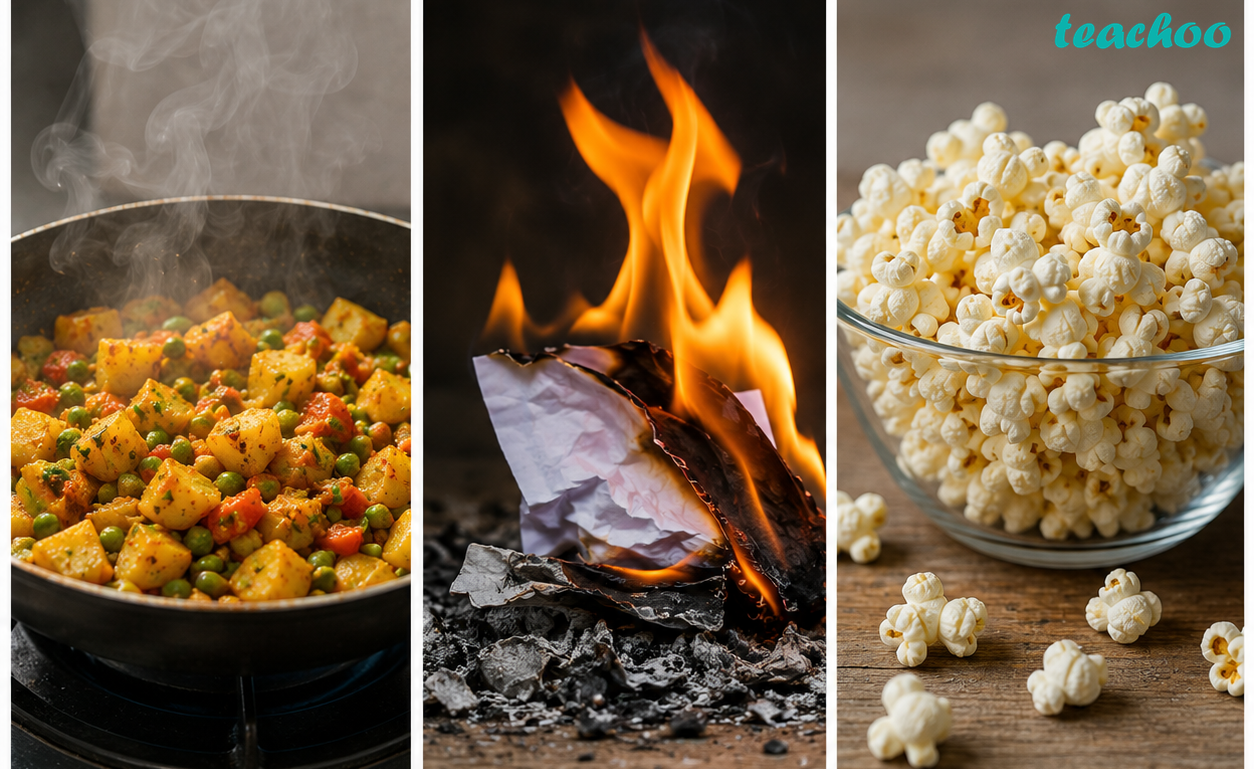
Examples of irreversible changes
- Chopping vegetables — the pieces cannot become whole again.
- Making popcorn — popcorn cannot become a corn kernel again.
- Burning paper — ash cannot become paper again.
- Cooking food — cooked food cannot become raw again.
Types of Physical Changes
Physical Change
Reversible
Examples:
- Melting ice cubes
- Making small balls of dough
Irreversible
Examples:
- Cutting a piece of paper
- Rolling small balls of dough into chapatis
Reversible vs Irreversible
- Reversible change — the original substance can be brought back (ice → water → ice).
- Irreversible change — the original substance cannot be brought back (paper → ash, raw rice → cooked rice).
The Connection With Physical and Chemical Changes
Reversibility and the physical/chemical idea are related but not the same .
How they usually go together
-
Most physical changes are reversible.
- Ice melts → water freezes back into ice.
- Paper folds → paper unfolds.
-
Most chemical changes are irreversible.
- Once paper is burned, the paper cannot come back.
- Once milk is curdled, fresh milk cannot be recovered.
But there are exceptions
-
Some physical changes are NOT reversible.
- Crushing chalk into powder — the chalk piece cannot be reassembled.
- Mixing beetroot extract in water — the colour cannot be fully separated out.
- So "physical change" does not always mean "reversible".
- The two ideas overlap but are not the same .
Quick fact: Whether a change is reversible is a
different question
from whether it is physical or chemical — though the two often go together, there are exceptions either way.
🤔
Quick Check — Test Yourself
-
What is a reversible change?
View Answer
A change in which the original substance can be brought back after the change. -
Give two examples of irreversible changes.
View Answer
(Any two) Burning paper; cooking food; making popcorn; ripening of fruits; chopping vegetables. -
Are all physical changes reversible?
View Answer
No — most are, but exceptions exist (e.g., crushing chalk into powder is physical but not reversible). -
Are all chemical changes irreversible?
View Answer
Almost always yes — once a new substance is formed, getting back the original is very difficult or impossible at home. -
Is melting of butter reversible? Is cooking of an egg reversible?
View Answer
Melting butter is reversible (cool it, it solidifies again). Cooking an egg is irreversible (the egg white cannot return to its raw form).
👀 Activity 5.8 — Sort the Changes by Reversibility
Procedure
- Look back at every change discussed so far in this chapter.
- For each one, ask: "Can I get the original substance back after this change?"
- Record your answers (Yes / No) in Table 5.2.
Table 5.2 — Can the Changes Be Reversed?
| S.No. | Change | The original state can be brought back (Yes / No) |
|---|---|---|
| 1. | Melting ice cubes | Yes — refreeze the water. |
| 2. | Chopping vegetables | No — cannot rejoin the pieces. |
| 3. | Boiling water | Yes — condense the steam back to water. |
| 4. | Making popcorn from corn | No — popcorn cannot become a hard kernel again. |
| 5. | Cutting a piece of paper | No — cannot rejoin into a single sheet. |
| 6. | Adding beetroot extract to water | No — the colour cannot be fully separated. |
| 7. | Burning wood | No — ash and smoke cannot become wood again. |
| 8. | Drying wet clothes | Yes — can re-wet the cloth (water cycle). |
| 9. | Making small balls of dough | Yes — can re-flatten the dough. |
| 10. | Rolling balls of dough into chapatis (raw) | Yes — raw dough can be reshaped before cooking. |
| 11. | Inflating a balloon | Yes — let the air out, balloon returns to original shape. |
| 12. | Crushing a piece of chalk | No — powder cannot reassemble into the original piece. |
Observation
- Out of 12 changes, about half are reversible and half are not.
- All the reversible ones are physical changes.
- All the chemical changes (burning wood) are irreversible.
- But not all physical changes are reversible (chopping, cutting, crushing).
Explanation
- State changes (melting, boiling, freezing, condensing) are always reversible.
- Chemical changes form new substances, which is hard or impossible to undo.
- Some physical changes destroy structure that can't be easily rebuilt (a torn paper, a crushed chalk).
