
 You are here
What is a Chemical Change?
It means a change where a new substance is formed.
The new substance is different from the original substance.
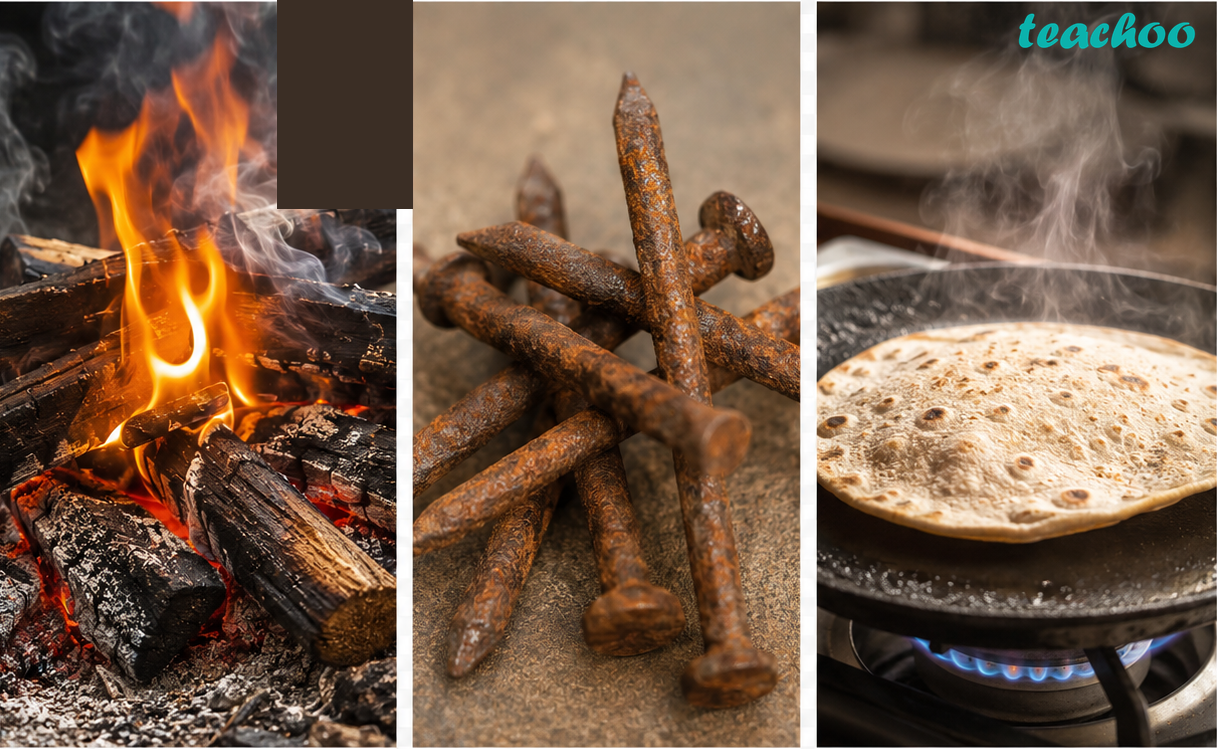
Examples
- Burning of paper.
- Rusting of iron.
- Curdling of milk.
- Cooking of food.
- Ripening of fruits.
Key features of a chemical change
- One or more new substances are formed.
-
The new substance has
different properties
:
- Different colour.
- Different smell.
- Different state or behaviour.
- The process is called a chemical reaction .
- Most chemical changes cannot be reversed .
Definition
A chemical change is a change in which one or more new substances are formed.
The process by which the new substance is formed is called a chemical reaction .
Physical Change vs Chemical Change
- Physical change — only appearance changes; no new substance is formed; usually reversible.
- Chemical change — one or more new substances are formed; usually irreversible.
How to Write a Chemical Reaction
- A chemical reaction is written in short form as a chemical equation .
- The substances on the left are called reactants — what we start with.
- The substances on the right are called products — what is newly formed.
- An arrow (→) connects them, meaning "gives" or "produces".
Example (lime water + carbon dioxide):
Calcium hydroxide + Carbon dioxide → Calcium carbonate + Water
(lime water) (from breath) (white insoluble substance)
Signs That a Chemical Change Has Happened
You can spot a chemical change by these clues.
Common signs of a chemical change
-
A new colour appears.
- Example: lime water turning milky.
-
Bubbles or gas are produced.
- Example: vinegar + baking soda fizzing.
-
A solid settles down at the bottom.
- Example: a white precipitate forming in the lime water test.
-
Heat or light is released.
- Example: burning of a candle or magnesium ribbon.
-
A new smell is produced.
- Example: a banana over-ripening.
- Example: milk curdling.
Quick fact: The turning of lime water milky is a
standard test for carbon dioxide gas
— whenever CO₂ is bubbled through lime water, it turns milky.
🤔
Quick Check — Test Yourself
-
Define a chemical change.
View Answer
A change in which one or more new substances are formed. -
What is a chemical reaction?
View Answer
The process by which a new substance is formed during a chemical change. -
What is the test for carbon dioxide gas?
View Answer
Pass the gas through lime water — if it turns milky, the gas is carbon dioxide. -
Name three signs that suggest a chemical change has happened.
View Answer
(Any three) New colour; bubbles or gas; solid precipitate settling; heat or light released; new smell. -
In a chemical equation, what are reactants and products?
View Answer
Reactants are the starting substances (left of the arrow); products are the new substances formed (right of the arrow).
👀 Activity 5.3 — The Lime Water Test for Carbon Dioxide
⚠️
Caution
— Do not suck the water or lime water while doing this. Only blow air
out
.
Materials needed
- Two glass tumblers or small transparent bottles, marked A and B.
- Tap water (for tumbler A).
- Lime water (for tumbler B).
- Two separate straws .
Procedure
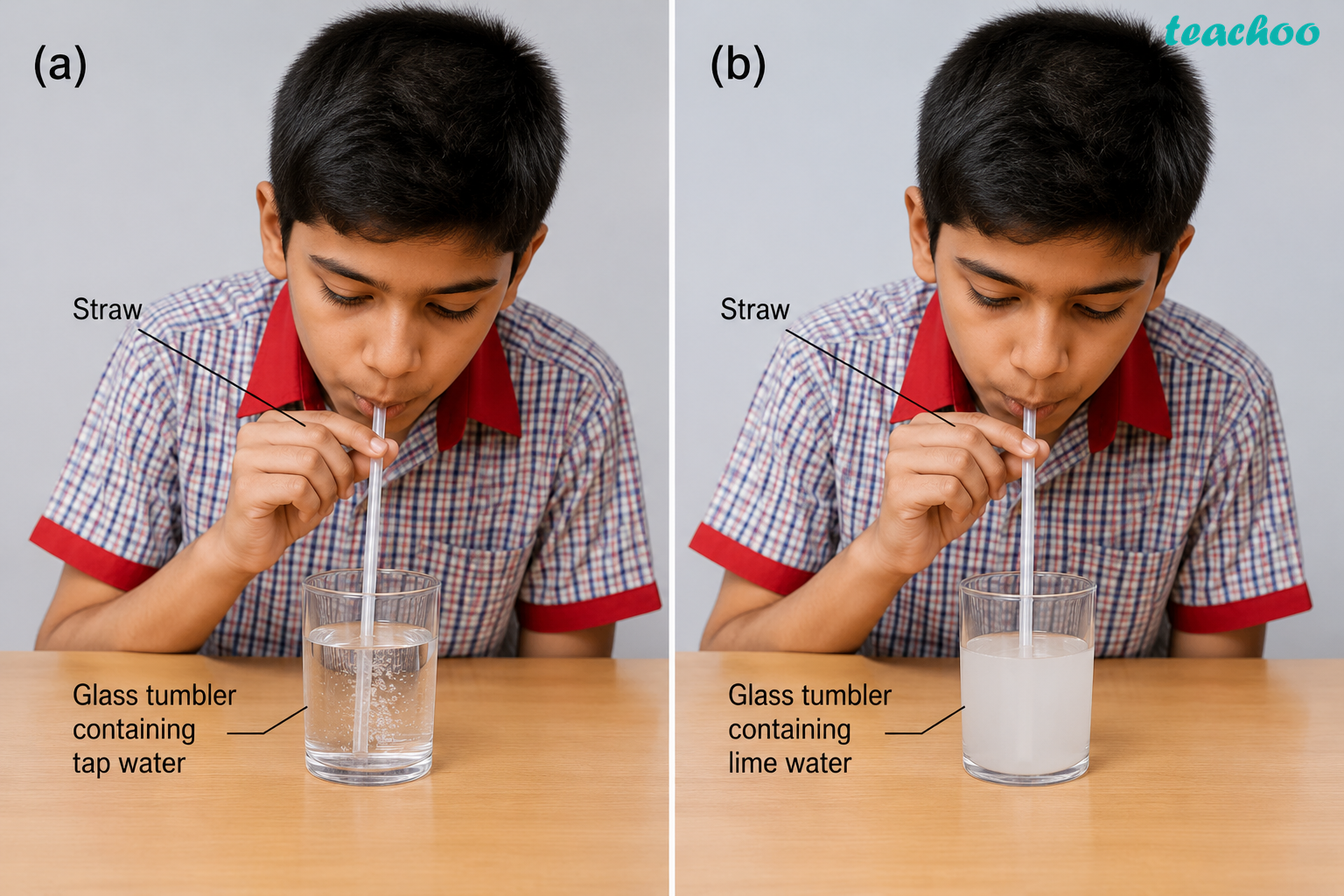
- Fill tumbler A one-fourth with tap water; fill tumbler B one-fourth with lime water.
- Using a separate straw for each, blow air (exhale) into each tumbler one at a time.
- Observe what happens in each tumbler.
Observation
- Tumbler A (tap water): Bubbles form, but the water looks the same — no colour or appearance change.
- Tumbler B (lime water): Bubbles form, and the lime water turns milky (cloudy).
- If left for some time, a white substance settles at the bottom of tumbler B.
Explanation
- The carbon dioxide we exhale reacts with the calcium hydroxide in lime water.
- This forms calcium carbonate — a new white substance that does not dissolve in water (so the liquid looks milky).
- A small amount of water is also formed.
- This is a chemical change — a new substance has been formed.
👀 Activity 5.4 — Vinegar + Baking Soda → Carbon Dioxide
Materials needed
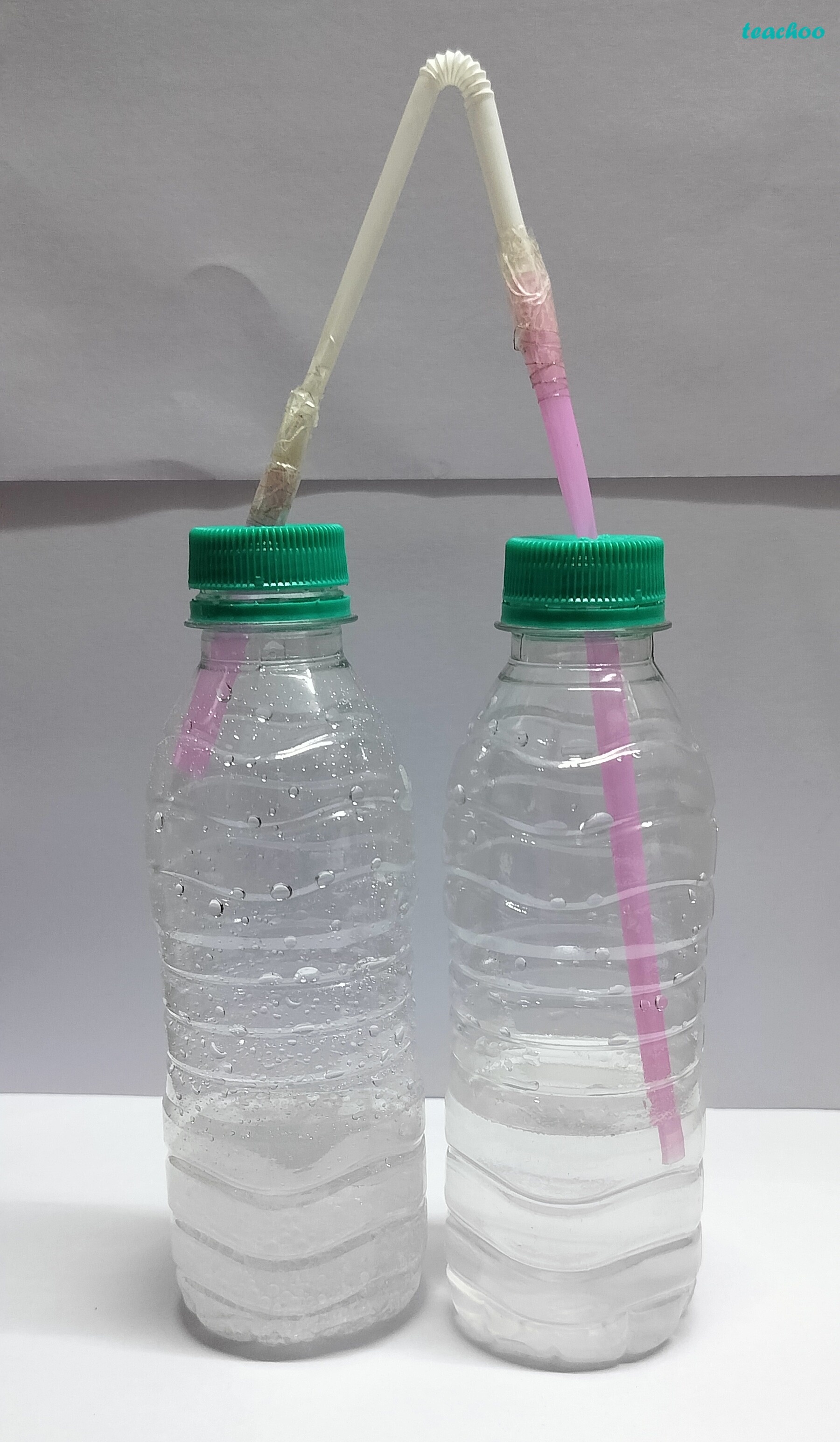
- Two test tubes (or two small bottles + a flexible straw).
- A teaspoonful of vinegar (or lemon juice).
- A pinch of baking soda (sodium hydrogen carbonate).
- Freshly prepared lime water .
Procedure
- Take a teaspoonful of vinegar in the first test tube.
- Add a pinch of baking soda to it.
- Observe and listen.
- Pass the gas produced through freshly prepared lime water in another test tube.
- Observe what happens to the lime water.
Observation
- A fizzing, bubbling sound is heard as soon as baking soda is added to vinegar.
- Gas bubbles rise out of the mixture.
- When this gas is bubbled through lime water, the lime water turns milky .
Explanation
- The lime water turning milky tells us the gas produced is carbon dioxide .
- The reaction between vinegar (an acid) and baking soda (a carbonate) produces carbon dioxide and other substances.
- A new substance (carbon dioxide) is formed — this is a chemical change .
Vinegar + Baking soda → Carbon dioxide + Other substances
📋 NCERT Question 6 — Is Curdling of Milk a Physical or Chemical Change?
Justify whether curdling of milk is physical or chemical.
View Answer →
📋 NCERT Question 8 — Eco-friendly Prithvi (Multi-Concept)
Identify each step in Prithvi's story (chopping, collecting peels, composting, plant growth) as physical or chemical change.
View Answer →
📋 NCERT Question 10 — Lime Water Tests in Four Setups
Identify which of the four lime-water setups (vinegar+baking soda; lemon+vinegar; vinegar+salt; lemon+baking soda) turn lime water milky and why.
View Answer →
