
 You are here
What is a Physical Change?
It means a change where only the look of a substance changes.
The substance itself stays the same.
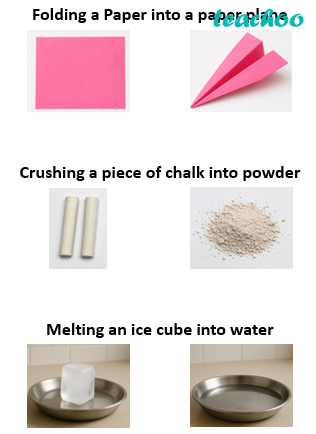
Examples
- Folding a paper into a plane.
- Crushing a piece of chalk into powder.
- Melting an ice cube into water.
- Cutting a vegetable into pieces.
- Boiling water into steam.
Key features of a physical change
- Only the appearance changes — shape, size, or state.
- No new substance is formed.
- The original substance is still there.
- Most physical changes can be reversed .
A physical change is a change in which only the physical properties (shape, size, or state) of a substance change.
No new substance is formed.
What are "Physical Properties"?
These are properties we can see or measure without changing the substance.
Three main physical properties that can change
-
Shape
- Example: a folded paper.
- Example: a rolled chapati .
- Example: a twisted wire.
-
Size
- Example: cut paper.
- Example: chopped vegetables.
- Example: crushed chalk.
-
State
- Solid to liquid: ice melting.
- Liquid to gas: water boiling.
- Gas to liquid: water vapour condensing.
Recall — The Three States of Water
Water can exist in three states .
The three states of water
- Solid — ice.
- Liquid — water.
- Gas — water vapour (steam).
How water changes state
- Water can change from one state to another.
- This happens by gaining heat or losing heat .
- All these state changes are physical changes .
- The substance is always H₂O.
-
Define a physical change.
View Answer
A change in which only the physical properties (shape, size, state) of a substance change and no new substance is formed . -
Name three physical properties that can change in a physical change.
View Answer
Shape, size, and state. -
Is melting of ice a physical or chemical change?
View Answer
Physical change — ice and water are both H₂O, only the state changes. -
When you fold a paper into a paper plane, is it a physical or chemical change?
View Answer
Physical change — the shape changes but the paper itself is the same; you can unfold it. -
What is the key test to decide whether a change is physical?
View Answer
Check whether the same substance is still present after the change. If yes — physical. If a new substance has formed — chemical.
👀 Activity 5.2 — Three Hands-On Demonstrations of Physical Change
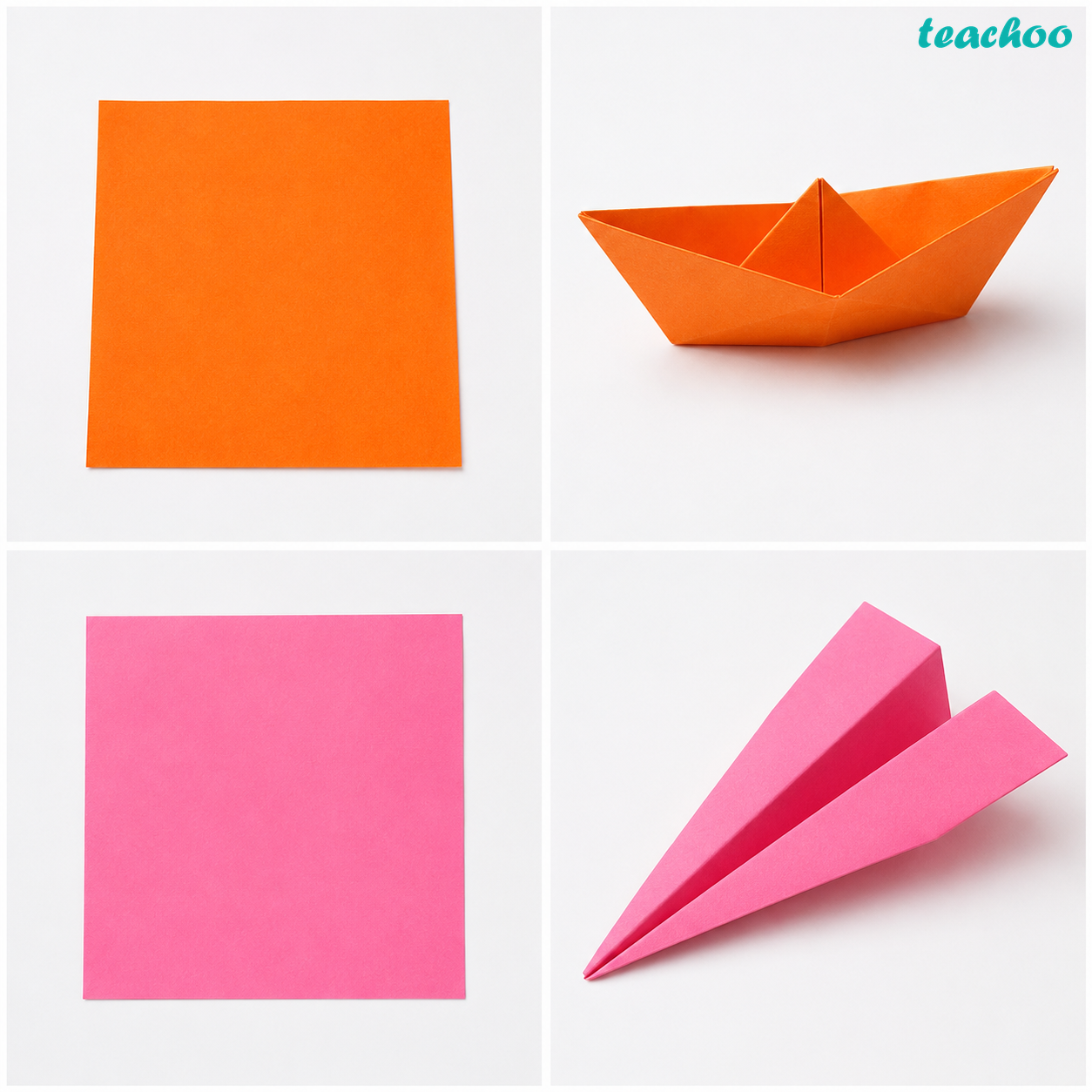
- Take a few sheets of paper.
- Fold them to create new objects — a paper boat, plane, bird, frog.
- Now unfold the objects.
- Question: Do you get the same paper back?
- Take a balloon and inflate it.
- Loosen your grip and let the air escape.
- Question: Do you get the uninflated balloon back?
- Take another balloon, inflate it, and grip the opening tightly.
- Prick it with a pin.
- Question: What happens? Will you get the uninflated balloon back?
- Crush a small piece of chalk into powder.
- Question: Can you get the chalk piece back from the powder?
- Paper: When you unfold, you get the same paper back — reversible.
- Balloon (let air out): You get the uninflated balloon back — reversible.
- Balloon (pricked): The balloon bursts — you cannot get the whole balloon back — irreversible.
- Chalk: Powder cannot be reassembled into the original chalk piece — irreversible.
- In every part — A, B, and C — the material itself remained the same : still paper, still rubber, still chalk.
- Only the appearance (shape or size) changed.
- So all of these are physical changes .
- Some physical changes are reversible (folding paper, deflating a balloon); some are not (bursting a balloon, crushing chalk).
📋 NCERT Question 1 — Characteristics of a Physical Change
📋 NCERT Question 5 — Are Water-to-Ice and Water-to-Steam Physical or Chemical?
We have just seen physical changes. Now let us explore a different type of change — one where a new substance is formed.
