End-of-Chapter Exercises

 You are here
Last updated at August 14, 2026 by Teachoo
Transcript
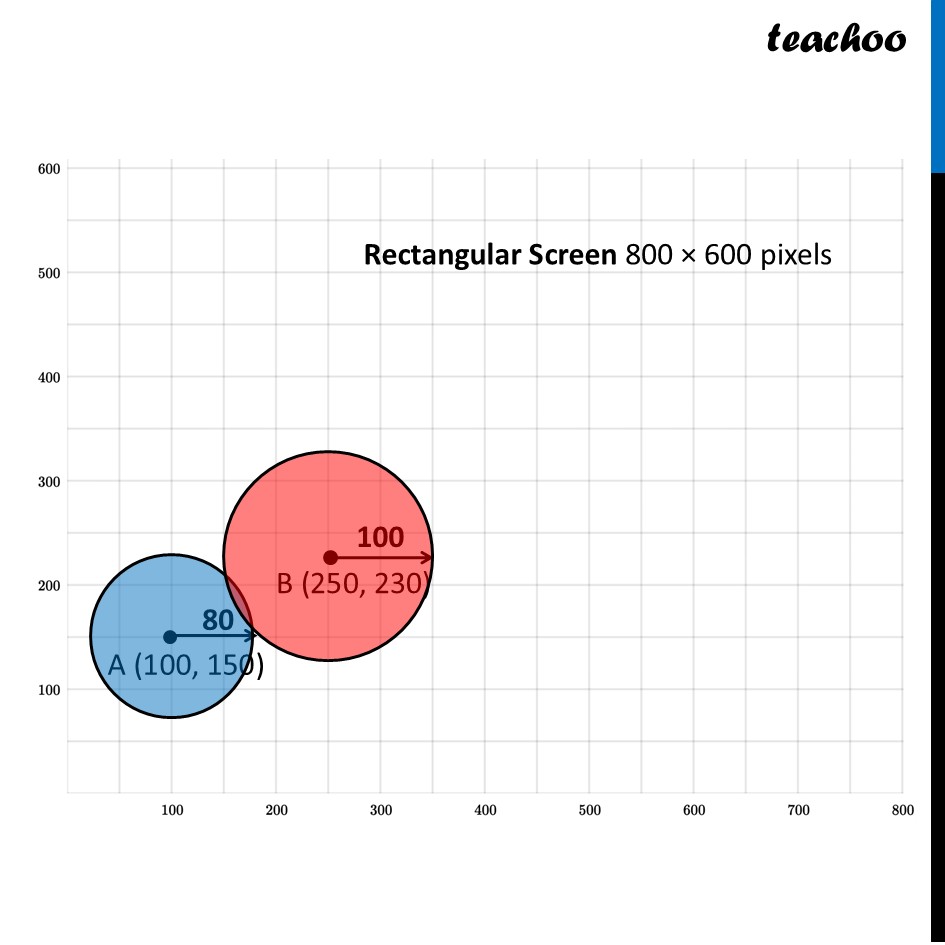
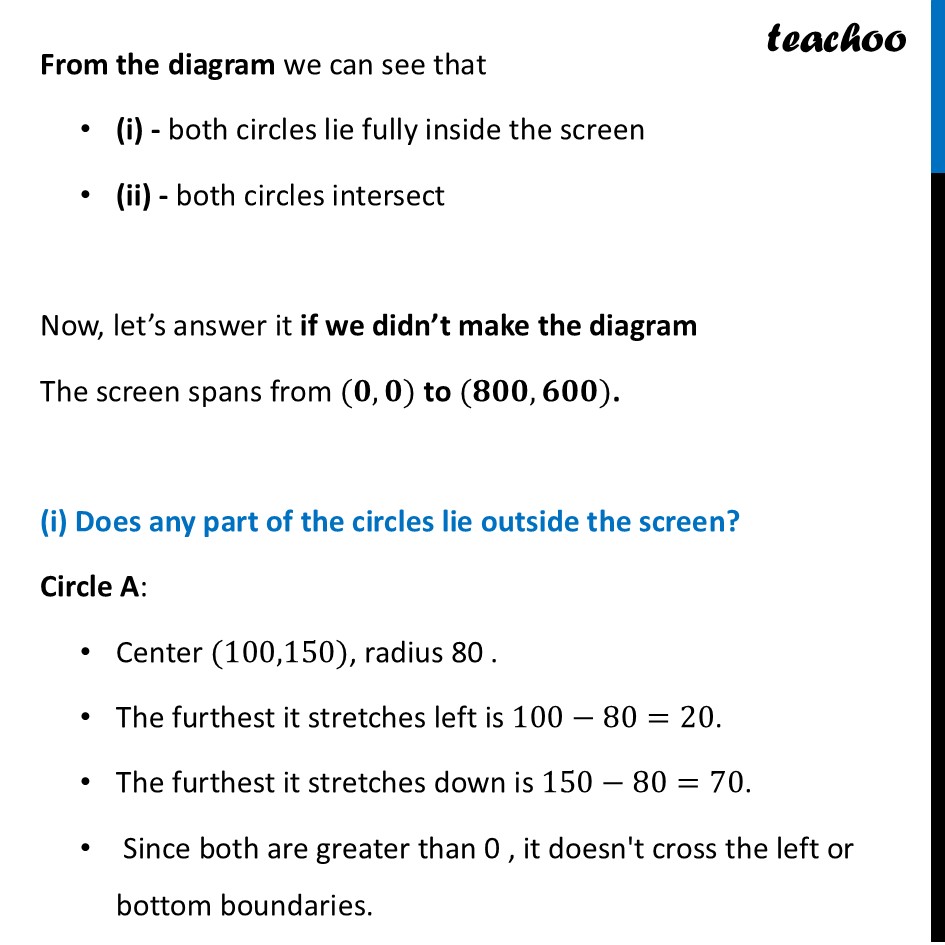
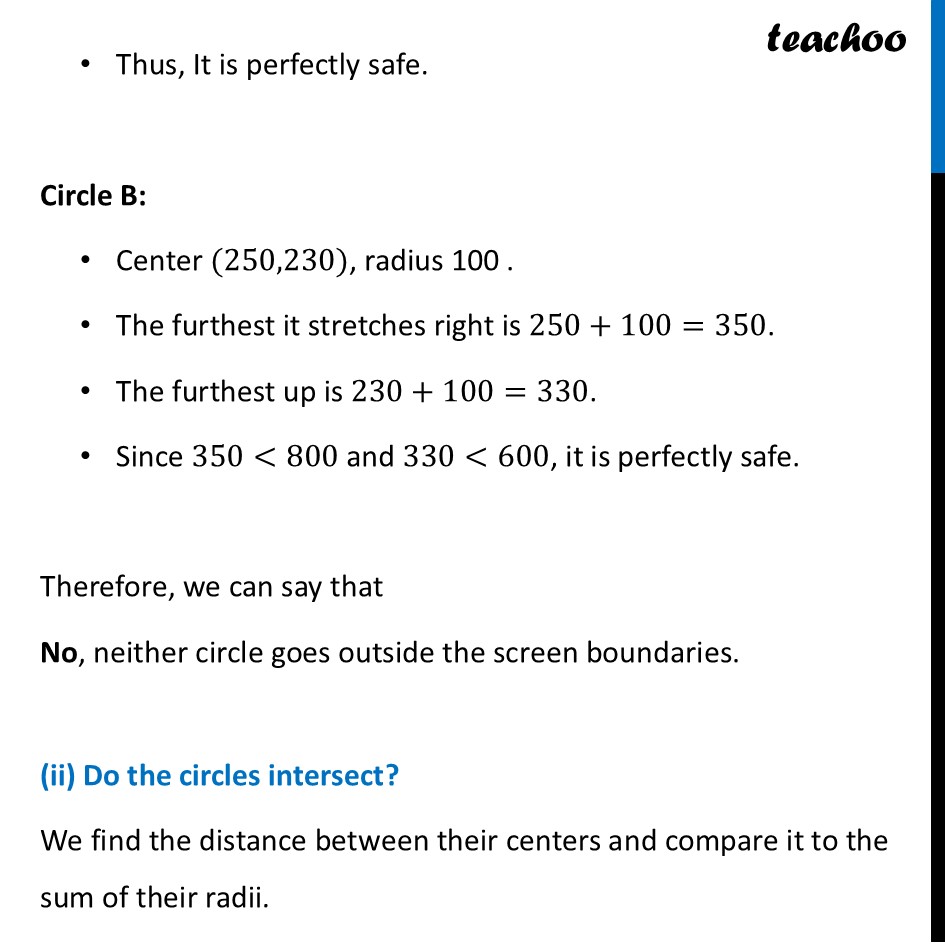
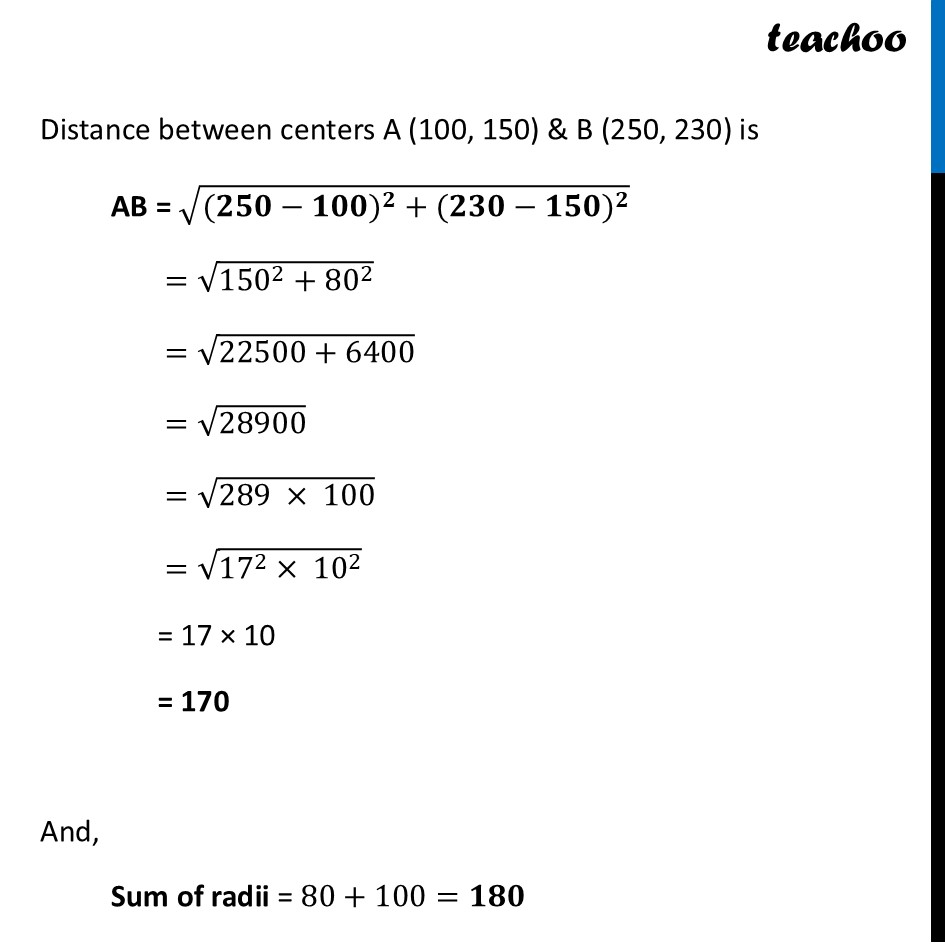
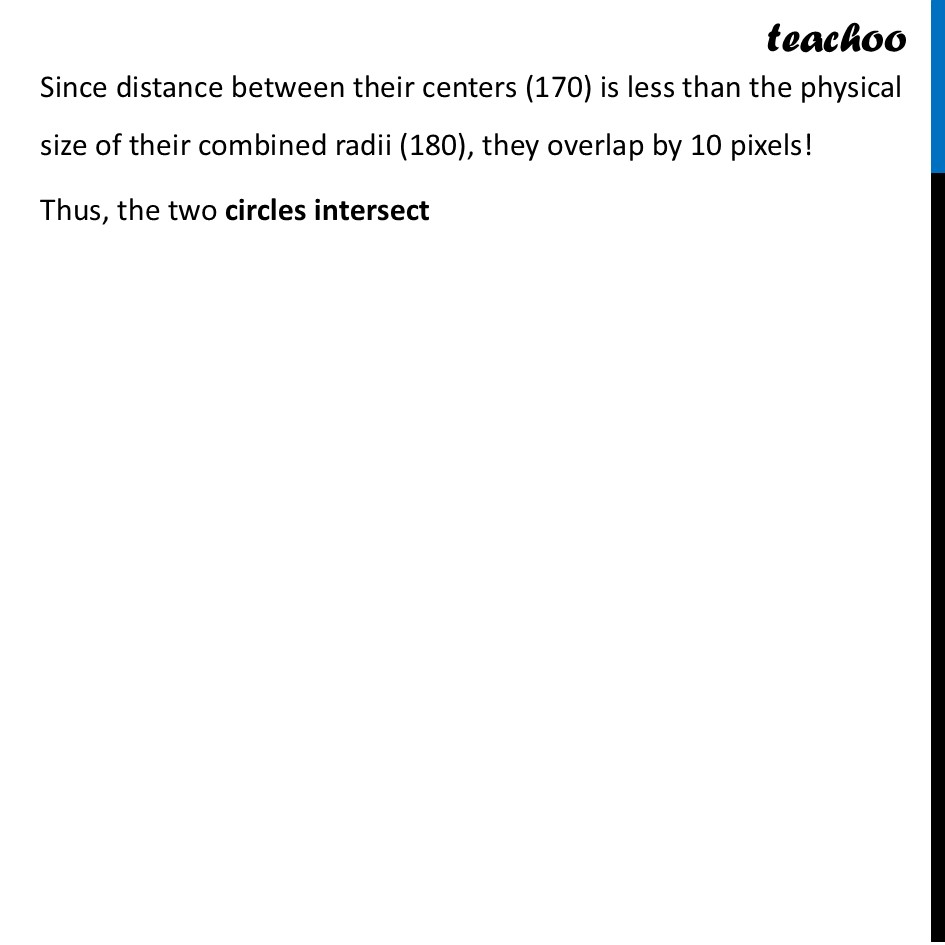
Question 15 (i) A computer graphics program displays images on a rectangular screen whose coordinate system has the origin at the bottom-left corner. The screen is 800 pixels wide and 600 pixels high. A circular icon of radius 80 pixels is drawn with its centre at the point A (100, 150). Another circular icon of radius 100 pixels is drawn with its centre at the point B (250, 230). Determine: whether any part of either circle lies outside the screen. whether the two circles intersect each other. Let’s draw the Screen and the circles Here, Width can be considered as x-axis Height can be considered as y-axis And, we only work in Quadrant 1 Rectangular Screen 800 × 600 pixels From the diagram we can see that (i) - both circles lie fully inside the screen (ii) - both circles intersect Now, let’s answer it if we didn’t make the diagram The screen spans from (𝟎,𝟎) to (𝟖𝟎𝟎, 𝟔𝟎𝟎). (i) Does any part of the circles lie outside the screen? Circle A: Center (100,150), radius 80 . The furthest it stretches left is 100−80=20. The furthest it stretches down is 150−80=70. Since both are greater than 0 , it doesn't cross the left or bottom boundaries. Thus, It is perfectly safe. Circle B: Center (250,230), radius 100 . The furthest it stretches right is 250+100=350. The furthest up is 230+100=330. Since 350<800 and 330<600, it is perfectly safe. Therefore, we can say that No, neither circle goes outside the screen boundaries. (ii) Do the circles intersect? We find the distance between their centers and compare it to the sum of their radii. Distance between centers A (100, 150) & B (250, 230) is AB = √((𝟐𝟓𝟎−𝟏𝟎𝟎)^𝟐+(𝟐𝟑𝟎−𝟏𝟓𝟎)^𝟐 ) =√(150^2+80^2 ) =√(22500+6400) =√28900 =√(289 × 100) =√(17^2× 10^2 ) = 17 × 10 = 170 And, Sum of radii = 80+100=𝟏𝟖𝟎 Since distance between their centers (170) is less than the physical size of their combined radii (180), they overlap by 10 pixels! Thus, the two circles intersect