End-of-Chapter Exercises

 You are here
Last updated at August 14, 2026 by Teachoo
Transcript
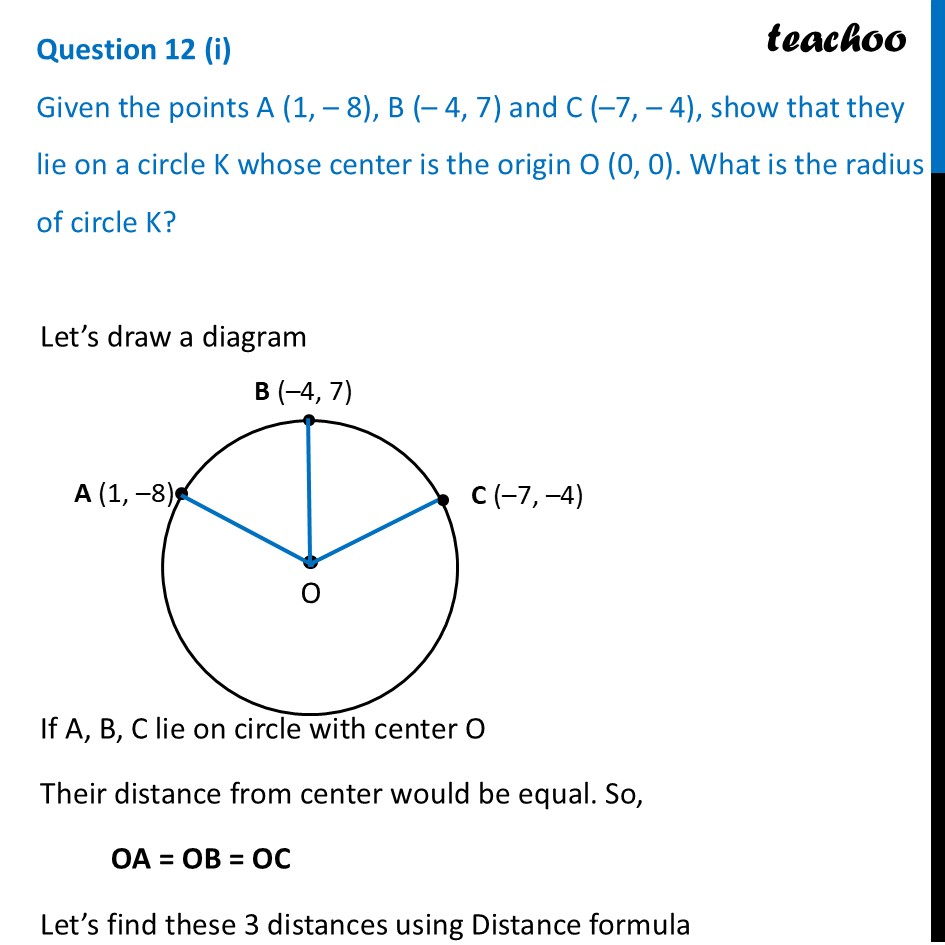
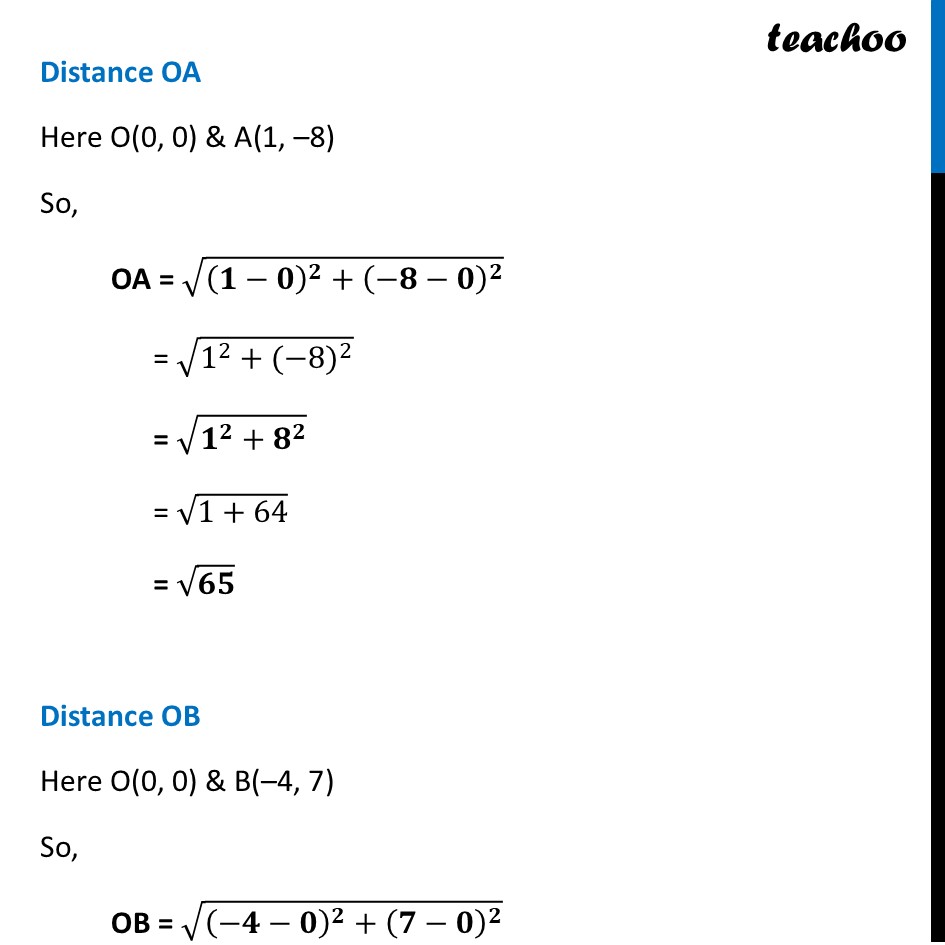
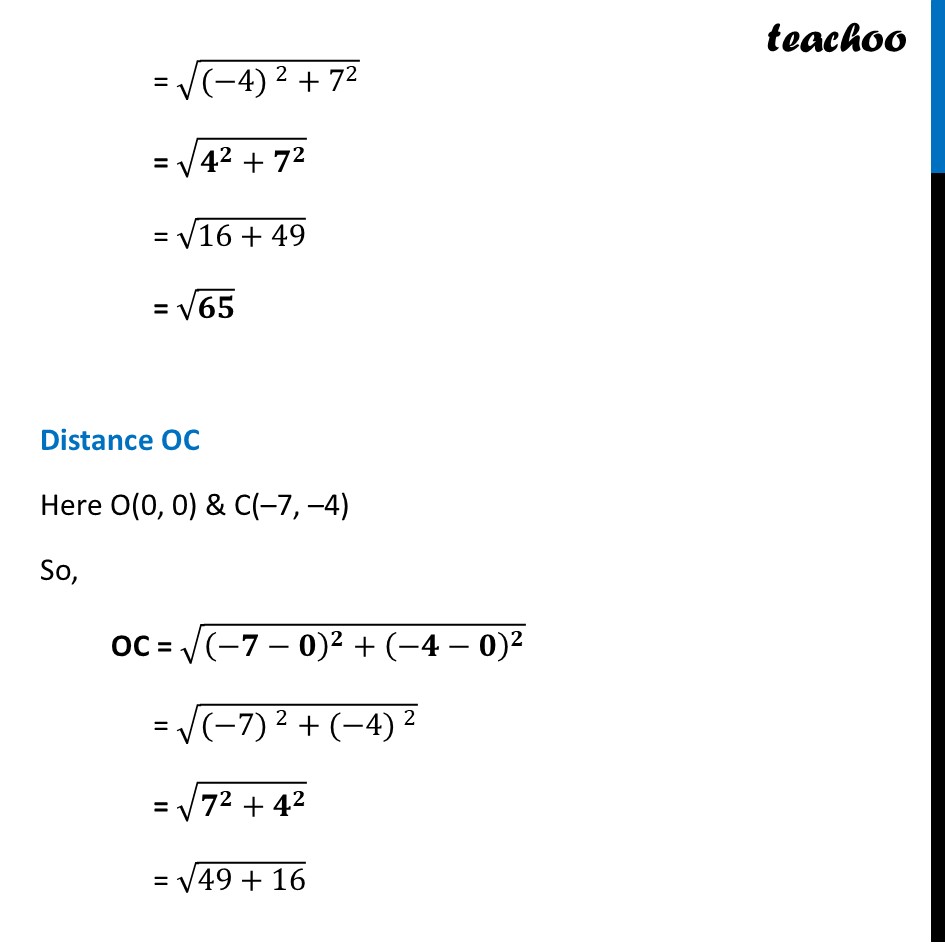
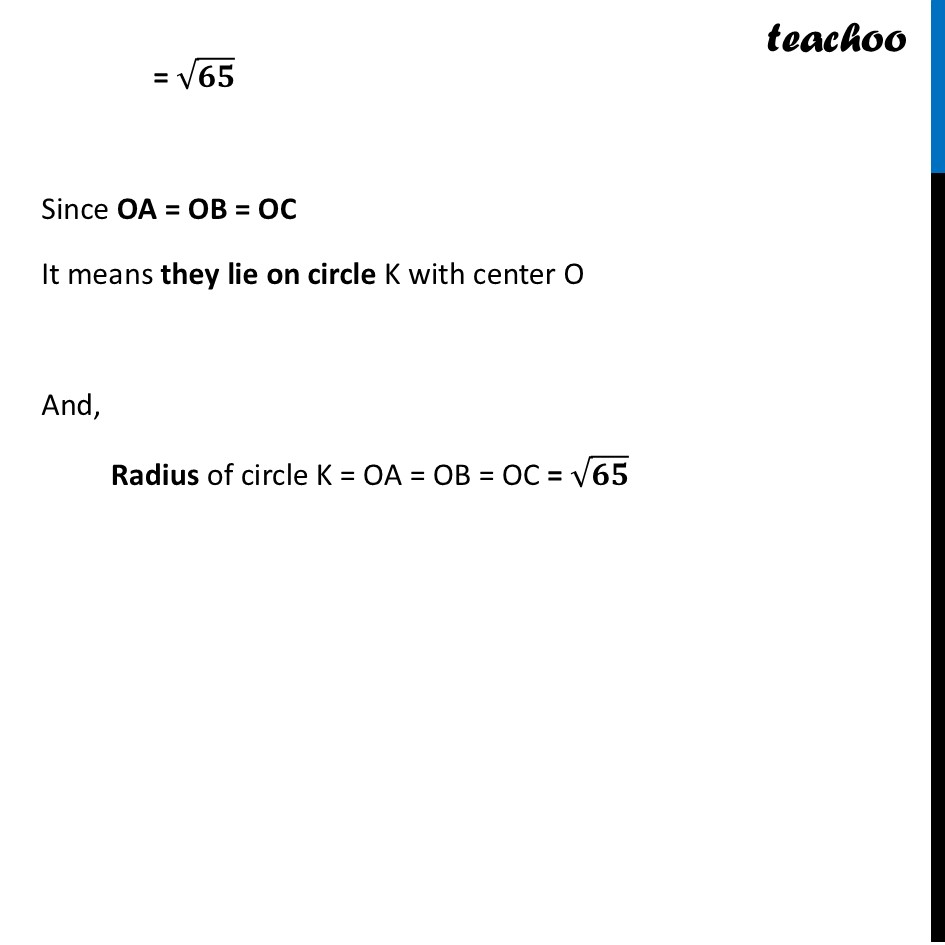
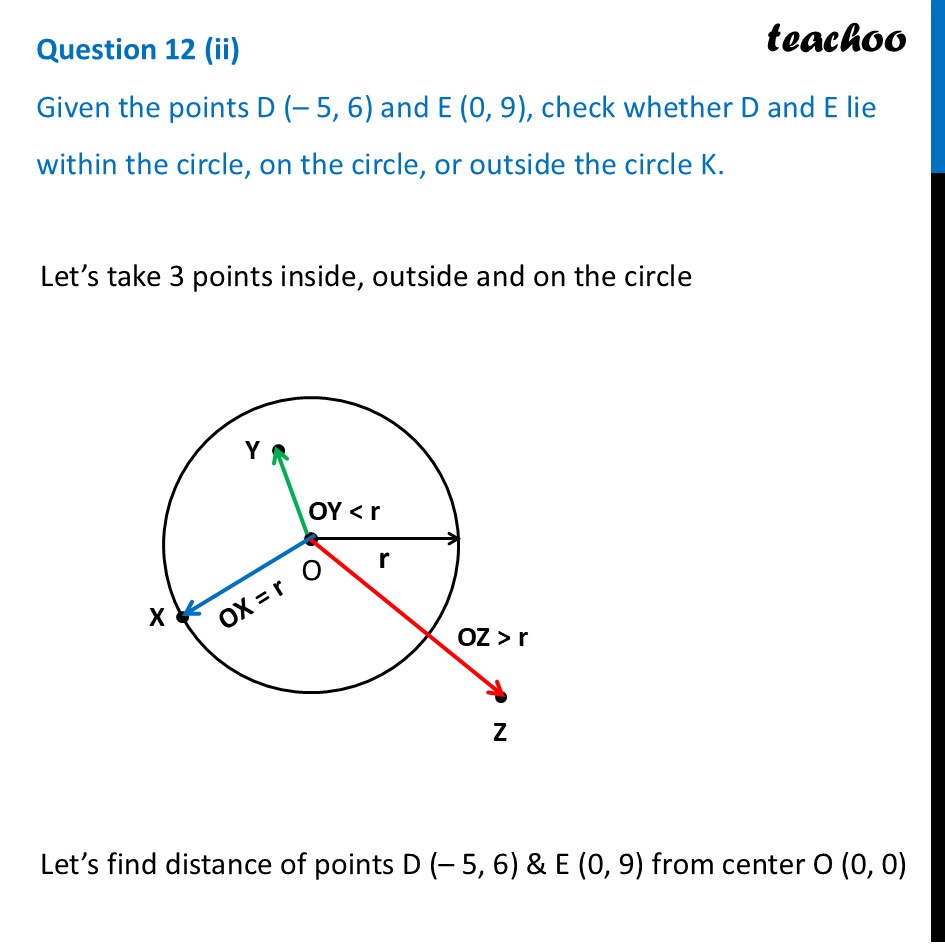
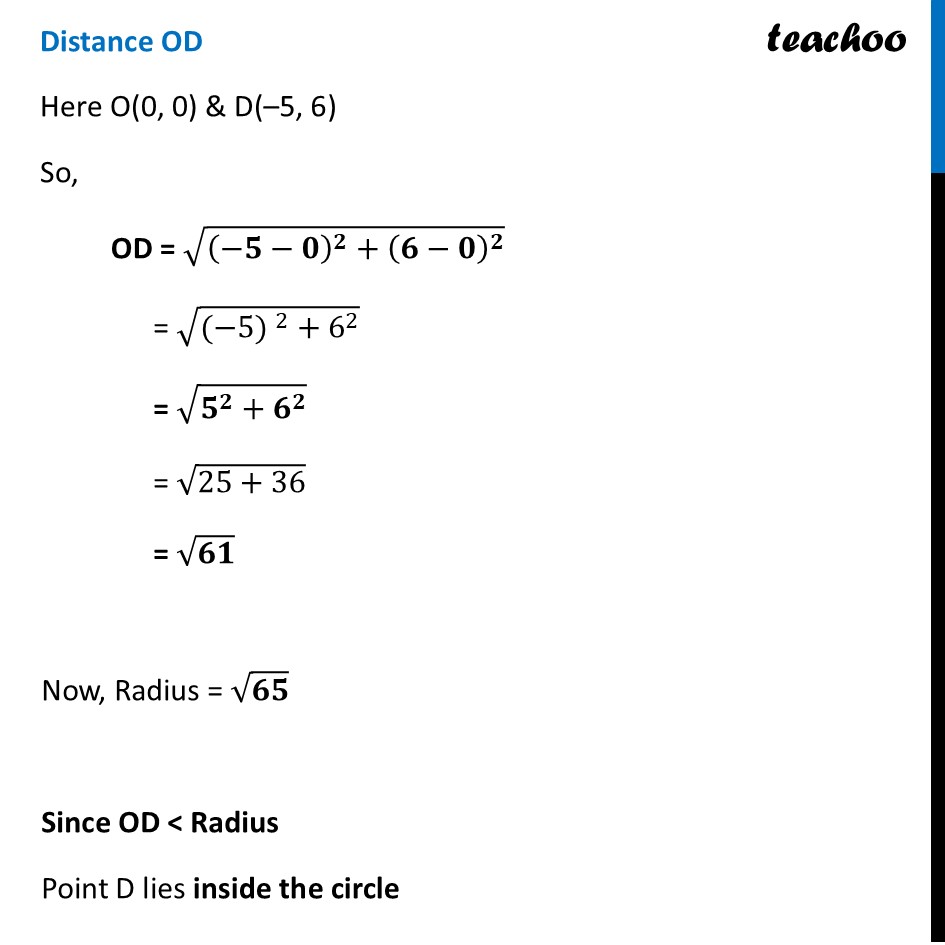
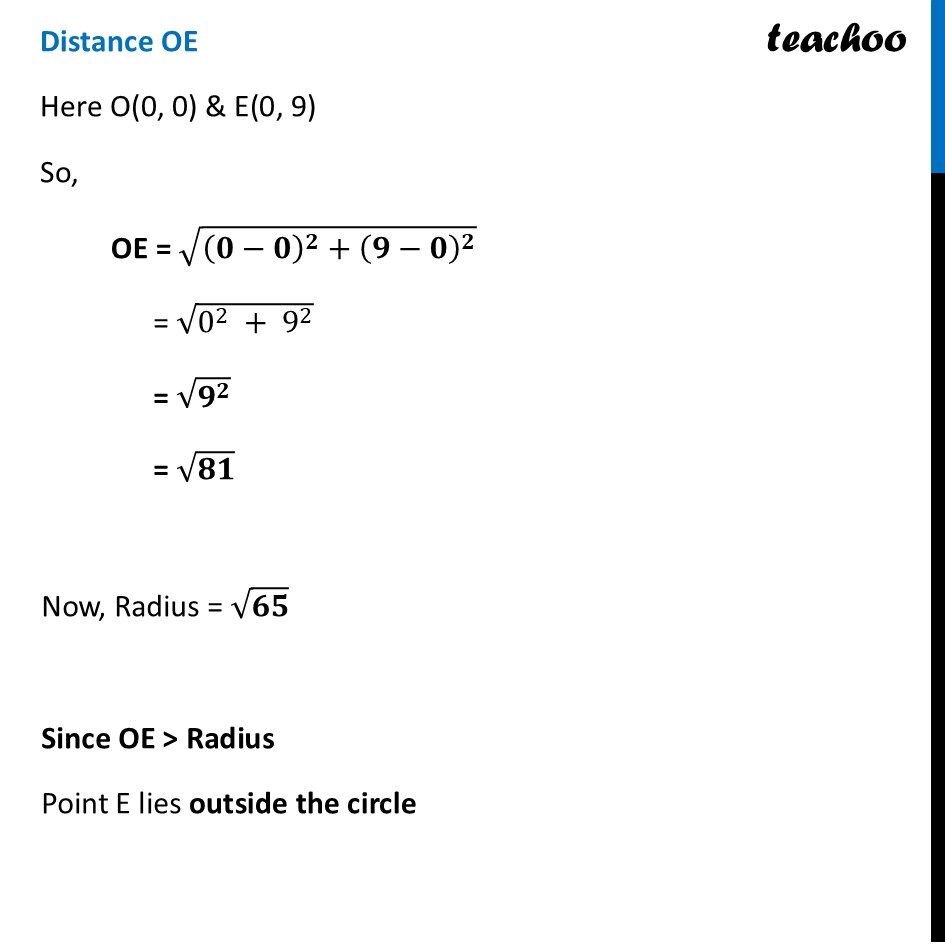
Question 12 (i) Given the points A (1, – 8), B (– 4, 7) and C (–7, – 4), show that they lie on a circle K whose center is the origin O (0, 0). What is the radius of circle K? Let’s draw a diagram If A, B, C lie on circle with center O Their distance from center would be equal. So, OA = OB = OC Let’s find these 3 distances using Distance formula Distance OA Here O(0, 0) & A(1, –8) So, OA = √((𝟏−𝟎)^𝟐+(−𝟖−𝟎)^𝟐 ) = √(1^2+〖(−8)〗^2 ) = √(𝟏^𝟐+𝟖^𝟐 ) = √(1+64) = √𝟔𝟓 Distance OB Here O(0, 0) & B(–4, 7) So, OB = √((−𝟒−𝟎)^𝟐+(𝟕−𝟎)^𝟐 ) = √(〖(−4) 〗^2 + 7^2 ) = √(𝟒^𝟐+𝟕^𝟐 ) = √(16+49) = √𝟔𝟓 Distance OC Here O(0, 0) & C(–7, –4) So, OC = √((−𝟕−𝟎)^𝟐+(−𝟒−𝟎)^𝟐 ) = √(〖(−7) 〗^2 + 〖(−4) 〗^2 ) = √(𝟕^𝟐+𝟒^𝟐 ) = √(49+16) = √𝟔𝟓 Since OA = OB = OC It means they lie on circle K with center O And, Radius of circle K = OA = OB = OC = √𝟔𝟓 Question 12 (ii) Given the points D (– 5, 6) and E (0, 9), check whether D and E lie within the circle, on the circle, or outside the circle K. Let’s take 3 points inside, outside and on the circle Let’s find distance of points D (– 5, 6) & E (0, 9) from center O (0, 0) Distance OD Here O(0, 0) & D(–5, 6) So, OD = √((−𝟓−𝟎)^𝟐+(𝟔−𝟎)^𝟐 ) = √(〖(−5) 〗^2 + 6^2 ) = √(𝟓^𝟐+𝟔^𝟐 ) = √(25+36) = √𝟔𝟏 Now, Radius = √𝟔𝟓 Since OD < Radius Point D lies inside the circle Distance OE Here O(0, 0) & E(0, 9) So, OE = √((𝟎−𝟎)^𝟐+(𝟗−𝟎)^𝟐 ) = √(0^2 + 9^2 ) = √(𝟗^𝟐 ) = √𝟖𝟏 Now, Radius = √𝟔𝟓 Since OE > Radius Point E lies outside the circle