You are here

Last updated at November 5, 2026 by Teachoo
Transcript
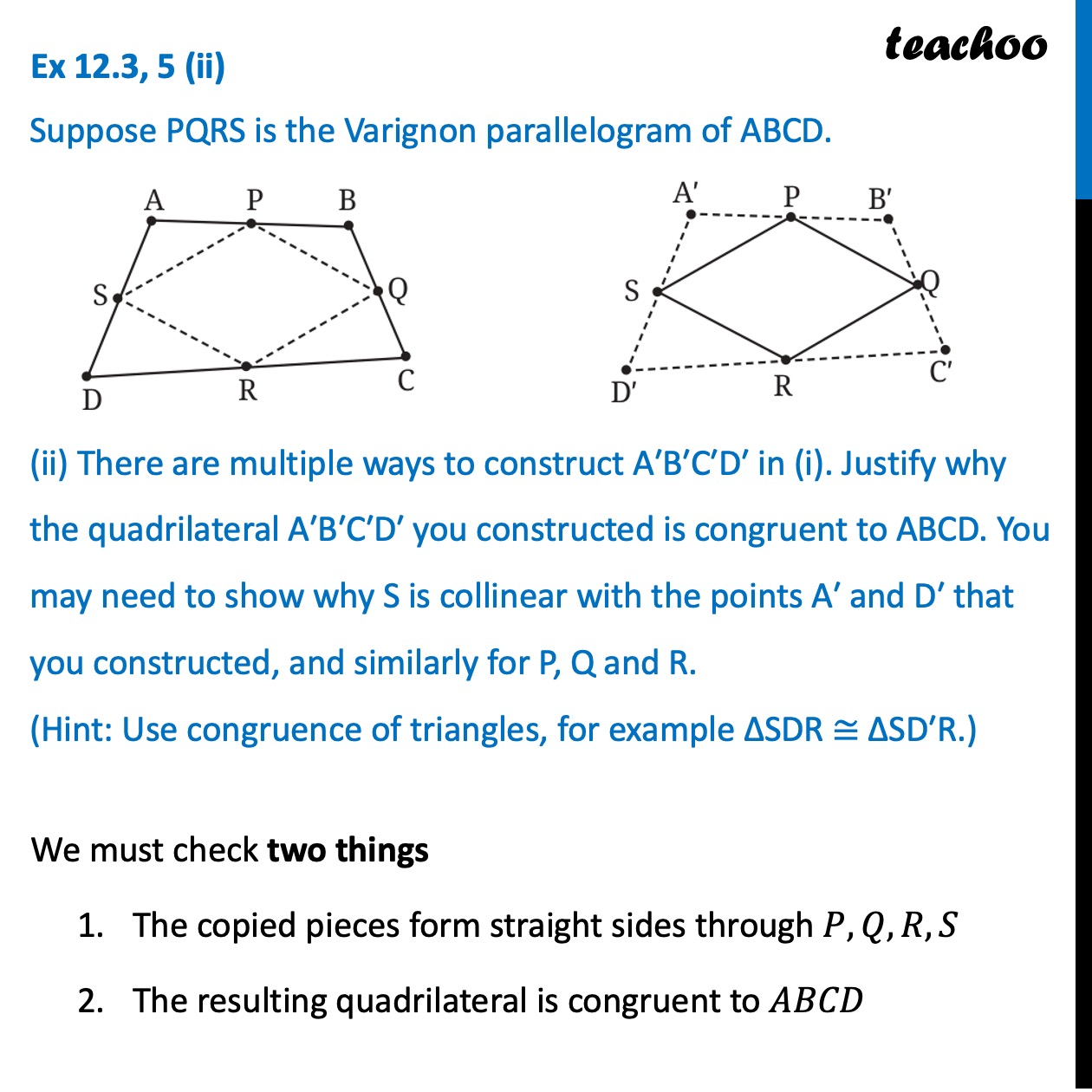
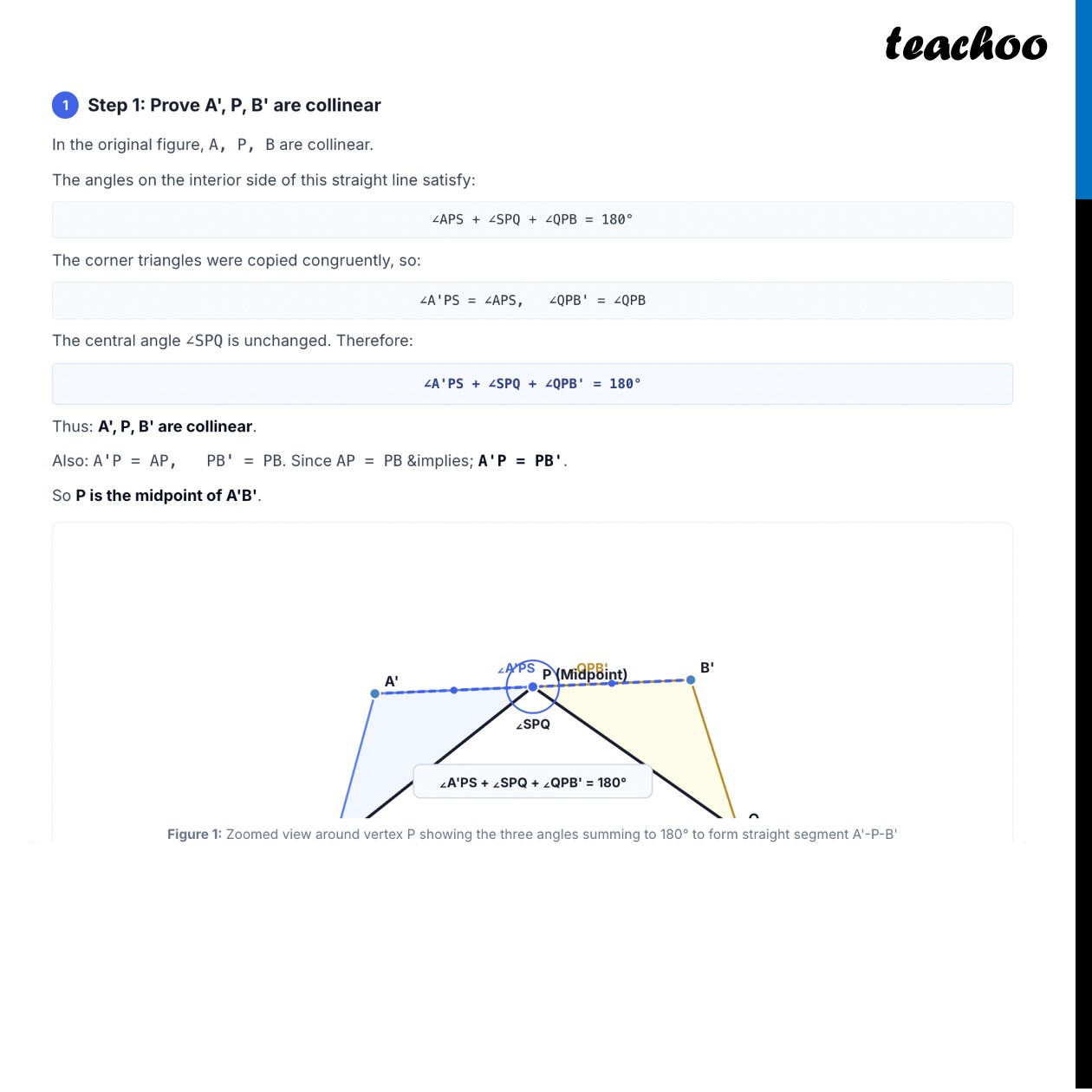
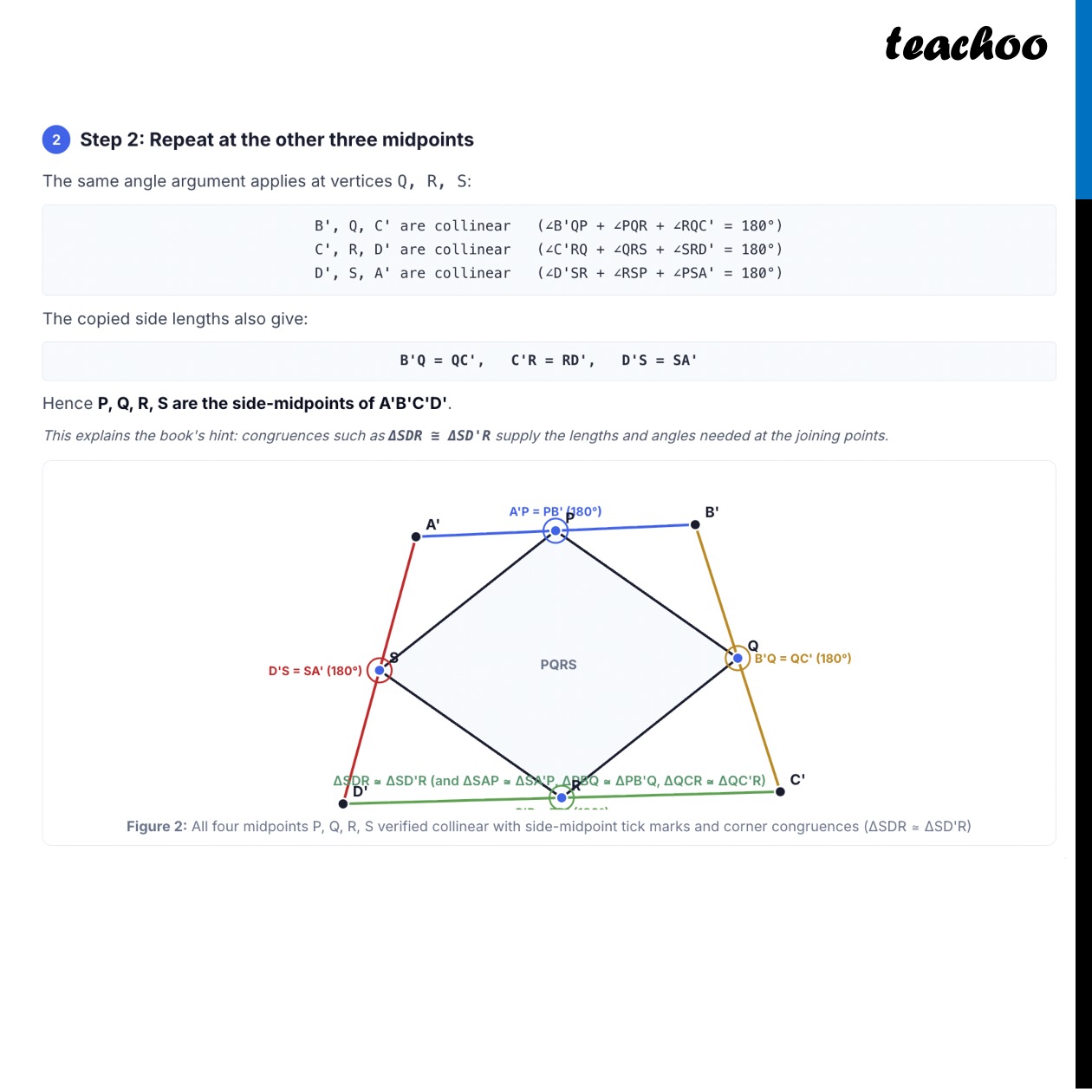
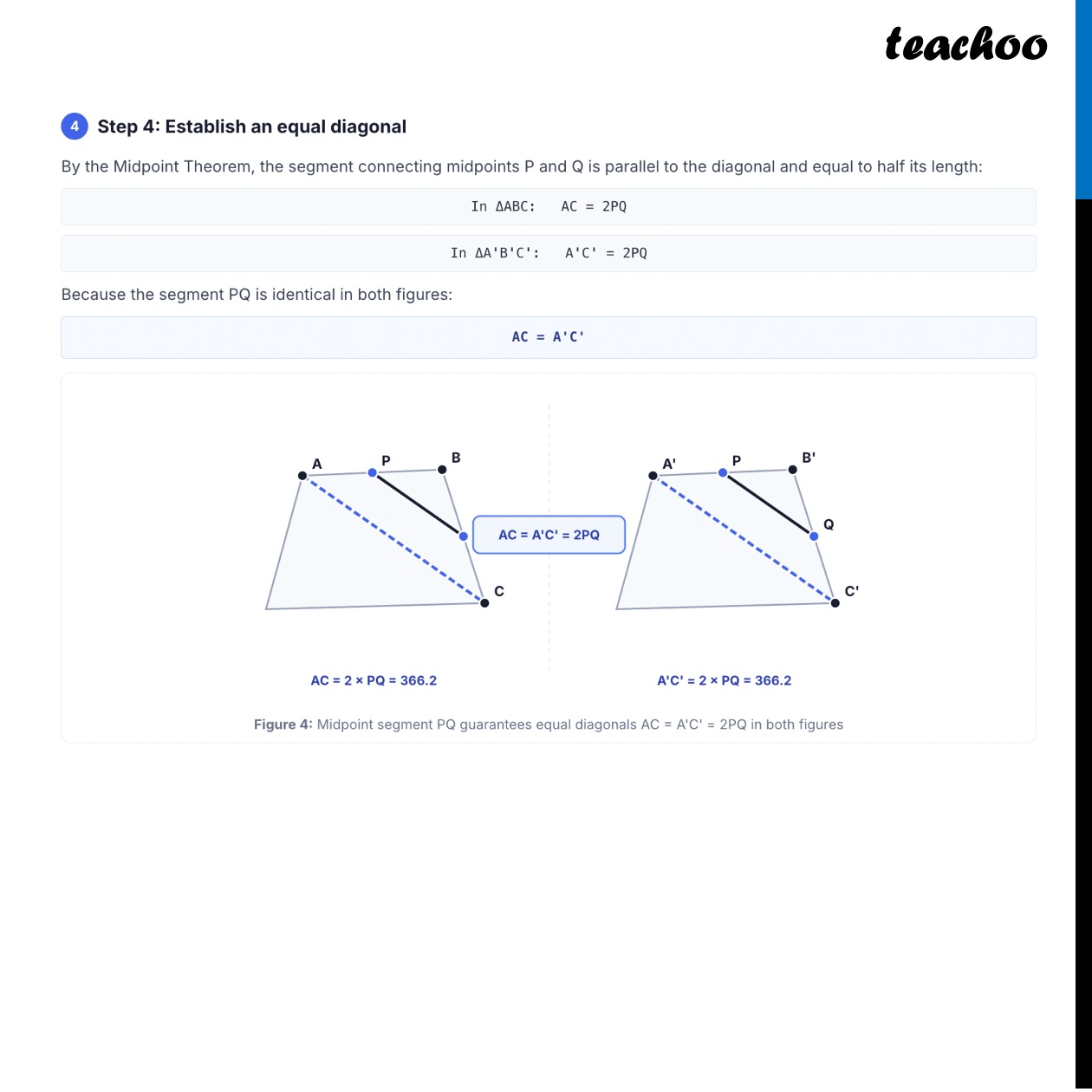
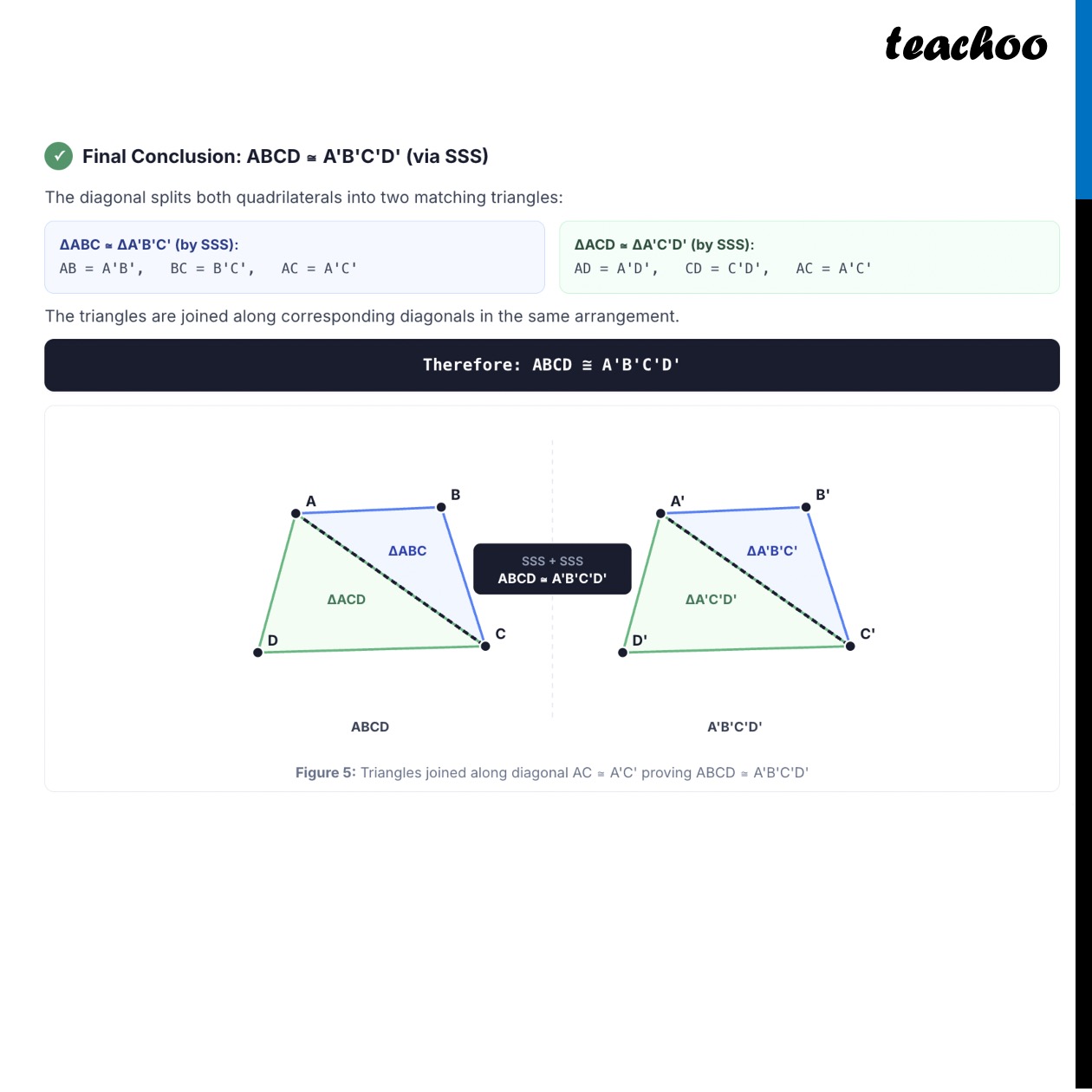
Ex 12.3, 5 (ii) Suppose PQRS is the Varignon parallelogram of ABCD. (ii) There are multiple ways to construct AʹBʹCʹDʹ in (i). Justify why the quadrilateral AʹBʹCʹDʹ you constructed is congruent to ABCD. You may need to show why S is collinear with the points Aʹ and Dʹ that you constructed, and similarly for P, Q and R. (Hint: Use congruence of triangles, for example ∆SDR ≅ ∆SDʹR.) We must check two things The copied pieces form straight sides through 𝑃,𝑄,𝑅,𝑆 The resulting quadrilateral is congruent to 𝐴𝐵𝐶𝐷 Fig. 12.25 a) Step 1: Prove A’, P, B' are collinear In the original figure, A, P, Bare collinear. The angles on the interior side of this straight line satisfy: ZAPS + ZSPQ + ZQPB = 180° The corner triangles were copied congruently, so: ZA'PS = ZAPS, QPB' = ZQPB The central angle 4SPQ is unchanged. Therefore: ZA'PS + ZSPQ + 4QPB' = 180° Thus: A', P, B' are collinear. Also: A'P = AP, — PB' = PB. Since AP = PB &implies; A'P = PB’. So P is the midpoint of A'B'. wh zA'PS + .SPQ + .QPB' = 180° _ an Figure 1: Zoomed view around vertex P showing the three angles summing to 180° to form straight segment A'-P-B' @ Step 2: Repeat at the other three midpoints The same angle argument applies at vertices Q, R, S: B', Q, C' are collinear (ZB'QP + ZPQR + ZRQC' = 180°) c', R, D' are collinear (ZC'RQ + ZQRS + ZSRD' = 180°) D', S, A' are collinear (4D'SR + ZRSP + ZPSA' = 180°) The copied side lengths also give: B'Q = Qc’, C'R = RD’, D'S = SA’ Hence P, Q, R, S are the side-midpoints of A'B'C'D'. This explains the book's hint: congruences such as ASDR = ASD'R supply the lengths and angles needed at the joining points. Figure 2: All four midpoints P, Q, R, S verified collinear with side-midpoint tick marks and corner congruences (ASDR = ASD'R) ‘i Step 3: Establish equal corresponding sides Because each side is the sum of two equal halves: A'B' = A'P + PB' = AP + PB = AB Similarly for all remaining three sides: B'C' = BC, C'D' = CD, D'A' = DA Thus, all four side lengths of A'B'C'D' equal the corresponding side lengths of ABCD. AB = A'B' = 230.2 B ' B' A A , BC =B'C' = 230.9 , CD = C'D' = 360.1 DA = D'A' = 228.0 Cc C' D D' Original ABCD Reconstructed A'B'C'D' Figure 3: Side-by-side comparison showing corresponding sides AB = A'B', BC = B'C', CD = C'D', DA = D'A' QO Step 4: Establish an equal diagonal By the Midpoint Theorem, the segment connecting midpoints P and Q is parallel to the diagonal and equal to half its length: In AABC: AC = 2PQ In AA‘B'C': A'C' = 2PQ Because the segment PQ is identical in both figures: AC = 2 x PQ = 366.2 A'C' = 2 x PQ = 366.2 Figure 4: Midpoint segment PQ guarantees equal diagonals AC = A'C' = 2PQ in both figures © Final Conclusion: ABCD = A'B'C'D' (via SSS) The diagonal splits both quadrilaterals into two matching triangles: AABC = AA'B'C' (by SSS): AACD = AA'C'D' (by SSS): AB = A'B', BC = B'C', AC = A'C' AD = A'D', CD = C'D', AC = A'C' The triangles are joined along corresponding diagonals in the same arrangement. Therefore: ABCD = A'B'C'D' B A AABC « - AACD AA'C'D' D D ABCD A'B'C'D' Figure 5: Triangles joined along diagonal AC = A'C' proving ABCD = A'B'C'D'