You are here
Last updated at November 5, 2026 by Teachoo
Transcript
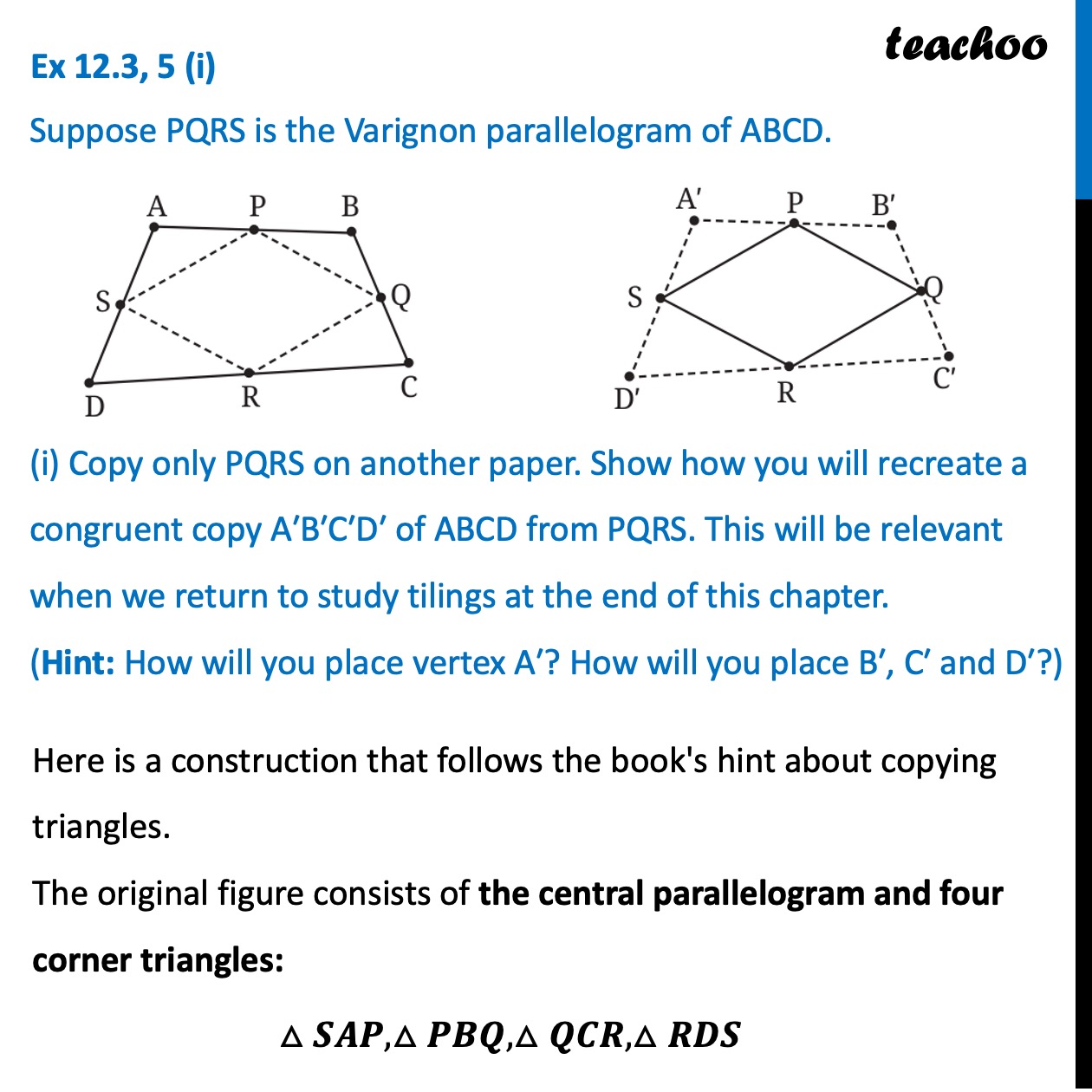
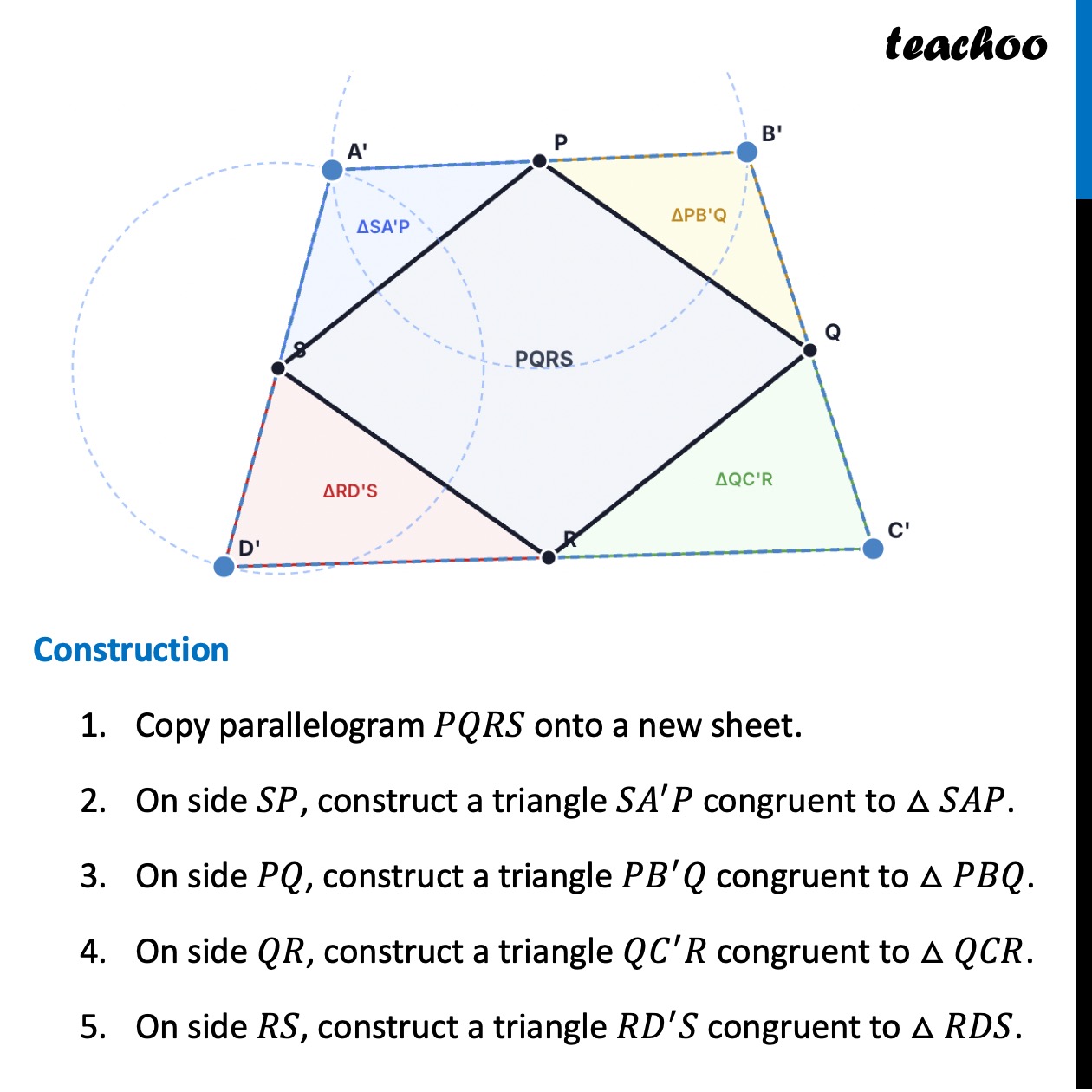
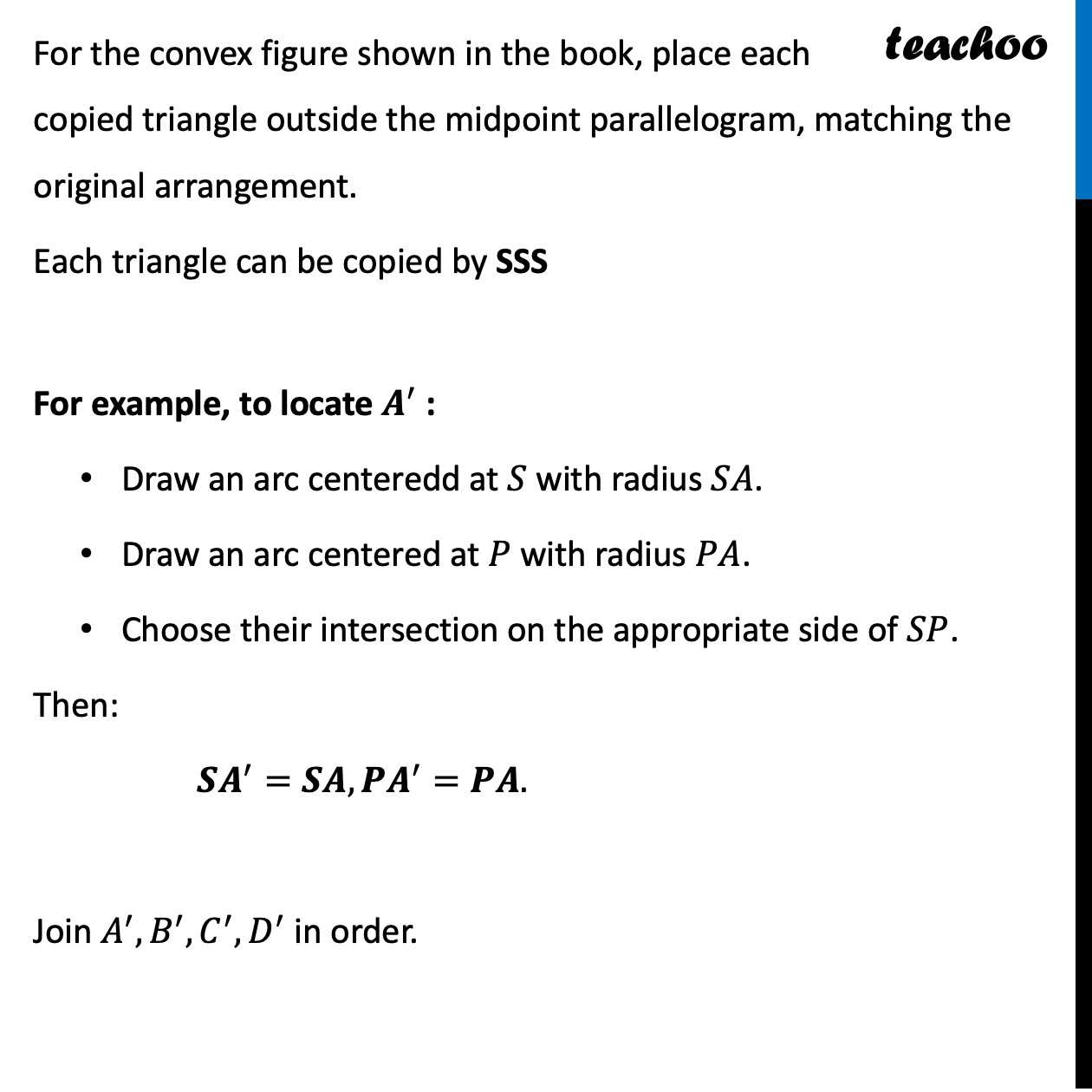
Ex 12.3, 5 (i) Suppose PQRS is the Varignon parallelogram of ABCD. (i) Copy only PQRS on another paper. Show how you will recreate a congruent copy AʹBʹCʹDʹ of ABCD from PQRS. This will be relevant when we return to study tilings at the end of this chapter. (Hint: How will you place vertex Aʹ? How will you place Bʹ, Cʹ and Dʹ?) Here is a construction that follows the book's hint about copying triangles. The original figure consists of the central parallelogram and four corner triangles: △𝑺𝑨𝑷, △𝑷𝑩𝑸, △𝑸𝑪𝑹, △𝑹𝑫𝑺 Fig. 12.25 Construction Copy parallelogram 𝑃𝑄𝑅𝑆 onto a new sheet. On side 𝑆𝑃, construct a triangle 𝑆𝐴^(′)𝑃 congruent to △𝑆𝐴𝑃. On side 𝑃𝑄, construct a triangle 𝑃𝐵^(′)𝑄 congruent to △𝑃𝐵𝑄. On side 𝑄𝑅, construct a triangle 𝑄𝐶^(′)𝑅 congruent to △𝑄𝐶𝑅. On side 𝑅𝑆, construct a triangle 𝑅𝐷^(′)𝑆 congruent to △𝑅𝐷𝑆. For the convex figure shown in the book, place each copied triangle outside the midpoint parallelogram, matching the original arrangement. Each triangle can be copied by SSS. For example, to locate 𝑨^(′) : Draw an arc centred at 𝑆 with radius 𝑆𝐴. Draw an arc centred at 𝑃 with radius 𝑃𝐴. Choose their intersection on the appropriate side of 𝑆𝑃. Then: 𝑺𝑨^(′)=𝑺𝑨, 𝑷𝑨^(′)=𝑷𝑨. Join 𝐴^(′),𝐵^(′),𝐶^(′),𝐷^(′) in order. We now justify why these pieces form the required quadrilateral. Ko For the convex figure shown in the book, place each copied triangle outside the midpoint parallelogram, matching the original arrangement. Each triangle can be copied by SSS For example, to locate 𝑨^(′) : Draw an arc centeredd at 𝑆 with radius 𝑆𝐴. Draw an arc centered at 𝑃 with radius 𝑃𝐴. Choose their intersection on the appropriate side of 𝑆𝑃. Then: 𝑺𝑨^(′)=𝑺𝑨, 𝑷𝑨^(′)=𝑷𝑨. Join 𝐴^(′),𝐵^(′),𝐶^(′),𝐷^(′) in order.