You are here

Last updated at November 5, 2026 by Teachoo
Transcript
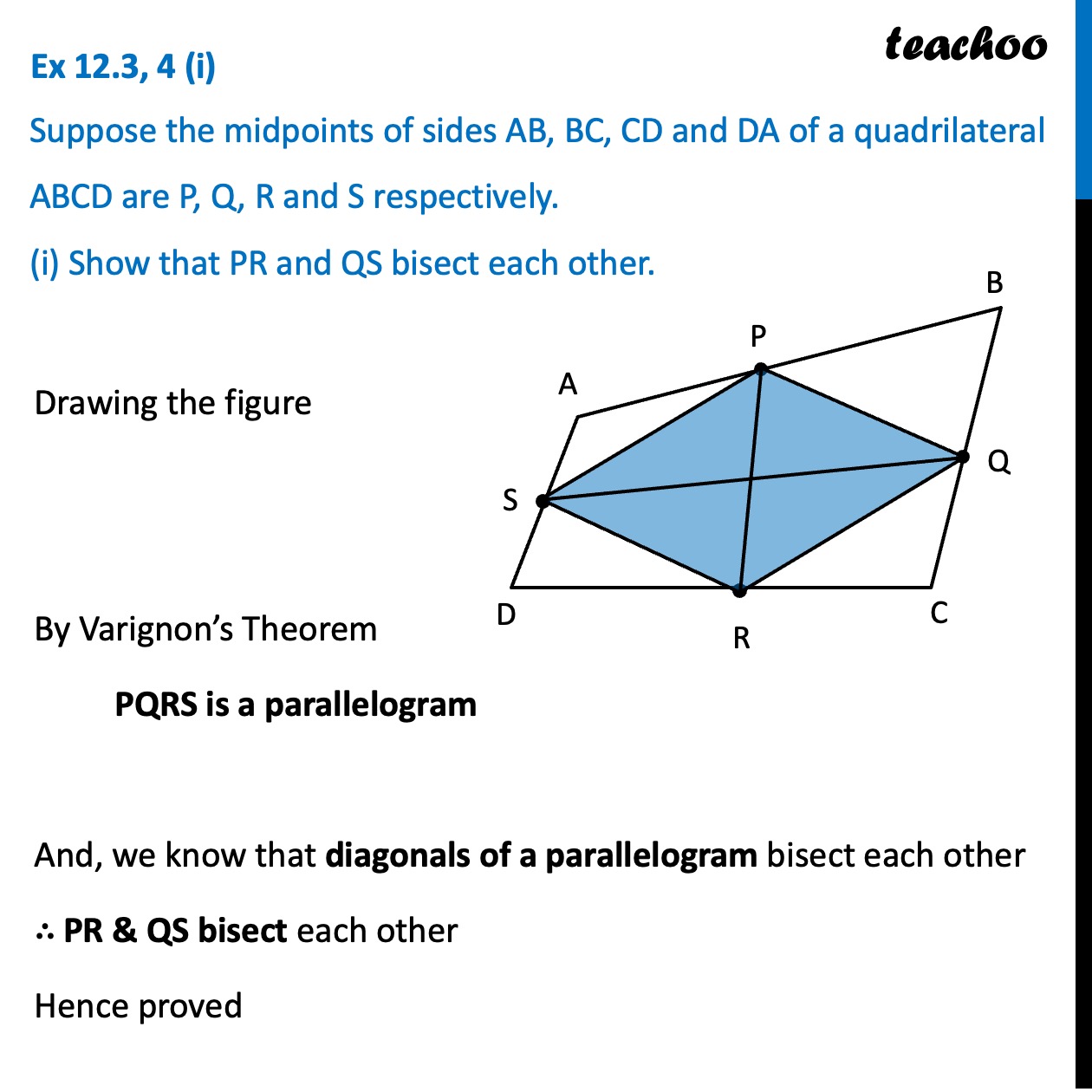
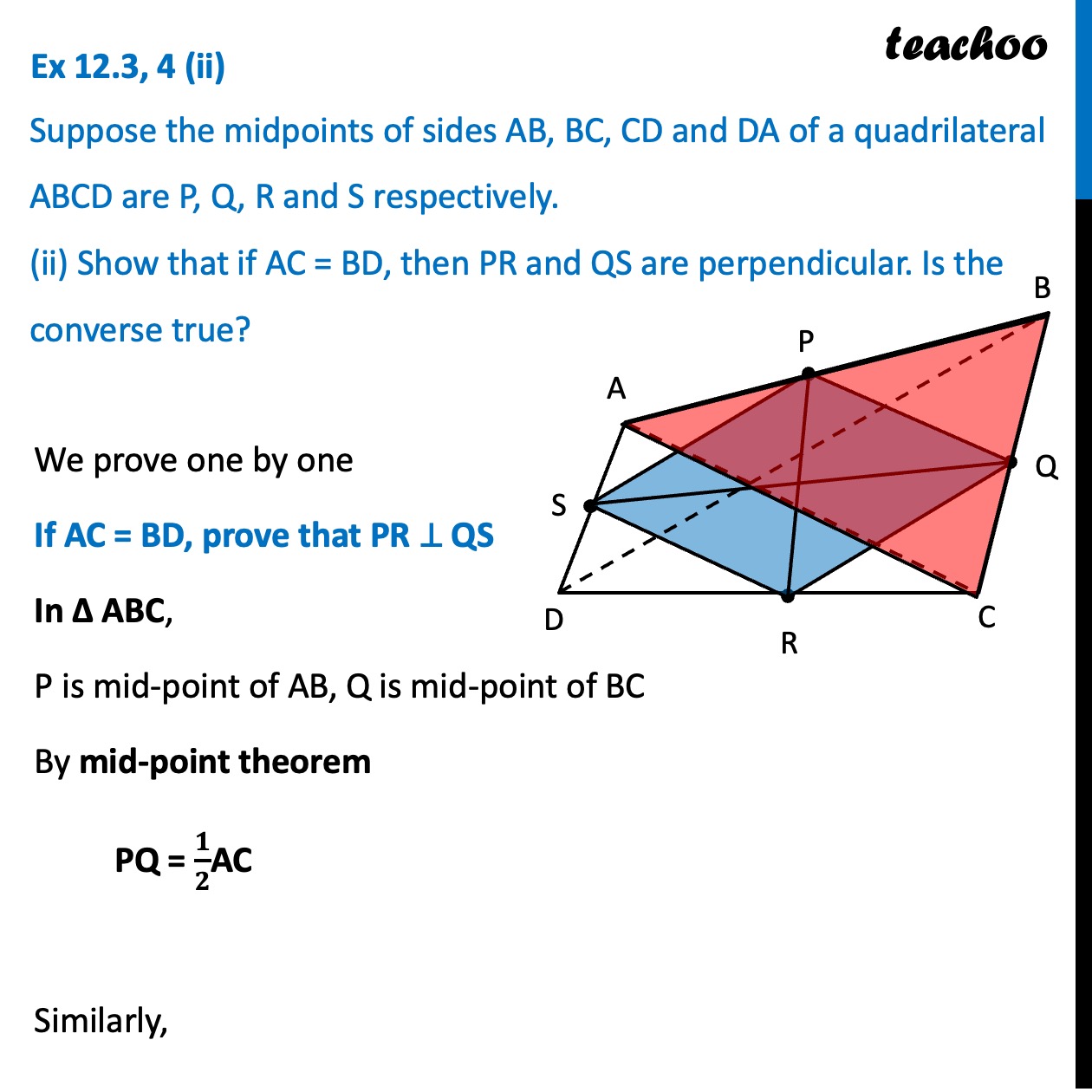
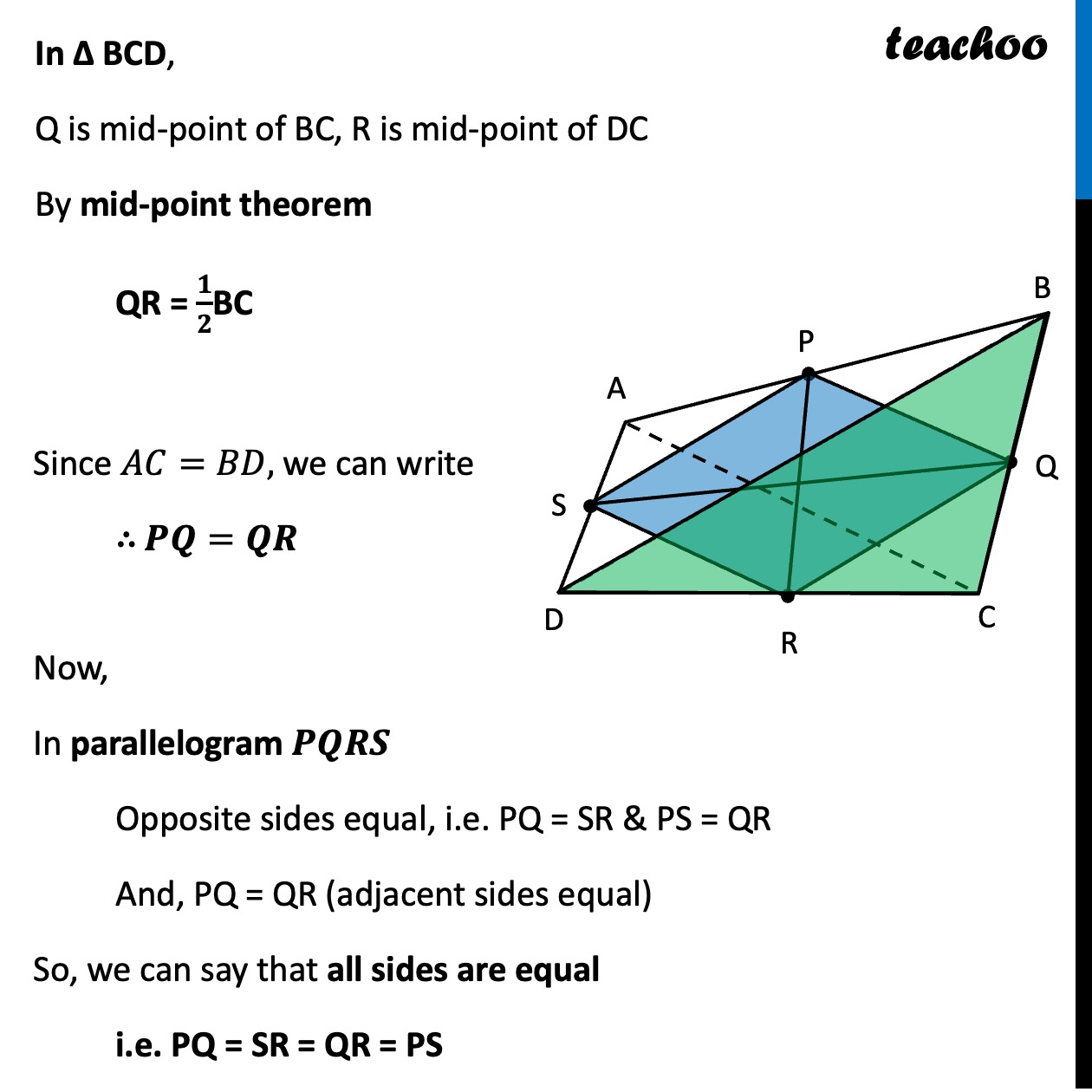
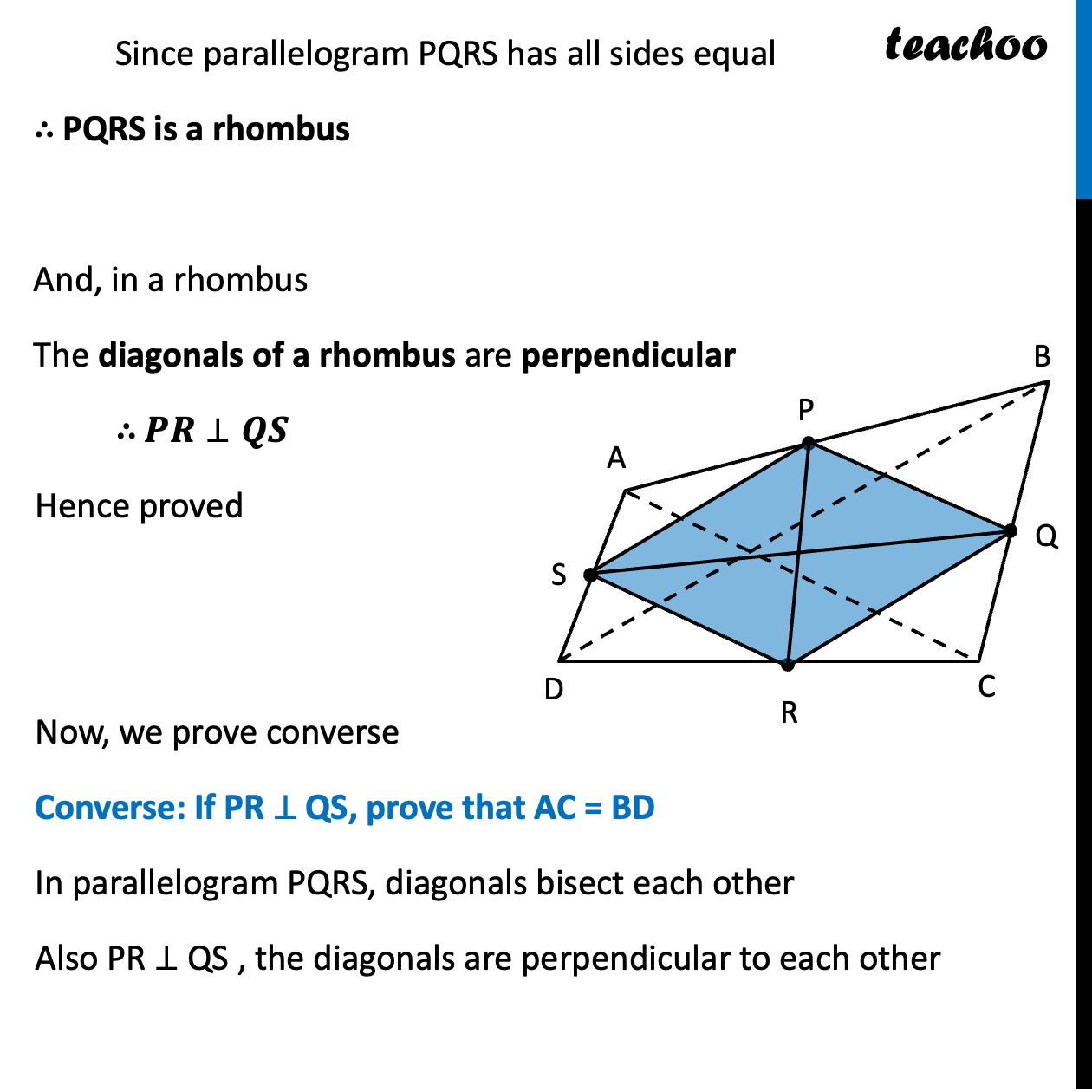
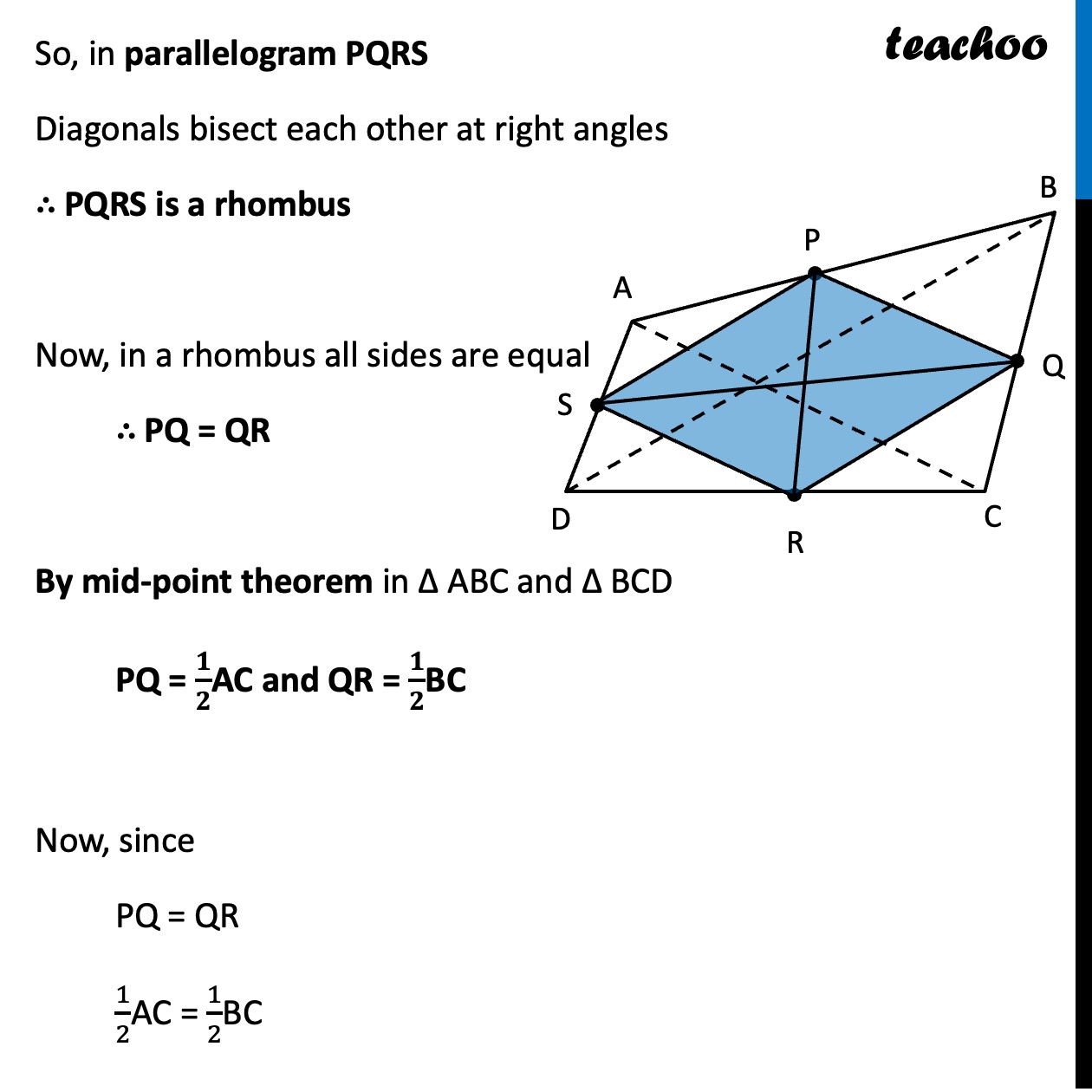
Ex 12.3, 4 (i) Suppose the midpoints of sides AB, BC, CD and DA of a quadrilateral ABCD are P, Q, R and S respectively. (i) Show that PR and QS bisect each other. Drawing the figure By Varignon’s Theorem PQRS is a parallelogram And, we know that diagonals of a parallelogram bisect each other ∴ PR & QS bisect each other Hence proved D A C B P Q R S Ex 12.3, 4 (ii) Suppose the midpoints of sides AB, BC, CD and DA of a quadrilateral ABCD are P, Q, R and S respectively. (ii) Show that if AC = BD, then PR and QS are perpendicular. Is the converse true? We prove one by one If AC = BD, prove that PR ⊥ QS In ∆ ABC, P is mid-point of AB, Q is mid-point of BC By mid-point theorem PQ = (𝟏)/(𝟐)AC Similarly, D A C B P Q R S In ∆ BCD, Q is mid-point of BC, R is mid-point of DC By mid-point theorem QR = (𝟏)/(𝟐)BC Since 𝐴𝐶=𝐵𝐷, we can write ∴ 𝑷𝑸=𝑸𝑹 Now, In parallelogram 𝑷𝑸𝑹𝑺 Opposite sides equal, i.e. PQ = SR & PS = QR And, PQ = QR (adjacent sides equal) So, we can say that all sides are equal i.e. PQ = SR = QR = PS Since parallelogram PQRS has all sides equal ∴ PQRS is a rhombus And, in a rhombus The diagonals of a rhombus are perpendicular ∴ 𝑷𝑹⊥𝑸𝑺 Hence proved Now, we prove converse Converse: If PQ ⊥ RS, prove that AC = BD Similarly, D A C B P Q R S Since parallelogram PQRS has all sides equal ∴ PQRS is a rhombus And, in a rhombus The diagonals of a rhombus are perpendicular ∴ 𝑷𝑹⊥𝑸𝑺 Hence proved Now, we prove converse Converse: If PR ⊥ QS, prove that AC = BD In parallelogram PQRS, diagonals bisect each other Also PR ⊥ QS , the diagonals are perpendicular to each other So, in parallelogram PQRS Diagonals bisect each other at right angles ∴ PQRS is a rhombus Now, in a rhombus all sides are equal ∴ PQ = QR By mid-point theorem in ∆ ABC and ∆ BCD PQ = (𝟏)/(𝟐)AC and QR = (𝟏)/(𝟐)BC Now, since PQ = QR (1)/(2)AC = (1)/(2)BC AC = BC Hence proved D A C B P Q R S So, in parallelogram PQRS Diagonals bisect each other at right angles ∴ PQRS is a rhombus Now, in a rhombus all sides are equal ∴ PQ = QR By mid-point theorem in ∆ ABC and ∆ BCD PQ = (𝟏)/(𝟐)AC and QR = (𝟏)/(𝟐)BC Now, since PQ = QR (1)/(2)AC = (1)/(2)BC D A C B P Q R S AC = BC Hence proved