
 You are here
Last updated at November 5, 2026 by Teachoo
Transcript
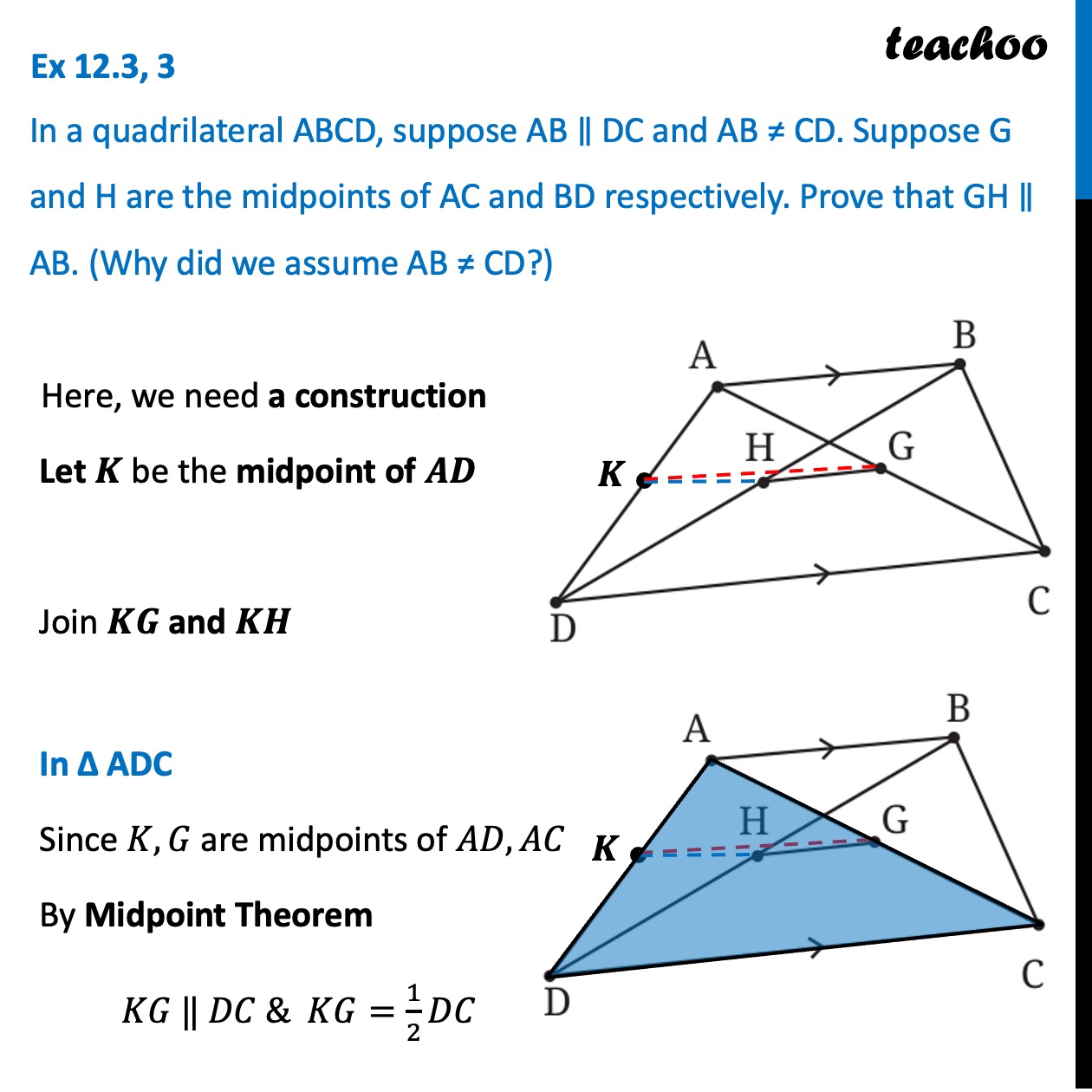
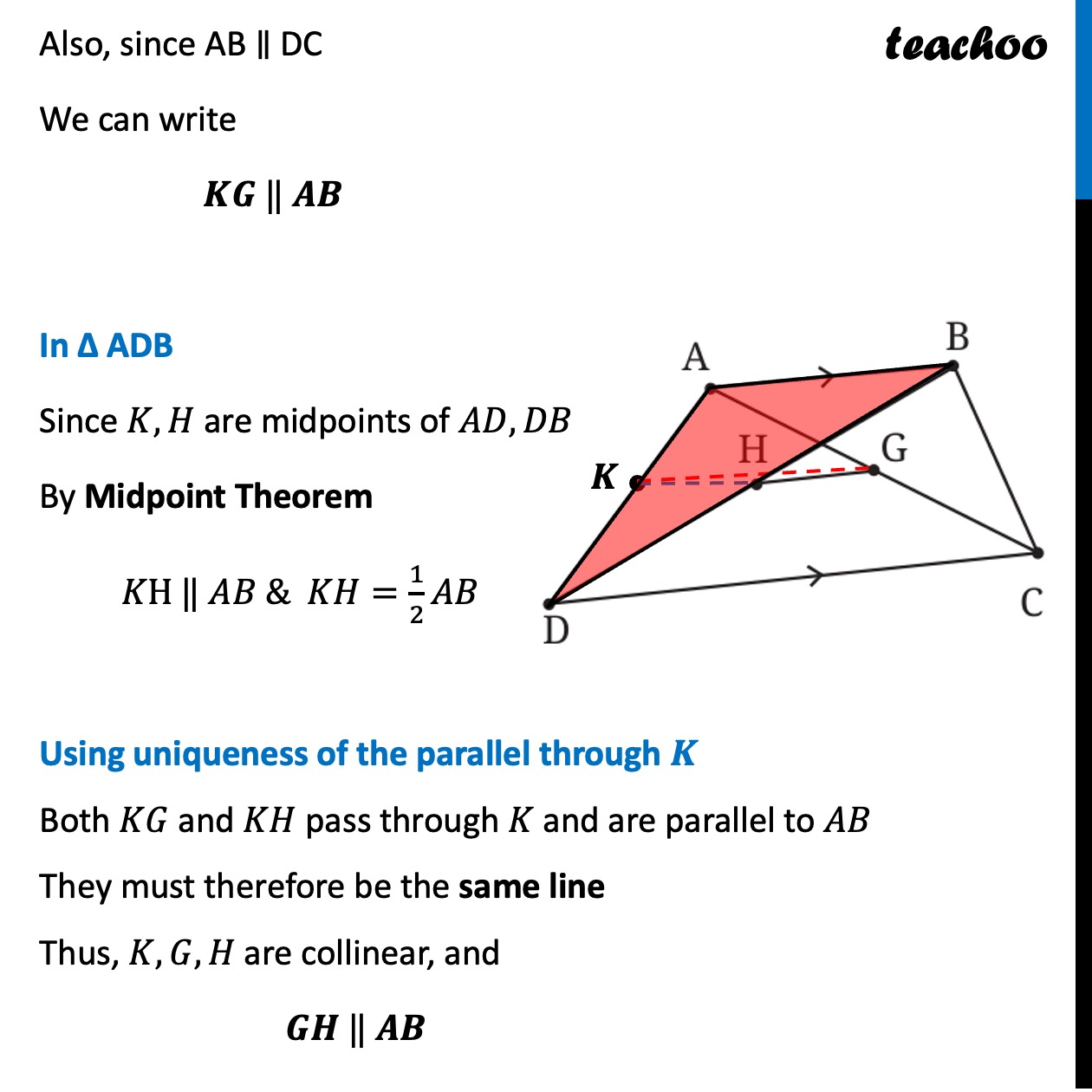
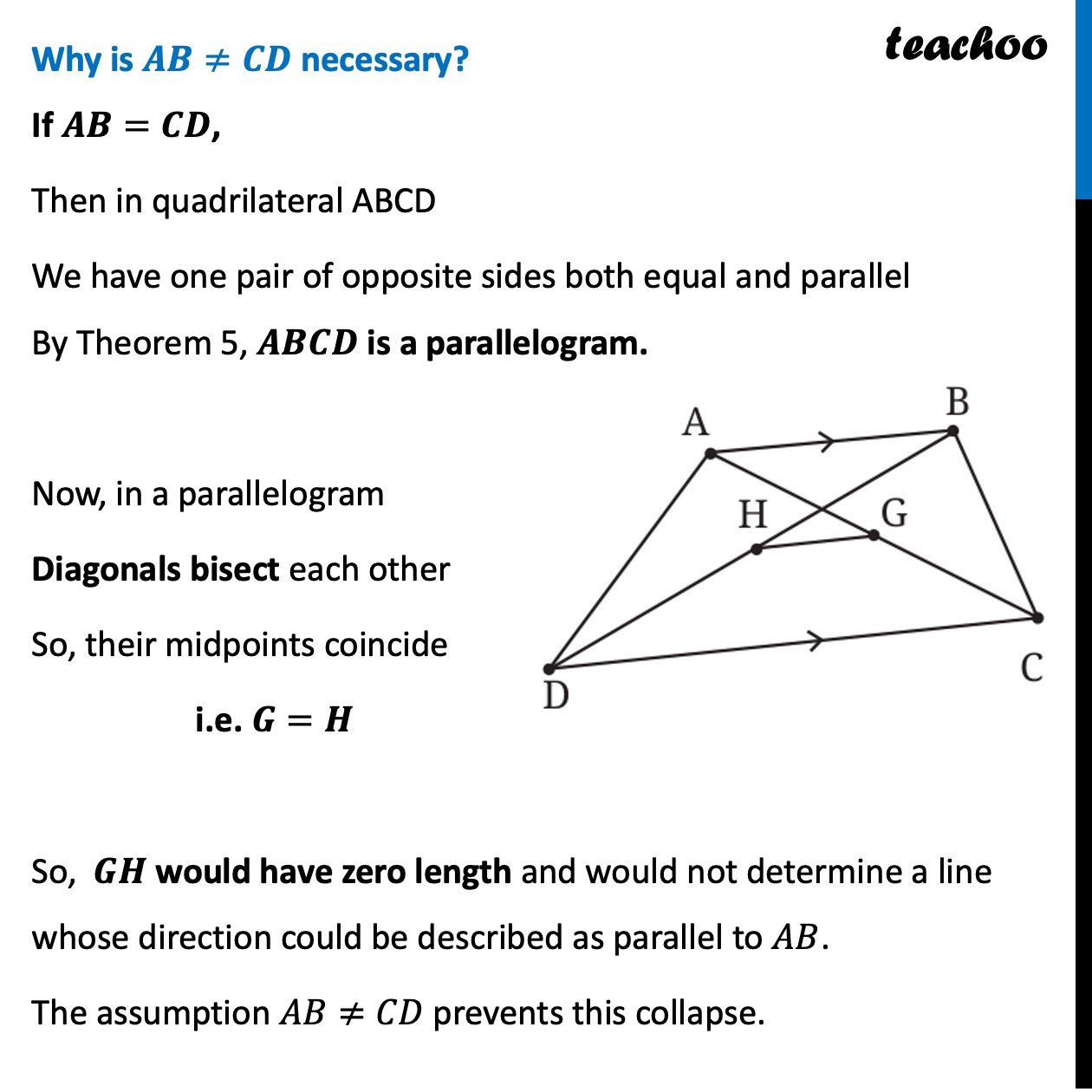
Ex 12.3, 3 In a quadrilateral ABCD, suppose AB ∥ DC and AB ≠ CD. Suppose G and H are the midpoints of AC and BD respectively. Prove that GH ∥ AB. (Why did we assume AB ≠ CD?) 𝑲 𝑲 Here, we need a construction Let 𝑲 be the midpoint of 𝑨𝑫 Join 𝑲𝑮 and 𝑲𝑯 In ∆ ADC Since 𝐾,𝐺 are midpoints of 𝐴𝐷,𝐴𝐶 By Midpoint Theorem 𝐾𝐺 ‖ 𝐷𝐶 & 𝐾𝐺=(1)/(2)𝐷𝐶 Fig. 12.24 𝑲 Also, since AB ∥ DC We can write 𝑲𝑮 ‖ 𝑨𝑩 In ∆ ADB Since 𝐾,𝐻 are midpoints of 𝐴𝐷,𝐷𝐵 By Midpoint Theorem 𝐾H ‖ 𝐴𝐵 & 𝐾𝐻=(1)/(2)𝐴𝐵 Using uniqueness of the parallel through 𝑲 Both 𝐾𝐺 and 𝐾𝐻 pass through 𝐾 and are parallel to 𝐴𝐵 They must therefore be the same line Thus, 𝐾,𝐺,𝐻 are collinear, and 𝑮𝑯 ‖ 𝑨𝑩 Hence proved Why is 𝑨𝑩≠𝑪𝑫 necessary? If 𝐴𝐵=𝐶𝐷, then one pair of opposite sides is both equal and parallel. By Theorem 5, 𝐴𝐵𝐶𝐷 is a parallelogram. Its diagonals bisect each other. Therefore their midpoints coincide: 𝐺=𝐻. So 𝐺𝐻 would have zero length and would not determine a line whose direction could be described as parallel to 𝐴𝐵. The assumption 𝐴𝐵≠𝐶𝐷 prevents this collapse. Fig. 12.24 Why is 𝑨𝑩≠𝑪𝑫 necessary? If 𝑨𝑩=𝑪𝑫, Then in quadrilateral ABCD We have one pair of opposite sides both equal and parallel By Theorem 5, 𝑨𝑩𝑪𝑫 is a parallelogram. Now, in a parallelogram Diagonals bisect each other So, their midpoints coincide i.e. 𝑮=𝑯 So, 𝑮𝑯 would have zero length and would not determine a line whose direction could be described as parallel to 𝐴𝐵. The assumption 𝐴𝐵≠𝐶𝐷 prevents this collapse. Fig. 12.24
