
 You are here
💬 Think about it
A tent stays soft and moves in the wind. A brick house stands firm and stays in shape. Plants cannot run from wind or rain, so they need a firm wall. Let us see what gives plant cells their strength.
Which cells have an extra layer outside the membrane?
![2.2.2 Cell wall — The outer cove - Cell — The Building Bl - [Teachoo] - Concepts](https://cdn.teachoo.com/09177378-6e1b-46de-99f3-5a29cbb9019f/image-a-plant-cell-shown-with-two-outer-layers-the-inner-thin-cell-membrane-and-the-thicker-outer-cell-wall-surrounding-it-clearly-labell.webp)
- Cells of plants, fungi and bacteria have an extra layer.
- This extra layer is called the cell wall.
- It lies around the cell membrane.
Why do plant cells need a cell wall?
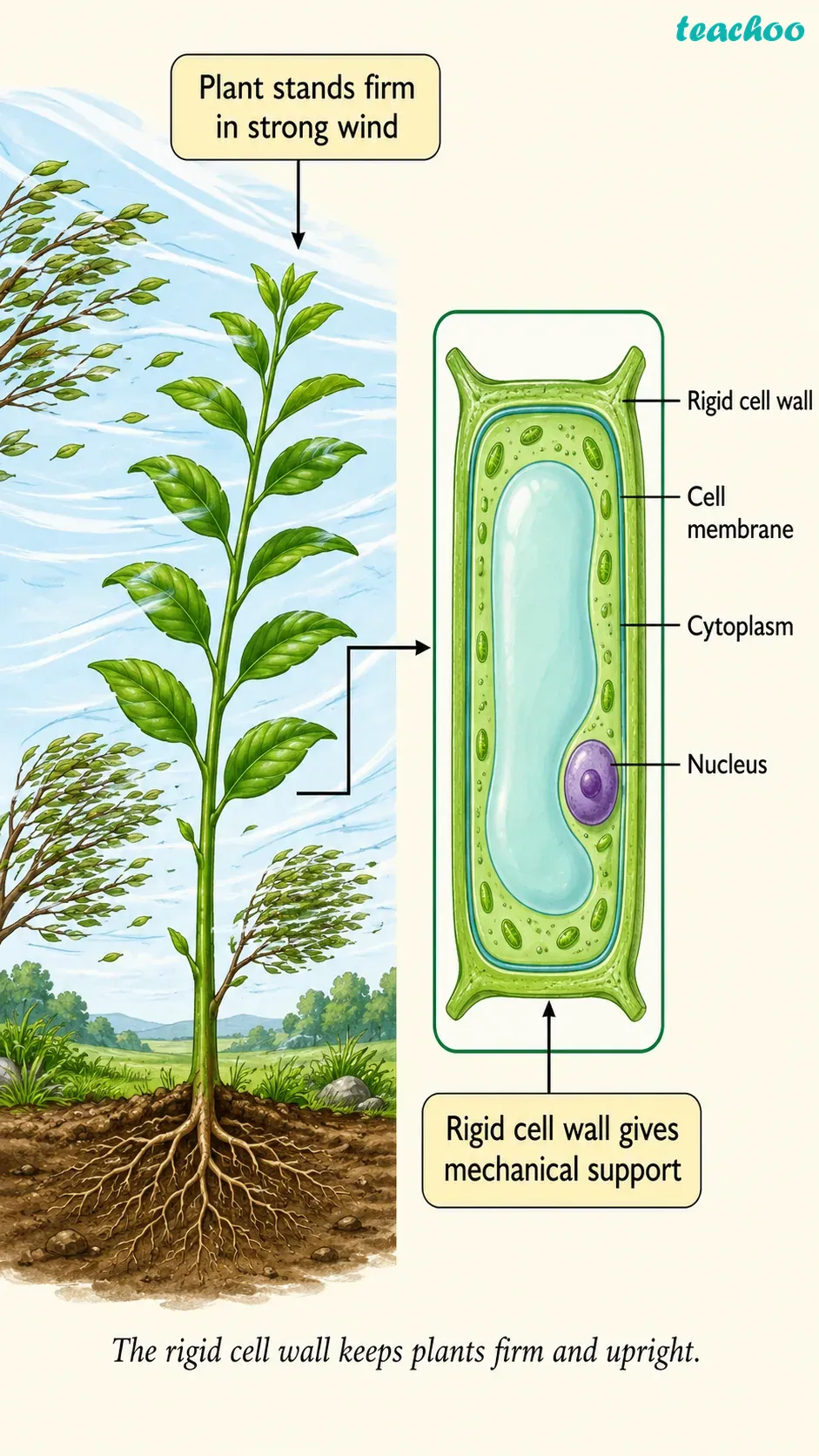
- Plants cannot move, so they need a rigid support.
- The wall helps them withstand wind and rain.
- It keeps leaves and flowers firm and in shape.
- It helps plants stay upright.
Example:
A firm stem holds a sunflower upright even on a windy day.
Is the cell wall permeable?
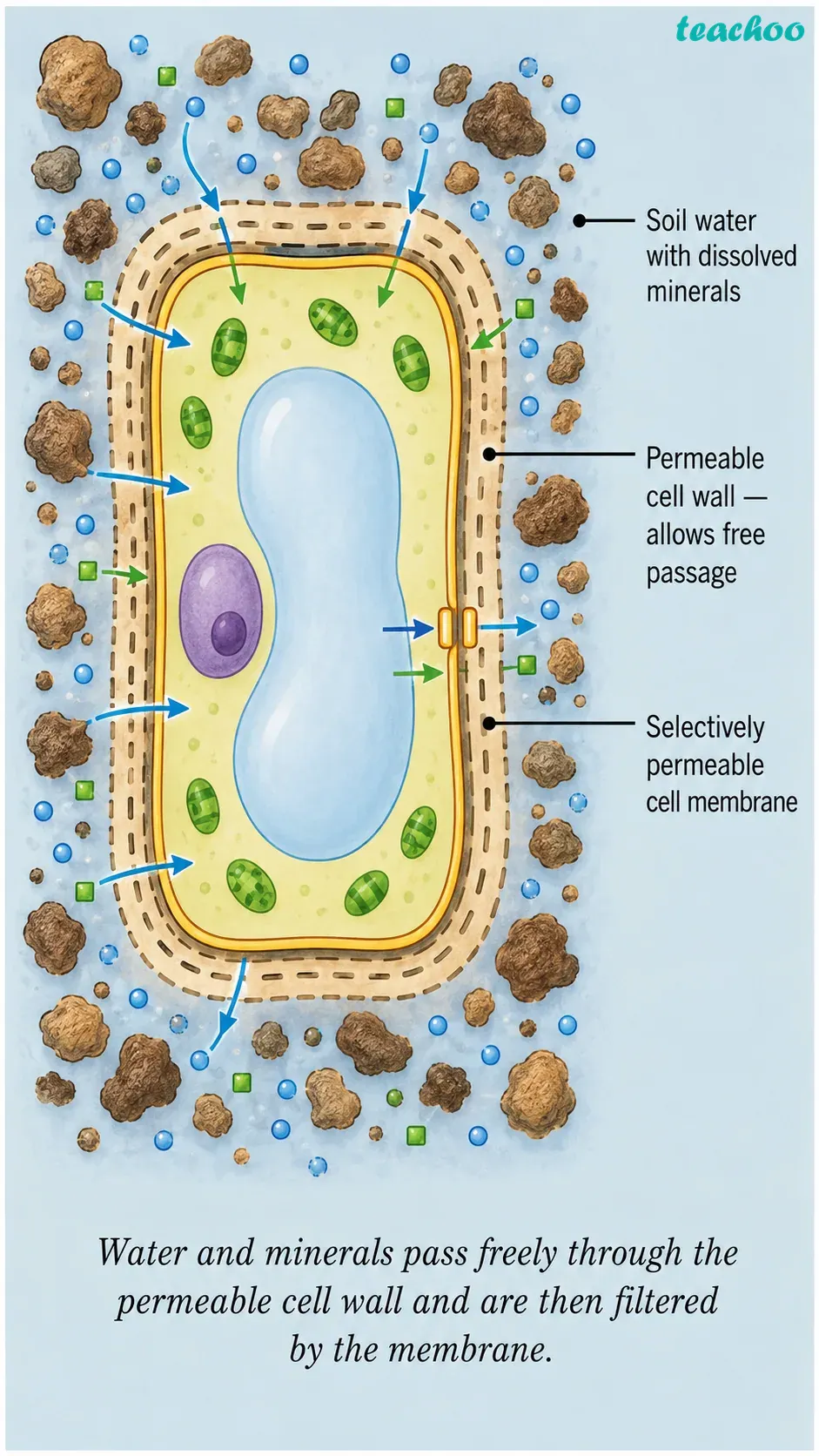
Cell Wall is Permeable
Water and some dissolved minerals pass freely through the cell wall. Along with the membrane, it helps roots absorb water.
- Yes, the cell wall is permeable.
- Water and some dissolved minerals can pass through.
- Along with the membrane, it helps roots absorb water.
In this Activity, we will compare onion (plant) cells and cheek (animal) cells under a microscope, and see how each reacts to a strong sugar solution.
Activity 2.3 — Steps
Step 1
Prepare an onion/Rhoeo peel slide stained with safranin.
↓
Step 2
Prepare a cheek-cell slide stained with methylene blue.
↓
Step 3
Observe both slides under the microscope.
↓
Step 4
Repeat with 20% sugar solution; observe after 30 min.
↓
Compare cell shapes and changes
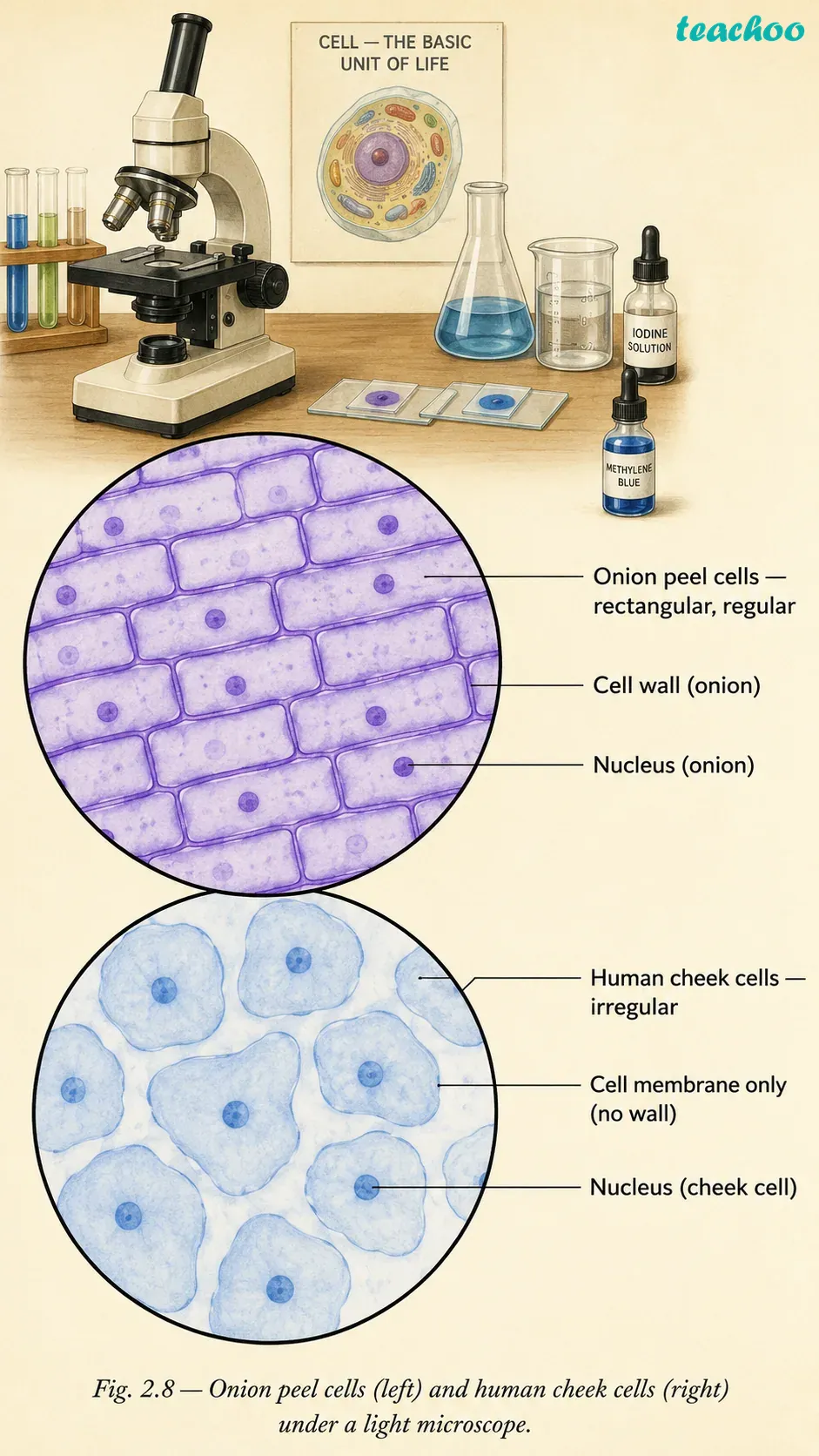
Materials needed
Onion or Rhoeo (Cradle lily) leaf, safranin stain, cheek cells, methylene blue stain, glass slides, coverslips, a microscope, and 20 per cent sugar solution.
Procedure
1. Prepare a temporary slide of a thin peel of an onion or Rhoeo leaf, mount it with safranin using a cover slip, and observe plant cells.
2. Prepare a slide of cheek cells by gently scraping the inner cheek with a cotton swab or the blunt end of a toothpick.
3. Spread the cheek cells on a clean glass slide.
4. Add a drop of water and a few drops of methylene blue stain, then place a coverslip.
5. Observe both slides under a microscope.
6. Now prepare fresh slides and put 20 per cent sugar solution on them; observe again after half an hour.
2. Prepare a slide of cheek cells by gently scraping the inner cheek with a cotton swab or the blunt end of a toothpick.
3. Spread the cheek cells on a clean glass slide.
4. Add a drop of water and a few drops of methylene blue stain, then place a coverslip.
5. Observe both slides under a microscope.
6. Now prepare fresh slides and put 20 per cent sugar solution on them; observe again after half an hour.
Observation
Onion peel cells are box-shaped and regularly arranged; cheek cells are irregularly arranged. In sugar solution, the plant cell boundary stays the same but its inner content shrinks; cheek cells shrink considerably.
Explanation
In a strong sugar solution plant cells lose water by osmosis, but their rigid cell wall keeps the outer shape. Only the inner content pulls away from the wall. This shows the cell wall keeps plant cells firm and in shape.
◆ Summary
- Plant cells: regular boxes.
- Cheek cells: irregular shapes.
- Sugar: inner content shrinks.
- Wall keeps shape.
What is the cell wall made of?
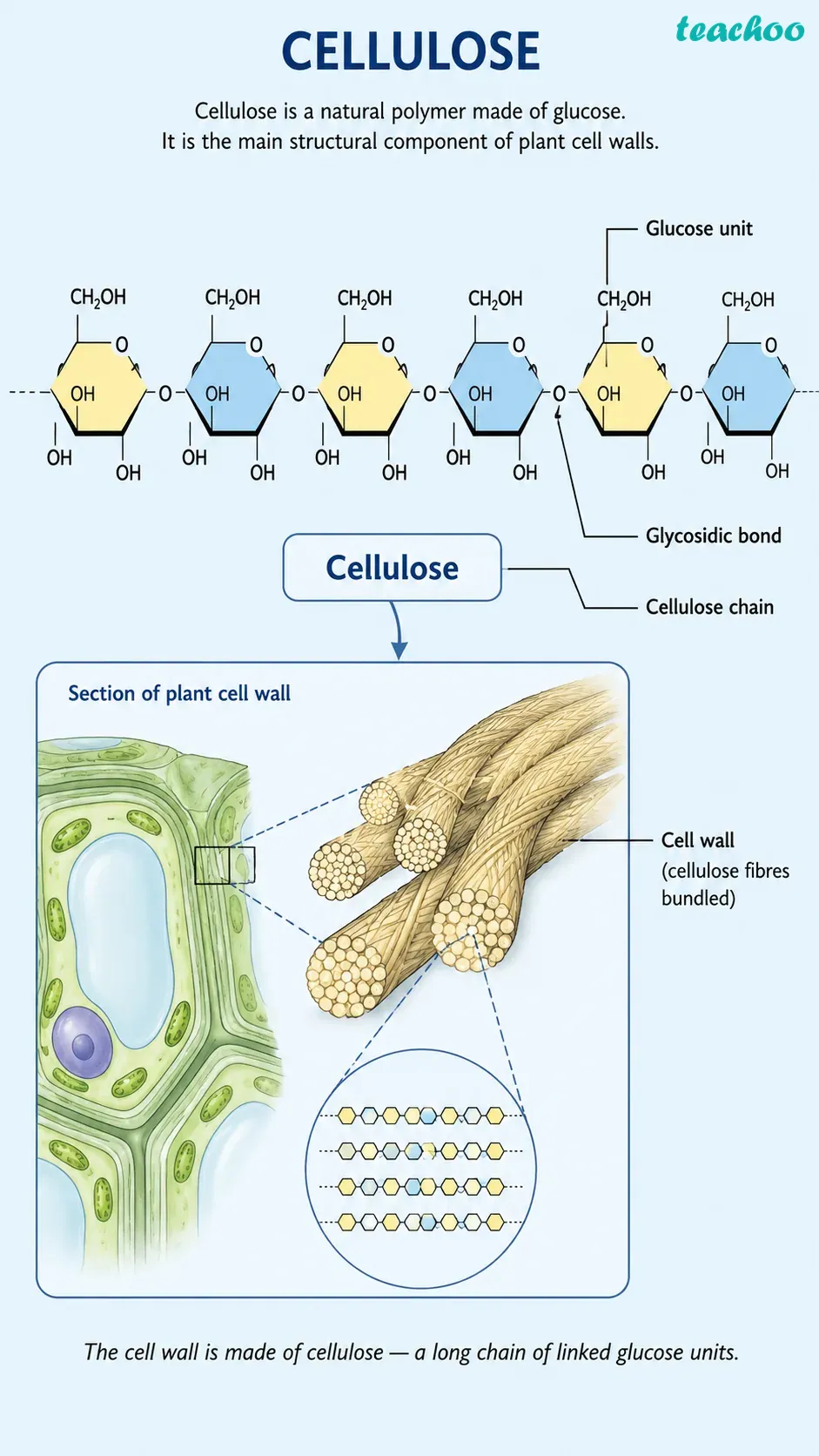
Cellulose
The plant cell wall is mainly made of cellulose — a carbohydrate of many glucose units linked together. Fungi and bacteria also have a cell wall.
Example:
Cellulose in our food acts as roughage and helps in digestion.
- The plant cell wall is mainly made of cellulose.
- Cellulose is a carbohydrate of many glucose units linked together.
- Fungi and bacteria also have a cell wall for protection.
Example:
Cellulose in our food acts as roughage and helps in digestion.
How are plant cells different from animal cells here?
Plant Cell vs Animal Cell — Cell Wall
Plant Cell
Animal Cell
Has a rigid cell wall (cellulose).
Has no cell wall.
Keeps shape in sugar solution.
Shrinks in strong sugar solution.
Stays firm and upright.
Can change shape easily.
Plant cell
Animal cell
Has a rigid cell wall.
Has no cell wall.
Keeps its shape in sugar solution.
Shrinks in sugar solution.
Stays firm and upright.
Can change shape easily.
- Plant cells have a rigid cell wall, so they keep their shape.
- Animal cells have no cell wall.
- In strong sugar solution animal cells lose water and shrink.
- No wall means animal cells can change shape easily.
Important Points
- The cell wall is found in plants, fungi and bacteria.
- It is permeable, while the membrane is selectively permeable.
- The plant cell wall is mainly made of cellulose.
- Animal cells have no cell wall, so they can change shape.
⏸️ Pause and Ponder
-
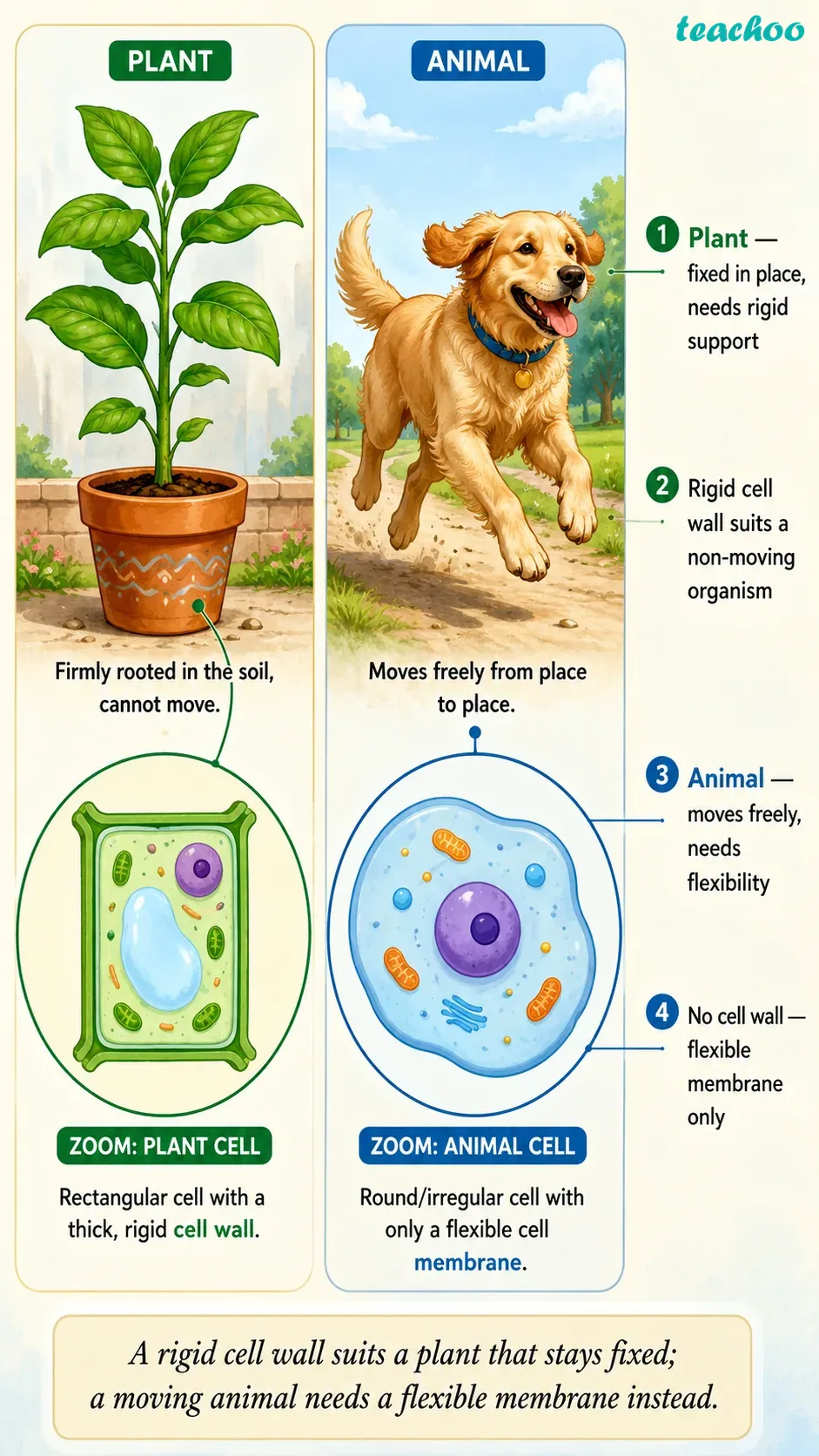
What argument would you give for the necessity of a cell wall in plants usually fixed in one place versus in animals usually moving from one place to the other?
A fixed plant needs a rigid cell wall for support against wind and rain and to stay upright. A moving animal needs flexible cells with no wall, so it can change shape and move easily. -
What consequences would you predict for a plant cell if its cell wall were to become as flexible as a cell membrane?
The plant cell would lose its rigid support. The plant could not stay firm or upright and would droop, and it could not hold its shape in changing conditions. -
Why is it important to cut the two potato pieces in roughly equal size and measure their initial weight before placing them in different liquids?
Equal size and a recorded starting weight make it a fair test. Then any change in weight can be compared correctly to show how much water moved in or out.
❓ Test Yourself
-
Which three kinds of cells have a cell wall?
View Answer
Cells of plants, fungi and bacteria. -
Is the cell wall permeable or selectively permeable?
View Answer
Permeable — water and some minerals pass through freely. -
What is the plant cell wall mainly made of?
View Answer
Cellulose, a carbohydrate made of many glucose units. -
Why do plant cells keep their shape in sugar solution?
View Answer
Their rigid cell wall holds the outer shape, even as the inside shrinks. -
Why can animal cells change shape easily?
View Answer
They have no rigid cell wall.
Important Definitions
- Cell wall — an extra rigid layer outside the membrane in plant, fungal and bacterial cells.
- Cellulose — a carbohydrate of many linked glucose units that makes the plant cell wall.
- Roughage — cellulose in our diet that helps in digestion.
📋 NCERT Question 1 — Differentiate between the following pairs
Differentiate between the following pairs of terms based on the clues given in parentheses: (i) Cell membrane and cell wall (permeability) (ii) RER and SER (structure) (iii) Chloroplasts and chromoplasts (pigments)
View Answer →
📋 NCERT Question 8 — A researcher carried out an
A researcher carried out an experiment in which she took two carrots of similar size. She placed one carrot in plain water and the other carrot in concentrated salt solution (Fig. 2.21). After 24 hours she recorded her observations. (i) What hypothesis does she want to test through this experiment? (ii) What would you suggest for the improvement of this experiment? (iii) Why does the carrot in plain water stay stiff and crunchy, but the carrot in concentrated salt solution become rubbery and limp?
View Answer →
📋 NCERT Question 10 — Carry out the following experiment
Carry out the following experiment: Take four peeled potato halves and scoop each one out to make potato cups. One of these potato cups should be made from a boiled potato. Place each of the potato cups in a beaker containing water (Fig. 2.22). Now, set up the experiment as follows: (a) Keep Cup A empty. (b) Add one teaspoon sugar in Cup B. (c) Add one teaspoon salt in Cup C. (d) Add one teaspoon sugar in the boiled potato in Cup D. Observe the four potato cups at least two hours and answer: (i) Explain why water gathers in the hollowed portion of Cup B and Cup C. (ii) Why is Cup A necessary for this experiment? (iii) Explain why water does not gather in the hollowed portions of Cups A and D.
View Answer →
