
 You are here
💬 Think about it
Imagine a mosquito net on a window. Air passes through, but mosquitoes cannot. The cell has a similar smart boundary. It lets some things in and keeps others out. Let us understand this clever gatekeeper.
What is the cell membrane?
![2.2.1 Cell membrane — The univer - Cell — The Building Bl - [Teachoo] - Concepts](https://cdn.teachoo.com/b8c93998-a0cc-47b5-80e2-1c28cb18ada8/image-a-round-cell-with-a-clearly-drawn-thin-outer-boundary-labelled-cell-membrane-or-plasma-membrane-surrounding-the-jelly-like-contents.webp)
- It is a thin boundary that surrounds a cell.
- It protects the contents inside the cell.
- It is also called the plasma membrane.
- It gives the cell its individuality.
What does "selectively permeable" mean?
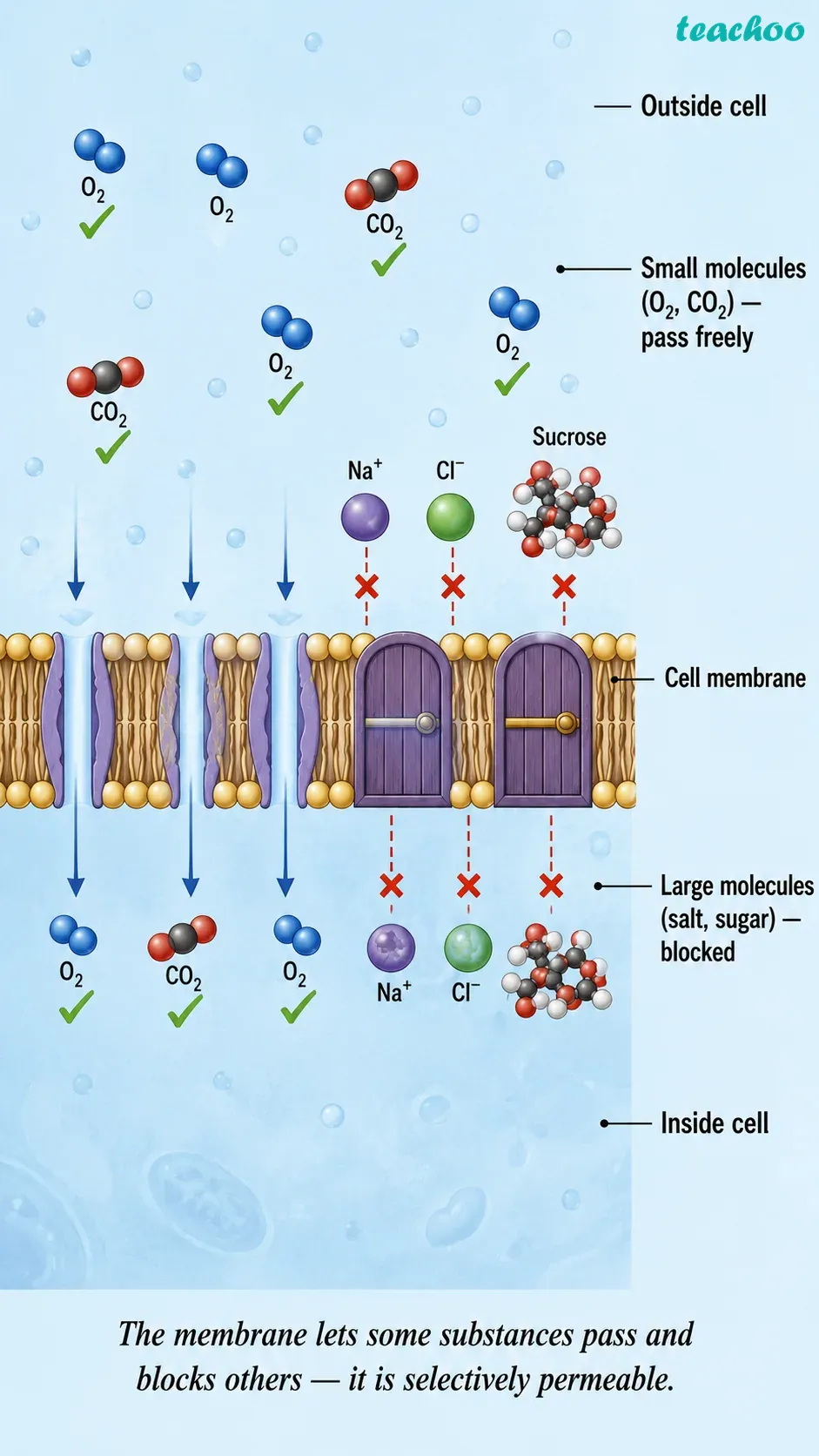
- It means the membrane lets some substances pass.
- But it blocks others.
- So it acts like a careful gatekeeper.
Example:
Oxygen and carbon dioxide move across the membranes of alveoli in our lungs.
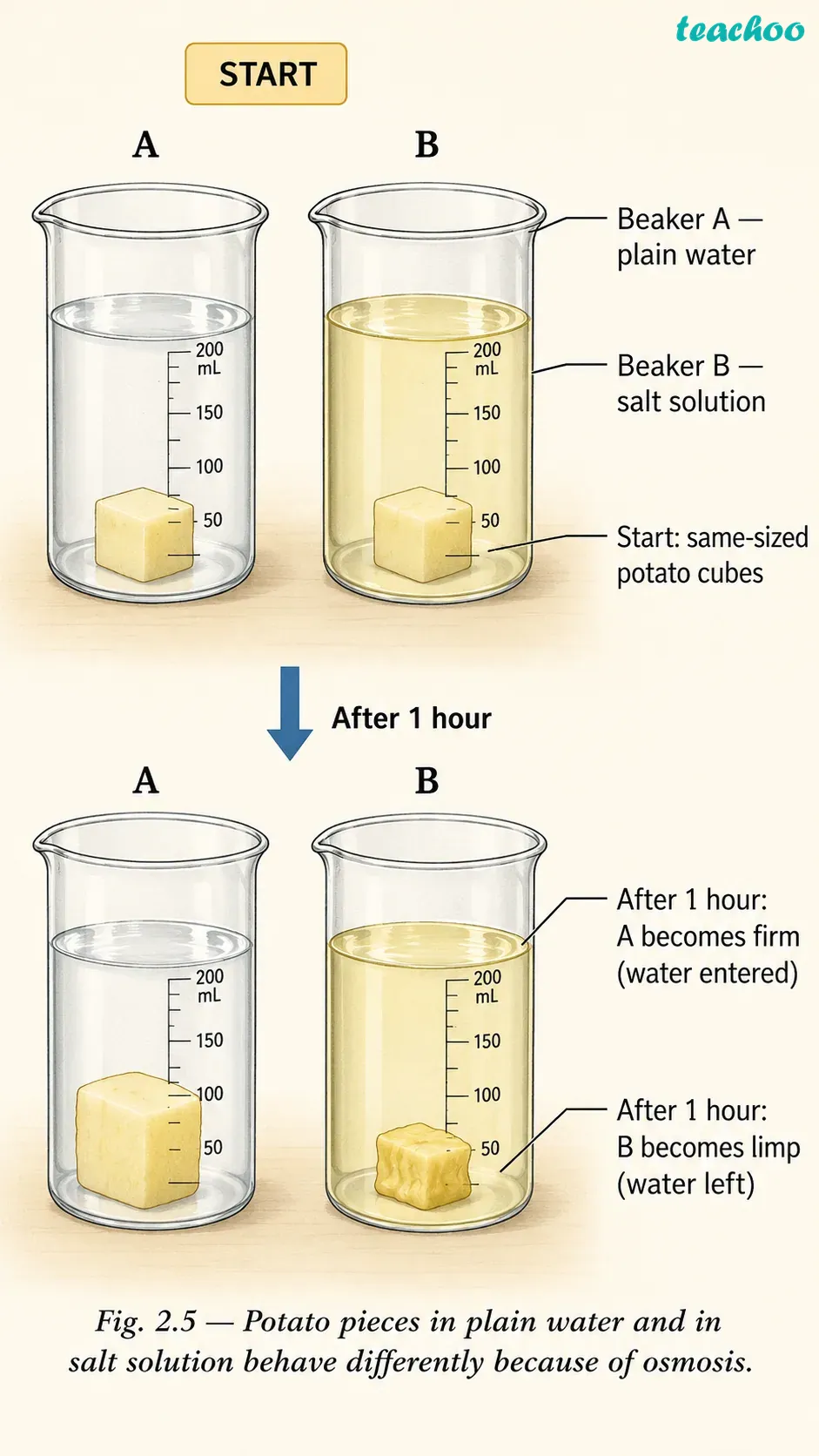
In this Activity, we will place two potato pieces in plain water and in salt solution to see how water moves across the cell membrane.
Activity 2.2 — Steps
Step 1
Cut a potato into two equal pieces; weigh both.
↓
Step 2
Piece A in plain water; Piece B in salt solution.
↓
Step 3
Leave undisturbed for about an hour.
↓
Step 4
Weigh both pieces again.
↓
Compare the change in weight (osmosis)
Materials needed
A potato, a kitchen knife, a weighing balance, two beakers, plain water, and 20 per cent salt or sugar solution.
Procedure
1. With a kitchen knife, carefully cut a potato into two pieces of roughly equal size.
2. Measure and record the initial weight of both pieces using a weighing balance.
3. Put one piece in Beaker A with plain water.
4. Put the other piece in Beaker B with 20 per cent salt or sugar solution.
5. Leave them undisturbed for about an hour, until you see a change in size.
6. Measure and record the final weight of each piece.
7. Calculate the difference between the initial and final weights.
2. Measure and record the initial weight of both pieces using a weighing balance.
3. Put one piece in Beaker A with plain water.
4. Put the other piece in Beaker B with 20 per cent salt or sugar solution.
5. Leave them undisturbed for about an hour, until you see a change in size.
6. Measure and record the final weight of each piece.
7. Calculate the difference between the initial and final weights.
Table 2 — What you observe
| Potato piece | What happens | Weight change |
|---|---|---|
| Beaker A (plain water) | The potato piece swells. | Weight increases |
| Beaker B (salt solution) | The potato piece shrinks. | Weight decreases |
Observation
In Beaker A the potato swells and gains weight. In Beaker B it shrinks and loses weight.
Explanation
The membrane allows water to move in and out, but not salt or sugar. Water moves from where there is more water to where there is less water, until both sides become equal. This movement of water through a selectively permeable membrane is called osmosis.
◆ Summary
- Water enters in A.
- Water leaves in B.
- Salt cannot pass.
- This is osmosis.
What is diffusion?
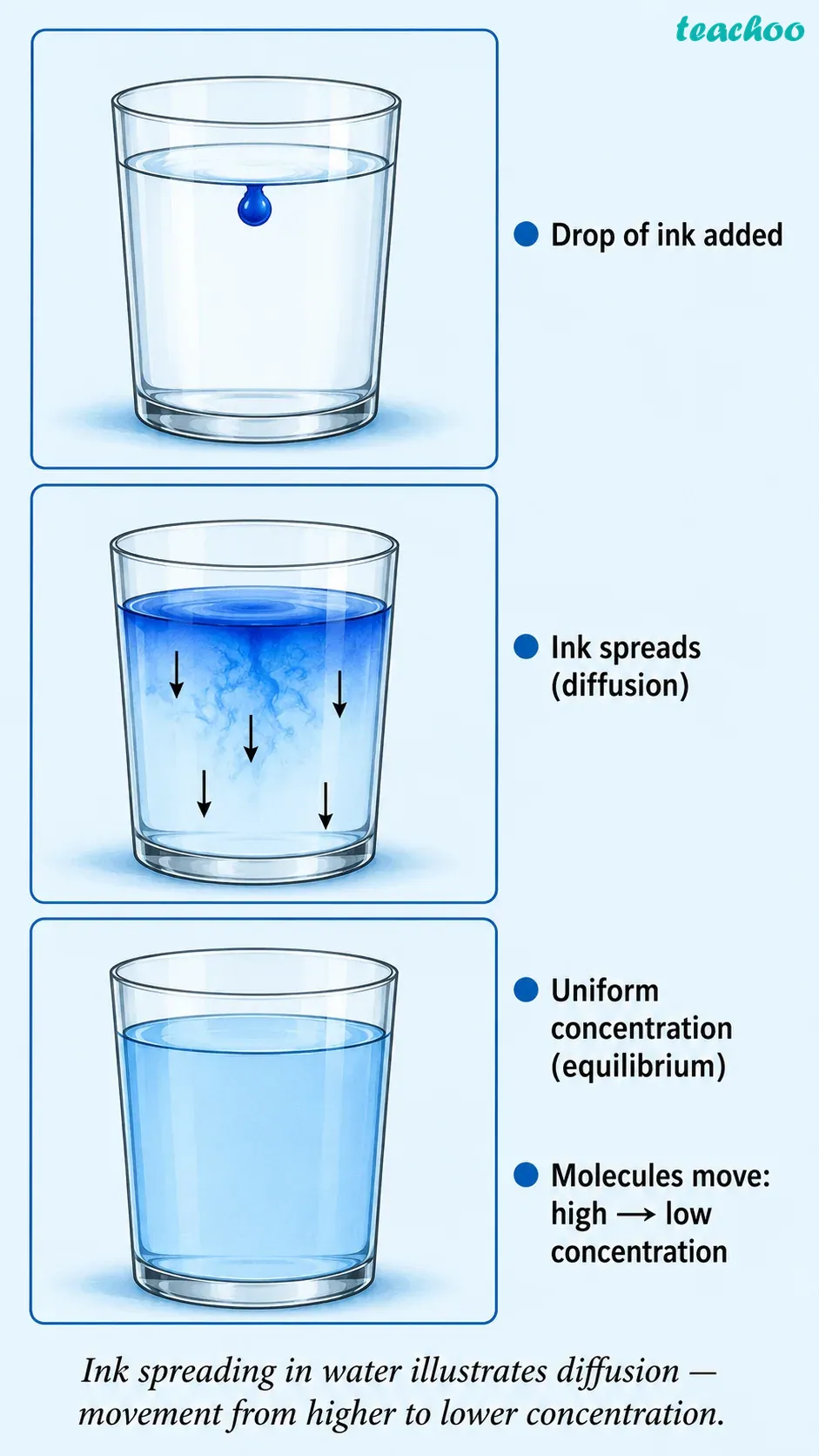
- Particles of matter always intermix.
- This happens because of a difference in concentration.
- Diffusion is the net movement from higher to lower concentration.
- It can happen even without a membrane.
Example:
The smell of food spreads across a room as particles diffuse through the air.
How is osmosis different from diffusion?
Diffusion vs Osmosis
Diffusion
Osmosis
Movement of any particles.
Movement of water molecules only.
No membrane needed.
Needs a selectively permeable membrane.
High to low concentration.
Water moves to where solute is more.
e.g. perfume spreading in a room.
e.g. potato piece in salt solution.
Diffusion
Osmosis
Movement of any particles.
Movement of water only.
Needs no membrane.
Needs a selectively permeable membrane.
High to low concentration.
Water moves to where solute is more.
- Osmosis is the diffusion of water only.
- It happens across a selectively permeable membrane.
- Diffusion can be any particle, with or without a membrane.
What happens to a cell in solutions of different strength?
Effect of Solution Strength on a Cell
Type of Solution
↓
Isotonic Hypotonic Hypertonic
Equal solute Less solute More solute inside and outside. outside. outside. No Water enters Water leaves net water the cell. Cell the cell. Cell movement. swells. shrinks. Cell stays same.
| Type of solution | Solute outside vs inside | Effect on cell |
|---|---|---|
| Isotonic | Equal on both sides. | No net water movement. |
| Hypotonic | Less outside than inside. | Water enters; cell swells. |
| Hypertonic | More outside than inside. | Water leaves; cell shrinks. |
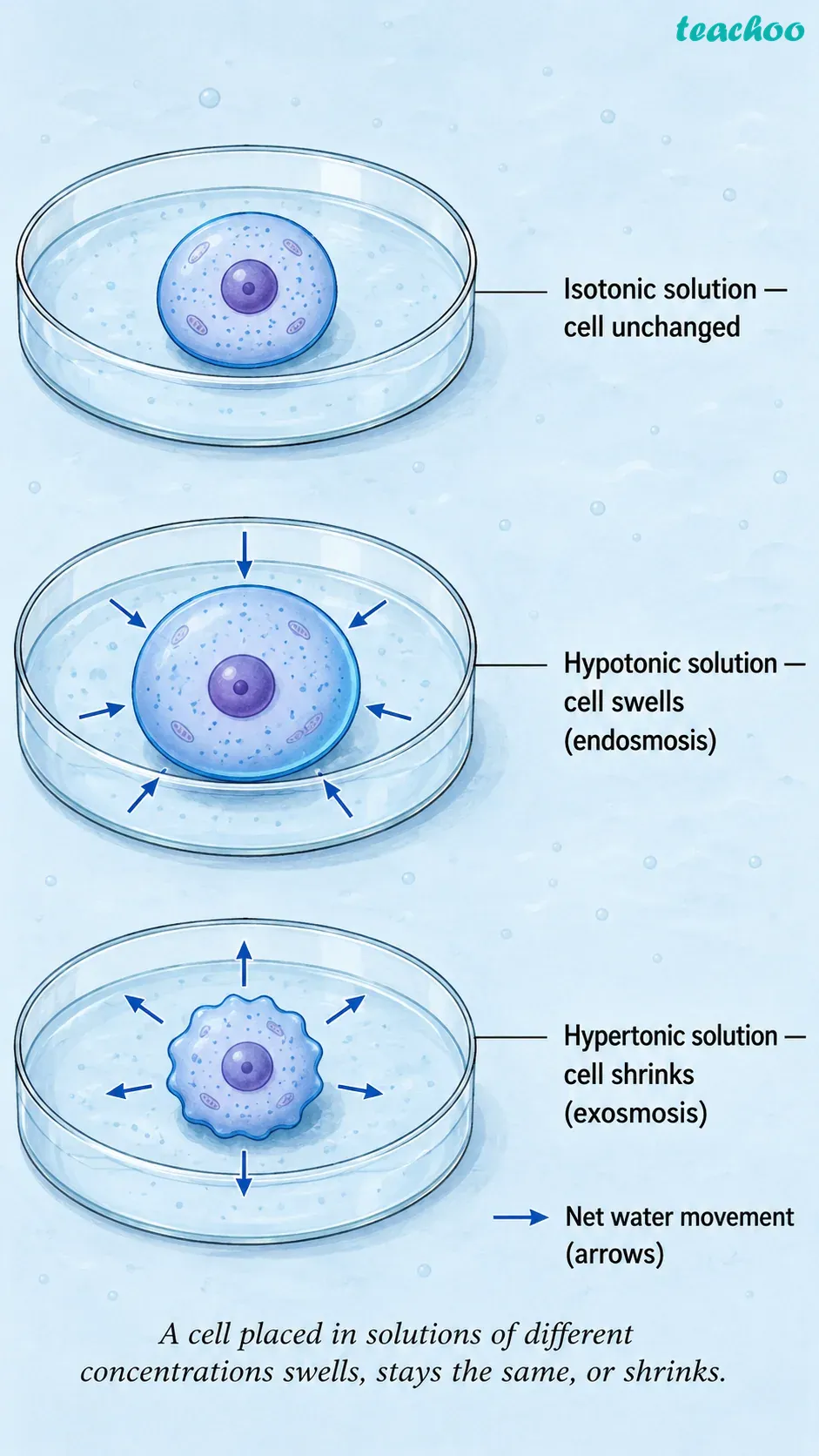
- Isotonic: outside equals inside; no net change.
- Hypotonic: outside is weaker; water enters and cell swells.
- Hypertonic: outside is stronger; water leaves and cell shrinks.
What is the cell membrane made of?
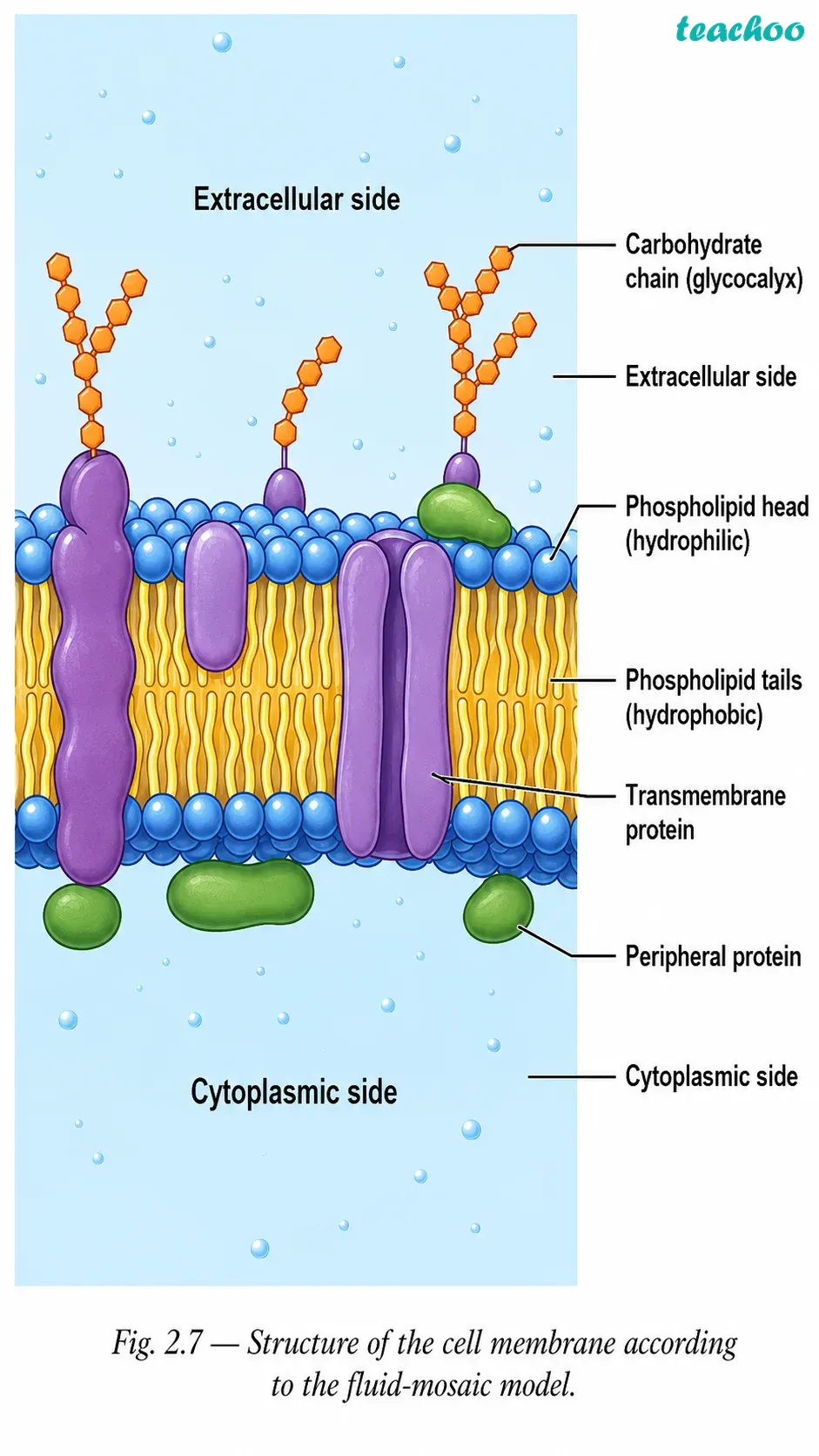
- It is very thin, about 7 to 10 nanometres.
- It is made of lipids (fats) and proteins.
- The fluid-mosaic model explains its structure.
What does the fluid-mosaic model tell us?
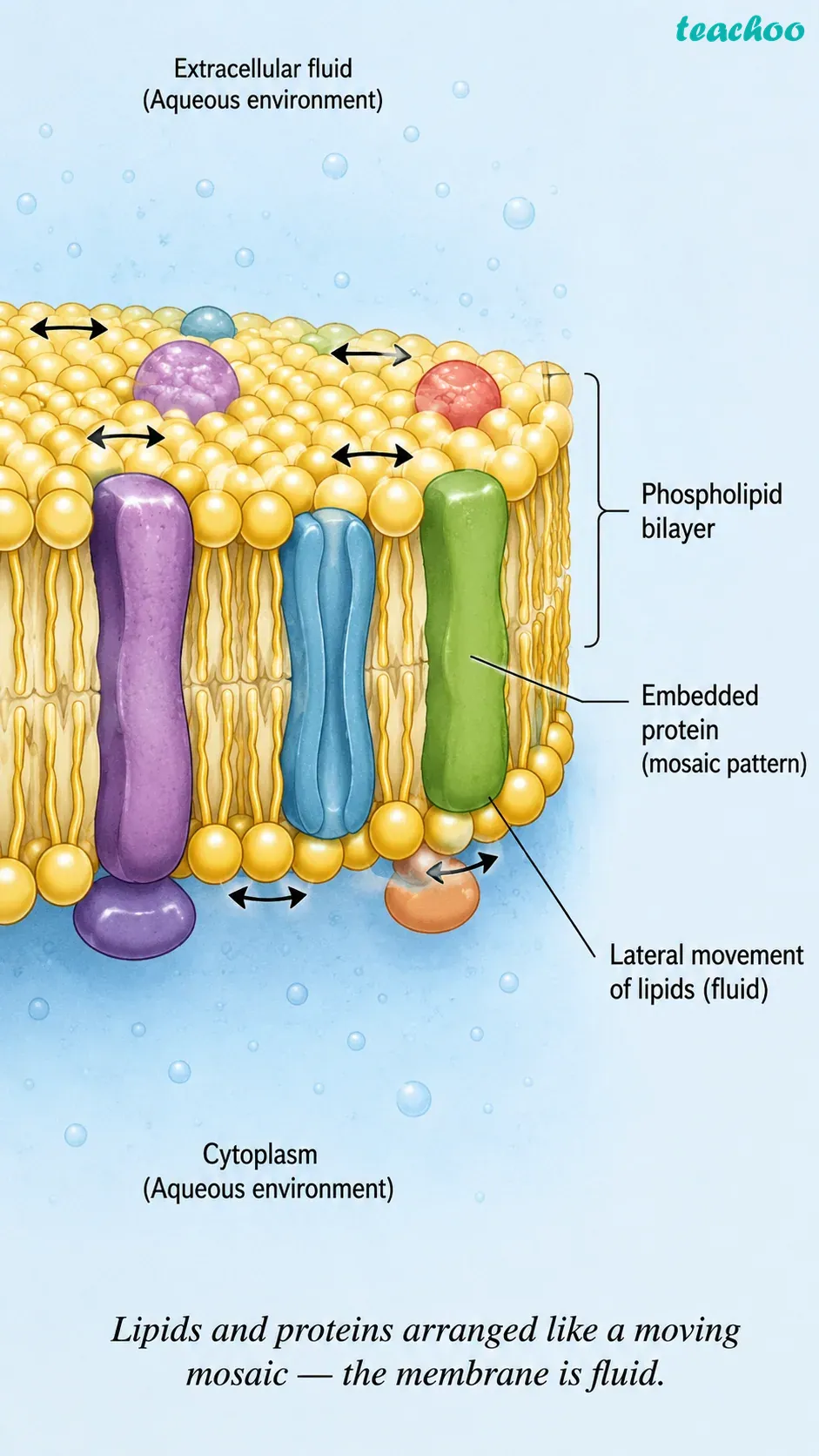
- The membrane has a lipid bilayer (two fat layers).
- Heads face water; tails point inwards; proteins sit in it.
- Molecules can move sideways, flip and rotate — so it is fluid.
- Molecules are arranged like tiles in a mosaic.
Example:
Proteins in the membrane act like gatekeepers, helping substances pass through.
💭 What if …
-
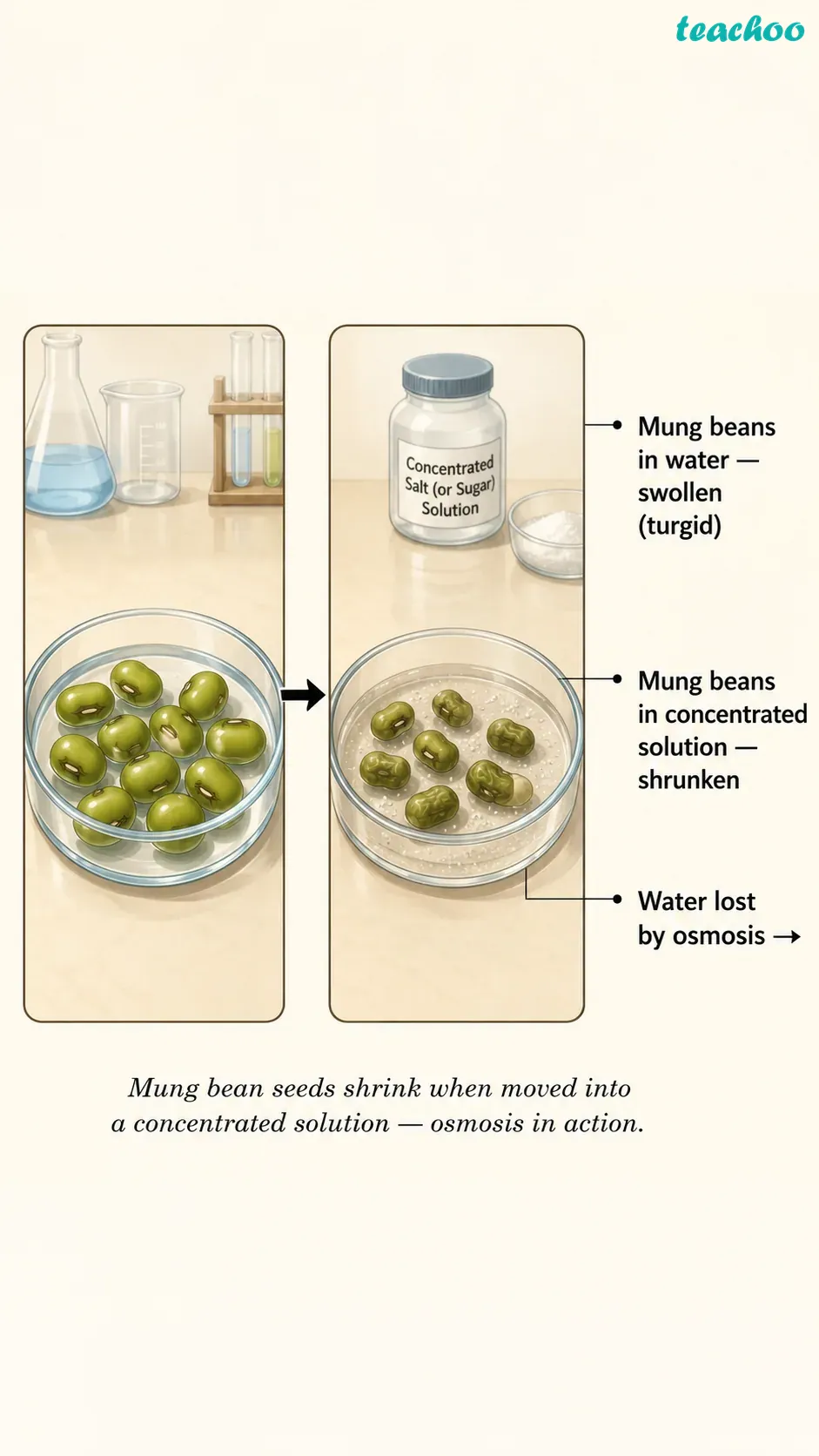
Mung bean seeds are kept in a concentrated solution after soaking in water for 12 hours. What will happen to them?
After soaking, the seeds are full of water. In a concentrated solution the outside has more solute, so water leaves the seeds by osmosis and they shrink and become firm again.
💭 What if …
-
A cell is kept in salt or sugar solutions of different concentrations — what happens?
In an isotonic solution there is no net change. In a hypotonic (weaker) solution water enters and the cell swells. In a hypertonic (stronger) solution water leaves and the cell shrinks.
Important Points
- The cell membrane is selectively permeable.
- Osmosis is the diffusion of water across a selectively permeable membrane.
- In plants, water enters root cells from the soil by osmosis.
- The membrane is fluid because its molecules can move about.
❓ Test Yourself
-
What is another name for the cell membrane?
View Answer
The plasma membrane. -
Why does the potato in plain water swell?
View Answer
Water enters it by osmosis, so it gains weight and swells. -
In a hypertonic solution, what happens to a cell?
View Answer
Water leaves the cell, so it shrinks. -
Why is the membrane called "fluid"?
View Answer
Its molecules can move sideways, flip and rotate. -
What do membrane proteins do?
View Answer
They act like gatekeepers, helping substances pass through.
Important Definitions
- Cell membrane (plasma membrane) — the thin, selectively permeable boundary around a cell.
- Selectively permeable — lets some substances pass while blocking others.
- Diffusion — net movement of particles from higher to lower concentration.
- Osmosis — diffusion of water across a selectively permeable membrane.
- Fluid-mosaic model — model describing the membrane as a moving mix of lipids and proteins.
📋 NCERT Question 2 — Two similar animal cells
Two similar animal cells are placed in two different solutions: Cell X is placed in pure water. Cell Y is placed in a concentrated salt solution. Cells are observed after some time. Cell X swells, and Cell Y shrinks. Which statement provides the correct explanation for the above observations? (i) Salt molecules moved into Cell Y, causing it to shrink. (ii) Water moved into Cell X and more water moved out of Cell Y than the salt solution entered in it. (iii) Water moved into Cell X and moved out of Cell Y through the cell membrane. (iv) Solute movement caused osmosis in both cells.
View Answer →
