You are here
Visualising an AP
Last updated at August 14, 2026 by Teachoo
Transcript
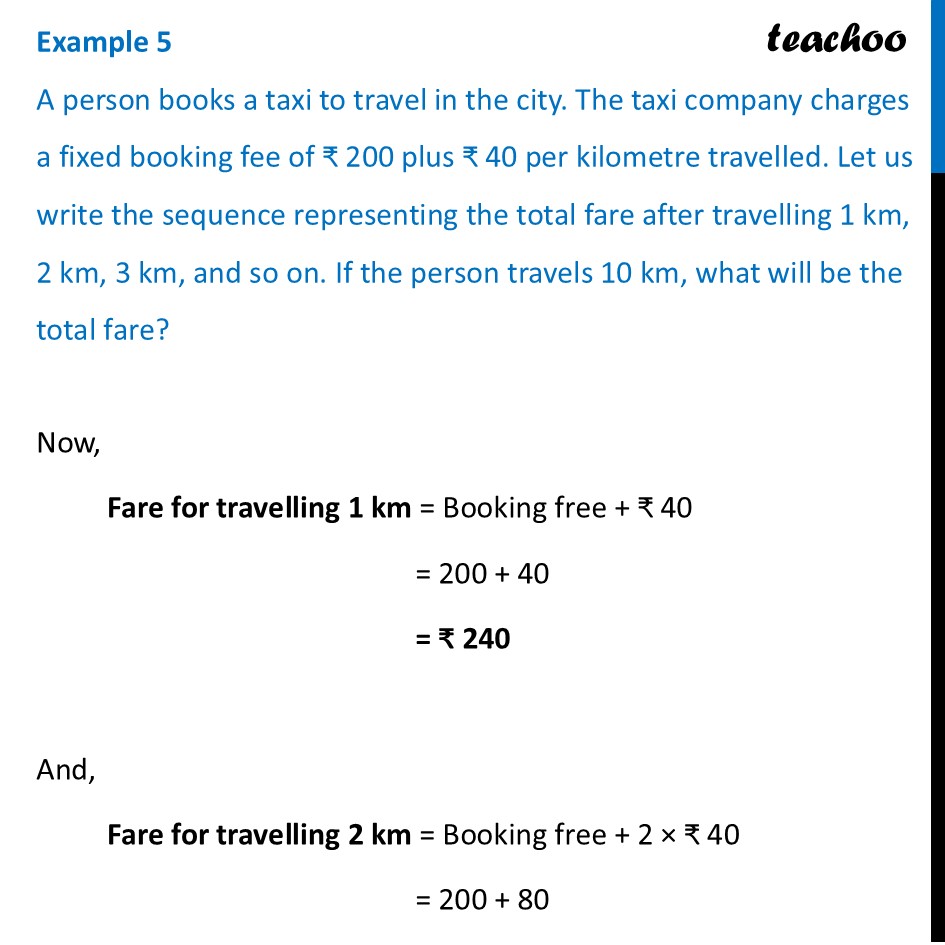
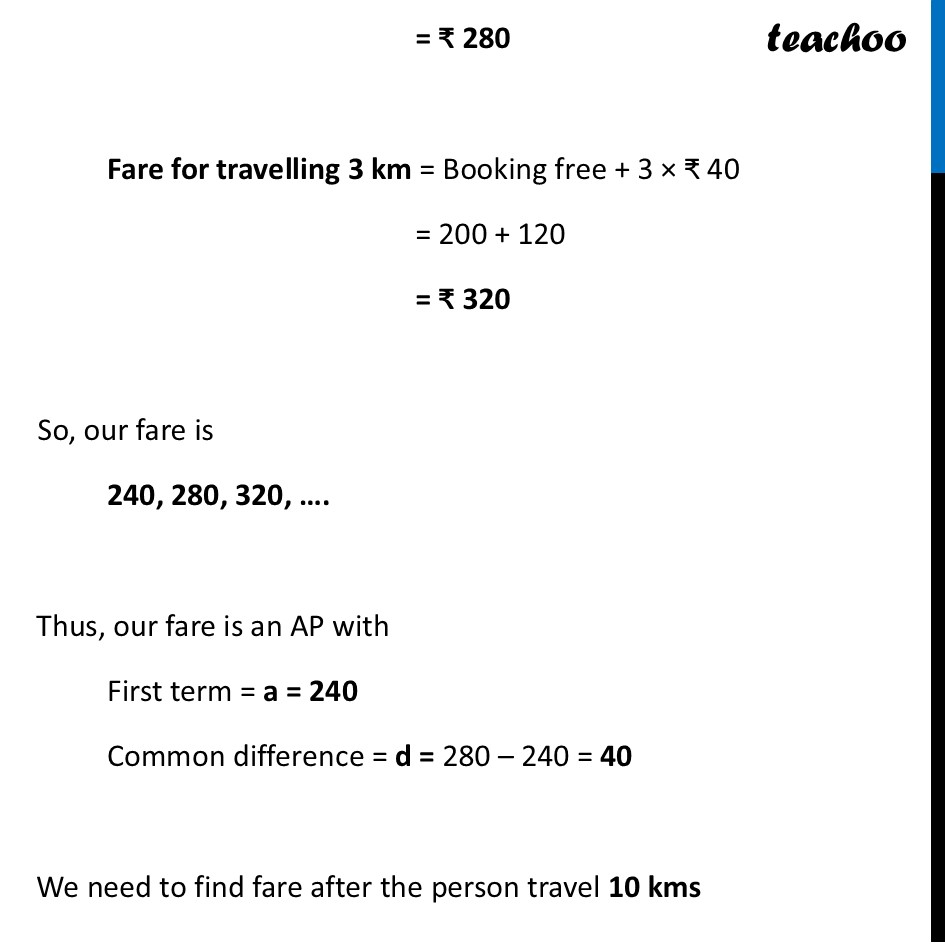
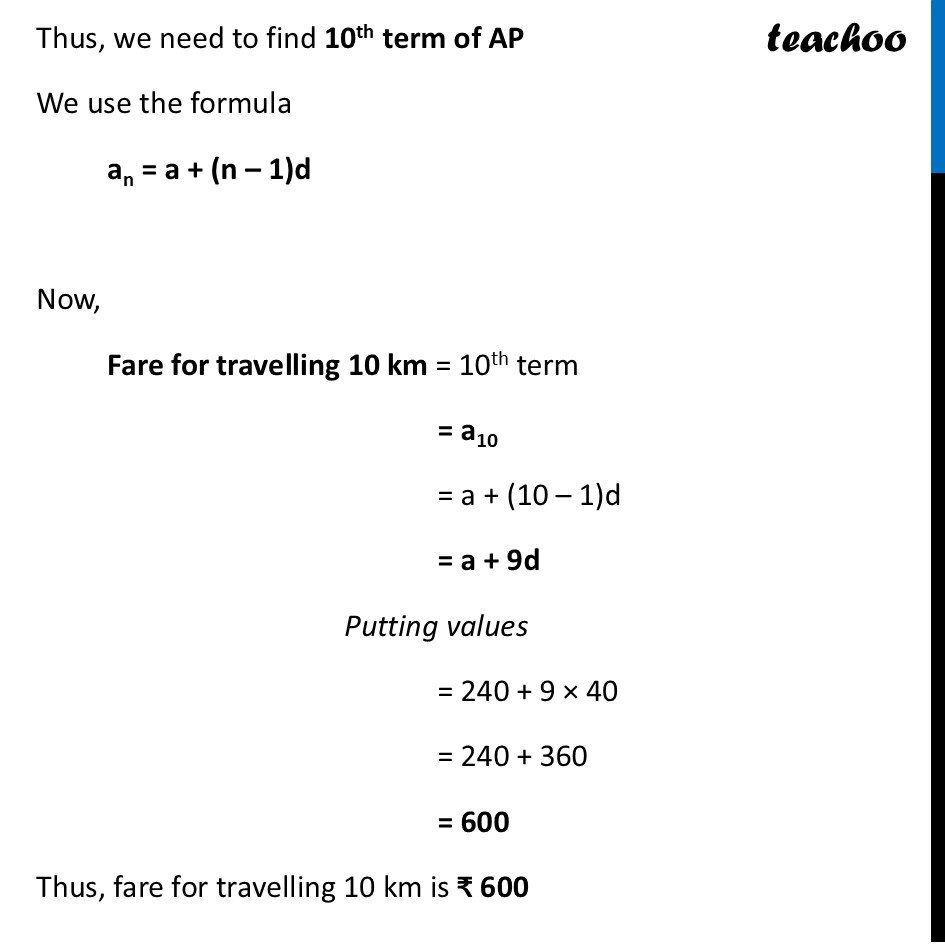
Example 5 A person books a taxi to travel in the city. The taxi company charges a fixed booking fee of ₹ 200 plus ₹ 40 per kilometre travelled. Let us write the sequence representing the total fare after travelling 1 km, 2 km, 3 km, and so on. If the person travels 10 km, what will be the total fare? Now, Fare for travelling 1 km = Booking free + ₹ 40 = 200 + 40 = ₹ 240 And, Fare for travelling 2 km = Booking free + 2 × ₹ 40 = 200 + 80 = ₹ 280 Fare for travelling 3 km = Booking free + 3 × ₹ 40 = 200 + 120 = ₹ 320 So, our fare is 240, 280, 320, …. Thus, our fare is an AP with First term = a = 240 Common difference = d = 280 – 240 = 40 We need to find fare after the person travel 10 kms Thus, we need to find 10th term of AP We use the formula an = a + (n – 1)d Now, Fare for travelling 10 km = 10th term = a10 = a + (10 – 1)d = a + 9d Putting values = 240 + 9 × 40 = 240 + 360 = 600 Thus, fare for travelling 10 km is ₹ 600 = ₹ 280 Fare for travelling 3 km = Booking free + 3 × ₹ 40 = 200 + 120 = ₹ 320 So, our fare is 240, 280, 320, …. Thus, our fare is an AP with First term = a = 240 Common difference = d = 280 – 240 = 40 We need to find fare after the person travel 10 kms Thus, we need to find 10th term of AP We use the formula an = a + (n – 1)d Now, Fare for travelling 10 km = 10th term = a10 = a + (10 – 1)d = a + 9d Putting values = 240 + 9 × 40 = 240 + 360 = 600 Thus, fare for travelling 10 km is ₹ 600