You are here
![[Class 9] Find recursive rules for the APs in the previous exercises - Visualising an AP](https://cdn.teachoo.com/d51fd214-a387-40ce-baf0-c1a200c2f425/slide101.jpg)
Visualising an AP
Last updated at August 14, 2026 by Teachoo
Transcript
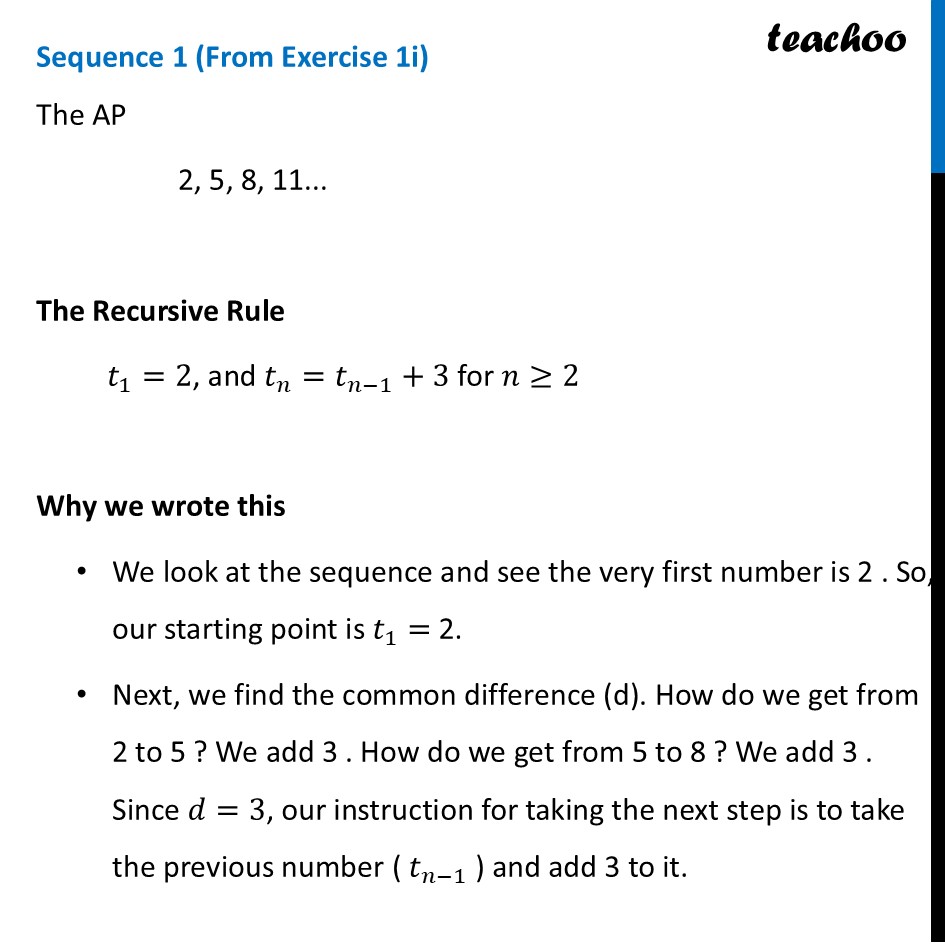
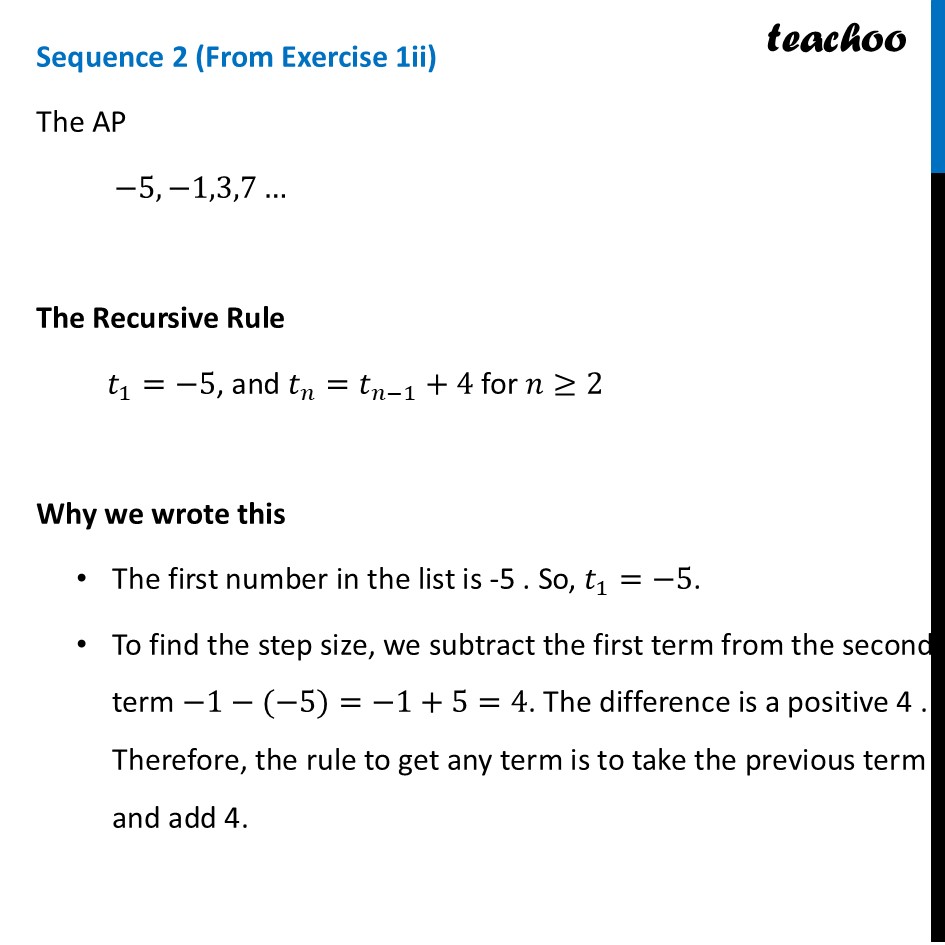
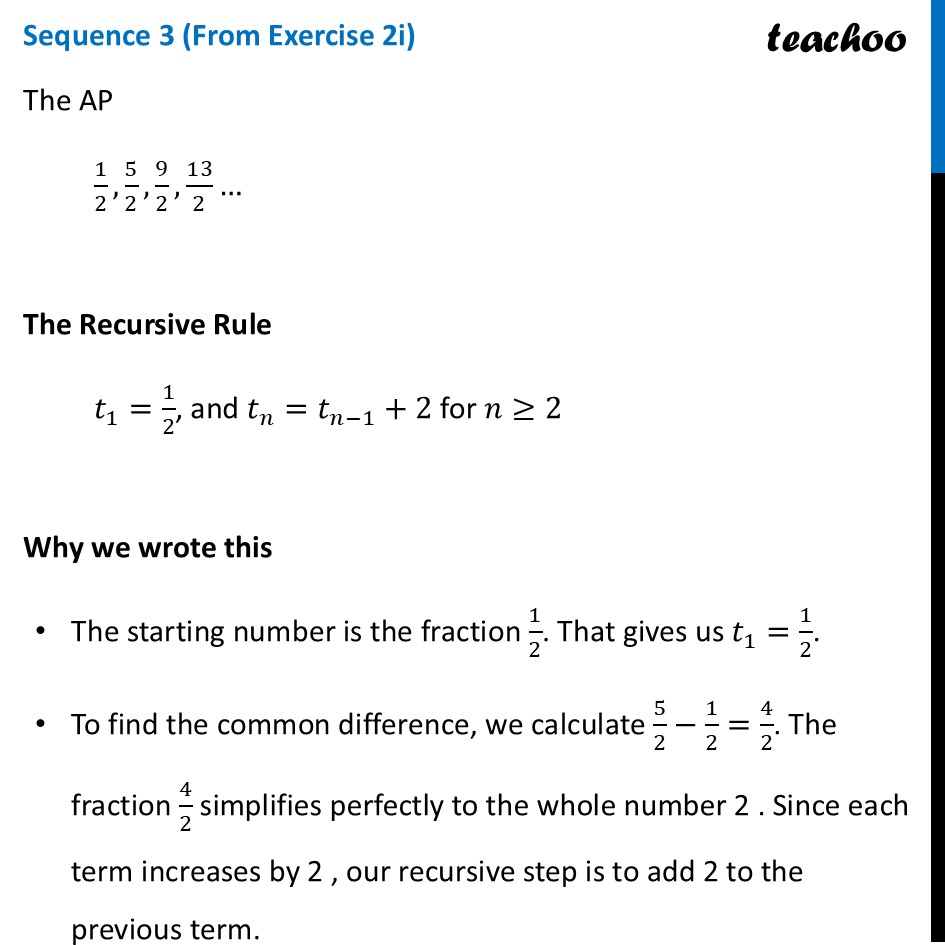
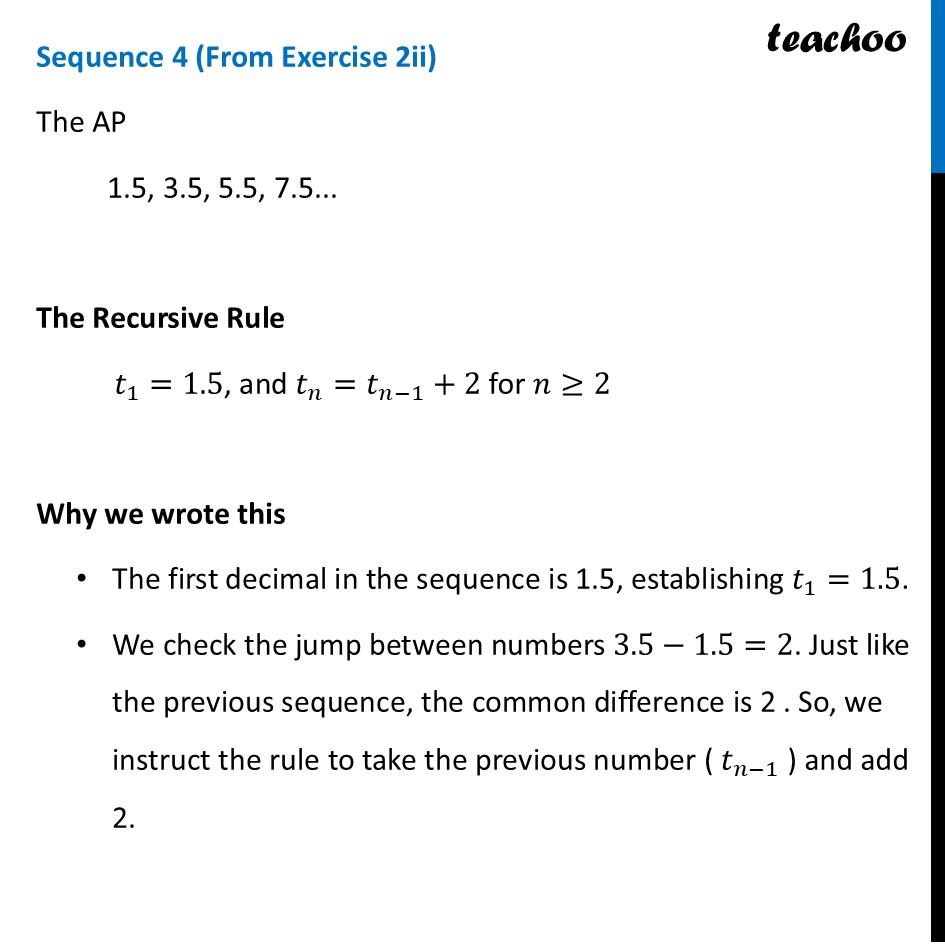
Exercise Question 1 (Page 183) Find recursive rules for the APs in the previous exercises. A recursive formula tells you how to find the next term in a sequence by doing something to the previous term. It always requires two pieces of information The starting point (usually the first term, a) The rule to get from one term (an–1) to the next term (an) For any AP, our recursive rule is an = an–1 + d, a1 = a Let’s do some examples Sequence 1 (From Exercise 1i) The AP 2, 5, 8, 11... The Recursive Rule 𝑡_1=2, and 𝑡_𝑛=𝑡_(𝑛−1)+3 for 𝑛≥2 Why we wrote this We look at the sequence and see the very first number is 2 . So, our starting point is 𝑡_1= 2. Next, we find the common difference (d). How do we get from 2 to 5 ? We add 3 . How do we get from 5 to 8 ? We add 3 . Since 𝑑=3, our instruction for taking the next step is to take the previous number ( 𝑡_(𝑛−1) ) and add 3 to it. Sequence 2 (From Exercise 1ii) The AP −5,−1,3,7… The Recursive Rule 𝑡_1=−5, and 𝑡_𝑛=𝑡_(𝑛−1)+4 for 𝑛≥2 Why we wrote this The first number in the list is -5 . So, 𝑡_1=−5. To find the step size, we subtract the first term from the second term −1−(−5)=−1+5=4. The difference is a positive 4 . Therefore, the rule to get any term is to take the previous term and add 4. Sequence 3 (From Exercise 2i) The AP 1/2, 5/2, 9/2, 13/2… The Recursive Rule 𝑡_1=1/2, and 𝑡_𝑛=𝑡_(𝑛−1)+2 for 𝑛≥2 Why we wrote this The starting number is the fraction 1/2. That gives us 𝑡_1=1/2. To find the common difference, we calculate 5/2−1/2=4/2. The fraction 4/2 simplifies perfectly to the whole number 2 . Since each term increases by 2 , our recursive step is to add 2 to the previous term. Sequence 4 (From Exercise 2ii) The AP 1.5, 3.5, 5.5, 7.5... The Recursive Rule 𝑡_1=1.5, and 𝑡_𝑛=𝑡_(𝑛−1)+2 for 𝑛≥2 Why we wrote this The first decimal in the sequence is 1.5, establishing 𝑡_1=1.5. We check the jump between numbers 3.5−1.5=2. Just like the previous sequence, the common difference is 2 . So, we instruct the rule to take the previous number ( 𝑡_(𝑛−1) ) and add 2.