You are here
Visualising an AP
Last updated at August 14, 2026 by Teachoo
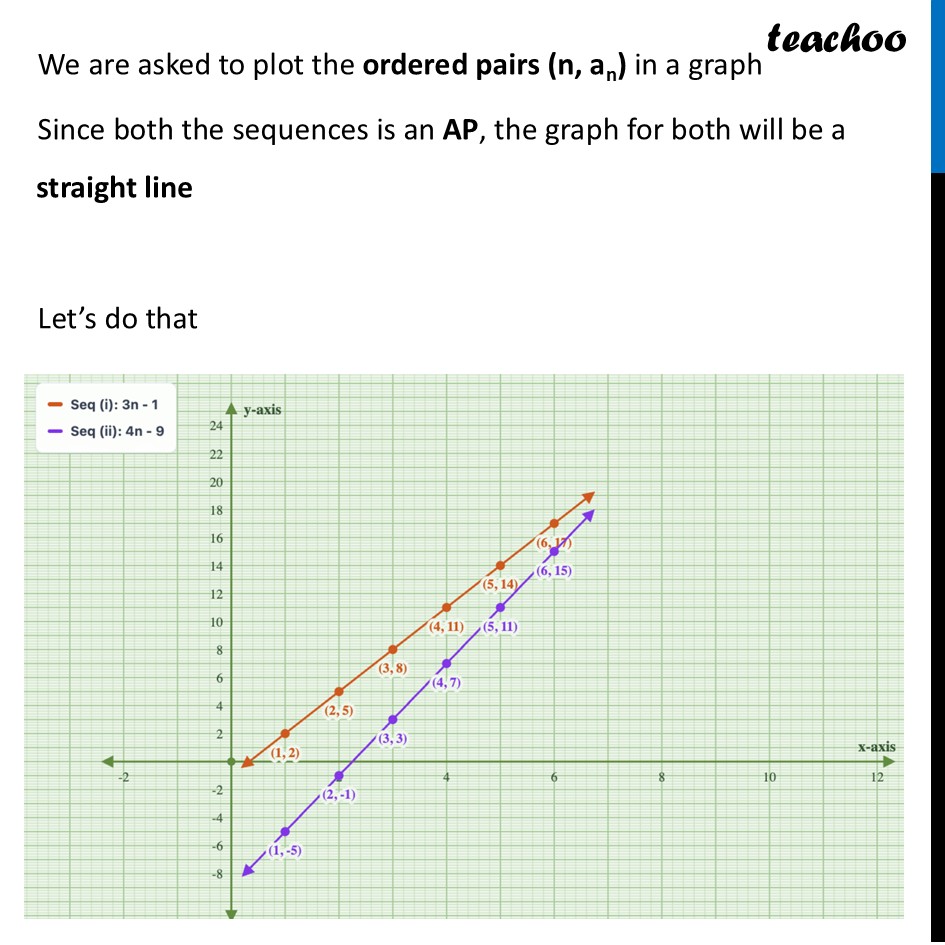
Transcript
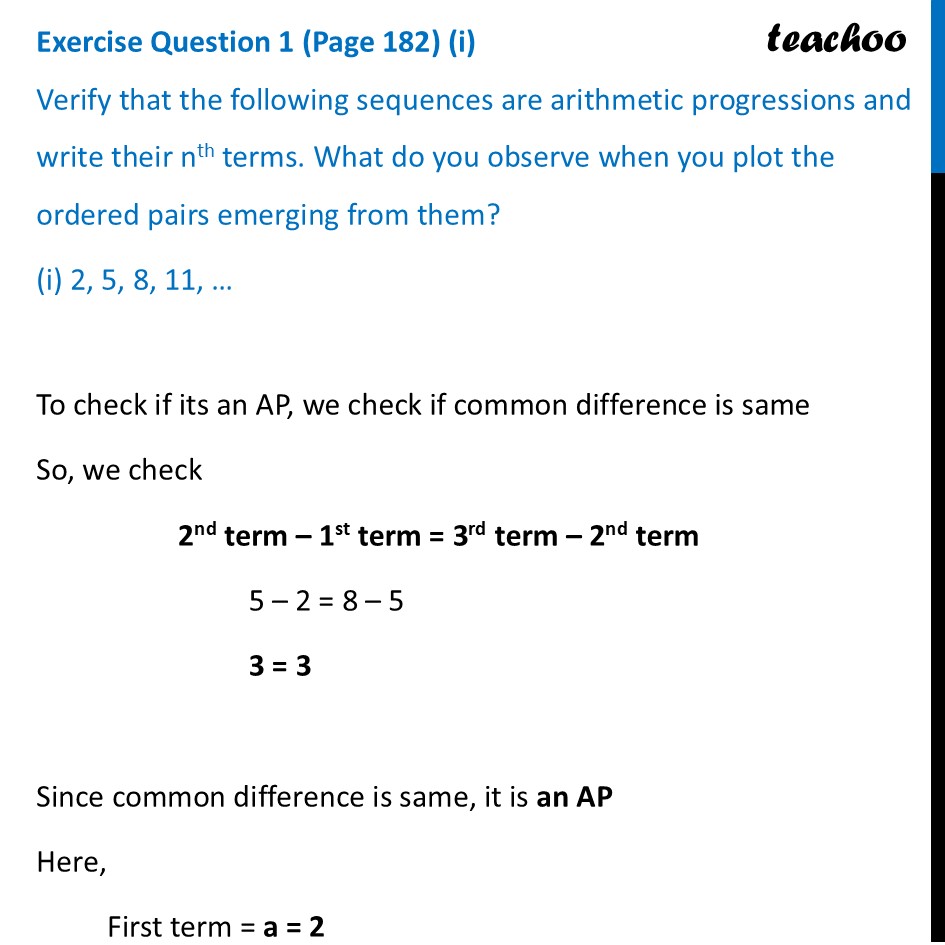
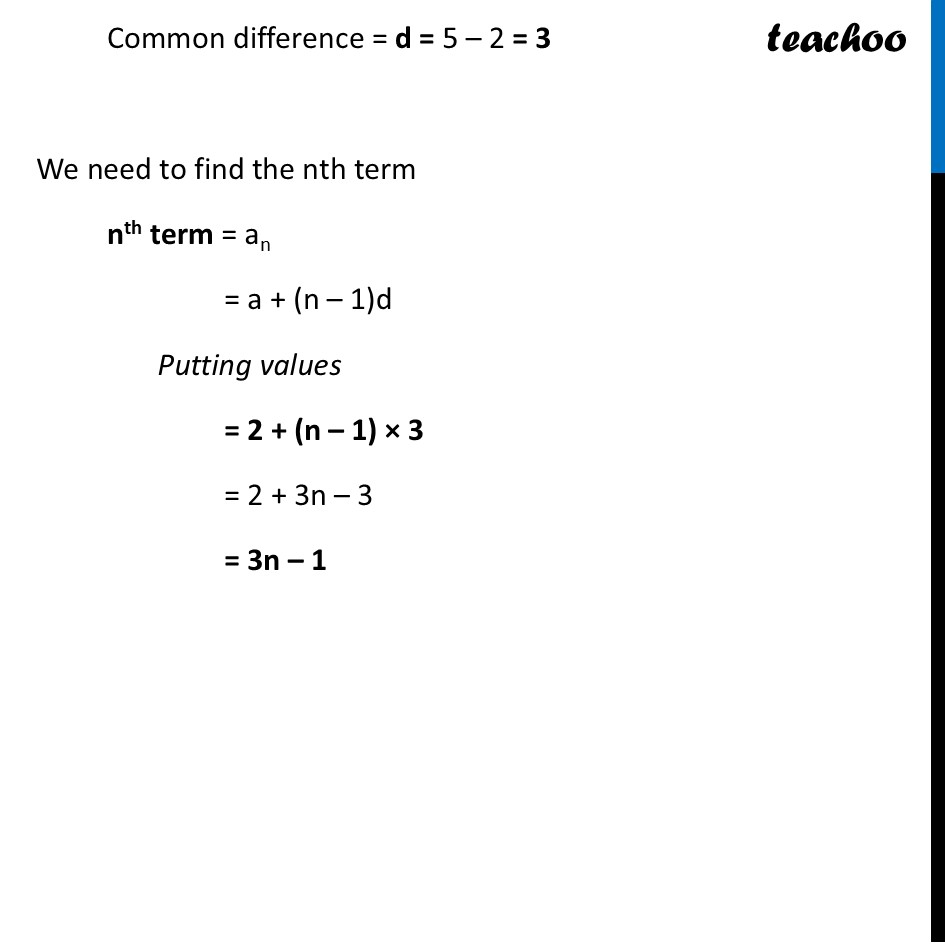
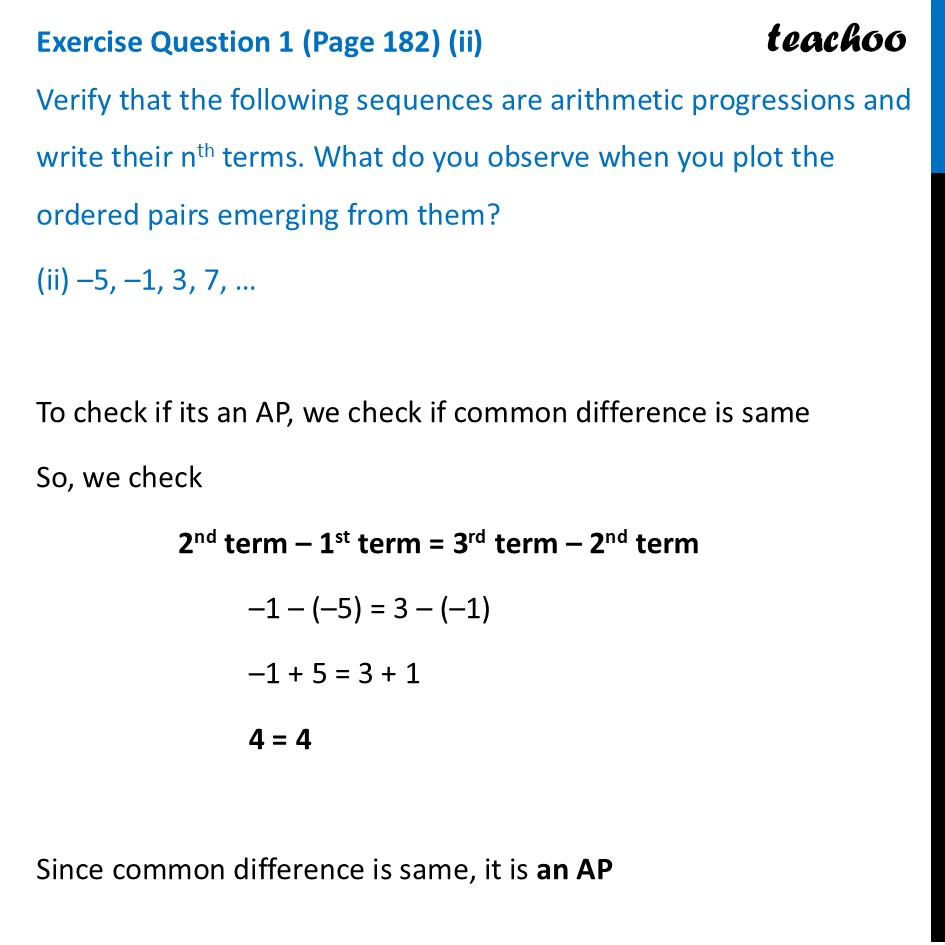
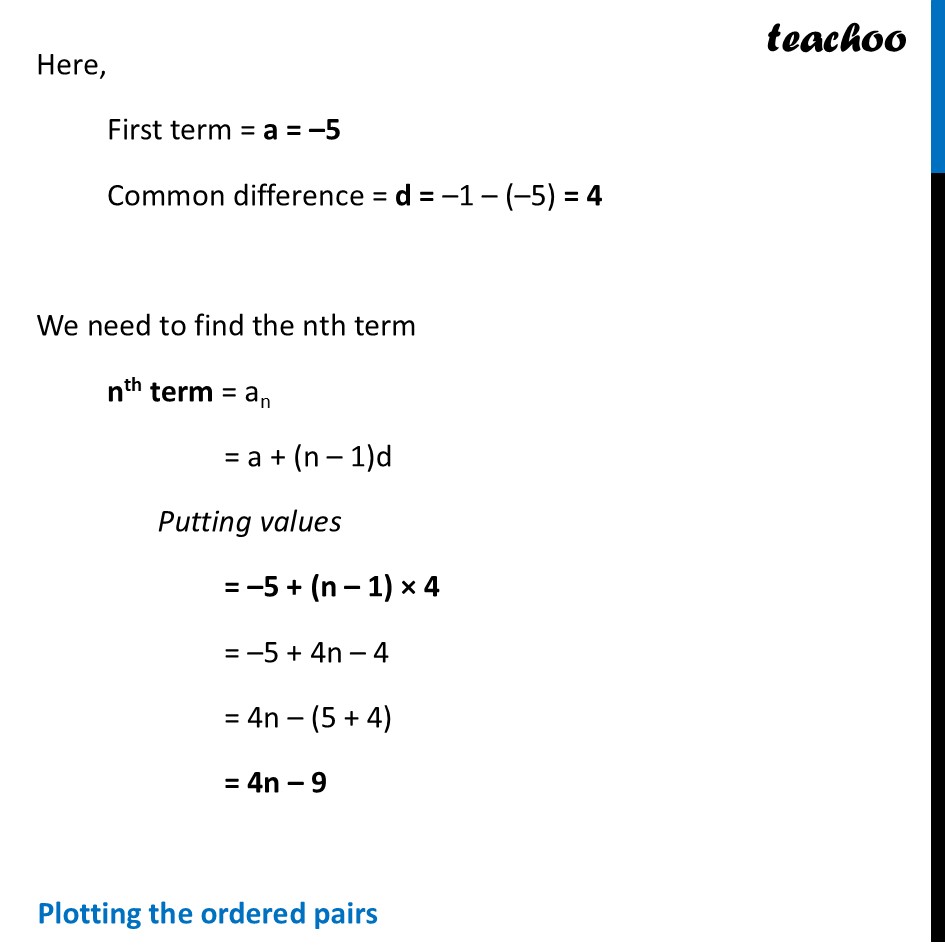
Exercise Question 1 (Page 182) (i) Verify that the following sequences are arithmetic progressions and write their nth terms. What do you observe when you plot the ordered pairs emerging from them? (i) 2, 5, 8, 11, … To check if its an AP, we check if common difference is same So, we check 2nd term – 1st term = 3rd term – 2nd term 5 – 2 = 8 – 5 3 = 3 Since common difference is same, it is an AP Here, First term = a = 2 Common difference = d = 5 – 2 = 3 We need to find the nth term nth term = an = a + (n – 1)d Putting values = 2 + (n – 1) × 3 = 2 + 3n – 3 = 3n – 1 Common difference = d = 5 – 2 = 3 We need to find the nth term nth term = an = a + (n – 1)d Putting values = 2 + (n – 1) × 3 = 2 + 3n – 3 = 3n – 1 Exercise Question 1 (Page 182) (ii) Verify that the following sequences are arithmetic progressions and write their nth terms. What do you observe when you plot the ordered pairs emerging from them? (ii) –5, –1, 3, 7, … To check if its an AP, we check if common difference is same So, we check 2nd term – 1st term = 3rd term – 2nd term –1 – (–5) = 3 – (–1) –1 + 5 = 3 + 1 4 = 4 Since common difference is same, it is an AP Here, First term = a = –5 Common difference = d = –1 – (–5) = 4 We need to find the nth term nth term = an = a + (n – 1)d Putting values = –5 + (n – 1) × 4 = –5 + 4n – 4 = 4n – (5 + 4) = 4n – 9 Plotting the ordered pairs We are asked to plot the ordered pairs (n, an) in a graph Since both sequences are AP, the graph for both will be a straight line We are asked to plot the ordered pairs (n, an) in a graph Since both the sequences is an AP, the graph for both will be a straight line Let’s do that