
 You are here
What is Adolescence?
It means the stage of life between childhood and adulthood .
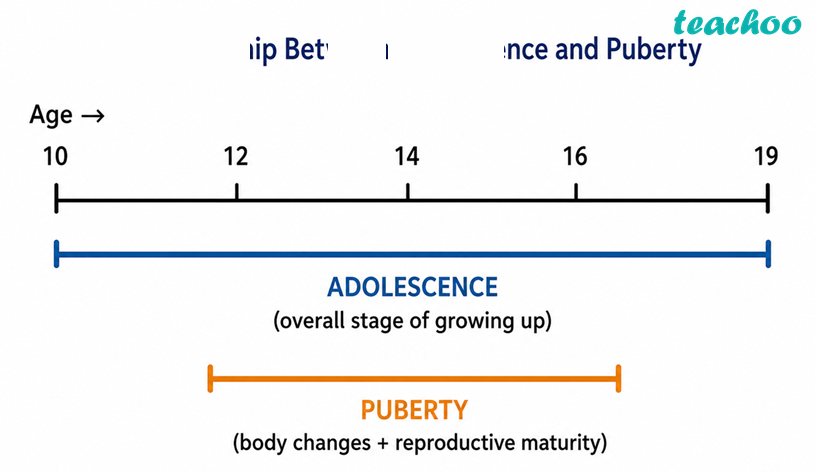
It usually starts around 10 years of age and lasts until about 19 years .
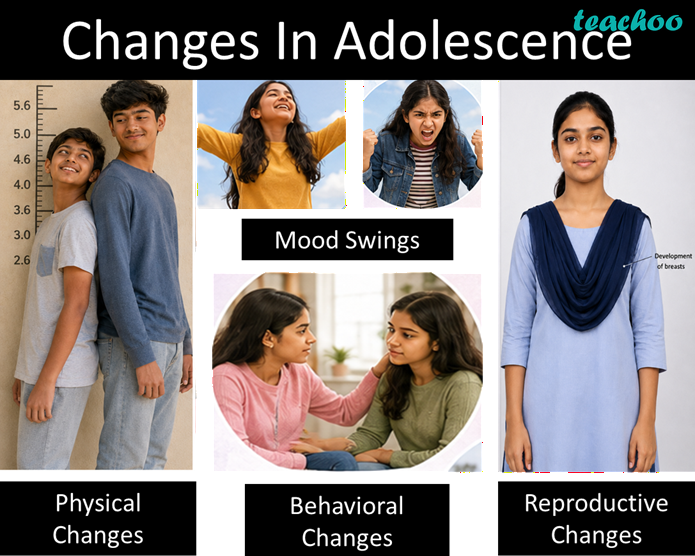
- Physical changes — height, weight, body structure, voice, hair, pimples.
- Reproductive changes — the body becomes capable of reproduction.
- Emotional changes — stronger feelings, mood swings.
- Behavioural changes — new interests, deeper sensitivity to others.
Key features of adolescence
- It is a period of rapid growth and development .
- The body is preparing for adulthood .
- Some changes are visible ; others are internal and not noticeable.
- The pace and duration vary from one individual to another.
Adolescence is the stage of development between childhood and adulthood, typically occurring between the ages of 10 and 19.
During this stage, the body undergoes significant physical, emotional, and behavioural changes , and prepares for adulthood.
📋 NCERT Question 4 — Shalu's Incomplete Description
The Five Main Physical Changes
While analysing Activity 6.1, you may have noticed the following five common physical changes during adolescence.
What is the "Increase in Height"?
It means the body grows taller as the person ages.
From birth, our body undergoes continuous growth in height — but this becomes more prominent during adolescence .
What are the "Changes in Body Structure"?
It means the body shape and strength change — differently in boys and girls .
Changes in boys
- Shoulders become a bit broader .
- Chest gets wider .
- Weight gain along with growing taller.
Changes in girls
- Increase in height and weight .
- Development of breasts .
What is the "Voice Box"?
It is a structure in our throat that helps us to speak.
Its growth in adolescent boys leads to a hoarse voice and a visible bump called the Adam's apple .
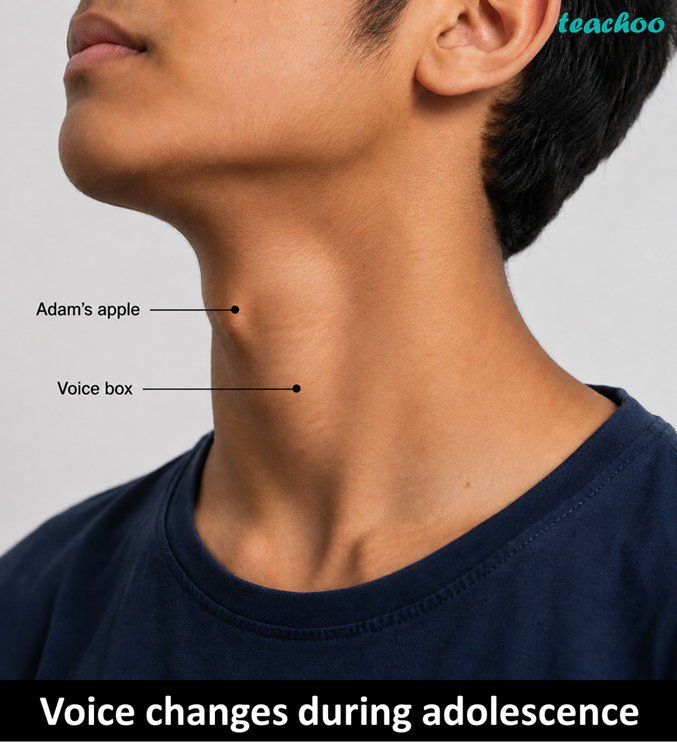
How the voice changes during adolescence
- In boys — the voice box grows large, leading to a hoarse voice and a visible bump in the throat called the Adam's apple .
- In girls — the voice box also grows, but is not as big as in boys , leading to only slight changes in voice.
- The Adam's apple is not noticeable in every individual .
Voice box — a structure in our throat that helps us to speak.
Adam's apple — the bump in the throat region of adolescent boys, formed due to the growth of the voice box.
📋 NCERT Question 8 — Mary and Manoj's Neck Bumps Treated Differently
What are "Pimples"?
They are small, reddish spots that appear on the face during adolescence.
Pimples are caused by a skin condition called acne .
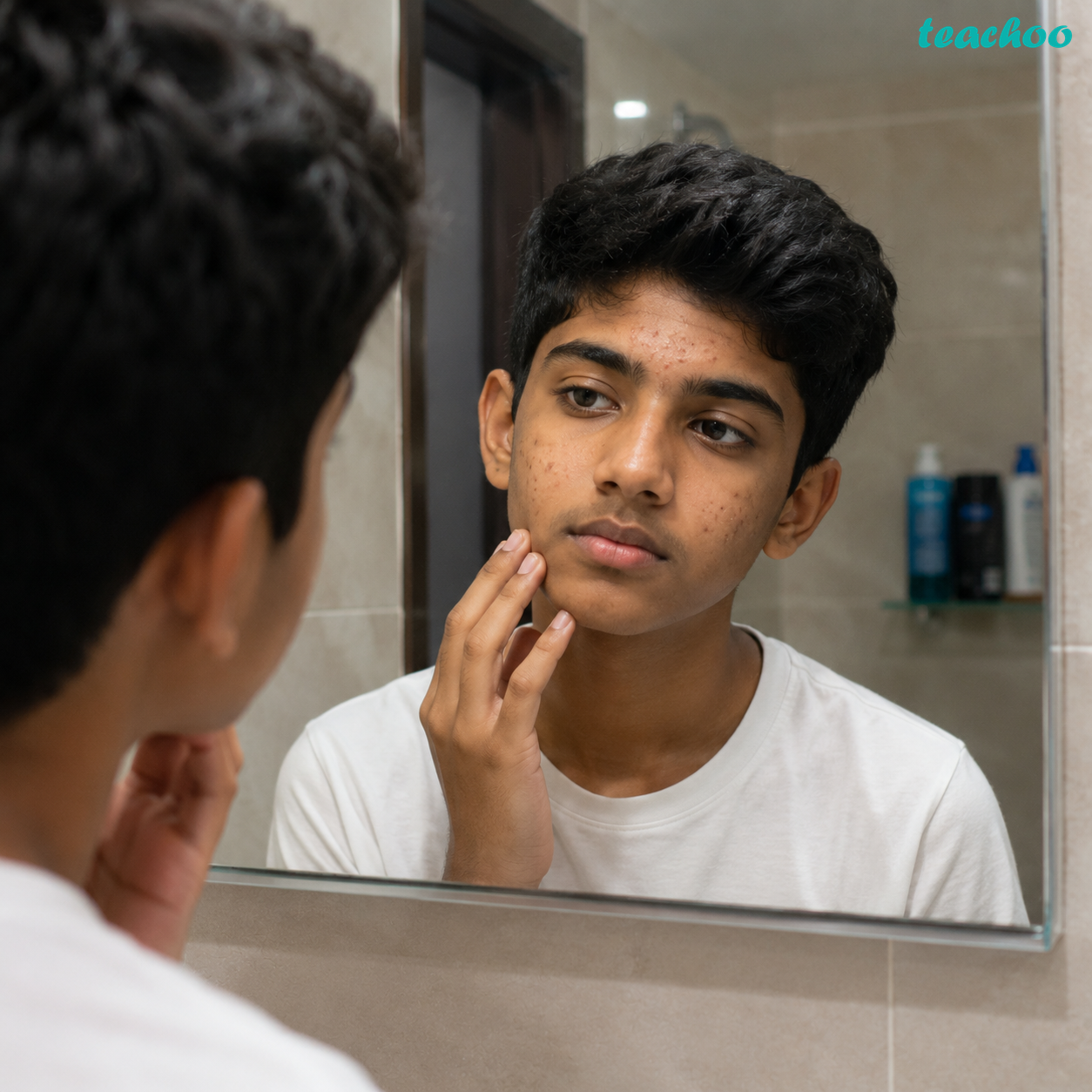
Why pimples occur during adolescence
- The skin produces an increase in oily secretions .
- These oils clog the skin pores .
- The clogged pores can lead to infections .
- The result — small reddish pimples appear on the face.
Acne is a skin condition during adolescence in which small, reddish pimples appear on the face. It occurs due to an increase in oily secretions that clog skin pores.
📋 NCERT Question 1 — Pimples on Ramesh's Face
What is the "Hair Growth" Pattern?
It means new hair appears in different parts of the body during adolescence.
Both boys and girls experience hair growth, but boys typically have more.
Hair growth common to both boys and girls
- Armpits — hair grows under the arms.
- Pubic region — hair grows in the genital region.
Hair growth specific to boys
- Facial hair — develops into a moustache and a beard as boys move towards adulthood.
- Some boys also develop chest hair and back hair .
- A few boys may have no significant hair growth — and that is also normal.
The timing, nature, and extent of these changes vary among individuals . These variations are completely normal .
Each person experiences adolescence at his or her own pace, and its duration also varies from one person to another.
What are "Secondary Sexual Characteristics"?
They are characteristic changes during adolescence that distinguish males from females .
These changes are not directly involved in reproduction .
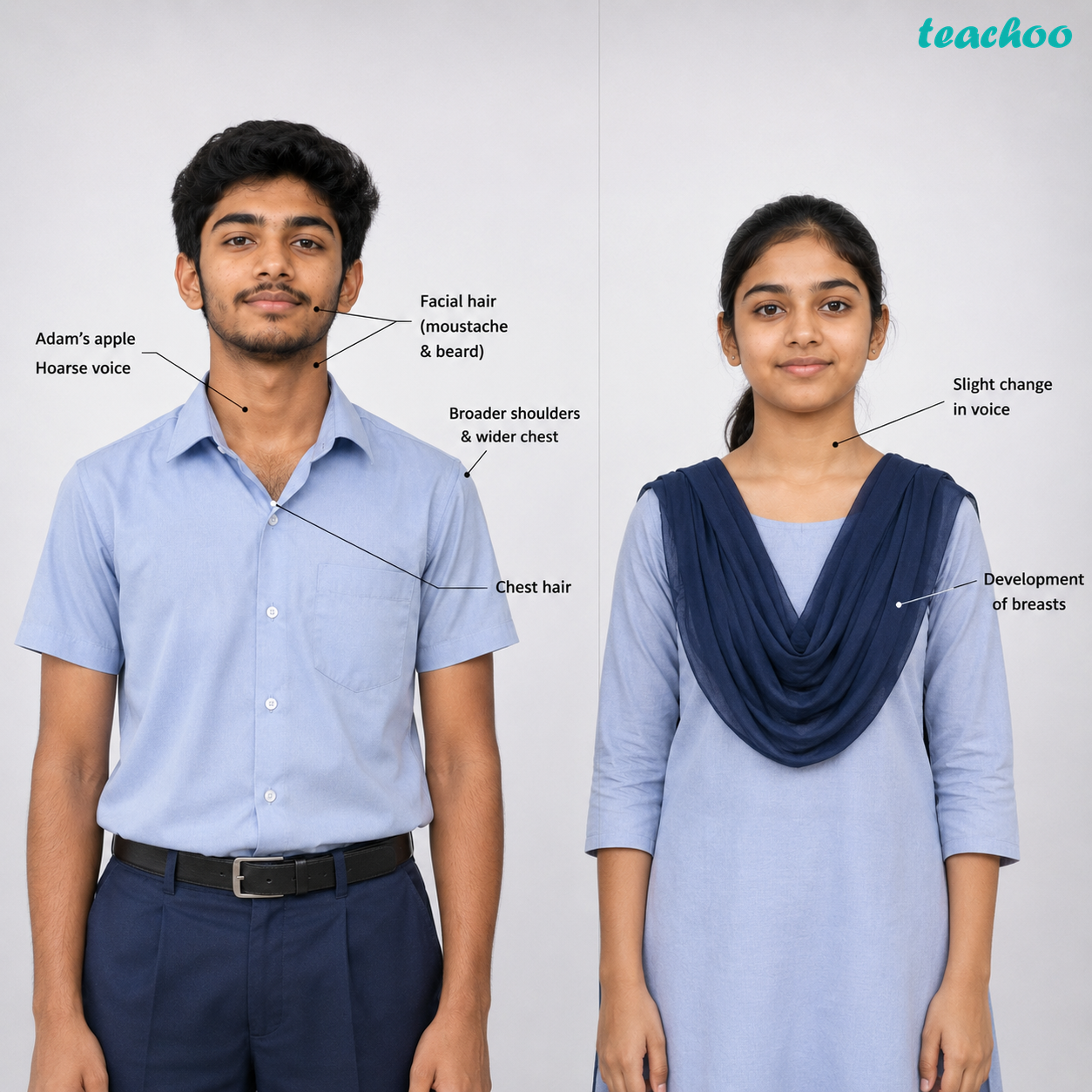
Examples in boys
- Change in voice (hoarse voice and Adam's apple).
- Growth of facial hair — moustache and beard.
- Growth of chest hair and back hair .
- Broader shoulders and wider chest.
Examples in girls
- Development of breasts .
- Slight change in voice.
Common in both boys and girls
- Growth of hair in armpits and pubic region .
- Appearance of pimples on the face.
Secondary sexual characteristics are the changes during adolescence that help distinguish males from females, but are not directly involved in reproduction.
They are natural signs that the body is preparing for adulthood and mark the onset of puberty .
📋 NCERT Question 9 — Categorise Physical Changes as Boys, Girls, or Both
What is "Puberty"?
It is the stage when the body of an adolescent develops the capability to reproduce .
It includes both external (visible) and internal (not visible) changes.
Key features of puberty
- Begins with the appearance of secondary sexual characteristics .
- Includes both external (visible) and internal (not visible) changes.
- Marks the body's preparation for reproduction .
- Timing varies from person to person.
Puberty is the stage in which the body of an adolescent undergoes external and internal changes to develop into an adult capable of reproduction.
📋 NCERT Question 3 — Unscramble the Adolescence Words
-
What is the typical age range for adolescence?
View Answer
Approximately 10 to 19 years of age. -
What is the bump in the throat region of adolescent boys called?
View Answer
Adam's apple — formed due to the growth of the voice box. -
What causes pimples (acne) during adolescence?
View Answer
An increase in oily secretions from the skin clogs the skin pores and leads to small reddish pimples. -
Define secondary sexual characteristics in one sentence.
View Answer
Characteristic changes during adolescence that distinguish males from females but are not directly involved in reproduction . -
What is puberty?
View Answer
The stage in which an adolescent's body undergoes external and internal changes to develop into an adult capable of reproduction .
