You are here
Irrational Numbers
Last updated at May 11, 2026 by Teachoo
Transcript
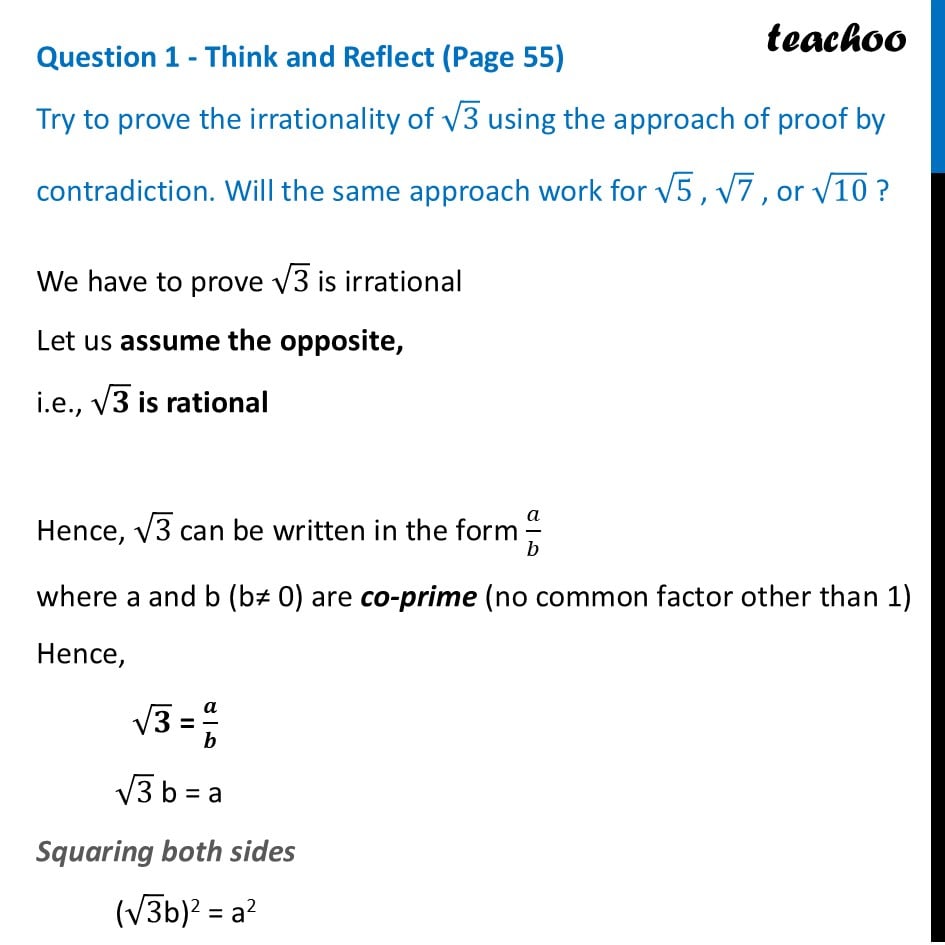
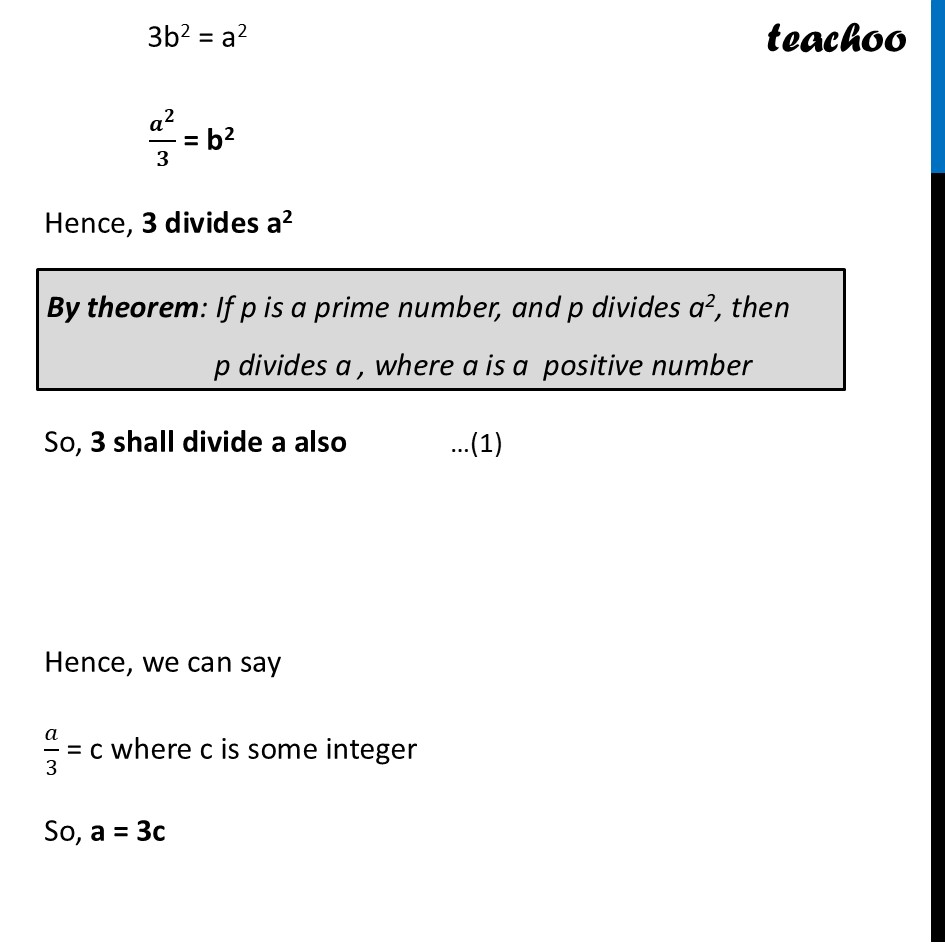
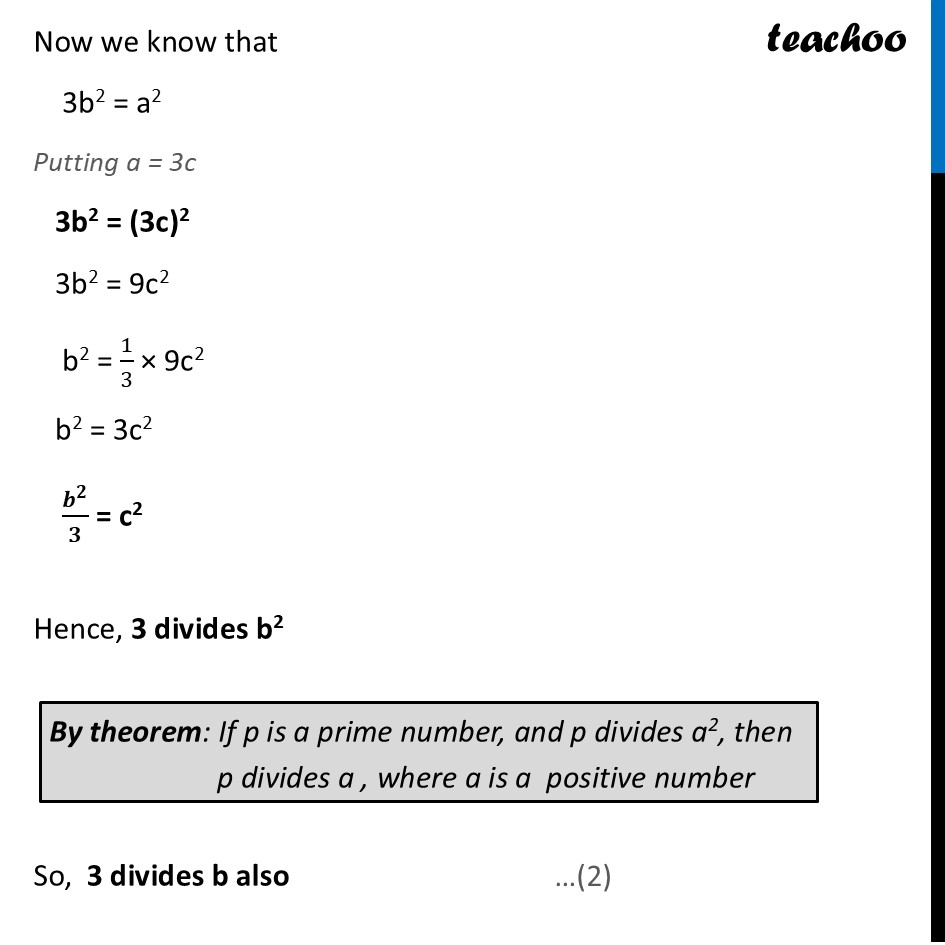
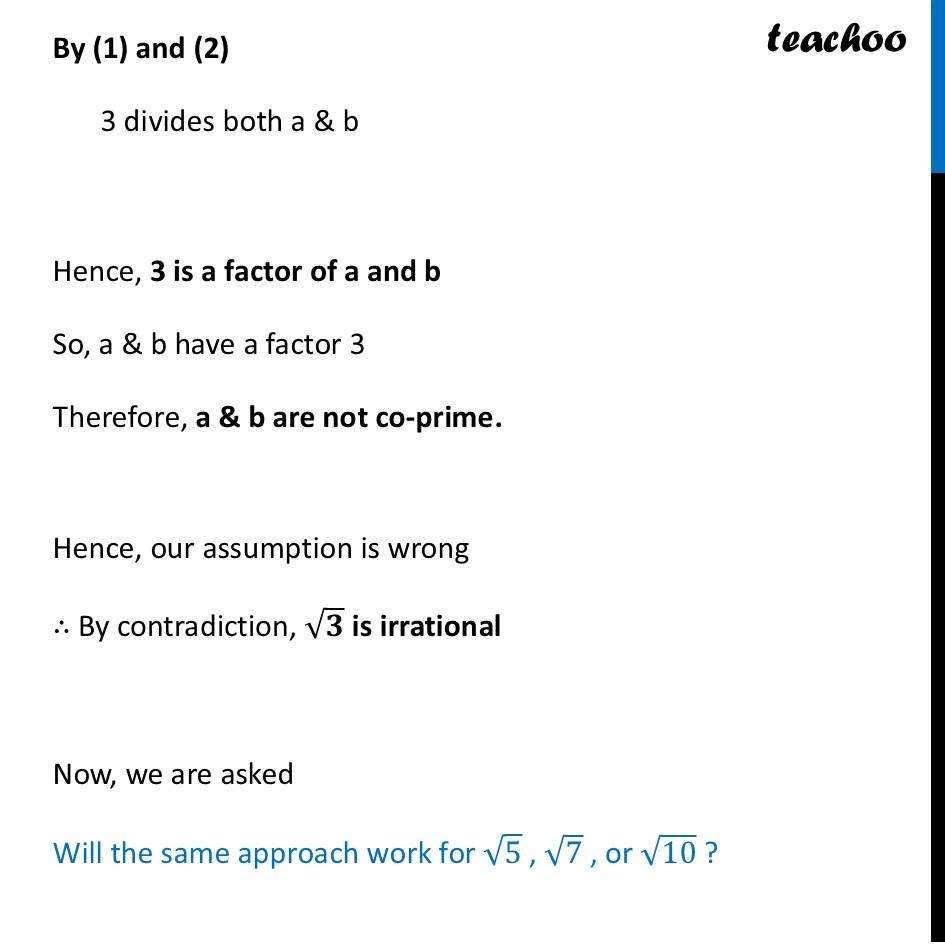
Question 1 - Think and Reflect (Page 55) Try to prove the irrationality of √3 using the approach of proof by contradiction. Will the same approach work for √5 , √7 , or √10 ? We have to prove √3 is irrational Let us assume the opposite, i.e., √𝟑 is rational Hence, √3 can be written in the form 𝑎/𝑏 where a and b (b≠ 0) are co-prime (no common factor other than 1) Hence, √𝟑 = 𝒂/𝒃 √3 b = a Squaring both sides (√3b)2 = a2 3b2 = a2 𝒂^𝟐/𝟑 = b2 Hence, 3 divides a2 So, 3 shall divide a also Hence, we can say 𝑎/3 = c where c is some integer So, a = 3c By theorem: If p is a prime number, and p divides a2, then p divides a , where a is a positive number Now we know that 3b2 = a2 Putting a = 3c 3b2 = (3c)2 3b2 = 9c2 b2 = 1/3 × 9c2 b2 = 3c2 𝒃^𝟐/𝟑 = c2 Hence, 3 divides b2 So, 3 divides b also By theorem: If p is a prime number, and p divides a2, then p divides a , where a is a positive number By (1) and (2) 3 divides both a & b Hence, 3 is a factor of a and b So, a & b have a factor 3 Therefore, a & b are not co-prime. Hence, our assumption is wrong ∴ By contradiction, √𝟑 is irrational Now, we are asked Will the same approach work for √5 , √7 , or √10 ? Yes, we use the same approach for √𝟓 , √𝟕 , or √𝟏𝟎 and indeed any square root of a number that isn't a perfect square. If we swap the "3" for a "5", the logic holds perfectly.